The Blue View - Where's the Spares?

A few days ago I wrote a blog about my philosophy on how many spares are enough. Basically, my feeling is you can never have too many spares. The trick is finding a place to stow them and then finding them again in a year or so when you need them. One thing we often do when storing a spare that probably won't be used for awhile is bag it in plastic using a vacuum sealer. This keeps it protected and rust free indefinitely. If there is any doubt as to what the part is, I write the part's name or its use clearly on a piece of paper and put it inside the bag. We bought a food vacuum bagging machine a few years ago with the intention of using it to repackage bulk purchases of staples like rice and flour. We still use it for this, but also discovered how useful it is for parts storage. The bags can be purchased in various sizes or in roll form, and we can vacuum bag just about any size part.


places spares could be


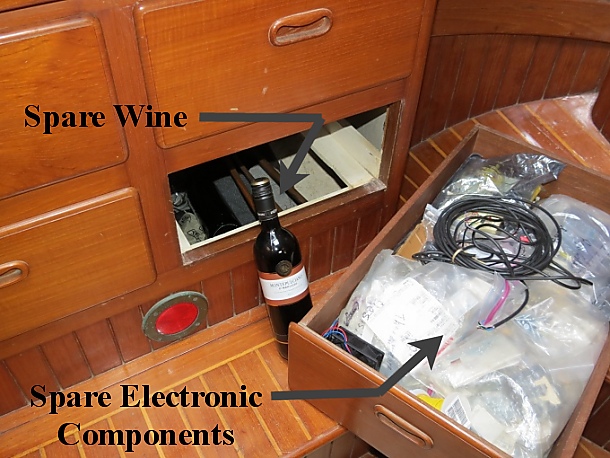
It would be nice if I could just assign some cubby or storage area as the “Engine Spares Stowage Area” for example and put all my engine spares there, but it never seems to work out well if I try to do this. I have large engine spares, like heat exchangers, starter motors and exhaust manifolds that aren't needed often. These fit nicely under the aft bunk along with a couple of spare anchors, a spare hydraulic ram and an emergency fuel bladder. The smaller spares, like solenoids, belts, and thermostats fit nicely under the nav station seat, while all my spare hoses and fittings fit under the forward sink. My engine gaskets have to be kept flat, so they reside under the forward bunk, and the consumables, like filters and engine anodes live behind the starboard settee. Multiply this by 40 for all the other systems and spares, and distribute them in the 50 or so small cubbies and storage areas aboard, and it gets complicated remembering where everything is.


notations in LBB


So a few years ago I worked out a system of sorts. I assigned a three character alphanumeric code to every storage area on Nine of Cups. The first character is a letter that defines the area of the boat. For example, the letter 'A' means the aft cabin, 'G' would indicate the galley and so on. The second character indicates which quadrant in the area it is located; 'S' for starboard, 'P' for port, 'A' for aft and 'F' for forward. The third character is a number that indicates which storage area in the quadrant the part is located. So, AS2 would be the designator for the second locker on the starboard side of the aft cabin. I used my label maker to create labels that I attached to the inside of each storage locker as well. Finally, each part that is listed in my Little Black Book has this three digit notation added to it.


spare locations


This sort of works and I can find the spare I'm looking for about 75% of the time. The remaining 25% of the time, I forgot to enter the part in my LBB, forgot to write the location of the part down or moved the part after I wrote its location down. So 25% of the time I end up spending between five minutes and two days tearing the boat apart, looking for a particular part.

I was reading the latest issue of Good Old Boat, and noticed a product announcement for a new iPhone App called What's on my boat that tracks all those spares – where they're stowed and how many. Could be just the thing; but I suspect I'd still have to remember to enter the part, quantity and location into the database, then have the discipline to keep it up to date as I used a spare, bought more, or changed the location.

I remember reading an article about how couples become more like each other the longer they live together. When we first started dating almost 30 years ago, Marcie was almost compulsively organized, while I was more on the slob side of the spectrum. Now, I like to think I am a lot more organized and a whole lot neater, while Marcie is nowhere near as compulsive. At this rate, in another 20 years or so, I should have no problem keeping a spares inventory App up to date. Of course, by then I probably won't remember what the spare is for or how to install it.

The Blue View - Spare Thoughts on Spares

spares  

In an earlier blog, Marcie mentioned an English sailor we spent an evening with in New Zealand who no longer carried much in the way of spares. He was an experienced offshore sailor with a lot of miles under his keel, and his boat was quite shipshape, so I was interested in hearing his point of view. His thought was that it is now very easy to have parts shipped almost anywhere in the world, and it is no longer important to have all that money and space tied up with spare parts. Our friend argued that the cost of shipping a spare was offset by the savings realized by not having to purchase as many unused spares in the first place. And if we were in so much of a hurry that we couldn't wait the extra week or so that it took to locate a particular part and have it shipped, perhaps we should be doing something else. We had quite a lively discussion, and in the end, agreed to disagree.

Our philosophy is different. We carry a lot of spares. I think his argument is a little stronger if you don't get too far off the beaten track, but in many of the places we've visited, it would take months to get a part shipped in, if it was possible at all. Likewise, in some countries, it can take weeks to get a part through Customs.

Even if we did nothing but coastal sailing, however, I think we would still keep a large stock of spares aboard. I like knowing we can fix most anything that breaks and are pretty much self-sufficient for long periods of time. I don't like having to disrupt our cruising plans or skip some out of the way anchorage because we have to head to civilization to round up a part. And more than once, we would have missed a weather window if we were forced to wait for a part.

For example, not long after meeting the English sailor in New Zealand, we waited two weeks for a window that would allow us to sail up over the top of the North Island and down the west coast to Fiordland. We weren't out more than 18 hours when the alternator quit. Having the spare allowed me to make the fix under way. We made it to the protection of Fiordland just ahead of several gales that pummeled the North Island for weeks and enjoyed six fabulous weeks of cruising the west coast of the South Island. Had we been forced to put in while sourcing a repair or replacement of the alternator, we would have missed our weather window and quite likely wouldn't have had time to visit the South Island at all that season.


spares stored


On the other hand, we probably do carry a lot more spares than most. We have spares or repair parts for every essential system on-board, and for most systems that would be a major inconvenience to do without. There aren't that many essential systems aboard, actually, but there are a lot of systems that we like having and are truly a big time inconvenience doing without. Fridge, freezer, watermaker, navigation electronics, communication electronics, electric bilge pumps and beer brewing equipment all fall into this latter category.

Sometimes it's difficult to differentiate between these two categories, by the way. If the engine won't start, that's usually a major inconvenience. We can usually sail to the next anchorage, although we may have to shut down the fridge and freezer to save power and curtail our communications to the bare minimum. If the engine dies on a calm day in the middle of a shipping lane or in some remote part of Fiordland or Patagonia, however, we would probably consider it an essential system. Likewise, the autopilot. On a passage of a day or two, it is a big inconvenience to do without it, but on a passage of a few weeks or longer, especially if the weather is bad, it is extremely fatiguing to spend two hours out of every four steering the boat.


more stored spares


We carry spares for a lot of non-essential, less important gear as well, and if I find a bargain on parts we use frequently, like filters, engine oil or anodes, I stock up (See my blog post on My Little Black Book). We probably have a year's worth of most of these consumables at any time.

The half ton of spares we carry probably lowered the waterline of Nine of Cups a half inch or so. Add to that the ton or so of tools I carry which are used to install the half ton of spares, and before long we are talking about some serious weight and a lot of dollars invested. This is, however, our preferred philosophy on spares, and is just as correct for us as the English sailor's philosophy is for him. We continue to agree to disagree.

Finding the right spare that has been stowed in some long forgotten cubby somewhere aboard is a whole other issue, however, and worthy of another blog. Stay tuned.

The Blue View - My Little Black Book

little black book  

I never go anywhere without my little black book. I often forget to grab my cell phone, and once in awhile forget to check for my wallet as I go out the door, but I rarely forget my LBB. My LBB does not contain phone numbers for old girlfriends. Instead, it contains pretty much all the information I need to keep my life in order.

Some of the information is pretty much to be expected. Phone numbers and addresses of friends and family for example. I also have a section with all those birthdays we need to remember (which I forget anyway)

Then there is the section devoted to the dozens of passwords and user IDs I need. As we all know, the list is long and gets added to frequently. I use a sort of shorthand encryption for my passwords in case I lose my LBB. This might slow down a dishonest old fart, but a halfway intelligent 3rd grader would probably figure out all my passwords in half an hour. I don't know what the solution is – I couldn't possibly remember all those account numbers, user IDs and passwords, and if my encryption method is too complex, I might need a 3rd grader on call to help me figure out how to unscramble my information. They have software programs for corralling all those passwords, but you need another password to get into the program.


inside the little black book


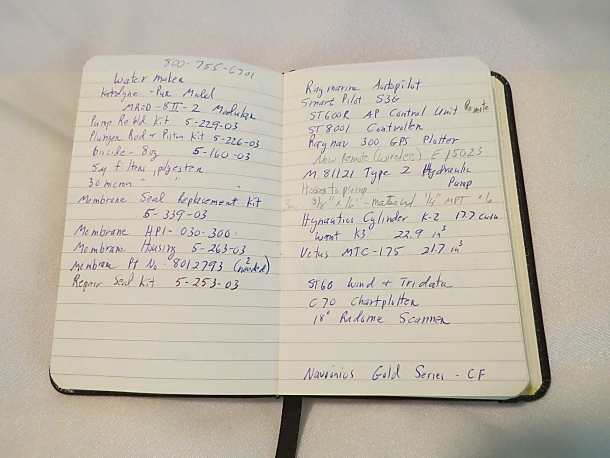
The most important section, however, is all the boat information I keep with me. I have all the pertinent information for every system on board Nine of Cups. For example, I have the watermaker model and serial number. I also list the part numbers for the various spares kits for it, as well as the contact info for the manufacturer and a couple of distributors. I include the usual prices for the spares in case I run across one in a chandlery or nautical flea market somewhere. That way I can tell immediately if the price is outrageous or a bargain, and whether the part is the correct one. Finally, I make a notation about where the spares for the watermaker are stored on board Cups.

There are similar notes about the diesel engine, outboard engine, electronics, autopilots, wind generator, solar panels, pumps, and the myriad of other devices and systems on board. Where it makes sense, I also make a note of dimensions. Our propane locker, for example, will fit some 20 lb. propane tanks, but not all. If I need to exchange one or buy a new one, I can measure the critical dimensions before lugging it back to the boat. Likewise, when we were looking for the new mattress for Nine of Cups, I had a drawing with the dimensions in my LBB.

I also have a list of all the lines we use aboard, with diameters and lengths. That way, if I come across a sale or another one of those flea markets, I don't have to rely on my notoriously bad memory to remember that we use a 9/16” line, 120 feet long for the mainsail halyard.

Ditto the sail dimensions. That's not so much in case I run across a used sail somewhere, but to make it easy when it's time to reorder a new sail. All the information I need is at hand and easy to find.

As I write this, I am thumbing through my LBB, and here are a few other miscellaneous items I've filed away: beer brewing records for each batch; gold leaf suppliers for the gold on the name boards; equalization records for the batteries; battery and charger information for our laptops; my list of things to do when preparing for a storm – one if we are anchored and one if we are at sea (hmm...maybe a future blog topic?); a table of fuel capacities and rate of fuel consumption at different RPMs; information on how much wobble I measured on the prop shaft after the last time I aligned the engine; combinations to all the locks we have aboard...

My LBB lasts about a year riding around in my back pocket. Then I buy a new one and before copying everything, I reorganize and regroup the information, deleting anything that is no longer relevant, like a bilge pump that has been replaced with a different model for example. Then I store the old one in a safe place as a backup in case the new one ever gets lost.


smart leatherman


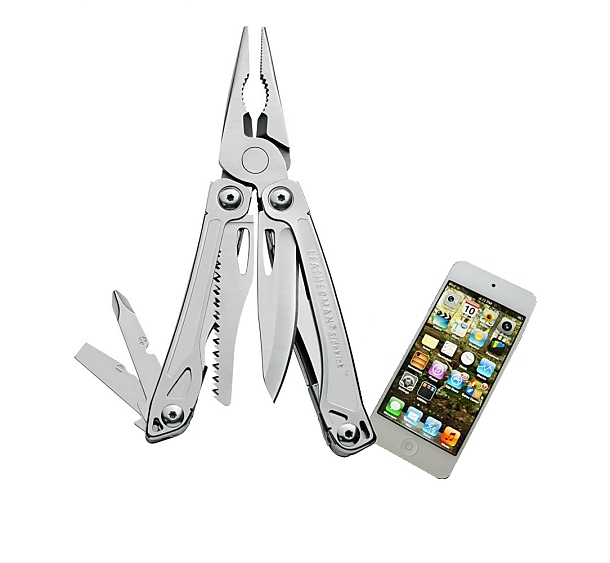
At some point, I will undoubtedly make the conversion from my LBB to the electronic version. I am resisting, mainly because my LBB works quite well, costs far less, and I don't have to worry about dropping it. Now if Leatherman ever comes out with multi-tool that combines pliers, wire cutters and a knife or two with a touchscreen mobile device, I'm there.