Before we moved aboard Nine of Cups and were just learning the basics about sailing and cruising, we frequently chartered boats in the Caribbean. We could afford to do it more frequently if we did our chartering off season when the rates were lower. The lowest rates were during hurricane season. We rationalized that the odds of a hurricane occurring where we were during any 10 day period were quite low and worth the risk.
The odds caught up with us one summer while we were chartering a sailboat in the British Virgin Islands. The charter company had us move the boat into a secure marina on Virgin Gorda, and we battened her down and stayed aboard as Hurricane Bertha moved over the area. It was quite the adventure as the wind shrieked, coconuts flew past like cannonballs and trees were uprooted. We saw it as a positive experience. After all, we had the opportunity to experience some of the worst weather mother nature has to offer in a semi-sheltered environment, and even though we did everything we could to look after and protect the boat, it still belonged to someone else. In the end, the boat was just fine and the charter company even gave us a credit towards another bareboat charter.
Now that we live aboard our own boat, we stay well clear of the hurricane/typhoon/cyclone regions when they are in season. We have had some near misses as a few of these cyclonic systems wandered out of their usual areas, but we have, so far, managed to avoid a direct hit.

Storms and gales are a different matter. In a recent Blue View, I talked about encountering storms at sea and how we prepare for them. For every gale or storm we've encountered at sea, however, we have seen many more while anchored. Two of these actually had hurricane force winds in excess of 64 knots (119 km/hr or 74mph). Just as at sea, it is important to be prepared for a storm while anchored. For us, the preparation starts with knowing what to expect and having the right gear aboard to begin with, followed by the steps we take to prepare Nine of Cups for a blow.
First in importance is what the weather is going to do. Which direction(s) will the wind come from and how strong will it be. Will it be primarily from one direction or will it swing around? If the forecast is wrong, are there contingency plans? Take a look at the local topography. Are there notches in the hills or mountains surrounding the anchorage? These will often funnel the wind and it will be much more intense there. Look at the trees – are they bent in one direction in certain areas? That's a good sign of where the wind will be the strongest. Check the chart. Is it best to anchor in the middle of an anchorage with lots of swinging room or would it be better to find a tight little cove to tuck into? Maybe the anchorage is just too risky, too open, or the holding is not good – it might be better to head out to sea and weather the storm offshore.
Just as important is having the right ground tackle. We have the biggest anchor our bow roller will handle, a 110 pound (50kg) Bruce anchor. This is more than twice the recommended size for our size boat. The extra 50 or 60 pounds it adds to the weight forward is minor compared to the weight of the 300 feet (90m) of chain we carry in the chain locker. If we are expecting a big blow, we add a second anchor in series with our Bruce for even more holding power.

There are two philosophies regarding the placement of anchors in series. Some feel that it is best to put the big anchor down first and shackle the second, smaller anchor to the anchor chain 20 feet (6m) or so closer to the boat. The second anchor acts more like a weight or chum on the chain and greatly increases the holding power of the main anchor. The second philosophy is to attach the small anchor to the main anchor with 20 feet (6m) or so of chain so that it extends beyond the main anchor and sets first. The primary anchor is still the main holding force, while the second anchor adds to its holding power. We use a 35 pound Danforth as our secondary anchor. We have tried both methods and have not had issues with dragging with either method. We prefer the latter method however, and have used it many more times.
An important part of the ground tackle is the snubber we use with an all chain anchor rode. It's such an important issue, I wrote an entire blog post on the subject. We have a 5/8” (16mm), three-strand, 60 feet (18m) long line that we use as our heavy duty snubber. We attach it in any kind of bad weather, but especially for the “batten the hatches, lash everything down, take the seasick medicine” kind of weather. When I secure the snubber to the cleat, I leave several feet of line between the bitter end and the cleat. In a storm, the snubber will sometimes start chafing against the bow roller. I check on it frequently, and if it shows any signs of chafe, I let out some of the extra line to prevent the snubber from chafing through.
Depending on the anchorage, this is often all we need to keep Cups safely anchored. If the anchorage is small and/or there is limited swinging room, we sometimes run lines ashore. We use heavy 3/4” (18mm) line, and carry two, 300' (90m) lengths. Polypropylene is good for this purpose. It floats, so towing it ashore in the dinghy is easier, and it is quite chafe resistant. Since we may be attaching to rocks ashore, we also have two 15 foot (5m) lengths of chain with shackles on board.
The procedure to run the lines ashore takes a little practice. We first deploy the dinghy and flake the line out on the aft deck. We pass one end through an aft hawse hole and tie it to the dinghy. Then we drop the anchors and set them, and attempt to back Cups up towards the shore, deploying more chain as needed. When we get as close as we can, I hop into the dinghy and tow the end of the line towards shore while Marcie feeds the line out. I find a place to go ashore and then secure the line to a stout tree or large rock. If there is any chance of chafing the line on the rock, I wrap a length of chain around the rock, shackle the ends together, and attach the line to the chain. The end of the line on the boat is wrapped around a winch, and we use the winch to pull the boat towards shore. Often, we then run another line to shore from the other side of the boat. By winching in the lines and letting out more chain, we can get the boat quite close to shore, often in some tiny cove that is completely protected. When we are all set, we attach the snubber.
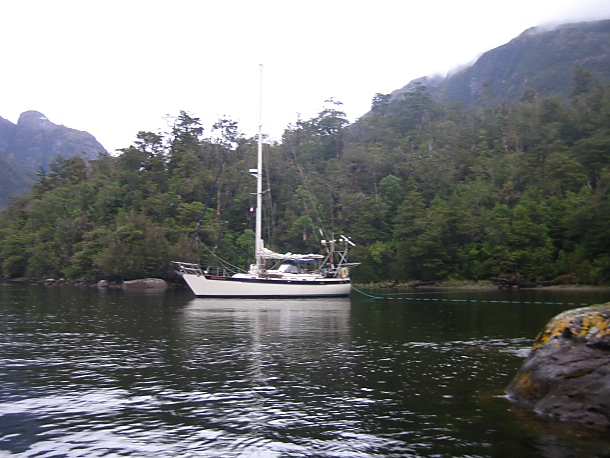
Fortunately, we were alone in the anchorage the first time we tried this. I've left out the part about how I kept the dinghy from drifting away as I tried to clamber up those mossy, slippery rocks, dragging two hundred feet of line and carrying 15 feet of chain wrapped around my neck. It took us well over two hours of sweating and swearing to get everything just right. After a dozen or so times, however, we were completing the task in about 20 minutes and with hardly any swearing.
We have used this technique in numerous anchorages, especially in Patagonia, Tierra del Fuego and Fiordland, in southern New Zealand. On occasion, we have run as many as four lines ashore, and sometimes we would be so close to shore we needed to avoid the tree limbs. Marcie always enjoys picking flowers without leaving the boat. Often it seemed that there were more gales and storms than good weather. Even when the weather forecast was for good weather, however, there were frequent katabatic winds called williwaws, often generating hurricane force winds for short periods of time and sounding like a railroad train barreling towards us. Neptune, with his endearing sense of humor, usually saw fit to send these to us around 3AM. Being securely tied to shore made these williwaws more of an annoyance rather than a major adrenaline rush.
Once we are as securely anchored as we can be, we pull out our checklist and go through the remaining steps to prepare for the blow. We have one checklist for prepping the boat for a storm at sea and one for prepping the boat at anchor. We have printed copies and keep them both in a notebook under the Nav station. If you would like a copy, email us and we will happily send you an electronic copy. Let us know whether you would prefer a .pdf format or in MS Word format.
Once the storm arrives, if we have any question about the anchor holding or the swinging room, or if our confidence in the anchoring skills of the other boats in the anchorage isn't real high, we stand watch in three hour shifts. We have had a number of near misses by other boats dragging, including one rather large ship. Usually by the second day, if everybody seems to be holding their position and all is well, we will rely on the electronic anchor alarm to alert us if we start dragging, and will go back to a normal sleep schedule. There's usually not much sleep to be had during a storm, at anchor or at sea, but knowing we're as prepared and safe as can be goes a long way towards peace of mind.