
The Blue View - EPIRBs

epirb  

One of the items on my list to bring back with me on my return to Nine of Cups is a new EPIRB, or Emergency Position Indicating Radio Beacon. Our old model is now 15 years old, and is pretty basic. In an emergency, either it becomes immersed in water or the switch is turned on and it begins sending out an emergency signal that is picked up by two or more satellites. The satellites triangulate the position of the EPIRB and forward the information to the U.S. Coast Guard. They look up our EPIRB registration and call our emergency contacts to verify that we are actually on a passage, then contact any rescue organizations or vessels in our area. If all goes well, this whole process takes only a couple of hours. I remember reading somewhere that the average time spent in a life raft is now under six hours, which is pretty amazing in my view

We know people who have been saved because their EPIRBs worked as advertised and searchers were able to find them at sea. On the other hand, when the vessel Nina went down in the Tasman Sea this past summer with all hands, including our friend Evi, no EPIRB signal was sent. We can only hypothesize that either whatever happened to Nina occurred so quickly that there was no time to release the EPIRB and it went down with the vessel, the boat was not equipped with one, or the unit malfunctioned.

We hold our EPIRB in very high regard. While our life raft and PFDs might keep us afloat, without an EPIRB, we could drift for weeks until a passing ship spotted us or we made landfall somewhere – assuming we didn't drown or perish first. Because it is so important, we take a number of precautions to make sure it does its job if ever it is needed:

Registration. We keep the registration information up to date. It is easy and quick to do online. In the U.S., we have to renew the registration information every two years or whenever the contact information changes. If the Coast Guard cannot reach your emergency contact, rescue will, at the very least, be delayed,and may not be initiated at all if there is no confirmation that there is actually an emergency.
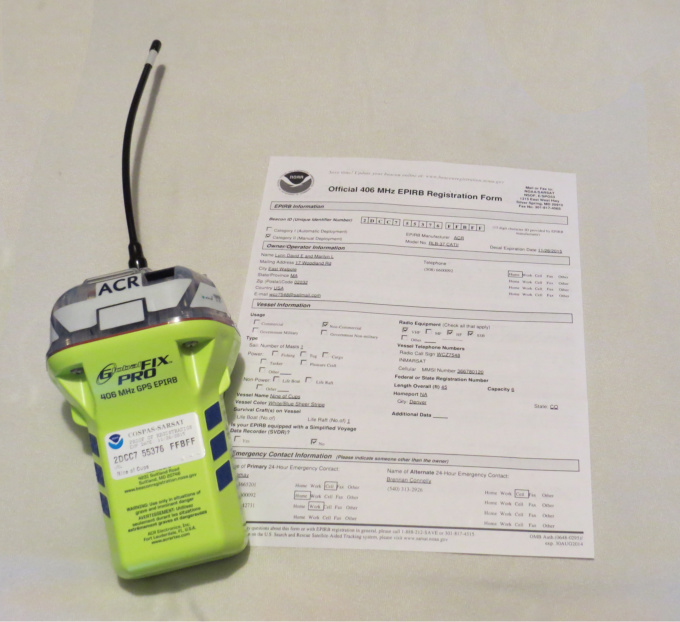
 

registration


Frequent testing. We inspect and test our EPIRB monthly.

Battery replacement. Most EPIRBs have a five year battery lifetime. Battery replacement must be done by an authorized facility, which will also perform a full functional test of the unit.

Mounting. The EPIRB won't do any good if you can't get to it quickly in an emergency. We mount ours next to the companionway ladder where we can grab it on the way out or reach it from the cockpit.

The reason we are replacing our old EPIRB is that it is now due for a new battery, but it is so old that the manufacturer no longer stocks batteries for our model. Like most electronics, the new EPIRBs are smaller, include many more features, and are half the size of the older models, and as it turns out, a new EPIRB doesn't cost much more than what it used to cost us for the battery replacement.

When it comes time to buy something new, especially something as important as an EPIRB, Marcie and I have different decision making processes. I like to assess our needs, evaluate the technology, determine which features and options are essential vs non- essential, derive cost vs benefit ratios, and eventually narrow the candidates down to a few dozen. Then I check the independent reviews and compare the pros and cons of each of the candidates, agonizingly narrowing them down as much as possible. Finally, I determine who has the best deal and make the purchase. This can take weeks.

Marcie's method is to do a quick search to find something that seems appropriate, is the right color, is reasonably priced and buy it. This can take minutes. (Okay, okay... perhaps I am exaggerating just a bit, but this is, after all, my view of things).

Over the years, in order to preserve family harmony, we have agreed to let me do the product evaluation. I can analyze, assess and grit my teeth to my hearts content, eventually coming up with a recommendation. And so it was that I was tasked with finding a new EPIRB.

Actually, the EPIRB decision making process wasn't all that difficult. The first big decision was whether we should get a model that includes a GPS. Most newer EPIRBs include a GPS which provides much more accurate positional information than solely depending on the satellites to triangulate the location. Having a GPS narrows the search from a square mile to a few meters. The cost for this feature is nothing, since the newer models with GPS are cheaper than the older models without, so this was a 'no brainer'.

The next big decision was whether we wanted a Category 1 Automatic/Manual release model or a Category 2 Manual only release model. The Category 1 models have a hydrostatic release mechanism that automatically releases the EPIRB from its holder and activates it if it is immersed in water. A Category 2 model must be manually released from its holder, but will activate either automatically after immersion or by turning the switch on.

In order for the hydrostatic release mechanism to be of use, the EPIRB would have to be mounted on deck. (It wouldn't be of much use mounted below decks – by the time it was immersed in water below deck, it would most likely still go down with the boat). Being mounted on deck, it is quite possible that it would release and activate when we didn't want it to, such as in the event of a knockdown or waves breaking over the cockpit. We've been in both situations, and we certainly wouldn't have wanted our EPIRB to initiate a search and rescue effort on our behalf as it floated away. Even if we were completely rolled, unless Cups was sinking or one of us was badly injured, we probably wouldn't want the EPIRB to initiate a rescue operation. Since the cost of a Category 1 model is quite a bit more than a Category 2 model, I felt the benefit was not worth the extra cost..

There were a few other features to contemplate, but in my opinion, they weren't worth the added cost either. For example, some models come with a feature that uses the vessel's onboard GPS to continually update the EPIRB's GPS position. That way, when the EPIRB is activated, it already has the current location and doesn't have to search for the GPS satellites and get a fix before transmitting the more accurate position. Since it is typically hours, not minutes, for a rescue operation to be initiated, the extra five minutes it takes for the EPIRB to find its GPS location is probably not an issue.


epirb rebate


This process narrowed the candidates down to about 5 models. The hands-down winner was the ACR GlobalFix Pro. Our old EPIRB was also an ACR, and although we never had to deploy it, we were happy with it. We were able to buy the new one online at Amazon at a very reasonable price, and ACR was running a year end promotion that provided $210 worth of cool stuff as a rebate.

We probably won't receive the cool rebate stuff before Marcie leaves for Australia, so it might be another two years before we have it aboard, but I felt better knowing I was getting more for my money.

The Blue View - Captain's License

Florida License  

It is always amazing to yachties and officials in other countries that anyone in the U.S. can take a boat out - no experience needed. If you rent or charter a boat in the U.S., the agency usually requires a resume and will often go out with you to make sure you know the basics before they let you sail away. If you buy a boat, however, it doesn't matter if the only previous experience you've had with boats was a rubber tugboat in the bath – you are the “Captain”, and can motor away in your spiffy new boat. You don't need to know why some markers are red and others are green, how to put on a PFD, or who has the right-of-way. That's a lot like learning to drive by buying a new Mercedes and driving it home in rush hour traffic.

Most other countries require the operator of a vessel to have an understanding of basic seamanship, safety at sea and the rules of the road. Many require one to pass a test not unlike a driver's test. When we first moved aboard Nine of Cups, however, there were very few states that had any licensing requirements at all. This is slowly changing – 45 states now have some educational requirements before allowing someone to operate a boat or watercraft, but most of these states have only minimal requirements or requirements that only apply to younger boaters. For example, California only requires boaters that have been convicted of a moving violation to take a boater's safety class; Florida only requires completion of a class if you were born after 1988, and exempts the operator of a vessel if it was purchased within the past 90 days; Massachusetts has no licensing requirement at all.

So now it is time for me to climb up onto my soapbox. I feel very strongly that every cruiser should at least take a general boating safety class. Besides the obvious benefits of knowing enough basic seamanship and the rules of the road to avoid putting your passengers, your boat and the other boaters in your vicinity at needless risk, there are several other advantages to having a boating safety certificate.

Many insurance companies give a discount to operators who have completed a boater's safety class.

Even if the state your boat resides in doesn't require a license, if you sail to a state that does require a license, you may be fined for not having one. A certificate from one state is usually good in another, just as a motor vehicle driver's license is good in any state.

On occasion, officials in other countries may require a “license” of some sort. A Fish and Game official in Queensland, Australia asked to see our boaters license and threatened us with a hefty fine if we didn't have one. I showed him our PASIS certificate (Bareboat Charter certificate) and my boater's safety class completion card from Colorado, which, with a lot of talking and a bit of hand waving, got us by.

And the most important reason for taking a class - it may prevent you from sounding dumb when you are sharing stories with the other cruisers in the marina. I remember a sailor telling me about a really rude power boater who “ blew his horn at me as he approached from behind. When I moved to the right to get out his way, he also went to the right and almost hit me!” If the sailor knew anything about the rules of the road, he would have known a single short blast from an approaching boat means that he intends to overtake you on the starboard side and you should maintain course. (Unless you are outside the U.S. where it's two longs followed by one short blast on the horn. This guy would have thought they were extremely rude in New Zealand with all that horn blowing to tell him to get out of the way.)


ship


Not only do I feel it's important to take a boating safety class, it is very easy to do so. There are several companies that provide online courses for every state. Most charge only a nominal fee, and the Boat U.S. Foundation even offers it free. The process is to review and learn the material, then complete a practice quiz in each of several sections. When you have completed all the sections and feel you are ready, you can take the online exam. If you pass, you can print your lifetime certificate – if you don't pass, you can review the material again and retake the exam as many times as you need until you do pass. It couldn't be easier and it is a great way to learn enough to at least make your stories sound somewhat credible.

The next step is the U.S. Coast Guard Captain's License. Once you have some experience, you can attend the necessary courses, either online or in a classroom, and then take a proctored exam to get your captain's license. The usual license is the “Six Pack License”, which allows you to take up to six paid passengers on a vessel smaller than about 65 feet. Most cruisers don't get this license because they don't intend to take passengers for hire. Instead, it is a good way to learn a lot about seamanship, boat handling, first aid at sea, navigation and advanced rules of the road.


coast guard license


When we first moved aboard Nine of Cups, we didn't have the minimum 360 days experience on inland or coastal waters that is necessary to get our licenses. Once we had the experience, we were out of the country or not in one place long enough to take the course. Now that the courses are offered online, I may bite the bullet and get my captain's license. That way, my sea stories will sound credible to even the saltiest of salts.

If you have any suggestions or experiences to share about online courses for the captain's licenses, please share them.

The Blue View - NOAA TO STOP PRINTING NAUTICAL CHARTS!

headlines  

Recently, there have been a flurry of very similar headlines to this one in the news, and, man, did the first few get my attention. NOAA is no longer going to print charts?? Surely, there are still a few other dinosaurs like me around who feel it is quite important to have paper charts aboard? What's the world coming to?

I quickly recovered from my initial shock and indignant outrage when I read the actual NOAA press release, however. The situation is not nearly as dire as I was led to believe. In fact, I discovered a number of new (at least to me) benefits NOAA is now offering that are quite positive.

After April 2014, NOAA will no longer print paper charts – this is true. For the past 150+ years, the U.S. Government has used a lithographic printing method to print charts, which were then sold to retailers. Lithographic printing is a cost effective method of printing if a lot of copies are to be made. NOAA would print thousands of each chart when the stock got low, and these charts would then sit on a shelf, for years in many cases, until the stock ran low again. As updates and corrections to any of the charts were made, all the charts in stock would have to be periodically corrected by hand. I would guess a significant amount of labor would be involved in keeping all those stocked paper charts up to date. After April 2014, the lithographic printing of charts by NOAA will cease.

This does not mean, however, that paper charts will no longer be available. Rather than printing, stocking, and manually correcting thousands of charts, NOAA will continue updating all their charts, and will provide them to third party retailers who will print them on demand. This means that you can order the latest version of any chart, in full or reduced size, and in color or black and white format, and have it shipped to you anywhere in the world from any of literally dozens of companies that provide this service. Our favorite has been Bellingham Charts. Their 2/3 size charts are relatively inexpensive, especially if you buy a chart set, the quality is good and their service is good.

My next thought was that this probably means that I won't be able to go to my local chandlery and spend a pleasant hour or so looking through the stacks of charts to find the ones I want. But after grumbling about this for a day or two, it occurred to me that most local stores would continue to order and stock the same charts they do now. The only difference would be that they would be ordering from a third party printer rather than the government printing office. It's even possible that the cost of the charts might go down since there is considerable competition (or more likely, the store's profit margin might go up?).

NOAA also provides the U.S. Charts directly to the public in several formats. The first format is a digital raster format. This format is used with several of the navigation programs and apps. I have used two of the free ones on my PC... OpenCPN and SeaClear . Both are reasonable, if basic, navigation tools, and both allow you to use the free raster charts provided by NOAA.

The second format is in pdf form. You can view, pan and zoom the pdf file on your computer or tablet, but unless you have a printer capable of printing large sheets of paper, the printed version will be too small to be usable.


pdf format


The third format is my favorite. You can now print any chart in a booklet format. NOAA has divided each of their charts into 8.5”x11” sections, and arranged them so that they can be easily printed. If your printer supports printing on both sides of a sheet, it is quite quick and easy to make a chart booklet for any NOAA chart. Their website indicates that this option has just transitioned from an experimental program into official production. Kudos to NOAA - I think this is a great option.


booklet chart


Bear in mind that all this only pertains to U.S. Coastal charts. The U.S. International charts are not provided by NOAA, but rather the National Geospatial-Intelligence Agency (NGA), and are only available to the public through third parties.

So now I am just a little depressed because I don't – at the moment – have anything to complain about. But the day is still early and I just discovered Amazon is having a sale on Leatherman Hand Tools which should cheer me up until I can find something else to grouse about.