The Blue View - How's the Boss Doing?

bruce and boss  

When we left the Adelaide area, we had just mounted our new Manson Boss anchor as our primary anchor and stowed our old reliable Bruce anchor. The thought was that our Bruce was good for most sea bottoms, but not especially great for the thick grass and hard sand bottoms that South Australia is known for. After looking at a lot of alternatives, I thought the Manson Boss had the potential to do well in this area, as well as perform well in other types of sea bottoms.

We have been on the hook every night for over three weeks now in 13 different anchorages, and I thought it might be time for a preliminary update on how it's doing. How well does it set? How well does it hold?
 

boss


First some caveats. I have always been skeptical of anchor tests and reviews. Even the best designed tests have just too many uncontrolled variables when attempting to compare a number of anchors. An anchor that is dropped in two different spots 50 feet apart might exhibit totally different holding capabilities just because of differences in the sea bottom. Some anchors require different techniques to properly set them. If two anchors are dropped and tested in exactly the same place, the first one might disrupt the bottom enough to affect the performance of the second. I can think of a host of reasons why even the most unbiased anchor reviews often result in different conclusions about the anchors being tested.

My evaluation has even more shortcomings. We've never before dropped a hook in any of these anchorages, so we have no first hand experience. I didn't try the old big Bruce or any other anchor as a comparison. There were no gales blowing and the wind didn't shift 180 degrees during the night. There are a whole host of reasons why this is far from a scientific evaluation of the anchor.

On the other hand, the anchorages in this area are known for their poor holding and difficulty in getting an anchor to set. The thick deep grass is difficult for most anchors to penetrate, and the hard sand, sometimes covering limestone, and grass roots make for poor holding once the grass is penetrated. Our anchoring conditions ranged from calm to 35+ knots of wind. So, while this is in no way an exhaustive test, I feel we have enough experience with it to provide a preliminary evaluation.

So here are our impressions:

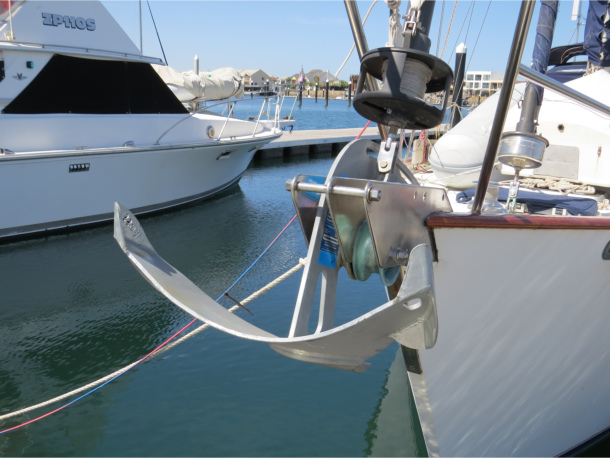
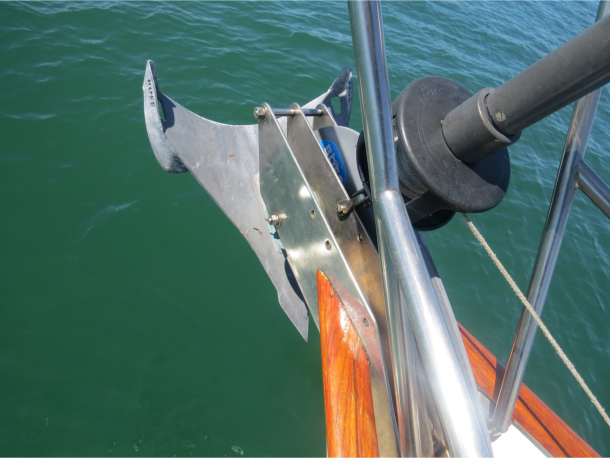
Ease of Use: The Boss requires only a small nudge to deploy and it comes back into the bow roller quite nicely. The Bruce was a bit of a pain to push out of the bow roller, invariably smacking into the jib furler drum on its way out, and retrieval required pulling it into place the last foot or so. Overall – a definite improvement.
 

boss is ready


Ability to set: Our technique for setting the anchor is to come to a stop, then slowly start backing up, letting the wind, if there is any, push us back, or using the engine, if not. Once we begin moving backward, we use the windlass to lower the anchor. We continue to back up at a knot or so until all the required chain is out – usually a minimum of 5:1 scope (the ratio of anchor rode to water depth). Once all the rode is out, we continue to drift backwards until the bow starts swinging towards the anchor. When the boat stops and the rode starts to tighten, I put the engine in reverse and slowly tension the rode. If it appears to be set, I increase RPMs to about 2/3 full throttle and hold it there for a minute or so while I check the GPS and try to line up objects ashore to see whether we are moving. Sometimes the boat will drag slowly or sometimes you can feel a definite jerk if the anchor breaks free from the bottom. If it still seems to be holding, I slow the engine to idle, put it in neutral and attach the snubber. The new Manson Boss set on the first attempt in all but two anchorages, and in those two anchorages, it required two tries to set. In our discussions with local yachties, even the most commonly recommended anchor for this area, a variation of the old admiralty anchor called a Marsh Stockless often requires more than one attempt to get it to set. We give the Boss a good rating for the hard grassy bottoms here.

Holding: The Boss held firmly in all but one anchorage. In the Kingscote anchorage on Kangaroo Island, the anchor broke free in 30+ knots of wind, dragged about 50 feet (15m) then reset and held firmly the rest of our stay there. We had the anchor alarm turned on, which alerted us to the fact we were dragging, but the anchor had reset before we could get on deck to investigate. Again, given the bottom type, we rate the Boss as good.

We will have the opportunity to try the anchor in a lot more grassy/hard sand bottoms as we move west, but we are beginning to gain confidence in it. Overall, our initial opinion is that it is a pretty darn good anchor.

The Blue View - Anchor Chock for the Bruce

chick with anchor  

When we bought the new Manson Boss anchor for Nine of Cups recently, the hardest part of making the switch was figuring out how to stow our big 50kg (110lb) Bruce anchor. I didn't know whether the new anchor would be a better all around anchor than our old trusty Bruce, and I was certainly not ready to part with it.

We now have an embarrassingly large inventory of anchors. Along with the 80lb Boss and 110lb Bruce, we have a 35lb Hi-Tensile Danforth which is a marvelous stern anchor and has definitely saved our bacon on a couple of occasions, an aluminum FX-37 Fortress anchor, and a 35 lb CQR. The CQR is too small by itself to hold Cups, but we have used it on many occasions along with the Bruce when using two anchors in series. This arrangement worked particularly well in the windy anchorages of Patagonia and Tierra del Fuego. The CQR and Fortress are stowed below deck under the aft bunk, but there was no way I'd want to try to wrangle the Bruce into the aft cabin, even if I could find room for it. I still want it available for use until I gain more confidence in the Boss, so ideally it should be stowed somewhere on deck and forward.

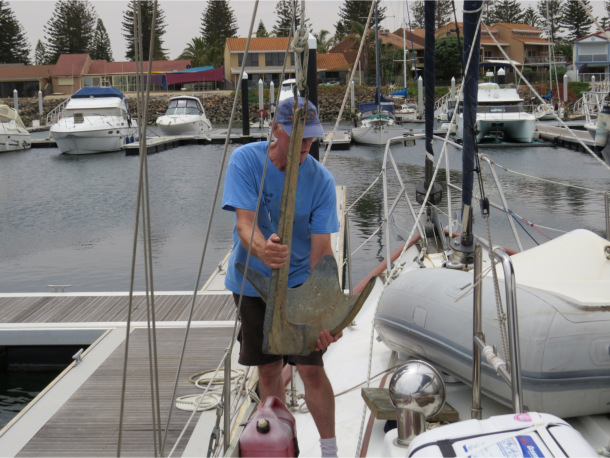
I made a few measurements and looked at all the possible locations where it could be stowed, and the best spot appeared to be next to the mast pulpit on the port side. I enlisted the help of Marcie, the designated winch wench, to hoist the Bruce up with the spare halyard while I guided it into place and made sure it would fit. This is where the Danforth currently resided, so I'd have to find another spot for it, but if I could build a chock that would support the Bruce in an upright position, it looked like it would fit nicely.


hoisting bruce


I drew up a sketch of what I thought would work and headed into town in search of materials. All I needed was a six foot length of 2 x 6 (180cm x 50mm x 150mm) seasoned or treated wood and a bunch of galvanized nuts and bolts to make the chock plus some hardware to attach it to the deck. After a train ride, two buses and a fair amount of walking, I found a salvage yard that had some great, well-seasoned hardwood timbers, and bought a length of jarrah wood. Jarrah is a red Australian hardwood that is quite heavy and dense, and it is well suited for marine applications. It was a heavy hunk of timber to carry back, but other than the odd look from bus drivers and fellow passengers, I managed to get it back to Cups without incident.

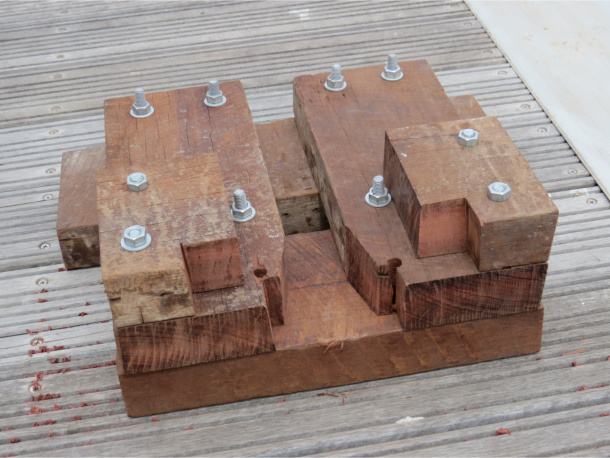
Cutting the dense, 2” (50mm) jarrah using only a jigsaw took some time, but eventually I got all the pieces cut to size, drilled and bolted together.


cute pieces


drilling holes


completed chock


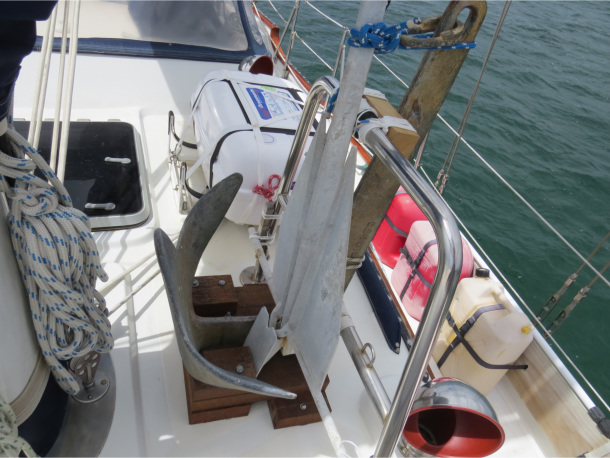
The groove at the bottom holds the Bruce upright and the two blocks under the flukes make sure it can't fall over. I through-bolted the chock to the deck to make sure it would stay put, then lashed the shank of the Bruce to the mast pulpit to keep it in place. Almost all the weight and strain is taken by the chock with very little stress on the pulpit.


anchors stowed


I discovered that the Danforth anchor rests nicely on top of the chock as well, in its original location on the inside of the pulpit, so I didn't have to relocate it after all.

Hopefully, the new Boss will perform faultlessly and our old Bruce will spend its retirement happily ensconced in its new chock, but if not, we can have it attached and ready to deploy in half an hour or so. Then the only problem will be how to stow the Boss...

The Blue View - In Search of the Perfect Anchor

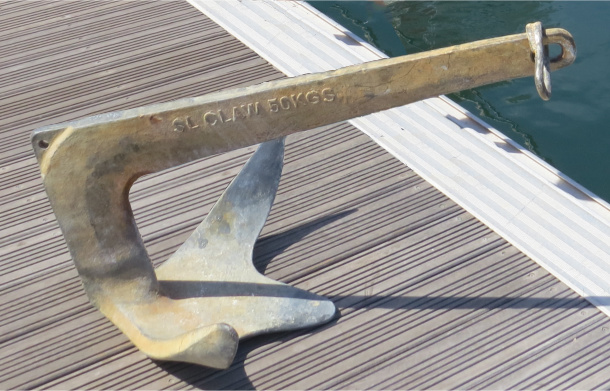
bruce anchor  

We have used a large Bruce anchor for the last 14 years. When we bought it, I did a lot of research on anchors and felt the Bruce, which is a claw or scoop type anchor, was the optimal anchor for us. I'm a firm believer that, all things being equal, a bigger anchor is always better than a smaller one, and we bought the largest anchor that would fit on our bow roller, all 50kg (110lb) of it, which is a couple of sizes larger than the recommended size for Nine of Cups.

In most bottoms, it sets well the first time, and the only problem we ever have is trying to get it unstuck when it is time to leave – a good problem, if ever there was one. In soft mud, it seems to drag very slowly when the wind pipes up – maybe 20 to 30 feet (6 to 9 meters) over the course of a day. It had difficulty in the heavy kelp we found in Patagonia and Tierra del Fuego, and we resorted to using two anchors in series and lines ashore to secure Cups at night. All anchors have difficulty in rock, and depend on wedging underneath, between or in some crevice of the rock to hold the vessel. Once hooked, it can be quite the exercise un-wedging the anchor. We almost had to leave our dependable old Bruce behind in a rocky anchorage in the Chatham Islands off New Zealand, before it finally came free.

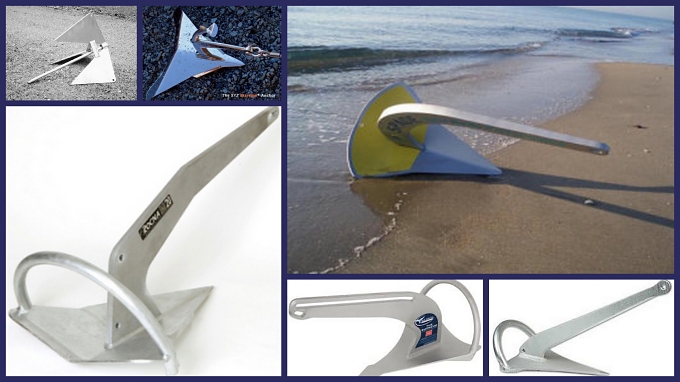
Since we bought our Bruce, there have been a whole host of new anchors on the market, the Bugel, Rocna, Manson Supreme, Spade, and Bulwagga, to name a few, all of which claim to be much superior to the older designs. Over the years, we have been reasonably happy with our Bruce, however, and didn't feel compelled to change.


new anchors


We will be cruising the south coast of Australia for the next couple of months, which is known for its deep grass combined with hard sand bottoms. Our Bruce, as well as many of the other common anchors like plows and CQRs, has problems digging into the sand under all that grass, and so we thought it was time to look at other anchors in the hopes of finding one that would hold well here, as well as perform well in most other bottom types.

A walk around any of the local marinas quickly made it apparent what the local yachties prefer. I'd estimate that 75% of them use a Marsh Stockless anchor as the anchor of choice in the grassy bottoms here. (Picture in your mind a miniature version of a traditional ship's anchor). While the stockless may do quite well in this area, however, it isn't the best all around anchor. The holding power for its weight is nowhere near as high in mud and soft sand as the newer design anchors, or the Bruce for that matter. To offset this, we would need to buy a very large version which is difficult to manage in our bow roller and is quite expensive. A 52 kg stockless anchor, the size recommended for Cups in strong winds would cost over $1000.


stockless anchor


In the hopes of finding a good alternative to the stockless anchor, I spent a fair amount of time perusing the online forums and asking the local boat owners about their experiences with the various anchors, and I got a multitude of conflicting responses. Some swore by the new designs and some swore at them. Many of the stockless anchor owners had tried Manson Supremes and Rocnas in the past, and were unhappy enough with them to go back to their trusty Marshs.

Over the years, we've found that many marina boats the world over do not tend to venture out of their local territories very often. Their boats are reserved for weekends and holidays in fair weather and many prefer marinas to anchorages except for lunch and swimming stops. Though I listened to their input, I was more interested in receiving recommendations from experienced offshore cruisers, especially those with all weather experience in these waters.

I did get a few opinions that were based on personal experience in more extreme conditions. One was from our friends Jack and Jude on Banyandah who have been using a Manson Boss since last July on their latest circumnavigation of Australia. They have anchored in all types of conditions and bottoms and highly recommend it. The Manson Boss is a scoop type anchor like a Bruce, except it has a very sharp, reinforced point that should dig into the hardest sand. It also has huge, up-turned flukes that should give it tremendous holding power.


boss anchor


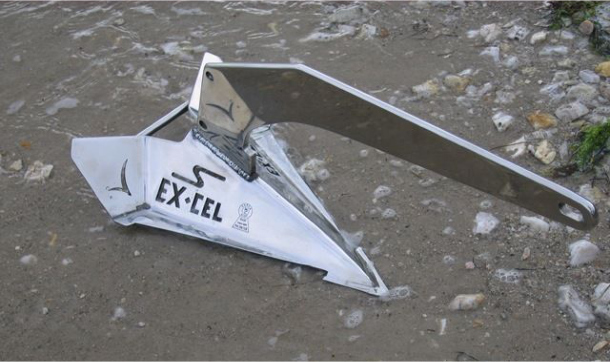
Another opinion came from the owner of a large power boat in our marina that has cruised this area for decades. He spends more time out and at anchor than he does in the marina, and highly recommends an anchor made by an Australian company called the Sarca Excel. It sort of looks like a cross between a plow and a scoop anchor with a very sharp point for digging into the hard sand. The owner of Anchor Right, the manufacturer of the Sarca Excel, is so sure of his anchor, he offered a full money back guarantee if we were unhappy with it after using it for awhile.


excel anchor


It was a tough decision, but in the end, we decided on the Manson Boss, and bought the 80 lb. version, which is a size up from the one recommended for Cups. Although it is only ¾ the weight of our big Bruce, it actually dwarfs our old trusty anchor in size. Delivery was fast and the courier actually delivered it right to the boat. The new Boss fits into our bow roller quite nicely and Marcie can deploy and retrieve it without having to help it along – unlike the Bruce which always required a bit of nudging and/or tugging. The hardest part of the whole process of switching to the new anchor was figuring out how to stow the Bruce.


bruce and boss anchors together


So far, so good. The next step to determine whether this is the perfect anchor – at least for us - is to see whether it actually holds in these south coast Australian anchorages.

To be continued...