Recipes for soups, anyone?

I was looking for some new and different soup and curry recipes using local ingredients. It's cold and soups, stews and curries always seem to warm us up from the inside out. The local supermarket, Pic'n'Pay, offers on-line  recipes and I thought I'd copy a few. A couple of issues cropped up immediately. kettle of soup

I'm always bummed when a recipe calls for something that is obviously not a “scratch” item. If they're going to use a pre-packaged soup mix as a main ingredient, why tell me they're providing a soup recipe when it's really only an enhancement to a mix they're talking about? Why not give me the recipe for the darned soup mix in the first place? I whittled down the list of possible soups by checking the ingredients and weeding out any recipe that called for anything other than fresh and/or on-hand ingredients. I ended up with recipes for peanut satay butternut squash soup, an interesting chicken vegetable soup and a mushroom soup. On the curry side, chicken korma caught my interest.

The cooking terminology in a foreign country is always a bit of challenge, not insurmountable, but it definitely causes me to think. Remember, we're talking English here, not actually a foreign language. It's just a different English than I'm accustomed to. Terms like “a glug of oil” and “a knob of ginger” aren't common expressions in an American cookbook. Easy to figure out, but odd to me. I don't have the ability to “blitz” which I assume is done with a blender or food processor, but I can mush, mash and puree things up pretty well manually.

The next issue, of course, is converting metric weight and liquid measurements to cups, teaspoons and tablespoons. Liquid measure is pretty easy, but dry weight measurements differ. A cup of white flour is 125 grams, but a cup of dry, uncooked white rice is 233 grams. Much easier with a volume measurement … a cup is a cup is a cup, no matter what it is. My thinking?  It's soup … how wrong can I go with guesstimating? There is a handy conversion site I use from time to time though.
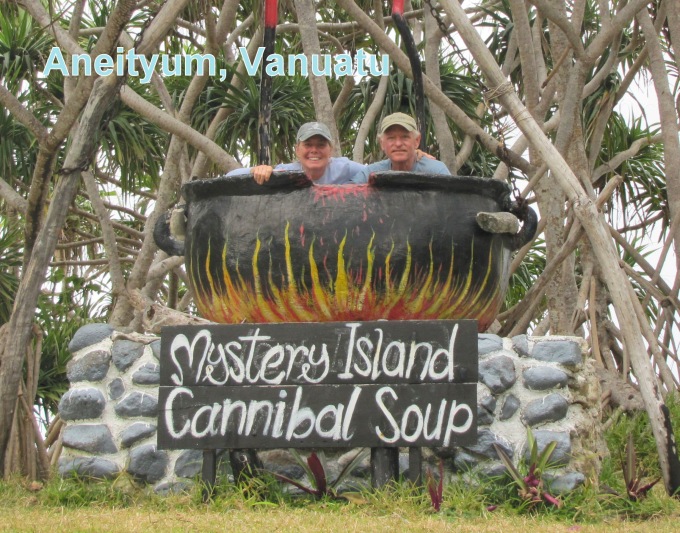
mystery island cannibal soup

I haven't tried any of the recipes yet … maybe this week before we leave. In the meantime, anybody out there have any good, hardy soup and/or curry recipes they'd like to share? Remember I don't eat red meat, but if I can substitute chicken for the meat, send it along. Veggie recipes most welcome.

When Life Hands You Potatoes...

A new foreign boat pulled into the marina and tied up at the end of the next T-dock down from us. We could see their flag flapping in the wind, but couldn't identify it. White, red and blue horizontal stripes … not Dutch … perhaps Eastern European? We had to consult our little flag book before we determined that it was a Russian flag. A couple of days later, the boat pulled into the berth beside us. We were surprised to see the boat's name hand-scrawled (or was that spray paint?) in large red-orange letters on the hull … Berserk. We knew a Berserk from New Zealand, but it had met an unfortunate end in Antarctica … the boat sunk and three of its  five-member crew were lost. How many Berserks could there be? berserk in the next berth

Sure enough, Jarle stopped by and after a few minutes of reminiscing, we determined it was the same guy on a different boat which he'd once again named Berserk. When I think of the word “berserk”, I think frenzied, deranged, going crazy … someone going over the deep edge. Berserk has come to mean this in English, but in actuality the word is borrowed from Norse mythology. It refers to the “berserkers”, Norse warriors who worshiped Odin and fought in a trance-like frenzied rage that some think might have been induced by eating hallucinogenic 'shrooms. These guys wore bear and wolf skins to make themselves even more ferocious looking. The word berserker comes from the Old Norse meaning “bear coat”. Just a little more trivia for you. Moving on … Jarle is Norwegian, though his boat is now Russian-flagged, and considers himself a modern day Viking, perhaps akin to  a berserker.

beserker

Back to the story at hand … I get side-tracked so easily. During the course of conversation, Jarle indicated he was heading back to Norway for several months and asked if we'd like some of Berserk's freshies. Well, sure, we could always use a few extra spuds and onions. He brought two huge, heavy laundry baskets full of potatoes, onions and carrots. As David hoisted them onto the boat, I couldn't imagine where I'd stow them all. Sharing came to mind immediately. Would our cruising friends on Ave del Mar like some? How about the guys working on the dock; they'd probably like some fresh veggies? I went through them all and sorted them, disposing of the soft, squishy, wet ones (ick!). Potato eyes were scattered everywhere in the cockpit. I filled up Cups' hammock and hanging baskets, then took the rest and divided them into bags which we distributed to any willing boat or worker.

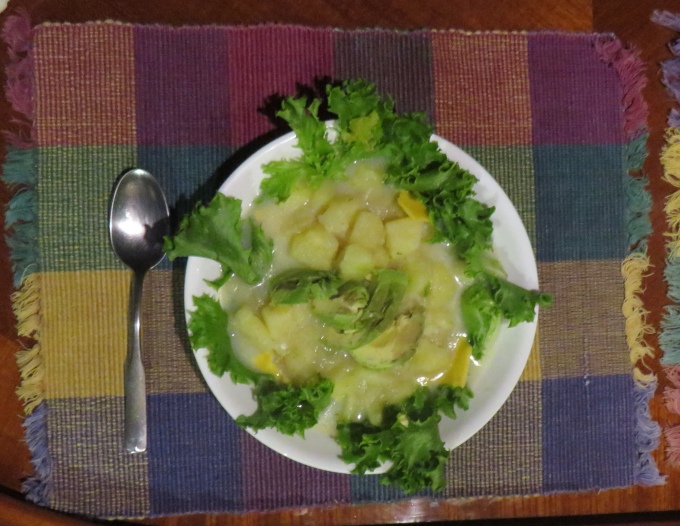
locro

Now … what to do with all those potatoes. The damp ones were peeled and boiled immediately. Some cooked potatoes went into a big potato salad for dinner and the rest can be used for home fries with eggs in the morning. I figured we could have a cottage pie for dinner one night with a mashed potato topper and perhaps I'd make locro, a hardy, delicious potato soup we tasted first in the mountains of Ecuador. I might not use them all, but I'd certainly put a dent in the potato stores over the next week or so. The rest will serve us well on our upcoming sea passage once I figure out a place to stow them.

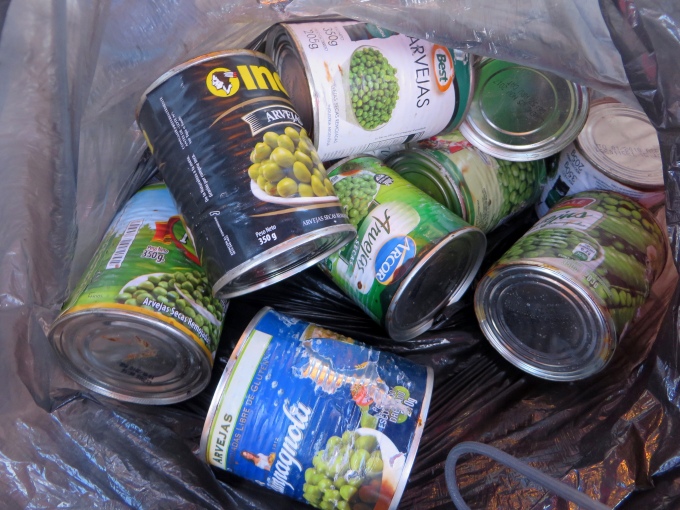
Then Jarle stopped by with a huge plastic trash bag full of tinned green peas. Hmmm … I'm going to have to give this one a bit more thought.

peas peas peas

By the way, here's the recipe for Locro Ecuatoriano (aka Ecuadorian Potato Soup) ... just in case you ever end up with too many potatoes.

recipe for potatoe soup

Locro Ecuatoriano
Cuisine: Ecuadorian
Author: Marcie Connelly Lynn
Serves: 4
Ecuadorian potato soup
Ingredients
  • 1 lb (500g) potatoes, peeled and finely diced
  • 1 large potato, peeled and cubed
  • 2 Tbsp (30ml) oil
  • 1/4c (60g) chopped onion
  • 3/4c (185ml) milk
  • 1 tsp (5ml) salt
  • 1c (250g) cheddar cheese, grated or thin-sliced
  • 1 ripe avocado, peeled and sliced (as garnish)
  • Water
  • Lettuce leaves, washed and dried
Instructions
  1. In a large saucepan, saute the finely diced potatoes with onion in oil, till onion is lightly browned. Add enough water to just cover the potatoes, then one cup more water. Cover and bring to a boil. Stir in the separate cubed potato. Reduce heat and simmer till the potato is tender and the diced potatoes are dissolved. Add milk and salt stirring in one direction until the locro almost boils. Remove from heat.
  2. In advance, line bowls with the lettuce leaves and then add cheese. Ladle the hot soup into the bowls and garnish with sliced avocado and more cheese if you like.
  3. Note: We rarely have fresh lettuce leaf aboard. Though it makes a lovely presentation and it's traditional, we find the soup tastes just fine without the lettuce. It would probably be good without the avocados, too, but we love avos so much, I don't make the soup unless I have them on hand.


It's Time for Chili

white chili graphic As the weather gets chilly, I start looking for recipes that warm us up from the inside out. I have two recipes for chili: a red, chili con carne version (con pollo, in our case) and a white chili that is distinctively different from the traditional. Not only is white chili different, it's particularly easy to put together and for lazy sailors like me, that's a big selling point. It's great when we're in port or when we're at sea. If I'm feeling ambitious, I bake up a batch of corn muffins as an accompaniment.

White Chili a la Nine of Cups
Author: Marcie Connelly Lynn
Serves: Serves 2 Hungry Sailors
Ingredients
  • 1 – 15 oz can corn, undrained (425g)
  • 1 – 15 oz can white beans, undrained (425g)
  • 1 – 6 oz can green chiles (125g)
  • 1 – large onion, coarsely chopped
  • 1 clove garlic, minced
  • 1 lb boneless chicken (500g)
  • 1 Tbsp cooking oil
  • ¼ c lime juice (60 ml)
  • 1 tsp ground cumin (5 gr)*
  • Diced jalapeño peppers to taste
  • Salt and pepper to taste
Instructions
  1. Cook onion and garlic in oil till tender.
  2. Cut chicken into bite-size chunks and cook with onions until done.
  3. Add the canned veggies, liquid and all. Stir.
  4. Add the balance of the ingredients.
  5. Stir and heat to a simmer (about 10 minutes).
  6. Sprinkle with grated Monterrey Jack or cheddar cheese, if desired.
  7. Tastes great with hot corn muffins or tortilla chips.
Notes
Use white corn and white pepper to make really “white” chili, but I rarely have either aboard. For an even easier recipe, used canned chicken. [br]*Cumin is called coriander or dhania in some places.

For the ambitious amongst us, whip up a batch of corn muffins as an accompaniment.

Easy Corn Muffins 1c white flour 1c yellow cornmeal* 3 tsp baking powder ¼ tsp salt 2 Tbsp white sugar 3 Tbsp cooking oil 1 large egg 1c milk

Combine the dry ingredients in a large bowl. In a small bowl, beat the egg lightly, then add the milk and oil. Make a well in the dry ingredients and add the liquids from the small bowl. Mix just until all ingredients are combined. With muffins, it's not necessary to beat the batter like a cake mix. When all dry ingredients are moistened, it's ready for the pan.

Bake in a preheated 400F (200C) oven. For muffins, pour into a prepared muffin tin and bake for about 15 minutes. Let the batter rest and rise for about 5 minutes before popping the pan into the oven.

Notes: *Cornmeal is called polenta in many places such as New Zealand, Australia and South Africa. Don't confuse it with corn flour which is corn starch, a thickener, in the USA.

For a spicy change, add ¼ c of shredded cheddar or Monterrey Jack and/or a 1 tsp (to taste) of minced jalapeños to the batter.

¡Buen Provecho!