Essential Ship's Library - pt. 2

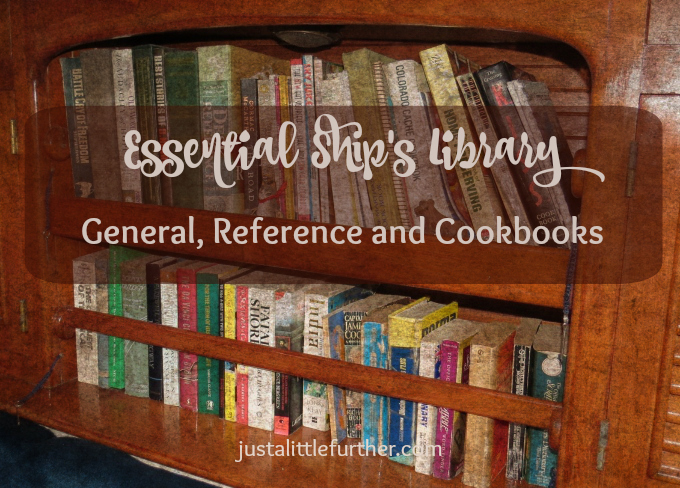
essential ship's library Yes, we still have lots of hard copy books aboard. We've had several comments about it like “Haven't you guys heard about Kindles and e-books?” and “No wonder Nine of Cups is so heavy … it's all books!” Well, yes we've heard of Kindles … we have one although we tend to use our iPads with Kindle and iBook reader applications instead of the Kindle nowadays, instead of investing in backlit Kindles.

There are two reasons for maintaining the hard copy versions of the books we have aboard. First, to replace them all in the Kindle version would be quite costly and second, sometimes we like to be able to open a book to a specific page for easy reference, rather than have a Kindle or iPad in the galley when I'm cooking or the engine room making a repair or the cockpit when we're trying to identify a certain dolphin, for instance.

David maintains the technical and how-to books aboard, of which there are many. My side of the book collection generally includes cookbooks and reference books and a few all-time favorite novels and short story collections. You'll be happy to know, all the regular paperbacks are now gone … donated to yacht club libraries and other cruisers.

I didn't narrow down my list to the top 10. Rather, I listed what I thought are the types of books required with my favorites in each particular category … whether digital or hard copy is your choice.

Cookbooks

Having a general reference cookbook aboard is important, especially one that offers “from scratch” recipes. My three favorite cookbooks of all times are The Cruising K.I.S.S. Cookbook by Corinne Kanter, The Cruising Chef Cookbook by Michael Greenwald and Ball's Complete Book of Home Preserving .

KISS (Keep It Simple System) is a general cookbook with lots of great recipes, handy references, hints and conversions as well as “scratch” and substitution ideas. I've used it for years and continue to refer to it regularly.

Greenwald's The Cruising Chef was the first cookbook I ever bought for the boat. It provides info on the care and handling of veggies and fruits, the preparation of fish and shellfish, sauce ideas and in general, some easy, tasty recipes that I use frequently. It's a gem.

Ball's Complete Book of Home Preserving is my ultimate resource for canning/jarring/ preserving fruits, veggies or meats/poultry.

I have a few others aboard like Martha's Vineyard Cookbook containing good Yankee recipes for this New England girl. I admit to having purchased several cookbooks en route when a particular cuisine, like Ecuadorian, for instance, seemed to offer lots of recipes that we liked. I could probably live without several of them, but I enjoy having them around.

Wildlife

We love to identify the birds, marine life and animals we see and thus have several books aboard. If you have a similar itch to name what you see and learn more about them, then having wildlife reference books are important. We have a few general books like National Audubon Society's Guide to Marine Mammals of the World and Illustrated Encyclopedia of Butterflies and Compendium of Seashells. For birds, I prefer having books more specific to the areas we visit like the Simpson Day Birds of Australia. We sometimes pick up plastic guides to local salt water fish to identify what's good for eating and what's not.

Language

Depending upon where we're heading, I usually have a language book aboard. Spanish for Central and South America, French for French Polynesia, New Caledonia, etc. It always helps to be able to speak at least a few words of the local language. I like having a general dictionary aboard, especially one that provides verb tenses, pronouns, etc. and a general phrase book. Kathy Parsons' Spanish for Cruisers and French for Cruisers are invaluable.

Medical

There are lots of general medical references out there. We picked up Merck Manual of Medical Information and Gill's Onboard Medical Handbook when we first started cruising and still refer to them from time to time, especially for common sailor's ailments like rashes, itchy ears, insect bites, etc.

I'm not sure these are the best references, but every boat should have at least one good reference aboard and the appropriate medical kit to go with it. Getting more information from the locals is always wise, e.g. cigueratera, jellyfish, etc.

Travel

I love Lonely Planet and pick one up for every place we visit. I find them essential when planning our inland travel and sightseeing once we arrive in port. These travel guides also provide all the basics for visiting such as currency, holidays, time zones, customs, as well as history, climate and geography.

I also like the free iPad app, Maps With Me, which allows me to download maps of every country in the world and subsequently use them without internet access.

Lonely Planet

General Reference

Hoyles Rules of Games is indispensable for settling rule arguments at sea, as is a Scrabble dictionary.

A general dictionary and thesaurus are handy references especially for writers and though many are available on-line, it's important to have ones that are available for off-line use while you're at sea. Artha is pretty good, but nothing beats a Websters or an Oxford.

If you're into hobbies or special interests, it makes sense to include them in your library. Especially if you're living aboard, the boat is your home and as such should have room for pleasure books, as well as general reference. Because I sew, I have Jim Grant's Complete Canvasworker's Guide aboard and a book on flags. I also have a book on sketching and watercolors, some photography books and David has one on scrimshaw. Are these books essential? Probably not. Could I live without most of them? Probably. Do I want to live without them aboard? Absolutely not.

Be sure to read David's blog post on his Essential Ship's Library.

This post has affiliate links. If you buy these books or shop for anything on Amazon through these links, it will be no extra cost to you and we will get a small percentage back. Thanks!

Guiana Space Center, Kourou

guiana space center kourou french guiana We visited Kourou briefly on our way to Cayenne, but decided it deserved a bit more exploration on our return trip. It's only about 60 km (36 miles) from Cayenne and lies at the mouth of the Kourou River. Some of our cruiser friends anchored in the river, but admit that Saint-Laurent is a bit easier and more convenient. Driving to Kourou was definitely easier than anchoring in the river and walking.


welcome to kourou

Kourou, too, was originally part of the French penal colony. There's not much left of the prison, mostly ruins. The Dreyfuss Tower remains, a solemn, but dilapidated reminder of years past when semaphore communication was used to communicate with the offshore prison islands. Iles du Salut (Devil's Island) is only 14 km (8 miles) away.

drefus tower french guiana

Kourou isn't known for its prisons, though. It's known nowadays for the Centre Spatial Guayanais, the Guiana Space Center. It's the launch facility for the European Space Agency (ESA), comprised of 10 cooperating European countries. It's also the home of Arianespace SA, a European multinational company founded in 1980 as the world's first commercial launch service provider It's a very active site with a schedule of six launches in 2015. The last was 30 September and the next will be 10 November. If we were staying around, we'd likely attend. They offer a free bus from Saint-Laurent to Kourou to view the launches. It would be great, but as always, there are compromises for sailors. If we delay our departure from French Guiana, we miss visiting Suriname and/or Guyana.

ariane space launch

Free tours are available, but pre-planning is required. We signed up for one, but found it was a three-hour tour and only given in French. Three hours of understanding 50% or less of what was going on added to the broken toe situation didn't make sense. We opted instead to drive around the facility and see what we could see.

kourou_entrance welcome to CSG

CSG (Centre Spatial Guayanais or the Guiana Space Centre) has been in existence since 1968. According to Wiki and the Space Center site, “it is particularly suitable as a location for a spaceport as it fulfills the two major geographical requirements of such a site:

  • it is quite close to the equator, so that the spinning earth can impart some extra velocity to the rockets for free when launched eastward, and
  • it has uninhabited territory (in this case, open sea) to the east, so that lower stages of rockets and debris from launch failures cannot fall on human habitations.”

csg headquarters french guiana

The CSG site continued ...

“Kourou is located approximately 500 kilometres (310 mi) north of the equator, at a latitude of 5°10'. The near-equatorial launch location provides an advantage for launches to low-inclination (or geostationary) Earth orbits compared to launches from space ports at higher latitude. For example, the eastward boost provided by the Earth's rotation is about 463 m/s (1,035 miles per hour) at the Guiana Space Centre versus about 406 m/s (908 miles per hour) at Cape Canaveral/Kennedy Space Center space ports in Florida which are at 28°27′N latitude.The proximity to the equator also makes maneuvering satellites for geosynchronous orbits simpler and less costly.”

There was plenty to see from the car actually. There's an impressive Ariane rocket replica on display next to the CSG headquarters.

replica of ariane rocket

We were surprised at how far we could drive without being stopped. Beyond the CSG headquarters building, we took a perimeter road and drove for several kilometers. We passed the Satellite Prep site and the Meteorological station.

satellite prep site guiana space center

A turn-off and parking area invited us to take a closer look at a recovered booster rocket engine.

used booster rocket guiana space center

When we approached the actual launch site area, however, we weren't surprised when we were very politely denied access. All in all though, a pretty impressive site and no French translation was involved.

French Guiana's Cayenne and Cacao

more cayennd and a little cacao I'd read about the Hmong Sunday market in Cacao on several websites and in Lonely Planet. Cacao is a small Hmong village about 70 km (40 miles) south of Cayenne.

Lonely Planet

The Hmong people are originally from the mountainous regions of China, Vietnam, Laos and Thailand. During the Vietnam War, France and the USA recruited thousands of Hmong people to fight against the North Vietnamese. After the war, Hmong refugees fled and sought political asylum elsewhere. France repatriated several thousand people to French Guiana where their industrious natures and talents have thrived. Not much goes on in French Guiana on Sundays and it seemed a worthwhile trip... so we were off.

welcome to cacao sign

We took the N2 highway, also known at Route de l'Est, heading south and east out of Cayenne. There aren't many major highways in French Guiana... the N1 and the N2. If we followed the N2 to the end, we'd be on the Brazil border. Though we weren't heading all that far, it was still a chance to get into the interior a bit. Several of the roundabouts provided a venue for public statuary which centered more on the AmerIndian tribes, the Wayana and the Wayampi.

amerindian statue in french guiana

Once we left the city limits, the road narrowed significantly and followed the contour of the land up and down (15% grades!) and around hairpin turns. We encountered single lane, wooden plank bridges that clop-clop-clopped as we took our turn to drive across.

narrow plank bridge in french guiana

We reached the turn-off for Cacao, an even narrower road, and were surprised to see several cars making the same turn. When we arrived in Cacao, we were gobsmacked by the amount of cars and people and the gendarmerie (police) directing traffic. There was no room to park closer and we were instructed to park in a gravel lot and walk the 1.5 km (1 mile) into town. Usually this would not have posed a problem, but it seemed I'd broken my toe before we left the boat (while hanging out clothes, no less … don't ask!). David explained the situation to an understanding, English-speaking cop. I showed him my swollen, black and blue toe and he let us pass the barricade into town. We continued wending our way through tiny streets, clogged with haphazardly parked cars and throngs of people. The gods were with us … we found a place to park within a few hundred feet of the main marketplace. Who could have known how popular this place would be?

hmong family in traditional dress french guiana

We headed directly to the market hall for some Soupe Pho. This variation included some coconut milk in the broth and it was even better than the last we'd tried. Slurping, however, seems to be an occupational hazard for eating this soup and it ain't pretty. (Note to self: Never let David hold camera while I'm eating!)

slurping pho in french guiana

Beyond the fruits and veggies, the Hmongs are known for their fine needlework tapestries. Some were large works of art … perhaps recalling scenes from home.

hmong tapestry in french guiana

Some were beautifully intricate geometric patterns in bright colors that boasted hours and hours of concentrated labor.

hmong tapestry french guiana

Other needlework was reverse appliqué, reminiscent of the molas created by the Kuna people in Panama. We looked and pondered whether to buy and in the end, purchased nothing. We have so much aboard already that may never be put to use, we hesitate to purchase more. Photos are the best mementos for sailors, I guess.

hmong reverse applique french guiana

There were also a few pieces of art that we didn't regret leaving behind.

coconut sculptures french guiana

We would have enjoyed exploring the town a bit more, but the crowds kept wandering to a minimum. We returned to Cayenne in mid-afternoon. The city was sleepy...nothing going on at all. All the shops, even the big supermarkets, were closed. All the restaurants were closed, save our hotel restaurant. It was a day of rest for all. Nothing happens on Sundays. We decided it was a good time for a walk. We headed first to the Cathedrale Saint-Sauveur. We were surprised to find it closed and locked up tight.

cathadrale sanit sauveur

We wandered through the Place des Palmistes. There were very few people around. The park was in a sad state. Old, ornate cement planters which lined the paths within the park were empty, chipped and faded. The grass was parched. Park benches needed paint and repair. A monument erected in 1889 commemorated the French Revolution of 1789, but it was hard to read the plaque.

french revolution monument french guiana

A statue of Felix Eboue erected in 1959, honored the first French Guianan-born black to be appointed to a high position in the French government.

felix eboue statue french guiana

Beyond the park, we passed the ruins of an old military installation, now all fenced off. The fencing, however, provided a great canvas for some lively street art which we appreciated.

cayenne street art

From the shore, we could see the muddy water mixing with the Atlantic blue and the grassy peninsula of Pointe des Amandiers not far away.

pointe des amandiers french guiana

Once again, hot and tired, we retreated to the cool respite of our room. All too soon, we'll be sweating and sweltering aboard Nine of Cups, taking advantage of the cool provides as much a pleasure as exploring. We'll head back to Saint-Laurent tomorrow via Kourou and the European Space Center. In the meantime, a cool shower, a cool room and a picnic for dinner. Vacations end all too quickly.

empty wine bottle