A Taste of France in French Guiana

a taste of france in french guiana Beyond the fresh baguettes, croissants, pains au chocolat, and palmiers, there was definitely a lot of France in French Guiana when it came to cuisine, mixed with the local flavor of spice and tropical fruits. We don't frequent restaurants all that often, but eating out is part of the experience, so we felt obligated.

le mombari restaurant

Moules frites is the the national dish of Belgium, but very popular here. We tried it at Le Mombari, a local, popular restaurant in Saint-Laurent and then again while we were in Cayenne. They serve a kilo of mussels in a marmite (black kettle) with a large plate of frites (French fries) on the side. We found a kilo was plenty enough for two to share.

kettle of mussels

The traditional way to enjoy mussels is to use the empty mussel shell from the first one you eat as pincers to extract the subsequent mussels. Served with cold white wine, and French bread to soak up the delicious, creamy broth, it was really a feast for the palate.

using mussel shells as pincers

I checked out several recipes on-line for preparing the mussels. Here's the one I thought most closely resembled what we had.

A Taste of France in French Guiana
Author: Marcie Connelly Lynn
Moules frites is the the national dish of Belgium, but very popular here. We tried it at Le Mombari, a local, popular restaurant in Saint-Laurent and then again while we were in Cayenne.
Ingredients
  • 2 tablespoons (30g) butter
  • 1 shallot, peeled and finely chopped
  • 3 garlic cloves, peeled and finely chopped
  • pinch of salt
  • 1.5 cups (375ml) dry white wine
  • 2 tbsp (8g) fresh parsley
  • 2 pounds (1kg) mussels
  • 1/4c heavy cream
  • Plus 750ml (1 bottle) of chilled, dry white wine … for the cook as she's preparing the meal
Instructions
  1. Cook shallots and garlic in butter till translucent.
  2. Add wine and bring to a boil.
  3. Add cream, salt and parsley and stir gently, then slowly add mussels, stirring gently once again.
  4. Cover and simmer for 5-7 minutes till all mussel shells open.
  5. Serve with bread.
Notes
Fries can be deep-fried or oven-fried and served with mayo.

A couple of other French culinary finds …

Pain perdu – We call it French toast. It's made here with leftover baguettes. Literally, “lost bread” because a day-old baguette is … well, a day-old baguette. It's stale and dry until you dip it in an egg and milk mixture, with a little sugar and nutmeg and fry it up. Oooh, la, la.

Jamais gouté - a fish caught specifically in the Maroni by Amerindian people which translates literally to “never tasted” and unfortunately, we never did get a chance to taste it. Next time maybe?

A Pirogue Trip to Albina

The local mode of transportation here on the muddy brown River Maroni is the pirogue. From the Spanish word piragua (by water), we've seen several different types of pirogues in our tavels. They're basically dugout canoes, but they come in many different varieties. Here they're particularly long and narrow and have humongous outboard engines on them to ply them back and forth across the river. Some of the tourist pirogues for taking daytrips up the river are brightly colored, but the regular ones for heading back and forth are workhorses.

tourist pirogue

We've been looking across the river at Albina, Suriname since we arrived in Saint-Laurent. It's only about 1.5nm across the river, but none of our friends has ventured over there. We were told it wasn't much, although locals go there to shop because the prices are considerably cheaper. There seems to be little issue with Immigration or Customs going back and forth from Suriname to French Guiana as long as you stay within the river towns. So, why not go? A ride in a pirogue plus a peek at Albina.

our pirogue awaits

We walked to the busy pirogue dock and negotiated a price for a one way ride. One was just getting ready to leave and he agreed that €3/pp was fair. I'd say that we “hopped” aboard, but it wasn't quite that easy. The pirogues are long and narrow and thus, quite tippy and unstable. Watching the locals get aboard made it look easy, but we “tourists” were a bit more cautious.

boarding a pirogue

Because it's narrow and low to the water, the inside is quite cramped and close.

inside the pirogue

Soon the colorful foreshore of Albina came clearly into view. The ride across lasted only 10-15 minutes.

colorful albina

Other pirogues zipped behind us, in front of us, beside us. The drivers are quite adept at maneuvering these long, awkward crafts and we managed to get to the other side unscathed. Unloading was less tricky now that we had the hang of it.

offloading the pirogue

Well, the folks who said Albina wasn't much were absolutely right. The town is pretty much only the riverfront wide. There are some houses scattered behind and along the riverfront. There are taxis and a once-a-day bus to Paramaribo, Suriname's capital city, but that's about it. Fuel is considerably cheaper here, so the fuel dock does a brisk business.

pirogues at fuel dock

We found no open restaurants other than a few street food vendors. We wandered along the narrow foreshore walk and found a couple of shops in which to poke around.

albina supermarket

The shops offered grocery items and a myriad of Chinese-imported goods … like Black & Docker (yes, Docker) tools and Galvin Klain jeans and underwear. We did find a local beer, Parbo … cold and refreshing, despite the fact it was only 10:30 AM!

black and docker tools

Finding a ride back was a little trickier, since we wanted to be dropped off at the beach near the dinghy dock. After some negotiation, we agreed upon €15 for all of us. We boarded the pirogue, Pasensi Lobi (Translation: Hot Love), and took off in a flash with the driver's brother at the bow providing slight hand movements to the helmsman to negotiate our path. He evidently needed to make a quick stop at another dock. We sped at full throttle under a low bridge which we thought might have knocked his brother's block off, but our bowman gracefully ducked just in time and was no shorter on the other side of the bridge.

approaching the bridge in a pirogue

While we waited at the other dock, we got the chance to view life on the foreshore from a slightly different perspective. People came and went with their purchases … just another day in Albina.

local folk of albina

We finally got under way again and sped across the river. As we landed at the beach, new fare negotiations began. It seems that the driver had mistakenly quoted us the wrong price. It should have been €20. In all fairness, we had been told the fare was €5/pp to our beach. We smiled, gave him his €20, shook hands and said adieu. After all, the best parts of the trip were the pirogue rides!

Check out a short video on our pirogue trip across the muddy Maroni to Albina.

Essential Ship's Library - pt. 2

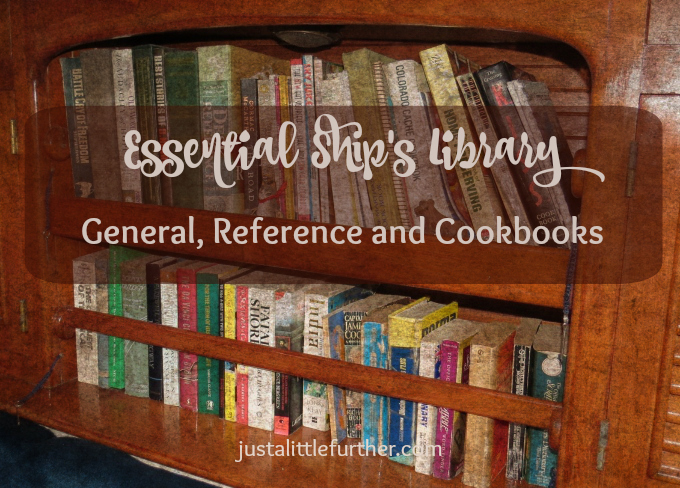
essential ship's library Yes, we still have lots of hard copy books aboard. We've had several comments about it like “Haven't you guys heard about Kindles and e-books?” and “No wonder Nine of Cups is so heavy … it's all books!” Well, yes we've heard of Kindles … we have one although we tend to use our iPads with Kindle and iBook reader applications instead of the Kindle nowadays, instead of investing in backlit Kindles.

There are two reasons for maintaining the hard copy versions of the books we have aboard. First, to replace them all in the Kindle version would be quite costly and second, sometimes we like to be able to open a book to a specific page for easy reference, rather than have a Kindle or iPad in the galley when I'm cooking or the engine room making a repair or the cockpit when we're trying to identify a certain dolphin, for instance.

David maintains the technical and how-to books aboard, of which there are many. My side of the book collection generally includes cookbooks and reference books and a few all-time favorite novels and short story collections. You'll be happy to know, all the regular paperbacks are now gone … donated to yacht club libraries and other cruisers.

I didn't narrow down my list to the top 10. Rather, I listed what I thought are the types of books required with my favorites in each particular category … whether digital or hard copy is your choice.

Cookbooks

Having a general reference cookbook aboard is important, especially one that offers “from scratch” recipes. My three favorite cookbooks of all times are The Cruising K.I.S.S. Cookbook by Corinne Kanter, The Cruising Chef Cookbook by Michael Greenwald and Ball's Complete Book of Home Preserving .

KISS (Keep It Simple System) is a general cookbook with lots of great recipes, handy references, hints and conversions as well as “scratch” and substitution ideas. I've used it for years and continue to refer to it regularly.

Greenwald's The Cruising Chef was the first cookbook I ever bought for the boat. It provides info on the care and handling of veggies and fruits, the preparation of fish and shellfish, sauce ideas and in general, some easy, tasty recipes that I use frequently. It's a gem.

Ball's Complete Book of Home Preserving is my ultimate resource for canning/jarring/ preserving fruits, veggies or meats/poultry.

I have a few others aboard like Martha's Vineyard Cookbook containing good Yankee recipes for this New England girl. I admit to having purchased several cookbooks en route when a particular cuisine, like Ecuadorian, for instance, seemed to offer lots of recipes that we liked. I could probably live without several of them, but I enjoy having them around.

Wildlife

We love to identify the birds, marine life and animals we see and thus have several books aboard. If you have a similar itch to name what you see and learn more about them, then having wildlife reference books are important. We have a few general books like National Audubon Society's Guide to Marine Mammals of the World and Illustrated Encyclopedia of Butterflies and Compendium of Seashells. For birds, I prefer having books more specific to the areas we visit like the Simpson Day Birds of Australia. We sometimes pick up plastic guides to local salt water fish to identify what's good for eating and what's not.

Language

Depending upon where we're heading, I usually have a language book aboard. Spanish for Central and South America, French for French Polynesia, New Caledonia, etc. It always helps to be able to speak at least a few words of the local language. I like having a general dictionary aboard, especially one that provides verb tenses, pronouns, etc. and a general phrase book. Kathy Parsons' Spanish for Cruisers and French for Cruisers are invaluable.

Medical

There are lots of general medical references out there. We picked up Merck Manual of Medical Information and Gill's Onboard Medical Handbook when we first started cruising and still refer to them from time to time, especially for common sailor's ailments like rashes, itchy ears, insect bites, etc.

I'm not sure these are the best references, but every boat should have at least one good reference aboard and the appropriate medical kit to go with it. Getting more information from the locals is always wise, e.g. cigueratera, jellyfish, etc.

Travel

I love Lonely Planet and pick one up for every place we visit. I find them essential when planning our inland travel and sightseeing once we arrive in port. These travel guides also provide all the basics for visiting such as currency, holidays, time zones, customs, as well as history, climate and geography.

I also like the free iPad app, Maps With Me, which allows me to download maps of every country in the world and subsequently use them without internet access.

Lonely Planet

General Reference

Hoyles Rules of Games is indispensable for settling rule arguments at sea, as is a Scrabble dictionary.

A general dictionary and thesaurus are handy references especially for writers and though many are available on-line, it's important to have ones that are available for off-line use while you're at sea. Artha is pretty good, but nothing beats a Websters or an Oxford.

If you're into hobbies or special interests, it makes sense to include them in your library. Especially if you're living aboard, the boat is your home and as such should have room for pleasure books, as well as general reference. Because I sew, I have Jim Grant's Complete Canvasworker's Guide aboard and a book on flags. I also have a book on sketching and watercolors, some photography books and David has one on scrimshaw. Are these books essential? Probably not. Could I live without most of them? Probably. Do I want to live without them aboard? Absolutely not.

Be sure to read David's blog post on his Essential Ship's Library.

This post has affiliate links. If you buy these books or shop for anything on Amazon through these links, it will be no extra cost to you and we will get a small percentage back. Thanks!