Statuary and Street Art in Paramaribo

As usual, one of the best parts of exploring a new city is wandering, sometimes aimlessly, to see what we can see. There is no dearth of statuary in Paramaribo. There seem to be monuments and statues at each little square spread throughout the town, however many times the plaques are missing or weathered beyond legibility. We enjoyed the walk and did our best to identify what we could. mama sranan statue

This bronze statue of three girls was in a tiny square on our walk into town each day. It had no plaque or description, but I learned later that it was a “gratitude gift” from the Netherlands to thank the Surinamese for their help during WWII.

thanks from the netherlands statue

We had to walk out of our way to find this aluminum sculpture representing the first two Indian indentured laborers who immigrated to Suriname and arrived aboard the Lalla Rookh in June 1873. Located in a beautifully kept little park, this statue is dedicated to the 34,000+ Hindustanis who made the voyage between 1873 and 1916 and the heritage and culture they built over the years for their Surinamese descendants.

baba en mai

Mahatma Gandhi, a little, unassuming fellow, stands tall and proud near the Central Market area.

ghandi

I ♥ SU – Found this not far from Fort Zeelandia. No info was provided, but the artwork says it all.

i heart su

The plaque was missing, but info on the Internet indicates that this sculpture situated in the middle of a non-functioning fountain was to commemorate Surinamese independence in 1975. Note the carillon in the background.

independence statue

This obelisk, its top atilt, sits in a dominant location on the foreshore, but I could find no information about it, its significance or its creator.

obelisk

My favorite statue was Kwakoe breaking away from his chains and symbolizing the end of slavery in Suriname in 1863. He was located in a small, very busy square not far from our hotel. Unfortunately, someone walked off with the sculpted bronze broken chains that once dangled from his wrist manacles. One reference to this statue indicates it is called Keti Kati (Chains are cut).

kwakoe

Queen Wilhelmina, Queen of the Netherlands 1898-1923, stands regally outside the walls of Fort Zeelandia overlooking the Suriname River.

queen wilhelmina

A tribute to Johannes Helstone, Surinamese-born pianist and composer was quite impressive, but sadly defaced.

johannes helstone monument

We ignored most of the politicians' statues, except for the rotund figure of Johan Pengel, Minister-President from 1963-1969, standing portly in Independence Square. How can you neglect a bronze belly like that?

pengel

There was not as much street art as I would have imagined. Perhaps, we looked in the wrong places. We liked what we saw though.

street art

Today's Dutch word – standbeeld – statue

Tomorrow … we're checking out Parbo's many houses of worship … mosques, temples, synagogues, cathedrals. Dress appropriately and put on your walking shoes.

Paramaribo - Suriname's Big Smoke

paramaribo surinames big smoke Paramaribo (Pah-ra-MAHR-ree-bo), Suriname's capital city, is only 10 nm down the river from us, but by bus … it's a 1.5 hour circuitous ride on a very limited two bus/day schedule. Through the marina, we hired a car from a local fellow … €10/day, unlimited mileage … and off we headed in an old Toyota towards the country's big smoke. The locals call it Parbo ... just like the beer. It seems the best view of the city's foreshore was from Nine of Cups as we sailed past a few days before.


paramaribo foreshore view

Paramaribo, probably a corruption of the AmerIndian village name of Parmirbo, was originally settled by the Dutch as a trading post in 1613. It fell into English hands when the Dutch abandoned it and the British built a fort on the site called Fort Willoughby. In 1667, Suriname was given back to the Dutch in the Treaty of Breda. They renamed it Fort Zeelandia, as it is today, and renamed the city New Middelburg (evidently that name never caught on). Paramaribo grew after the abolition of slavery in 1863, attracting many former slaves to the city.

Our first stop was Tourist Info housed in an historic building and located near Fort Zeelandia. For some reason, tourist info is only open Monday-Friday 0900-1530. (Heaven forbid, it would be open on the weekends when people had time off and wanted to get info.) The women were pleasant enough, but had very little information available … a city map, but no country map, and a few commercial brochures for restaurants, hotels and tours.

paramaribo tourist info office

We decided Fort Zeelandia would be our first stop since it was close by and also had limited hours. On the way to the fort, we walked along a shady, tree-lined street past homes that were the residences of former military officers.
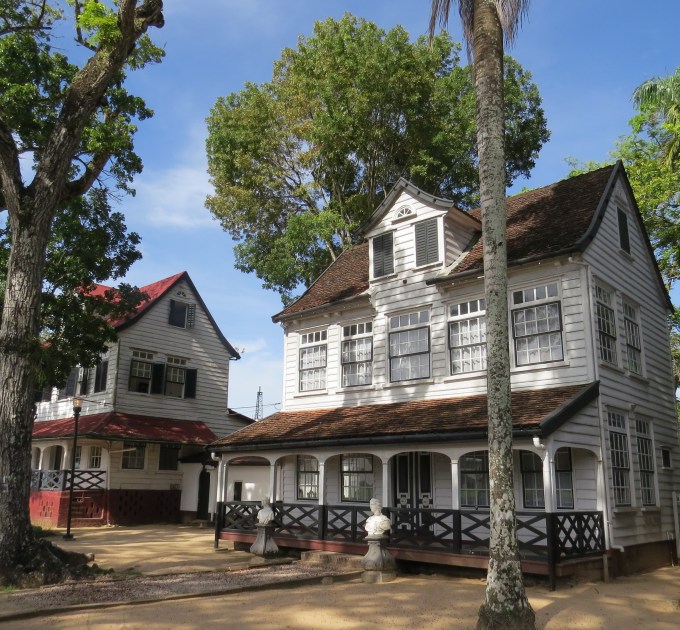
paramaribo dutch colonial houses

We paid our admission fee (SR$20/pp) and entered the fort which also houses the Surinaams Museum. The fort, “the oldest monumental building in Parmaribo”, has been carefully restored and its brick walls and bastions have historically been the hub of this UNESCO World Heritage city.
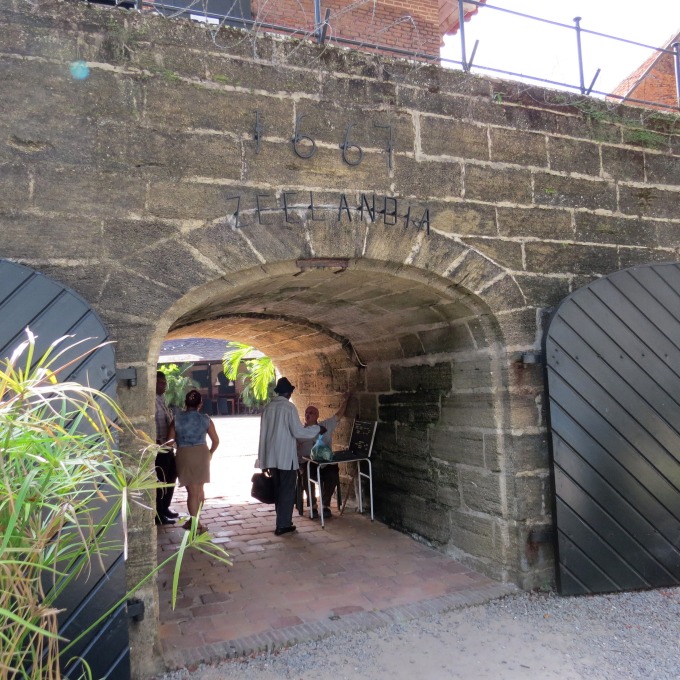
fort zeelandia paramaribo

The fort's many rooms have been converted into the Surinaams Museum, a rather eclectic mix of Suriname history and culture. A wide open courtyard greeted us on the other side of the short entrance tunnel. A pleasant little cafe, Baka Foto, provided us with our first coffee of the day.

fort zeelandia courtyard paramaribo

One room was dedicated to the “apotheek”, an old Dutch pharmacy displaying lots of apothecary jars, bottles and pharmaceutical miscellany. All the signs were in Dutch, but we got the gist of the display.

fort zeelandia apotheek paramaribo

The fort is not very large and never really fulfilled its mission as a fortress. It was too easy to sack … a French pirate, Jacques Cassard, proved the point in 1712 when he plundered the city. We climbed the stairs to the second story and admired the view and the breeze of the Suriname River from the bastions. AmerIndian and Maroon artifacts and handiwork were displayed in several rooms there.
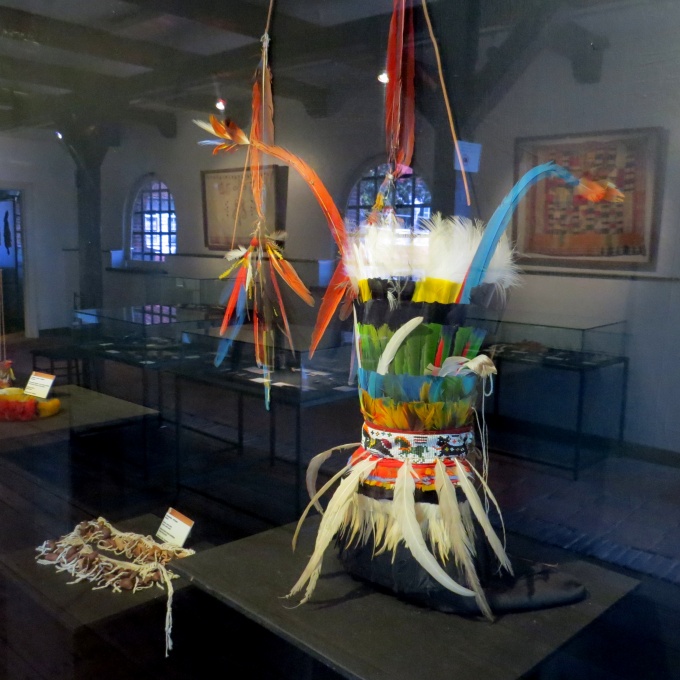
maroon aritfacts fort zeelandia paramaribo

Beyond its role as a fortress, the fort has operated as the site for criminal and slave punishment including hangings. For nearly a century (1872 to 1967), it was used a prison known as “Gebouw” (Devil). It was converted into a museum in 1972, but taken over by a military regime in 1982 until 1994 when it was converted again into a museum. What we missed because of our lack of Dutch language skills, was the sign on the Bastion Verre. A fellow museum visitor, a Dutchman, asked if we'd seen “it”, the site of the Decembermoorden (December murders) that took place December 8, 1982. He led us back to the spot and reiterated the story of 15 prominent men who were tortured and killed on this spot because they criticized the current government. Bullet holes in the wall attest to their fate. According to their website, “The events remain controversial today, as the exact circumstances are still unclear, but the current president of Suriname is the main suspect.”
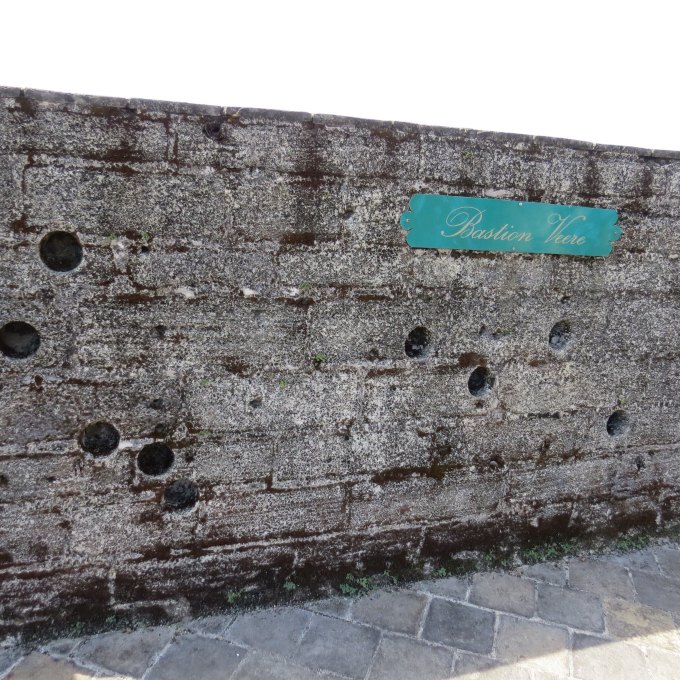
bullet holes fort zeelandia paramaribo

Climbing to a dusty, stuffy, hot attic area, we found information on Suriname's independence in 1975, as well as small displays on the influences of different immigrant groups especially Indian, Chinese and Indonesian. The fort and museum were a good introduction to Suriname and the city.

asian artifacts

It was time for lunch and we were hankering for a roti, those delightful Indian creations of curry wrapped in flatbread … kind of like an Indian burrito. We found a roti shop (they're everywhere) and indulged ourselves. We washed them down with a djogo of cold Parbo, the national beer and then got under way again.

parbo beer in suriname

Back on our walking tour track, we walked past the Presidential Palace, a pretty impressive place opposite Onafhankelijkheidsplein (say that three times fast … actually, say it just once if you can) aka Independence Square.
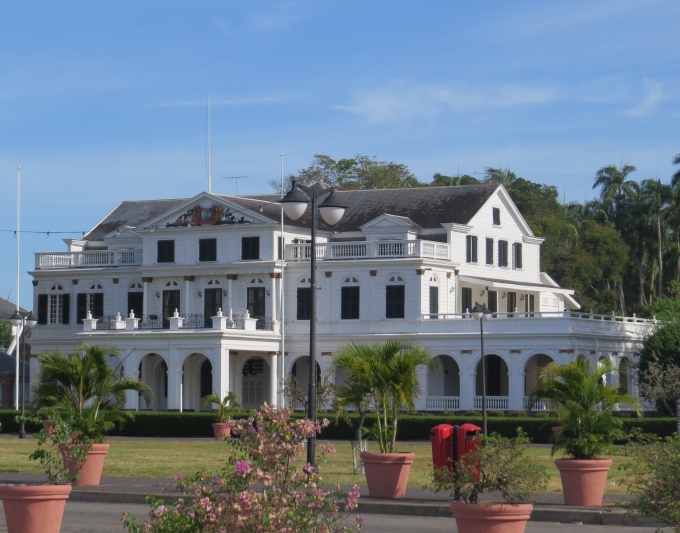
suriname presidential palace

The Ministry of Finance building incorporated the clock tower we'd seen when we'd sailed past. We noted on closer inspection that the clock was about 40 minutes fast.

ministry of finance suriname

The Palmentuin (Palm Tree Garden), just behind the Presidential Palace, is Parmaribo's only public park. Originally a 17th century vegetable garden, the 10-acre in-city park is home to about 1,000 palm trees, providing shade along its meandering paths.

palmentium paramaribo

We headed to the Waterkant (waterside), the road along the foreshore, where many of the historic wooden mansions stand. The designs are clearly inspired by Dutch architecture of the time, but we're told “incorporate a range of indigenous techniques and local materials.” Painted a crisp black and white, the Dutch style was evident in its eight-over-eight windows, dormers, shutters and decorative embellishments, reminiscent of houses we'd seen in South Africa not so long ago. Most of the current mansions originate from the first half of the 19th century however, as they had to be rebuilt after large city fires in 1821 and 1832. We walked up Mr. Lim A Postraat (Lim A Po Street) for more of the same.

waterkant houses in paramaribo

There are probably more dilapidated historic buildings than there are restored ones. Many of the wooden houses are in dire need of restoration, to the point where UNESCO has urged the government to address the problem with threats of revoking the city's world heritage status. Remarkably, despite the decrepit look of the houses, many still appeared to be occupied.

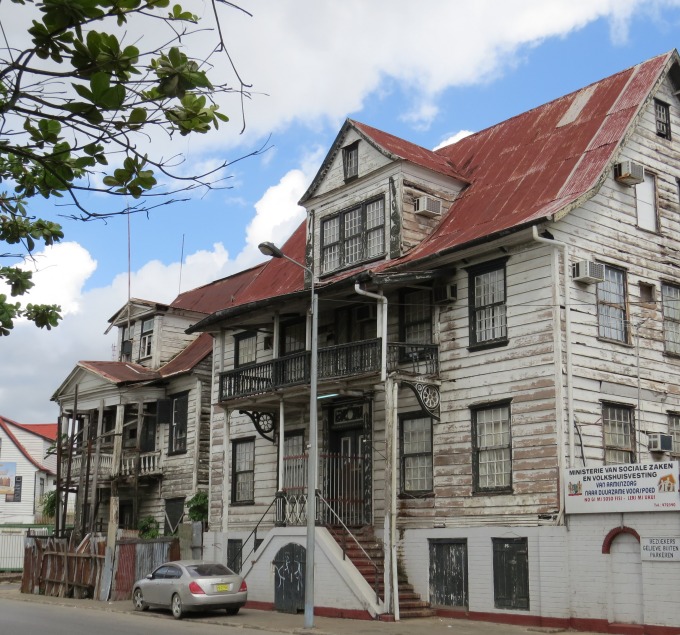
dilapidated house in paramaribo


another dilapidated house in paramaribo

Enough walking for the day, we headed to our hotel for the evening...the Hotel Paramuru. After my success in Cayenne scoring a beautiful suite at the Hotel Palmistes, I was hoping to continue my winning streak in Paramaribo. I was able to book the penthouse at a weekend rate of $50US per day. The website pics looked great. The description was awesome. The reality … a bit disappointing. The elevator ran to the third floor and we lugged our luggage up a rickety metal/wood spiral staircase to reach the “penthouse”. The bath was a shower/toilet/sink only with much to be desired. The bed was lumpy, the pillows thin and the bed linen … well, let's just say, it wasn't quite what we expected. But you know what? It really didn't matter. It had A/C that worked, the shower had hot/cold water and there was a little fridge that managed to keep our Sauvignon Blanc cold. We were together exploring Paramaribo, Suriname. Really … who can complain?

paramuru hotel paramaribo

Today's Dutch word “djogo” -jug, in this case a liter bottle of Parbo beer.

djogo

More Parbo exploring tomorrow.

Book a trip to Paramaribo, Suriname...or anywhere you want! Find the best deals here:

New River, New Country, Same Old Chores

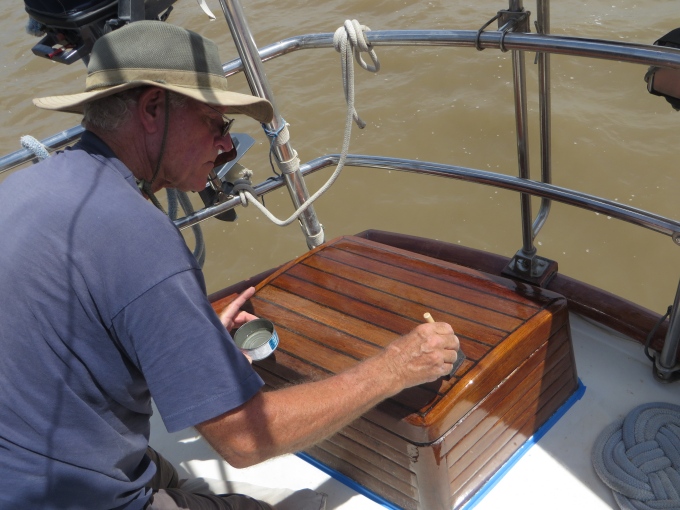
One of the inescapable parts of the liveaboard cruising/travel life is chores. I guess it's not much different than living in a house … except we float (usually in salt water), things vibrate and shake a lot (and we're not talking earthquakes) and we're solely responsible for fixing/maintaining it all ourselves. No local handyman to call; no quick trip to the local Home Depot. Yes, we could wait till we were in a marina and hire all the jobs out … sometimes we do, but rarely. Our budget doesn't support it, plus it's always better to do things yourself. The to-do list in Suriname includes varnishing. David had started it in French Guiana, but he was far from finished. Varnishing, in and of itself, isn't all that bad. It's the prep work involved that takes up the time. First, we must remove everything obstructing the work area. In this case, David is working on the eyebrow, the port cap rail and the teak boxes on the aft deck. (He tells everyone that's where we hide our doubloons.) All the fuel cans and the fender boards on the port side need to be removed and stowed somewhere else on deck. Hardware needs to be removed and hopefully put in a place where we'll find again. (No worries, we have a system … that usually works.) Sheets and lines need to be coiled up out of the way. Then comes the sanding … a mindless, hand-wrenching, skin-abrading task that takes forever and, if not done properly, screws up the whole varnishing job.

david sanding

There's the careful masking of all areas to be varnished, then a wipe-down of the teak with acetone and finally … the first coat of varnish or in this case, Uroxsys, can be applied. Depending on the product and directions, a second coat may be applied without more sanding … or not. By the third or fourth coat, light sanding is always required once again … and then at least one more sanding before the final coat. Then, of course, when the varnishing is done, the masking tape and any sticky residue must be carefully removed and all the hardware, fender boards, fuel cans, etc., must be re-stowed and lashed. This whole process takes days, not hours and it's particularly tedious. (Note to selves … next boat should have less teak...and stainless)

david varnishing

Okay, so you've listened to me whinge about varnishing for a few paragraphs. What else? The decks are filthy and I've been scrubbing them in sections, careful to avoid the newly varnished areas. There's still laundry to be done everyday. The marina has one washer ashore, but the cost is high (US$6/wash-no dryer), so I've been doing it by hand which means lugging fresh water to the boat. There's a fresh water tap on the dinghy dock though which is a bit easier than toting those full water jugs for two blocks in Saint-Laurent.

filling water jugs

There's the usual sweeping, cleaning, dusting, washing, meal prep, cooking and clean-up required midst the rest of the chores we need to tackle. There's free wifi here at Marina Suriname, but alas, the signal is not strong enough to reach the boat even with our super duper antenna, which means we have to tote the laptop to shore each day. All in all, we're keeping busy. Please note that though all the photos show the Captain working, the First Mate, does, on rare occasion, pitch in and do her share.

Forgive me if I sound like a broken record when it comes to doing chores. The only reason I provide the chore routine regularly and in detail is because that's the way it really is. We'd hate you to think that we sail along, get into a port, plan our inland touring, have fun, and then move on. It's never that way … never. Living on a boat is about compromise and hard work. It's about keeping up with repairs and maintenance. It's about working in the hot sun or with your head in the engine room or the bilge when you don't really feel like it, so that the boat is always shipshape… so you can find time to go exploring another day. That's the reward.

We've worked hard since we arrived and you guessed it … time for a road trip to see some of Suriname. Maybe this weekend?