
Bird Singing - Parbo's Unusual Pastime

It's early... just before 7am on Sunday morning and the coolest it will be all day in Paramaribo. Church bells chime in the distance. The grass on Independence Square glistens, still wet with dew. The Presidential Palace and the clock tower of the Ministry of Finance building stand as prominent sentries overlooking the park. Men begin arriving on foot, in cars, trucks, SUVs, vans, HumVees, motorcycles, and mopeds. They're well-dressed businessmen in casual clothes or burly, tough-looking guys with scruffy t-shirts and their baseball hats on backwards or just regular looking fellows … all with one thing in common … they're all carrying little birds in cages. We rose extra early to be here to witness Paramaribo's most unusual pastime … a bird singing competition. bird singing in paramaribo

We'd noticed that men regularly walk around with their caged birds. Bird cages frequently hang outside shops and a birdseed stall was always busy in the fresh market. We didn't realize it was quite as competitive as it is. We were unable to ascertain the origins of the bird-singing competition or why it has become so popular in Suriname. Some say it was brought to Suriname in the early 20th century by Chinese immigrants; others say it comes from the jungle. We were told that similar competitions occur in Belgium. The formal contests here were established in the 1950s. There is now a league of 17 bird-singing clubs in the Paramaribo area and they all compete regularly.

bird cage in paramaribo

This is a man's sport; few women participate. In some places, guys get up early to go fishing or to play golf. Here in Paramaribo, they display their birds and coax them to sing. We'd read about the competitions, but found it hard to gather specific information. After milling around a bit and asking questions of other onlookers, we found out that today was not an actual competition. It was a training session, but we were content to watch anyway.
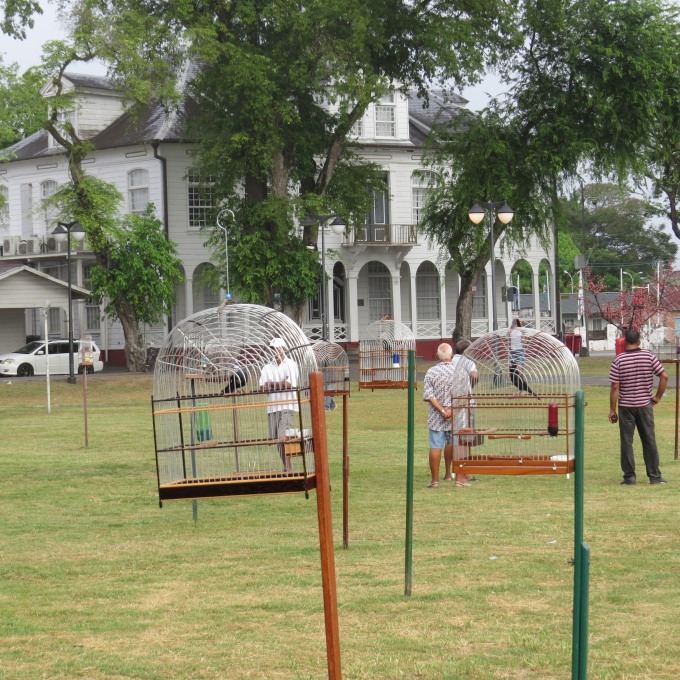
birdsinging in paramaribo

Men of the Suriname Whistling Birds' League greeted each other cordially as they walked onto the green and chose places to stick in stakes that would support the bird cages. Some men had one bird; others had two or three. They hung the cages near other birds and the birdsong became increasingly louder. It's a territorial thing. Sometimes they use a favorite female to get the males in the mood.

encouraging birds to sing in paramaribo

Have a listen...

Though it wasn't a competition day, I researched what a contest entailed. It involves birds competing in pairs to see which can sing the most melodies in 15 minutes. A "melody" is a sequence that includes at least two tones. Two bird cages are placed 18” apart in the middle of the green. Next to each cage stands a referee at a chalkboard . The clock starts and the referees lean in to concentrate on the birds' songs. What sounds to the untrained ear like twittering is in actuality, a series of well-defined songs. Every few seconds a stroke is added to the tally as each referee identifies a melody. In an average round, we're told a good bird will sing between 100 to 115 melodies.

keeping score

Most of the birds come from the rain forests, purchased from AmerIndians or captured by the trainers themselves. The competing birds are all male. Their owners work diligently to teach them new, complex songs. Teaching is done by whistling new songs to the birds, an arduous process that requires at least two hours of daily effort.. The owners constantly play CDs for their songbirds to aid in the learning process. The tiny black picolet or the twatwa, a canary-size brown bird, are typical choices and they can be sold for as much as $3,000 each.

twatwa bird in paramaribo

After an hour or so, the men collected their birds and began to wander off. We went searching for a cup of coffee. Enough excitement for a Sunday morning in Paramaribo.

Dutch word for the day – vogelgezang – birdsong

Celebrating Birthdays and Fine Dining

This is my (Marcie) birthday month. Yes, I'm a Scorpio and proud of it, though obviously I had little to do with it. Unlike many people who shun birthdays, I love mine...not the aging part, just the celebrating part. In fact, I enjoy it so much, I celebrate for the entire month. David's a good sport about it and calls it Marcie's birthday season. Each time we head out in November to explore, we count it as part of my birthday celebration. A weekend in Parbo? Yup, part of my birthday. Walking tours, zoos, butterfly parks … definitely part of the birthday package. Gifts, birthday cakes and candles? Not so much. Well … maybe a few gifts. birthday cake gif

It's a fine time for culinary exploration. We've been eating out at roti shacks and warungs (Javanese food stalls). We've had our fill of curries and nasi and bami for the time being. After all, at some point during this month, I felt entitled to a grand birthday dinner. A bit of research and we settled on The Garden of Eden, a highly rated Thai restaurant.

garden of eden restaurant

From the moment we walked in, I could tell it was going to be a fabulous evening. We were all “duded-up” or at least as finely dressed as possible considering our sketchy wardrobes. We were greeted at the door and seated outside at a table with an umbrella. Tiki torches burned. The ground was covered in white sand. Thatched cabanas offered private seating areas. Flowering trees, shrubs and plants bloomed. Bamboo and palm trees formed a pleasant, airy canopy overhead.

garden of eden restaurant suriname

A hint of jasmine mingled with delicious food smells emanating from the open air kitchen. It really couldn't have been more lovely or romantic.

garden of eden open air kitchen

It was one of those evenings when everything meshed. Our server, Elliot, was attentive, but not obtrusive. Chilled water with an herb sprig came first. We ordered cocktails. I had a pina colada made with local coconut, pineapple and Borgoe rum. David tried a Hazelnut Absolut martini … served chilled with whole hazelnuts and described on the menu “like angels pissing on your tongue”. How could he pass up that description? It was so good, he ordered a second.

garden of eden drink menu

There were so many fine little details of the restaurant and the service that added to the overall ambiance. The menus, displayed in three languages, were inserted in rattan folders with a fan inside each one. Rattan napkin rings encircled red linen napkins. Fresh flowers adorned the cocktails and the meals.

rattan menus at garden of eden restaurant

We ordered different menu items to share. An appetizer of Thai Sate Gai (chicken in a spicy peanut sauce) and Tom Kha Gai soup (chicken and vegetables in a tangy, rich coconut milk broth). David tried Homak Pla (sea bass in red curry wrapped in banana leaves) and I tried Yam Sam Krob which they described in English as “inkfish” with mango and roasted peanuts. It was, of course, squid, i.e. calamari and it was fantastic. All served with jasmine rice. We ate and sampled each other's dishes until we could eat no more. Doggy bags, please … a Thai breakfast for tomorrow morning? We lingered and savored the evening.

dinner at the garden of eden

A ginger flower was my parting gift.

garden of eden ginger flower

The only negative? The lighting was so dim, David couldn't count out our taxi fare. He had to rely on a torch at the exit.

counting fare by torchlight

All in all, a wonderful birthday dinner. But, of course, there's more to come. It's only mid-November … another half month to celebrate … and then there's Christmas.

Dutch word for the day – verjaardag – birthday

Moored in the Suriname River

Once again, we're up a muddy, brown river hanging on a mooring, watching the tide do its thing with great enthusiasm as we tackle our chore list. Each river seems to have its own unique feel. Though the river here is narrower than our anchorage on the Maroni, it seems calmer and a bit less turbulent even at the height of the flood tide. The breeze is certainly better here. It's cooler… no Edith Cavell wreck to block the wind. The wind gen and solar panels are always churning out power. We've had no need to start the engine since we arrived. sunrise on the suriname river

Not far from us on shore is a busy water taxi stand. From dawn till dusk, folks are ferried up and down the river regularly to little AmerIndian villages along the riverside. They look similar to the dugout canoes called pirogues in French Guiana. The prows are different. I asked if they were called pirogues here as well, and they're not. “So what then?”, I queried. “They call them boats”, was the response. I found out later that the AmerIndians call them corials or korjaal.

suriname river taxi stand

It's not nearly as busy here as St. Laurent though and the mornings are typically calm and quiet. Sometimes on the weekends, there are fancier, two-decker corials that bring tourists up the river for a tour.

suriname river tourist boat

The boats typically stop at the little Domburg dock for a quick look-around and snack at the Javanese warungs (food stalls) in the little square next to the marina restaurant. Quiet during the week, the place is jumping with tourists and local families on the weekends.

domburg square on the suriname river

We usually head into the little marina restaurant, the River Breeze, twice a day. In the morning, it's a quick check on the Internet for e-mails and posting the blog. In the early evenings, after the workday is finished, we return for showers, more Internet, a shared djogo of cold Parbo beer and a get-together with other cruisers. Currently, there are Canadians, Brazilians, Argentinians, Austrians, Italians and Germans here plus an American family from Seattle that just arrived from Brazil this morning.

river breeze restaurant on the suriname river

In the early mornings, it's been very foggy … the pea soup variety. We can sometimes hear the leonine roars of the howler monkeys in the jungle in competition with dogs barking on shore. Kiskadees still provide the key melody to morning bird song. Tiny welcome swallows flit around and frequently land on our solar panels or lifelines. At night, when the birds sleep, we hear the flutter and whoosh of bat's wings. A bat flew in through the forward hatch the other night, giving us an adrenaline rush. We could feel him and hear him more than actually see him. He was like a wraith as he whizzed back and forth and finally, thank goodness, found his way out through the aft hatch. We thought this was very unusual, but talking with other yachties, it happens quite frequently here.

Thanks to the bats, there are amazingly few bugs or mosquitoes around. We see butterflies and bees during the day that check out the boat before continuing on their way up the river, but that's about it. The only nuisance is the disturbingly loud drone of jet-skis that come out in swarms on the weekends, churning up the river water as they race around the moored boats.

jetskis on the suriname river

Logs and debris float by regularly with the turn of the tide. We're told that folks clearing land up river, dump all the tree trunks and cleared shrubs into the river, so they don't have to cart it away. One sailboat anchored near us was unable to raise his anchor when it came time to move. Closer inspection indicated about 50 meters of anchor chain wrapped around a huge, water-sodden log. It took the crew the better part of two days to unravel the mess and break free.

anchor chain around a log

We watched a good-sized powerboat sink near shore over several days with apparently no intervention by locals or the owner. We noted that his stern seemed to be particularly low in the water one evening … perhaps his stern line was too tight? The next morning only his bow remained above water. We reported it at the marina, but after two days, still no action was taken. Some fellows took a look at it, but we think they're perplexed as to what to do. They have limited funds and limited equipment with which to work.

sinking boat on the suriname river

We're trying to finish up chores in order to get on with our passage through the Guianas and then on to Trinidad for a haul-out. David sands or varnishes whenever possible. It's so dewy in the mornings, it's hard to get an early start and it appears the rainy season has begun. After a couple of days of dry weather when we first arrived, we now have showers and heavy downpours nearly every afternoon making varnishing a challenge. It might have to wait. There's plenty more to do, however. He's replaced the cockpit GPS with a spare. The whisker pole track and a new solenoid switch for the stove are still on the “to-do” list. And, of course, there's more to see in Suriname before we depart. Never enough time!

Today's Dutch word – ankerplaats - anchorage