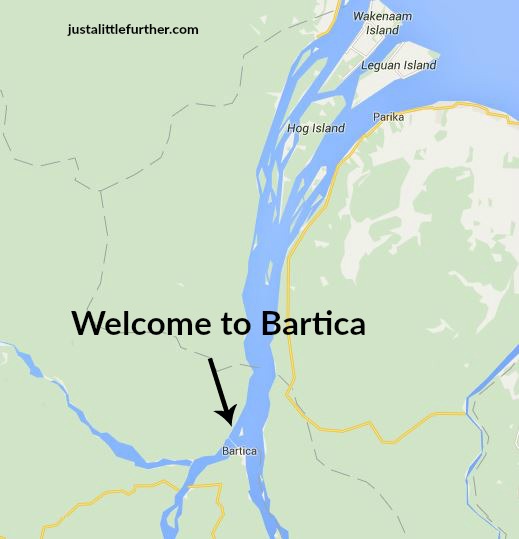
Welcome to Bartica

Bartica, (pronounced BAHR-ti-kah), a small port town of ~15,000+ people, is located on the Essequibo River, at the confluence of the Cuyuni and Marzaruni Rivers, about 50 miles upriver from the Atlantic. It's called the “Gateway to the Interior” as it's the key jumping off spot for freelance miners, known as pork knockers, that scour the alluvial fields of Guyana's interior for gold and diamonds. More about pork knockers later. welcome to bartica
We arrived just before Noon, launched the dinghy, and after feeling comfortable with our anchorage and holding, headed into town to check-in. We dinghied up and down the wharf to determine a place to tie up. No place was immediately evident. At the fast ferry dock, we asked and were pointed upriver to a raft of boats tied aft and stern not far away.

view of wharf from the dinghy

We nudged our way between the nestled boats up to a ramshackle hut with a wooden loading ramp that was missing about every other plank. A young black fellow grabbed our painter as we gingerly climbed out of the dinghy and made our way up the steep, rickety ramp, over a cement embankment and onto land. He would tie up the boat and we'd pay him later. Good, since we didn't have any Guyanese currency yet. The narrow muddy trail along the shore led to an alley which finally dumped us out on the main street, First Avenue. We made a mental note for our return that the little alley was next to a Digicel Top-Up sign.

parking the dinghy

Our first stop was Immigration on First Avenue. It may be a small town, but it seemed everyone was out and about either walking or driving. We arrived just after lunchtime (Noon-1pm) at the Immigration office, but no one was around. We waited a half hour and finally checked in with the police next door. They promised to give the guy a call. He showed up about 10 minutes later, apologetic, and after completing our entry forms and showing him our paperwork, he stamped our passports and directed us to an ATM in order to be able to pay our Customs' fees
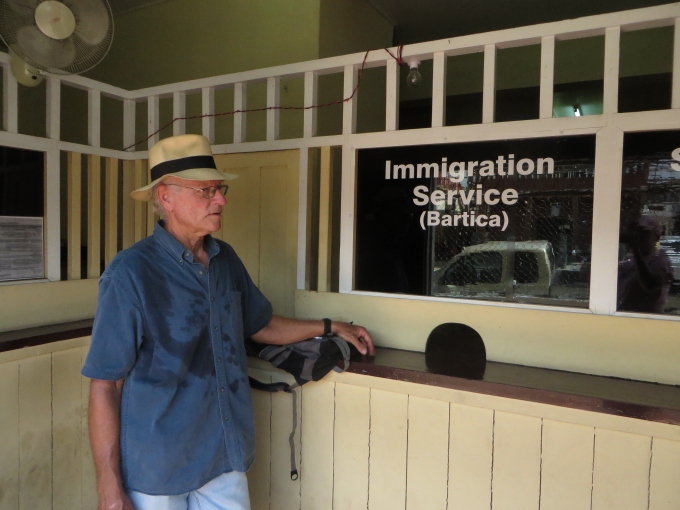
immigration check in bartica

We found the Scotia Bank on Second Avenue without much trouble and withdrew G$30,000 from the 24/7 ATM . It's an affiliate bank of Bank of America … no withdrawal fees involved. (Hooray!) Seemed like a lot of money (~US$150) and it was dispensed in all crisp G$5,000 notes. There's always a sigh of relief when our ATM card works in a new country. We headed immediately to Customs back on First Avenue across from Immigration. The office was located down an alley with no signs, next to Church's Chicken and up a steep cement staircase. We completed more forms and paid our G$2,500 incoming fees. We were legal in Guyana. The whole process took about 90 minutes … most of it spent waiting.

5c notes in guyana currency

It was mid-afternoon now, hot and steamy. David had read that Digicel offered prepaid data packages here in Guyana and throughout the Caribbean and they had an office in Bartica. We found it at the other end of First Avenue and waited our turn in line. No complaints … the shop was air-conditioned. After much discussion, it was determined that Digicel did not sell dongles/digital modems for the computer … at least not in Bartica. If we could get our iPad unlocked, they could sell us a SIM card and we could then buy a prepaid data package. Though this wouldn't be optimal for transferring blogs and pics, it was doable and better than nothing. We went in search of the “unlock” guy, but his “office” was closed on a Friday afternoon.
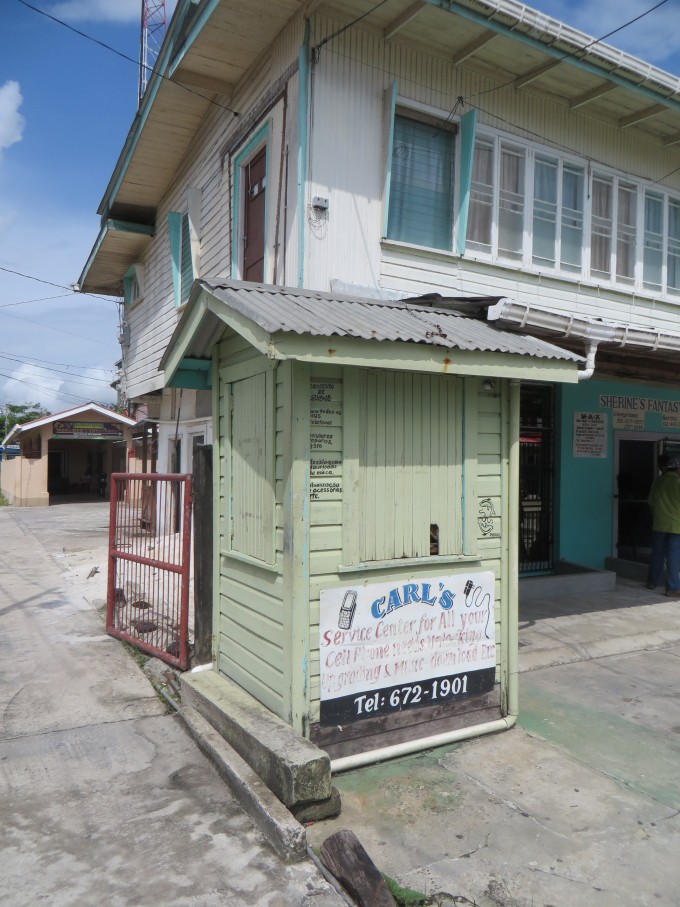
unlock guys office in bartica

We decided to check out the Central Market, a couple supermarkets and generally get the lay of the land. The Central Market was pretty much done for the day...early morning is best, so we'd return another day. There were several small supermarkets with basic supplies. We noticed lots of American products … Bush's beans, Heinz ketchup, Kellogg's Frosted Flakes. Brazilian products were plentiful as well. The prices were horrendous, but considering where we were, probably reasonable just for the effort of getting the products here. Demerara sugar, produced locally, was a bargain, however, at G$240. Rice and beans seemed plentiful and were sold in quantities from huge 25kg (55#) sacks down to individually packaged small plastic bags.

demerara sugar in bartica

Mike and Tessa's General Store on First Avenue has been around quite awhile. We poked our heads in … five cans of this and four cans of that on the shelves. They sold lots of bulk products like flour, rice and beans. They still weighed everything on an old-fashioned balance scale. Rubber boots hung from the ceiling and we imagined during the rainy season, they'd be in high demand.

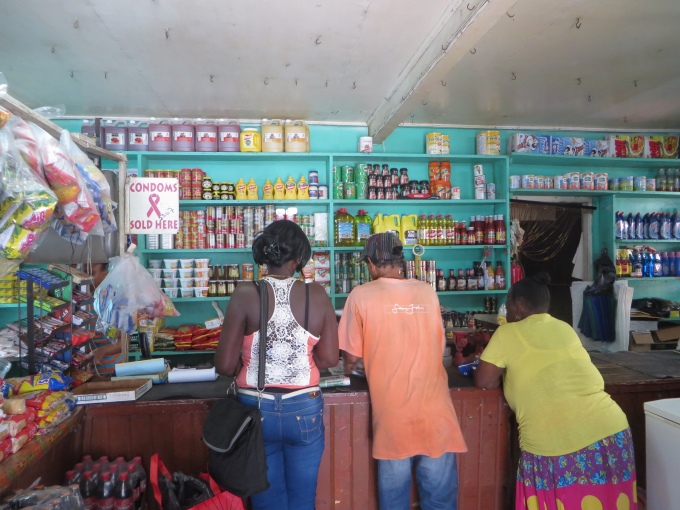
mike and tessa general store bartica


mike and tessa general store bartica

There were bars and drinking establishments on every corner and several in between. We saw cases of the local Banks Beer being unloaded. Some men staggered along the streets and we figured they'd begun their drinking early.

banks beer bartica

The Morocco offered three beers for G$1000. Three beers for a thousand dollars … even for Guinness that seemed high until we did the math … ~US$1.50 each.

3 beers for 1k in bartica

It was late afternoon when we tried to find our way back to the dinghy dock. It seems that our landmark, a Digicel Top-Up Sign, was one of many along First Avenue. We finally managed to find the right alley and retrace our steps to retrieve the dink. Heading over the cement embankment and down the steep, now slippery, every-other-plank-missing ramp was a bit awkward, but we managed. Our dinghy parking valet brought the dinghy back to the edge of the ramp. We paid our G$500 fee and nudged our way back out of the parking lot and back to Cups. Enough exploring for one day. Time for dinner, a cold beer and a movie. Tomorrow's another day and we're looking forward to it.

retrieving the dinghy


The Blue View - Handheld Windlass Controller

anchored off bartica In the last Blue View, Nine of Cups was in Suriname and I talked about installing foot switches for controlling a windlass, and using a windlass motor control module to reduce the current that passes through the switch contacts. Now we are 50 miles up the Essequibo River in Guyana, anchored off the small town of Bartica. In this BV, I want to address the usefulness of a handheld windlass controller and how to make one.

up the essequibo

Navigating the river was a challenge at times. The river has a strong tidal current, and it is necessary to wait until the current is flowing in the right direction before heading upriver. I know this is nothing new to you sailors who grew up sailing in waters with a large tidal swing, but for a guy who grew up in Colorado, it never ceases to amaze me when a river not only flows backwards six out of every twelve hours, but does so with great enthusiasm. The river is quite muddy, making it impossible to pick out shoals and rocks visually. In addition, the electronic charts are off by several hundred feet, and most of the channel markers have long since disappeared. Finally, the local fishermen use long nets, either stretched between poles stuck in the river or between an anchored float and their small dugout fishing boats. Our trip up the river had to correspond to the tidal swings, but had to be in daylight as well. We anchored offshore the first night, a few miles up the river on the second night, and made it to Bartica during the flood tide on the following day.

hosing off the chain

The river is quite muddy, and every time we haul the anchor, it and the chain come up coated with thick grey mud and clay. Our Boss anchor pulls up great gooey globs of the stuff. Rather than getting the mud all over the deck and down into the chain locker, Marcie uses the deck wash and hose to wash the mud off as the chain comes up. She leans over the bow pulpit, raises the anchor a few feet, and sprays the exposed chain until the mud is washed off, then repeats the process. Unfortunately, in this position, she can't reach the windlass foot switch with her toe.

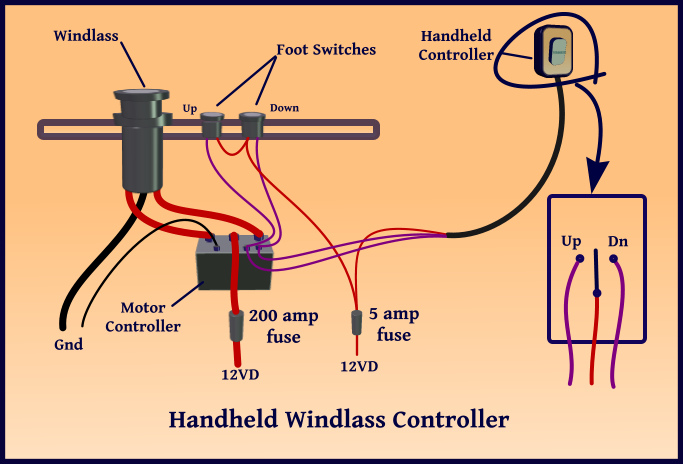
hand held controller

Our handheld windlass controller makes her job easier and faster. She can lean over the bow pulpit with the hose sprayer in one hand, while controlling the windlass with the other. When we have a lot of chain out and the mud is thick, raising the anchor might take a half hour using the foot switches, while the handheld controller might knock ten minutes off the process. Notice that we still have the foot switches mounted in the deck. If either the foot switch or the handheld controller stops working, the other remains as a backup.

hand held controller sketch

The handheld controller is nothing more than a SPDT rocker switch mounted in a small palm-sized enclosure and connected to the windlass motor control module with a long, three conductor cable. The cable is long enough to reach from the motor controller to the bow. One switch contact connects 12vdc to the 'Up' connection on the motor control module and the other contact connects 12vdc to the 'Down' connection. Since the current required for these connections is less than 5 amps,(typically 3 amps) for our Lofrans windlass motor control module, the switches and wiring can both be small. I used a waterproof Cole Hersee “Contura” rocker switch from West Marine (C-H Pt. No. 58332-22-BP). I store the handheld controller in a small bin mounted in the forepeak locker when not in use to keep it out of the elements for most of its life.

In the next Blue View, I'll talk about our chain counter. It's not difficult to add a small display and some circuitry to the handheld controller so that Marcie can see how much chain is in the water as we drop or raise anchor. Marcie may disagree, but for you fellow sailor-geeks out there, it just doesn't get much more entertaining than that.

About Guyana

about guyana As usual, we've done our homework in advance and have some feel for what to expect when we arrive in Guyana. We're kind of excited about the trip; it's the only country in South America we haven't visited and it'll be a good tick on our bucket list. Guyana is a small country, a bit larger than the state of New York. Formerly British Guiana, it became independent from Great Britain in 1966. It's proper name is the Co-operative Republic of Guyana. Nestled between Venezuela to the west and Suriname to the east, it borders Brazil to the south and the Atlantic sweeps its shore on the north.

map of guyana

Guyana is an Amerindian word translating to "land of many waters." It has a huge network of rivers, the three largest of which are the Demerara, the Berbice and the Essequibo. It's the Essequibo, Guyana's longest river, that we'll tackle. From what we've read, the climate is pretty much identical to that of French Guiana and Suriname … hot and steamy this time of year with frequent showers. Like the other Guianas, Guyana is more Caribbean in culture than South American. We aim to find out.

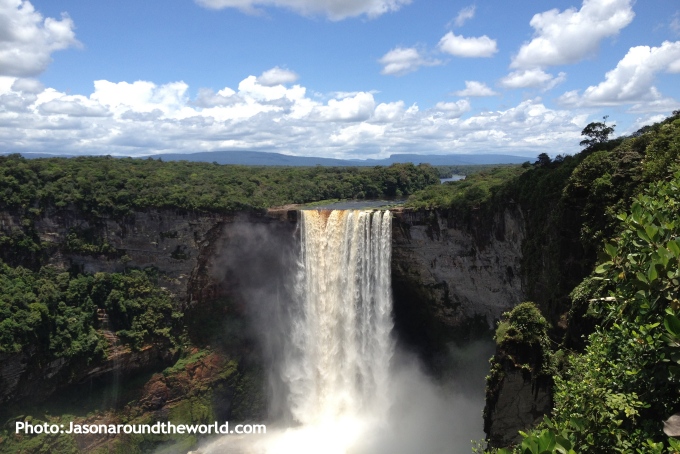
Lonely Planet provided a list of Guyana's key attractions. Kaieteur Falls tops the list. LP describes it this way … “Watching 30,000 gallons of water per second be shot out over a 250m (820ft) cliff in the middle of a misty, ancient jungle without another tourist in sight is a once-in-a-lifetime experience.” Something we'd love to do. We'll see how it works out.

kaieteir falls in guyana Lonely Planet

The Guyanese currency is the Guyanese dollar (GYD – G$). The exchange rate today is about US$1=G$200 which means we'll be doing higher math to figure out our true cost of things.

currency in guyana

A little Guyana trivia for you …

Guyana is the only country in South America with English as its official language although Creole, Hindi, Urdu and several AmerIndian dialects are frequently spoken.

Guyana is probably best remembered as the site of the mass suicide at Jonestown in 1978. Jim Jones, the leader of the People's Temple Movement, convinced 900 of his followers that it was “time ... to meet in another place”. They all drank cyanide-laced red Kool-aid and were dead within an hour.

Georgetown, Guayana's capital and only large city, lies 13 feet below sea level at high tide. A sea wall and an early Dutch canal system keeps the town from flooding and provides drainage.

Demerara sugar, a brown, raw cane sugar, gets its name from the Demerara River in Guyana. The Guyanese sugar industry, with a 300-year old history, is nationally controlled (Guysuco) and huge. Logging and mining (gold and bauxite) are also important contributors to Guyana's economy.

The Guyanese national flag is called “the Golden Arrowhead”. Whitney Smith, an American, is credited with the design. Our friend Doris in Namibia made ours for us and we'll have the chance to use it now.

courtesy flag of guyana

Guyana's first Olympic medal was won by Michael Parris who got a bronze for boxing in 1980. Cricket is a national sport, introduced by the British and played religiously.

We're looking forward to our time here. We hope you plan to come along.