
When the gods conspire...

Home for the holidays

route map

The last few days in Trinidad have been hot, humid and hectic. We hauled Nine of Cups, finished all of our chores with much sweat and energy expended, got Cups all set for her respite at Power Boats, then packed and got ourselves ready for our trip home to Boston. We had an economy Jet Blue flight that departed Port of Spain at 0349. Yes, it was a cheap flight and the uncivil departure time confirmed it. The road trip from Chaguaramas to Piero Airport is about an hour and the taxi driver insisted that he pick us up at midnight to insure we were there in plenty of time.

trinidad airport steel drums

Check-in was a breeze, other than we were singled out for a random luggage check. No big deal. We headed to the gate and heard the first announcement that our flight departure would be delayed 45 minutes for an equipment change (read that something was wrong with the scheduled plane and they had to find a replacement). Well, the 45 minutes stretched to nearly two hours and we finally boarded the flight at 0540. At least, we were on our way.

Now there's economy and then there's “economy”. Jet Blue takes economy to a whole new level. Would you like a pillow or blanket? No problem … $5/each! The movies on international flights are free … great! Want a headset? $5, please! We declined all offers until about 4 hours into the 6 hour flight when they offered complimentary OJ, coffee/tea and light snacks. The OJ cart came first and we indulged. Then came the coffee/tea lady.

“I'll have tea with milk, please”, I requested politely. David asked for coffee.

“Oh, sorry, you already had OJ...you can't have a hot beverage, too” and the attendant passed us by. Really? Then came the snacks … 0730 and they were offering Doritos and pretzels. Give me a break! What happened to granola bars or something more appropriate to the time of day? We declined, asking if we could possibly substitute tea and coffee for the snacks. With a bit of snippy reluctance, we finally got our coffee and tea.

We finally arrived at the gate at JFK Airport, NYC with an hour to clear Immigration/Customs and get onto our domestic flight to Boston. All things are possible … if you hustle. Enter a few more “delay gods”. The fast, efficient check-in machines at Immigration should expedite the process. You answer a few questions on the screen, slide in your passport, get your picture taken and a receipt pops out of the machine and you're good to go. Except David's receipt got jammed in the machine and no one could get it out, so he had to go through the process again at another machine which generated a duplicate check-in into the system, which put a big black X on the new receipt and put us in a very slow line for a face-to-face with an Immigration agent. The official was fast and efficient once we got to the head of the line, but the minutes were ticking away.

jfk airport sign

Next, we needed to collect our baggage for Customs inspection. Well, the delay in Immigration turned out to be a non-issue because when we got to Baggage Claim, not a single bag had come down the shoot yet. We waited and waited and finally a signal sounded, lights went off and the luggage started arriving. Well, other people's luggage started arriving … ours were the very last two pieces to come down the shoot. What luck!

We joined the tail end of the Customs line. It moved quickly, but the minutes were ticking quickly, too. We had that frustrated, out-of-control feeling in the pits of our stomachs. Luckily, no problems with Customs, but we needed to recheck our bags with Jet Blue for Boston. We found the recheck counter, but they were backed up and couldn't accommodate us. We were instructed to lug all the bags up the escalator to the bag check level and check them there. With persistence and a bit of persnickety-ness, we convinced the Jet Blue agent at the baggage check counter to expedite our bag check-in. She wasn't happy, but she conceded. We offloaded the luggage and literally ran down the terminal to Security.

We had a TSA pre-check validation on our boarding passes which allowed us to get expedited processing through Security. Hooray … almost there and we'd make it with at least 2-3 minutes to spare. Except … as our carry-on luggage went through x-ray, it was flagged for a manual check. They did a quick explosive-residue check and the alarms went off! David claimed the suitcase and while one agent unpacked our suitcase, inspecting one item at a time, David underwent a very thorough pat down. He hasn't been that thoroughly probed since the last time he was asked to bend over and cough. They put several items back through the xray scan and did another explosive residue check after calibrating their machine. We passed with flying colors, but the delay was just too much.

We repacked, gathered our belongings and David dressed on the fly as we ran to our gate … the last one, of course. The plane was still there, but the doors were closed. An agent called the plane, but no dice. We missed the flight. “Just go to Customer Service and they'll rebook you.” Grrrrr!

We joined the line at Customer Service where the affable agent was able to confirm us on the next flight to Boston. Hooray! That was the good news! The bad news? The flight was delayed due to weather. “Where was our luggage?” we inquired. Well, no one was quite sure if it made it on the flight we missed or if it would go on the flight with us or perhaps another flight, but they were sure it would show up eventually. Very comforting to know.

We hadn't eaten since last night's sandwiches in Trinidad, but nothing seemed appealing … $12 plastic-wrapped sandwiches just didn't cut it. We were getting grumpy now, despite the familiar Christmas carols playing background to the constant flight announcements. So close … yet so far.

Another flight announcement confirmed a further delay. The gate agent explained that the plane that would take us TO Boston was coming FROM Boston and it hadn't left the ground in Boston yet. We were emailing back and forth with Lin who was picking us up in Boston. It was overcast there, but no bad weather at the moment. Another interminable wait, but the plane finally arrived. We boarded and in 45 minutes we were in Boston. Our luggage was not at baggage claim, but miracle of miracles … it had made the previous flight and was waiting at the Jet Blue Customer Service office.

We headed out to the curb to the designated pick-up spot, but no Lin. It was cool, but definitely not the freezing weather we had anticipated. Our USA cell phone which we'd just charged before leaving Trinidad was dead as a doornail. I convinced a pleasant lady to make a call to my sister for us. Though Lin left an hour early, she was caught up in traffic. A 20-minute ride was taking 90 minutes. We waited and waited and finally spotted her. All the trials and tribulations of travel disappeared in the wonderful mix of hugs and kisses and hellos.

We're home for the holidays!
The Blue View - Hauling out in Trinidad

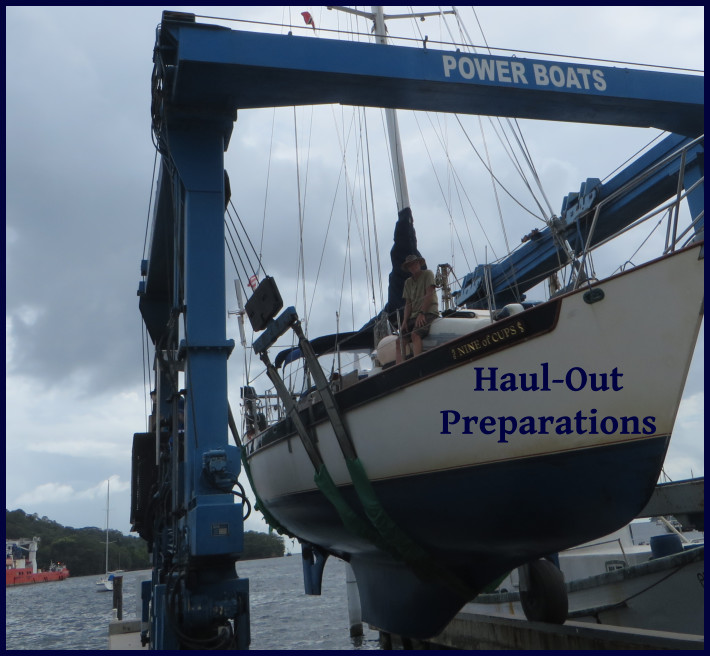
haulout prep We hauled out in Trinidad a few days ago. Nine of Cups always looks a little morose when she is on the hard. I don't think she likes sitting on her keel with seven or eight supports holding her upright. Nor does she like having her bottom exposed for any passerby to check out. I think it's sort of like having a physical done in the middle of a busy airport. Hopefully, she will forgive us when we clean and wax her topsides and treat her to fresh bottom paint and a new bootstripe.
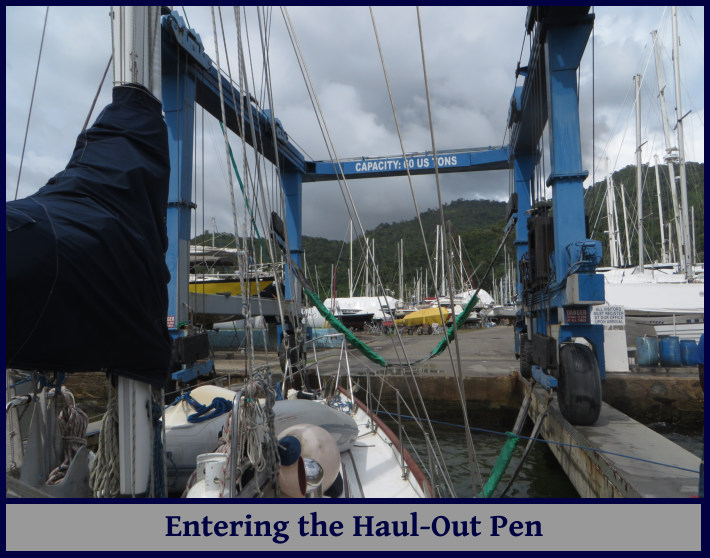
We've hauled out in a lot of different ports around the world, but no matter how many times we do it, I dread the process. The wind always seems to pipe up – or die down - just as I'm trying to maneuver Cups into the narrow concrete pen or the wake from a passing tug generates a big surge at precisely the wrong moment, and poor Cups has a lot of dings and gashes in her teak as a result. That repaired section of the port side caprail? That's from an overzealous marinaro in Venezuela who was helping us into the pen with a dinghy and pushed us into the concrete wall. The big ding on the starboard rub rail? That's my fault when I misjudged the wind as I maneuvered into the pen in Papeete, Tahiti.

entering the pen

Being as prepared as possible helps. Here are the things we do ahead of time to prepare for the haul-out.

Haul-out method. First a caveat. While we have seen several different methods of getting a boat high and dry – everything from careening at high tide, to cranes, to wagons mounted on train tracks that are winched out of the water, we have only ever hauled Cups using a Travelift type of lift.

Reconnaissance. Every place we've been does things differently. Sometimes we are expected to tie up to the walls of the pen while the Travelift maneuvers into position, sometimes the operator 'catches' Cups with the straps as we maneuver into the pen – sometimes there are cleats, sometimes not – sometimes there are 10 men standing by to help fend off, sometimes there's no one – sometimes the operator expects us to have fenders deployed, in other places fenders are a problem. If possible, we visit the facility ahead of time and check with the operator or manager to get as many details as we can. Ideally, we watch another boat being hauled out.

Conditions. Check the wind and current – both on the approach to the pen, as well as in the pen itself. I have the most problem with a current or wind on the beam that is blocked by the pen itself. If I enter the pen too slowly and Cups' stern is still moving downwind or down current while the bow is in the pen, she gets skewed at an angle. If I enter too quickly, a miscalculation on my part will make any damage that much worse. Always a dilemma.

Lift Points. We always provide a diagram of the boat to the lift operator, so he knows what our keel and underwater profile look like. We have lift points marked on the topsides, but different operators using different sized Travelifts often choose to use different lift locations. It's usually not a problem, but if I'm uncomfortable with the operator's decision, I don't hesitate to discuss it.

Headsails. When we were first learning to sail, an instructor once told me that it was a lazy captain who didn't remove his headsails when hauling. Maybe so, and while we do remove our headsails, it isn't because I'm afraid that someone will think I'm a slacker – there are many other indications of my laziness that are all too apparent. Instead, there are a couple of other reasons why I remove the headsails. First, it gives me a chance to inspect the parts of the sail and rigging that aren't visible from the deck. I can check the shackle, eye splices and the section of the halyard that spends most of its life inside the mast. The second reason is that we sometimes have to remove the forestay and baby stay before the Travelift can pick us up (see the next section), and this can't be done on Cups with the headsails furled in place. It is much easier and much less frenetic to remove and stow the sails ahead of time than trying to get the job done in the haul-out pen with the operator and crew glaring at us.

Forestays. Nine of Cups is a 45' cutter, and requires a fairly big Travelift to lift us out of the water. It isn't her weight - she weighs around 20 tons and most Travelifts are big enough to lift this much. It's her size that is at issue. We've found that a Travelift with a capacity less than 50 tons will almost always be too small to lift Cups without first removing the forestay and quite possibly the baby stay as well. We first discovered this after owning Cups a couple of years. We tied up the haul-out facility a couple of hours while I rounded up the necessary tools, used an impact driver to remove a couple of seized screws and figured out how to remove the furler assembly. Quite embarrassing. Having learned that lesson, I now round up all the tools I might need and prepare the forestay for removal ahead of time. I slack off on the backstays, loosen the locknuts on the furler, and loosen or remove any furler parts I can. I also rig a spinnaker line forward to take the strain off the clevis pin holding the forestay so I can remove it without too much drama. I have a couple of old cockpit cushions I use to pad and protect the furler and some short lines to secure it. If I think the baby stay might also have to be removed, I prep it in the same manner.

N.B. Some folks can back into the haul-out pen, but this would require even more effort since we would have to remove both back stays and the wind generator.

Hardware. Anything that could conceivably get in the way of or get damaged by the Travelift is removed and re-positioned. For example, I relocate our dinghy engine so it sits inboard of the lifelines, and tie off the wind generator.

Lines. We always rig two long bow lines and two stern lines. Rather than using our heavy dock lines, we rig lighter weight lines that can be thrown further. They may not be needed, but it's always better to have them rigged and ready, just in case. We keep two other lines – one on each side around midship – flaked out and ready to use. Cups' keel has a sloped forefoot, and although very unlikely, it is possible that the forward lift strap could slide forward as she is being lifted. To eliminate this possibility, we tie a line between the two straps once they are in position.

Fenders. We usually have our fenders rigged and in place as we enter the pen, then pull them back aboard once we are secured. Some facilities discourage them as they may hang up on the straps as we maneuver into the pen. When in doubt, we rig them. We also have a big fat fender we keep at the ready on the foredeck.

Boat hook. We have two boat hooks that can be used for fending off, and keep one lying on the top of the coach roof on each side of the boat.

Disembarking. Occasionally, we are expected to stay aboard while the Travelift lifts us out of the water, but usually the boatyard requests we climb off the boat once the straps are in place and the boat is ready. Sometimes, in a smaller pen, the boat is pulled close enough to the side to disembark that way. Most often Cups is carefully moved forward until the anchor is a few inches from the end of the pen, and we are required to climb over the bow pulpit, and using the anchor as a step, clamber ashore . So far we've been able to accomplish this, if not gracefully, at least without falling into the drink.

Power wash. Once the boat is out of the water, we usually have a power wash done to remove all the sea critters before they dry out and harden. Sometimes we can rent the high pressure washer and do it ourselves, but more often, the boatyard provides the operator. One thing to be aware of is that the operator often shoots the stream of water into the thru-hulls to get all those barnacles out of the hoses and valves. If the thru-hull leads to a sink, the stream of water will shoot up the sink drain and deposit a combination of anti-fouling paint and sea crud on the header above it. We try to remember to close these thru-hulls before the haul-out.

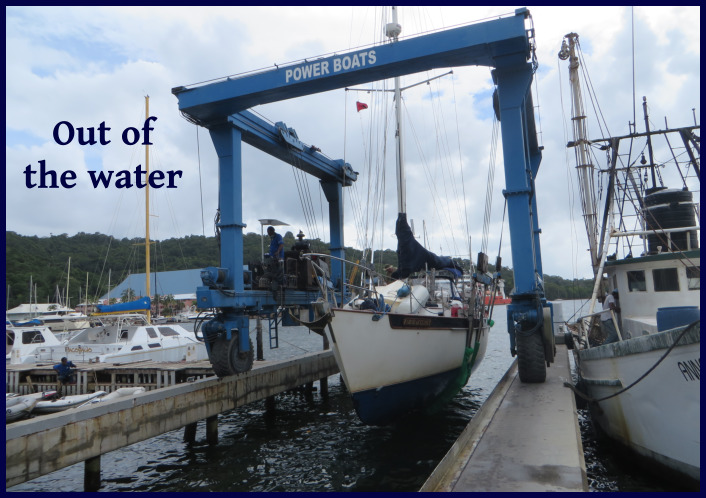
out of the water

This haul-out went quite well with no new damage or scrapes. The wind kicked up to about 20 knots as we were approaching the pen, but there were two dock hands there to catch our lines and the landing went remarkably well. I'm sure it was due to that tot of rum we gave Neptune on our arrival in Trinidad.

Lepers and Lighthouses - Pt. 2

Exploring Chacachacare Island, Trinidad

We had a hard time figuring out where to find the path to the lighthouse. We had climbed it once before, but access had seemed more evident. During the week, men had been working, in a rather desultory manner, on an old, decrepit public wharf which proved to be inaccessible by the dinghy. The wharf area was all fenced in. Behind it, we could see a sign welcoming us to Chacachacare Island. Dozens of vultures stood sentry, not bothered in the least by our presence, just daring us to come ashore. We had found a hiking map for Chacachacare on line, but the shore road delineated on the map had collapsed. It appeared however, that the road to the lighthouse led from the wharf. We beached the dinghy nearby.

vultures on the welcome sign

On shore, empty oil drums were everywhere...some overflowing with trash, others knocked over with trash spilling out of them. Tens of torn, black plastic trash bags disgorged their contents. Plastic bottles, beer bottles and rubbish was thick on the shore. A No Littering sign stood firmly in the midst of the junk and debris.

no littering sign

We carefully picked our way through the rubbish and found the asphalt road leading up to the lighthouse. The first few hundred feet were covered in trash, but soon the trash was left behind (obviously it's inconvenient to litter further up a steep hill) and we were climbing the pleasant, albeit steep, switch-backed road to the summit of the hill (825'/251.5m) where the lighthouse stood. The Brits built the lighthouse in 1876 and cut the road to the top. Hardy weeds poked through the crumbling asphalt and remnants of a sturdy, retaining wall could be glimpsed midst the heavy jungle foliage.

retaining wall

We climbed and climbed, stopping for brief respites in shady spots. Cotton plants bloomed and rotten bolls hung from the blossoms. Colorful butterflies and dragonflies flitted past. Birds sang in the trees. And, as always, vultures circled overhead.

butterfly

We remembered reaching the top on our last visit. The lighthouse was still tended then and we chatted with the lighthouse keeper. The area was kept fairly neat and tidy. We took turns swinging on an old swing suspended from a sturdy branch. What a change! Old diesel oil drums were haphazardly lined up like undisciplined soldiers...some in the bush, rolled half way down the hill. Trash and debris was scattered all over. The old swing hung limply, the thick weed patch below it testifying to its disuse.

old swing

The once stately Bocas Lighthouse was faded and in sad shape. Solar panels had been added. No lighthouse keeper was needed any longer. The area was all fenced in and an unsightly, erector-set communications tower stood beside it. A committee of vultures had established their territorial presence on both structures and had no intention of moving away.

lighthouse

We ambled back down the path, much faster on the descent than the ascent had been. We always see new sights when the path is viewed from a new perspective. An abandoned oropendula nest suspended from a bamboo tree, swayed in the breeze. Several different species of butterflies fluttered past. Birds twittered away in the dense foliage, keeping themselves well hidden.

oropendula nest

We returned to the dinghy and headed back to Cups. We weren't really disappointed, as much as dismayed by the volume of trash and garbage that had accumulated and remained in such a beautiful place. We remembered a sign in a bus in Ecuador years ago which read “Keep this bus clean. Throw trash out the window.” Chacachacare Island remains under the auspices of Trinidad's national parks system, but it appears it's an orphaned child. It would take an army to clean it up and haul all the refuse away. We postulated that a prison work detail would make a good dent in it, but then who would continue to keep it up? We're hopeful that the workers we saw on the wharf are the beginning of a solid reclamation project.

After five days in our blessedly peaceful Chacachacare anchorage, it was time to face the congestion and frenzy of Chaguaramas. Sigh! We waited till the very last minute and sailed across the bay just a couple of hours before our scheduled haul-out time. No more tranquil anchorage. No refreshing evening dips. Back to reality.