

Nevada Caucusing - What's That?
/What's a caucus? And why do we care? The word “caucus” derives from the Algonquin “cau-cau-as'u” which roughly translates to “adviser” in American English, a term used in American politics as early as the mid-18th century. In the USA, in order to determine who will be the candidate for President for each major political party, there are either primary elections or caucuses or a combination of both held in each state. Of the 50 states, only 12 states, plus 2 territories and the District of Columbia use caucusing We've voted in primaries before, but never participated in a caucus. Last Saturday, the Democratic caucus was held in Nevada and our precinct caucus was being held at the Whitney Elementary School, walking distance from home. We feel it's inappropriate to discuss political issues in our blog, but thought it might be interesting to share the caucusing process. It was definitely a new experience for us.
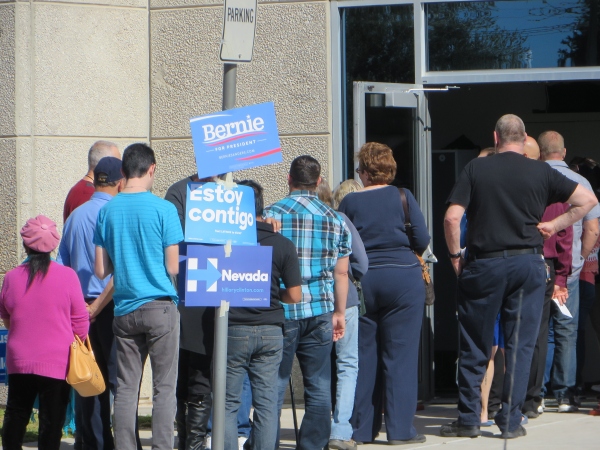
We sauntered over around 10:45. A constant stream of cars was heading into the school parking lot. As we approached, we noted that the queue for registration was very long and very slow. People were sweltering and squinting in the Nevada late morning sun. We had used an on-line caucus registration process which was supposed to streamline check-in.
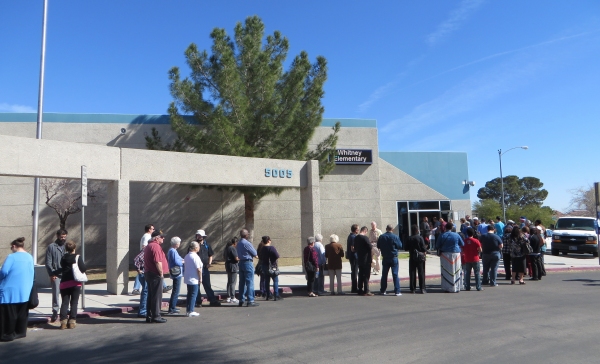
Truly, this was one of the most disorganized events we'd ever seen. There were a myriad of volunteers, but none seemed to know what was going on and we received conflicting directions from nearly everyone we talked to. We finally edged our way into the school building at one fellow's suggestion and advanced further forward in the line. We saw an unmanned, open laptop with a hand-lettered sign marked “Express Check-in”. Hmm … just a thought … “Is anyone using that computer at the moment?”, I asked. “No” was the resounding response from all the folks milling around waiting to register. With our trusty iPhone in hand, we retrieved the individual texts we'd received earlier with our own unique pre-registration code. We entered them into the express computer while wearing our magic decoder rings and performing the secret handshake and in a couple of seconds a wonderful thing happened … shazam … we were checked in.
Next, we needed to find the caucus room for our precinct. Several folks pointed us in the direction of the precinct rooms. We wandered purposefully, following big black arrow signs through a labyrinth of hallways to the various rooms, but none showed our precinct number and we ended up back where we started from … which was lucky because they'd changed the meeting place for our precinct caucus to the registration hall we'd originally registered in. We attempted to sit down. “Are you for Bernie?”, a fellow asked. “We're uncommitted at the moment”, David replied. “Can we still sit here?” No one seemed to know. We scrunched ourselves into low cafeteria tables with attached bench seats. This is an elementary school and everything seemed mini.
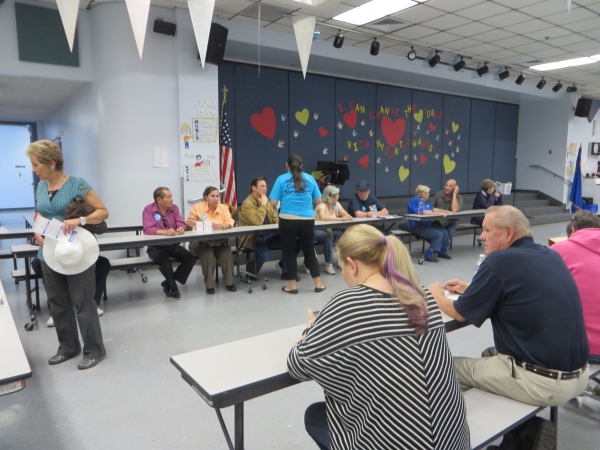
Around 12:35, the doors were closed, the registration lines ended and the precinct chief got to work … kind of. The fellow leading the group had misplaced some letters he was supposed to read and finally, after consulting the rules and regs one more time, called the caucus to order. We thought it might work according to parliamentary procedure/Robert's Rules of Order or something of the like, but no, chaos continued. He shouted over the boisterous group, but his little voice didn't carry. One strong-voiced woman (not me) finally got the group's attention and we strained to listen to the chief's instructions.
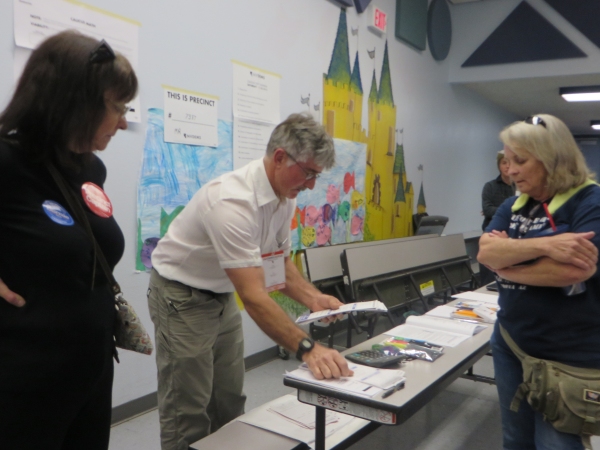
He took a count of the total number in the group … three times with three different results. He asked for some help. There were 46 folks in the precinct group. Next, he passed around an envelope for contributions. “The suggested contribution is $16”, he advised. What is this … church? $16 for what? I thought this caucusing thing was free. “It's for the Democratic party”, he said, “because everyone who works here is a volunteer.” We didn't get it. If everyone is a volunteer and we assume the use of the school building was free and the only things we received were Bernie buttons, Hillary stickers and two #2 yellow pencils, what exactly were we contributing to?
The chief instructed us to “align”. Bernie supporters on one side. Hillary supporters on the other. Those uncommitted (there were 6 of us) were instructed to stand up in the middle of the two groups. Well, that seemed a vulnerable place to be … and it was. We had read about the process, and we thought this would be an opportunity to rationally discuss each candidate's positions with informed supporters. Instead, within seconds, we were surrounded by Bernie and Hillary zealots, screeching at each other, making few valid or viable arguments for their candidates, but rather out-screaming their opponents. Sort of persuasion by intimidation and volume. There was no relief and certainly no order. The chief said “8 more minutes remain”. Oh, my … “What if we prefer to remain uncommitted?”, we asked the chief. “Then you just leave”, he responded.

Well, we committed to the least objectionable candidate just so we could observe the rest of the process. One old, grizzled fellow missing his front teeth congratulated us on our decision to join “his” team. We weren't sure that was a good thing.
What followed was more bedlam as we turned in our caucus cards and they were counted. The chief made a big show of writing the results and doing the “caucus math” calculations with a huge black magic marker on a large tally sheet hung on the wall. He made a mistake … putting results for Sanders in Clinton's column. A mighty ruckus ensued. Chagrined, he crossed out the wrong numbers and corrected the error. Sanders won … 26 to 24. The chief then set about determining how many of the 10 total delegates each candidate was allowed. Sanders-6 and Clinton-4. The selection of delegates was very methodical. “Who wants to be a delegate?” he asked the group. People raised their hands. He counted 4 on the Clinton side and 6 on the Sanders side (making only one mistake) and then gave the newly appointed delegates their paperwork. These folks will continue on to the county level sometime in April.
That's it. That was a caucus in Nevada … kind of like herding yowling cats and then asking them to vote. The overall state result was a win for Clinton … 53% to Sanders 47%. By all accounts, attending the Republican caucus was even more lively.
 Whether you're on land or sea, lighthouses have a special allure. We all fantasize about the solace and peace of the ocean. Most folks tend to forget the power of Neptune when the seas get ugly and gales and hurricanes pound the shores. Instead, it's easier to romanticize and imagine the splendor of a 360º ocean view. Lighthouses are indispensable to sailors, although in recent years, the traditional lighthouses are being replaced worldwide by mechanical, more efficient structures that do their duty, but have nowhere the charm of their predecessors.


