Easter in Trinidad

It's Easter Sunday in Trinidad. The Trinidadians take their holidays seriously. Banks, shops, the boatyard, etc. were closed on Good Friday and Holy Saturday, plus today, Easter Sunday, and they'll be closed again tomorrow, Easter Monday. The other day, I asked a young woman in the boatyard office, a native Trinidadian and a woman of color, if the Easter Bunny comes to Trinidad and how she planned to celebrate. She said “No bunnies here. I'm going to sleep for four days. That's what you do on holiday.” bunny and eggs

I later spoke with Tammy, owner of the B&B we'd stayed at. She's a Syrian who has lived in Trinidad for 50 years. She's a devout Catholic and planned to spend the holiday with her son and his family. She participates in all the Easter and pre-Easter religious and secular celebrations. She got her palms on Palm Sunday and bought Cadbury chocolate bunnies for her grandkids. She'd baked hot cross buns in anticipation of a big, traditional Easter Sunday ham dinner. She'd celebrate Good Friday in church and attend Easter Mass on Sunday with her family. The local mall, she informed me, had an Easter fashion show and local children would participate in an Easter parade, sporting their newly created Easter hats.

We listened to the Chaguaramas cruiser's net and other than announcing the weekly Sunday dominos game, there was not much going on to celebrate Easter. Winter and spring are dry here. April showers do not bring May flowers. We're told there's really not much noticeable change in this hot, humid weather until the end of May when the rains come … then it's hot and rainy.

spring flowers

I remember other Easters aboard. One time we were in Ecuador on the hard. I colored and decorated eggs with my Swedish friend, Ulla aboard Lovina. We gathered all the cruisers together on Easter Sunday for a huge potluck dinner and the marina accommodated us by setting up tables and chairs in the parking lot. Another Easter, we were sailing to the Galapagos and I cooked a canned ham en route. Yet another year, we were in a secluded anchorage in New Zealand's South Island by ourselves and ate mussels and fish. In Australia, there were chocolate bilbies, not bunnies. Down under, Easter represents the beginning of the austral autumn/winter season … not as joyous as the advent of spring.

bilbies not bunnies

We have always found a way to celebrate Easter. Though we're not religious folks, we do acknowledge the change of seasons and the coming of Spring, even if the change is negligible where we are. We remember the long, cold, hard winters growing up in Massachusetts and Colorado and the absolute joy (and relief) that Spring had finally arrived … even though there was still two feet of snow on the ground. We remember the thrill of waking to find Easter baskets on the kitchen table and later, the fun we had with our kids on Easter morning with scavenger hunts for eggs and treats.

chocolate bunnies

So what's on our agenda for the day? We've only been back a few days and we're still learning our way around. Our fridge is not working (GRRRR!), so no shopping in advance for Easter dinner fixin's. But we've seen lots of old friends here and perhaps it'll be a good day for a cruiser get-together … a day for sharing adventures and tall tales and cold beer and just maybe … chocolate bunnies.
The Blue View - HF Radio Ground Systems

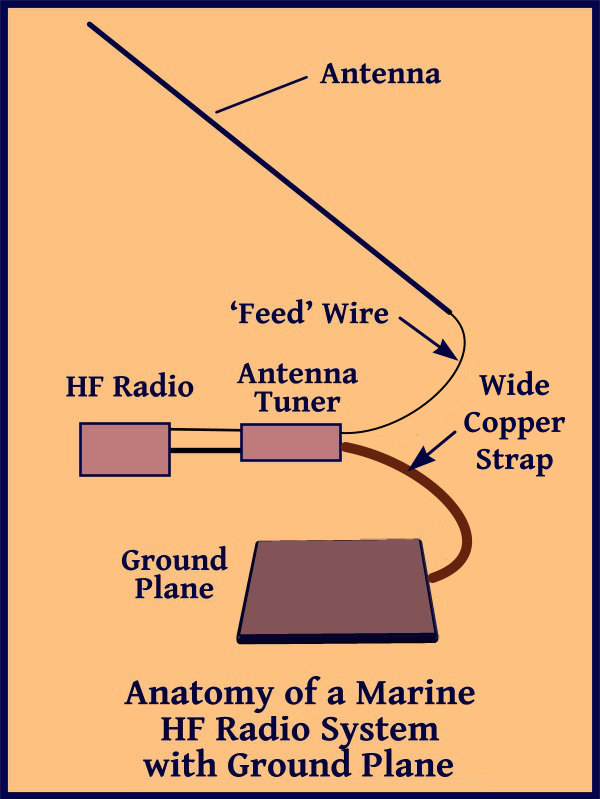
In the last Blue View, I talked about a typical marine HF radio setup, consisting of the radio, an automatic antenna tuner and a long line antenna. As I mentioned, the wire of the antenna is only half of the antenna. To transmit any distance, a good ground plane or counterpoise is also needed. On a land based antenna, the earth is sometimes used as the ground plane, but often a network of wires is run radially out from the base of the antenna, and this type of ground system is called a counterpoise. On a boat, the seawater acts as a great ground plane as long as there is a good connection between the antenna ground and the water. overview

If the boat is steel, all that needs to be done is to connect the antenna ground to the hull. I'm not sure whether the hull would be classified a counterpoise or a good ground connection. More likely, it is some of both.

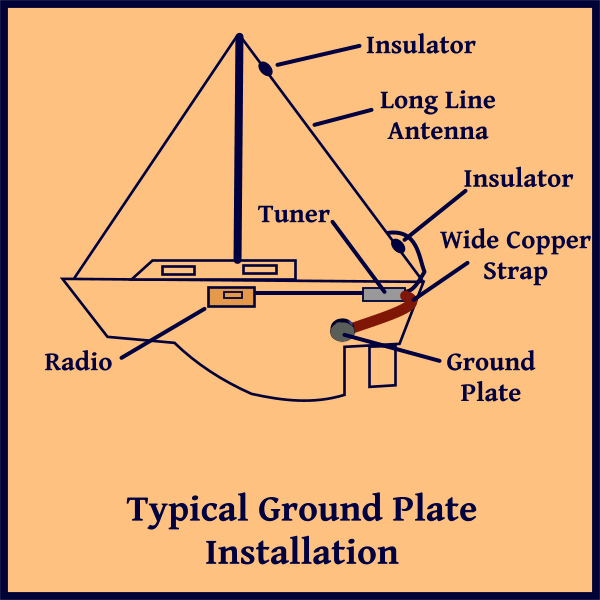
On plastic or wooden boats, making a ground connection or counterpoise is slightly more complicated. One method is to attach a large ground plate to the outside of the hull under the water line. It is held in place with large bolts through the hull, then the antenna ground is connected to it using a wide copper strap.

groundplate

A variation of this is to use a copper strap to connect the ground to one or more bronze thru-hulls. This method is most effective if the thru- hull is located close to the antenna ground, ideally 3-4 feet, but a maximum of 10-15 feet, and the conductor to make the connection is a wide – 3” or more – copper strap. Gordon West, arguably the foremost expert on marine radios, is a proponent of this system.

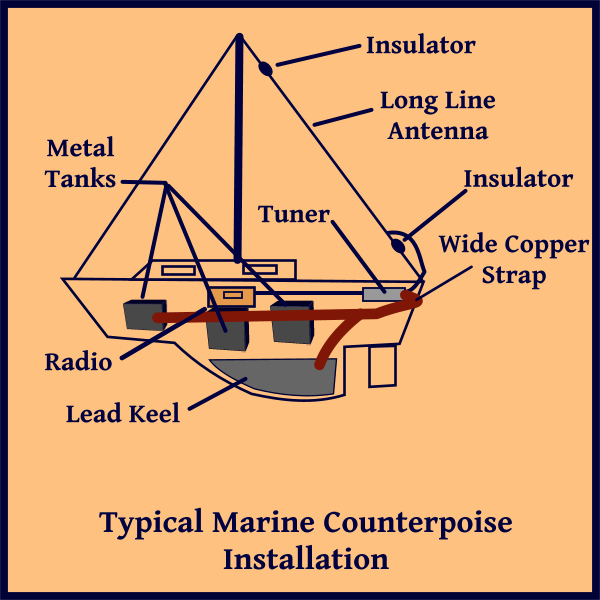
Another method is to construct a counterpoise by running as many copper straps as possible from the antenna ground, and connecting metal tanks, lead keels and other various metal objects together. Steel lifelines, stanchions and even the mast can be included. This can be a very effective counterpoise, but it is difficult to add all that copper. In addition, since copper and seawater don't go together well, the copper should be protected from corrosion, especially anywhere that the copper strap might come in contact with seawater – like the bilge for example. Some installers encapsulate the copper straps in epoxy and bond it to the hull. We also saw one boat that had a blister problem, and was having the gel coat stripped. Before the new epoxy barrier coat was applied, they bonded a copper mesh to the hull. Unfortunately, we didn't keep in touch with the owners, so we don't know how well the counterpoise worked nor whether there were any long term bonding problems.

counterpoise

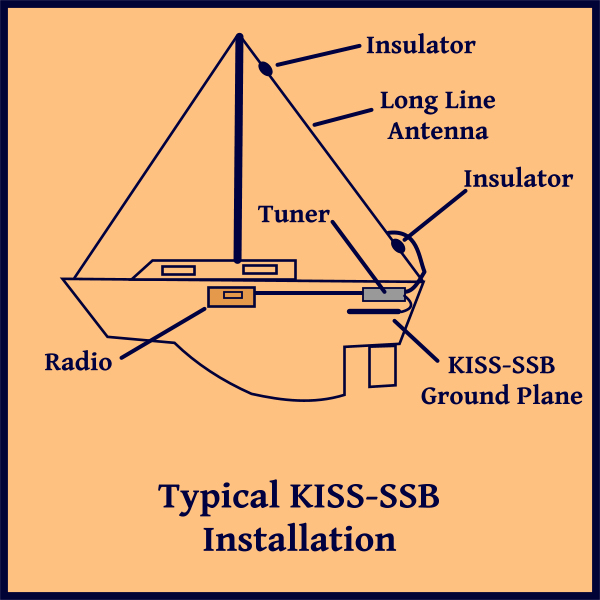
A third method is a commercial product, the KISS_SSB, that uses a number of wires of various lengths bundled together and connected to the antenna. The wires are all contained in a flexible tube about the size of a garden hose. The manufacturer claims that the various lengths of wire are finely tuned to make sure the radio transmits well on all the marine and HAM frequencies between 2Mhz and 28 Mhz. It is somewhat costly ~$150, but very easy to install. A heavy wire is used to connect the wires to the antenna ground, and then the bundle of wires can be routed under the cabin sole or in a lazarette locker. The manufacturer's website has lots of endorsements, and those of our friends who have installed them claim their transmission ability has improved. Other knowledgeable experts (whose opinions I respect, BTW) insist that the device can't possibly work as claimed. There are several forums devoted to the topic, resulting in a number of heated discussions between the proponents and the detractors. The only performance testing I've seen was done by John (KA4WJA) on the s/v Annie Laurie. He used a spectrum analyzer to measure the the return loss/VSWR/resonance of a transmitter equipped with the KISS-SSB counterpoise as the transmitter was swept throughout the frequency range of 1.5Mhz to 28.5Mhz. His conclusion was that it would probably work great on three or four frequencies and have a marginal performance throughout the rest of the range. His opinion: “If you just grab some wire out of a dumpster, cut it into a few random lengths (between 12' and 35'), attach a ring terminal to the end of the group of wires...you HAVE made an antenna counterpoise for FREE that works as well as (or better than) the KISS....and if you need to buy some wire, it'll cost you < $5.... “.

kiss installation

So, there is the opinion of several experts as well as John's test results saying it can't and doesn't perform as claimed by the manufacturer versus the actual real world, albeit subjective, experience of a number of actual users claiming it is great. I love it!

Meanwhile, what did we do? Sixteen years ago, when we first started cruising, I read everything I could and decided to use the second method. I bought 100 feet of 3” copper strap and connected all my fuel and water tanks together, as well as a few thru-hulls, and attached it all to the antenna ground. This has worked reasonably well for us over the years, but some segments of the copper have started to deteriorate. Nine of Cups is currently on the hard in Trinidad, and one of the items on my to-do list is to replace the thru-hull for the port cockpit drain. As long as I will be scrunched head down into the lower reaches of the engine compartment, I plan to run a copper strap directly from the antenna tuner to this thru-hull and see whether there is any improvement in our transmission range.

I'll keep you posted. Meanwhile, stay tuned for the next blog when I'll talk about alternative antennas.

Back in Trinidad

Yes, we're back in Trinidad. It was a long, two days to get back here, but things went like clockwork. The flights were all on time and the airline crews were hospitable and efficient (though we still only got one drink on the 5-hour flight). Trinidad Immigration and Customs at the airport were a breeze and our ride was there to pick us up, help wrangle the luggage and whisk us off to the boatyard. Note: Thanks to Mike Fiedler! Next time we have a layover in Fort Lauderdale, we'll head to Lester's Diner instead of taking out a mortgage for crappy airport food!

climbing up to cups

Cups was a sight for these tired, sore eyes. She was covered in dust and dirt, but otherwise looked to be in good condition and perhaps happy to see us. We gave her a quick once-over then, driving our short-term rental car, we retired to Tammy's, a local B&B that the cruisers favor. We had been up a total of 36 hours straight. Marcie took short naps on the plane, but David's not a plane-napper, so by the time we finally arrived, we were both exhausted and sleepy. We managed to stay up until 8:30pm and then, after a hot shower, collapsed into bed for a comatose night's sleep … until about 3am.

cups is dirty and dusty

Tammy fixed a great, full breakfast and sent us on our way before 8am. The traffic in Trini is horrendous, but we made the trip along the winding West Main Highway in about 20 minutes. We hauled up the duffels and suitcases and began the process of trying to get settled in. Cups was in a shambles in a matter of minutes, but first things first. It averages about 90-95F with high humidity here each day and seeing about an air-con seemed like a really good idea. David ordered a rental unit, then pondered how he'd get it up the ladder and install it. No worries … the workmen showed up about 20 minutes later with the air-con unit on a forklift. They'd done this once or twice before, it seems. They installed the air-con unit over a hatch using a baffled plenum. They sealed all the gaps and in minutes we cooled down to a comfortable level. Now, we could work!

ac unit on cups

David had painted several galley lockers before we left. He re-installed shelves and hardware as Marcie began the duffel unpacking and stowing. It was a slow process since the settees were full of locker gear which also needed stowing. By 11 am, we were making some progress and it was time for a cuppa.

re installing shelving on cups

At first glance, all was good aboard Cups, but as we looked around, a few things came to our notice. Like the tea kettle wouldn't whistle or pour, for instance. The little ball that whistles and allows me to pour was stuck. David fixed it, put the repair item on his list and immediately crossed it off. “One thing done!” he boasted. Then, we noticed the clock wasn't working. No fix for it; the works are kaput. The biggie? The fridge isn't working and this will take some time to evaluate and determine a fix. Sigh!

The varnish is in rough shape and needs redoing. No surprise … add it to the list. There are already some sizable tasks on the list … replace the cutlass bearing which requires removing the prop shaft; replace the shaft seal; replace the engine room thru-hull. Not to mention anti-fouling the bottom and all the usual annual maintenance chores. And that's all we noticed in our first afternoon aboard. What other insidious gremlins are waiting for us?

We're back and demanding mistress that she is, Nine of Cups is commanding our attention (and she shall have it!).