The Blue View - Decanting Propane

decanting propane One of the chores to complete before leaving Trinidad was to fill our propane tanks. Running out of propane on a passage, while not exactly life threatening, would certainly be a hardship. Actually, if I went a few days without my morning coffee, the first mate might be ready to jump overboard - or throw me to the sharks – so, truth be told, it might very well be a life threatening situation.

We have three tanks aboard Nine of Cups; two fiberglass 10 lb. (4.6 kg) tanks that fit down into our propane locker, and a standard 20 lb. (9.2 kg) steel tank that sits on deck inside a nice, made-to-purpose ditty bag. When one of the smaller tanks becomes empty, I refill it using the large tank.

In many parts of the world, it is expensive and/or quite difficult to get our tanks refilled. There are often places that will swap filled tanks for empties, or refill the local tanks, but just as often, either the tank fittings are different, or local codes prohibit the filling of any but their approved tanks, or there isn't a refill station within walking distance of Nine of Cups. So, we usually buy or borrow a local tank, and use it to fill our tanks.
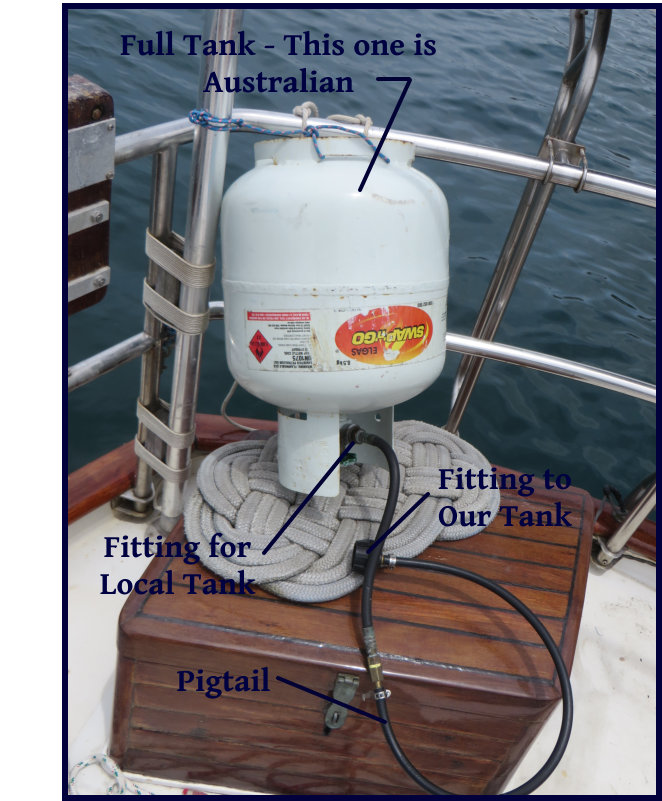
full tank

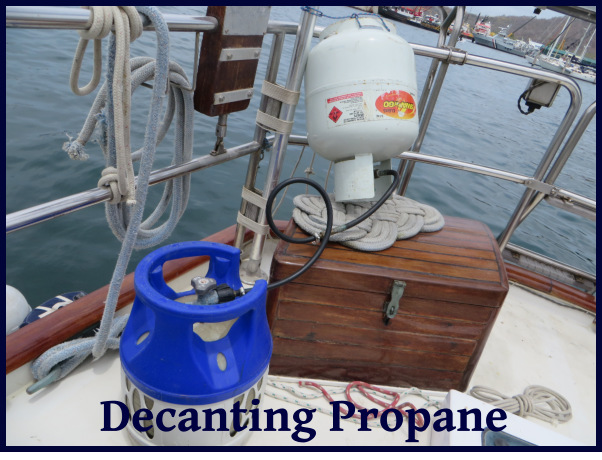
Decanting propane isn't difficult. A full tank contains mostly liquid propane with a little propane vapor at the top. To move the liquid propane from the full tank to the empty tank, I connect the two with a hose, set the full tank upside down and higher than the empty and open the valves on both tanks. The liquid propane runs out out of the full tank and into the empty. That's the principle anyway – in reality there are a few complications.
bleed screw

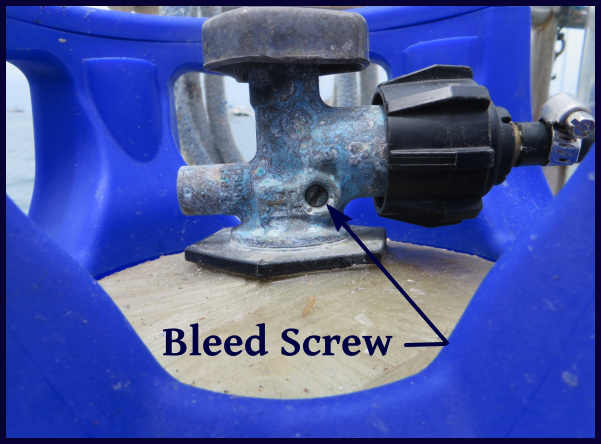
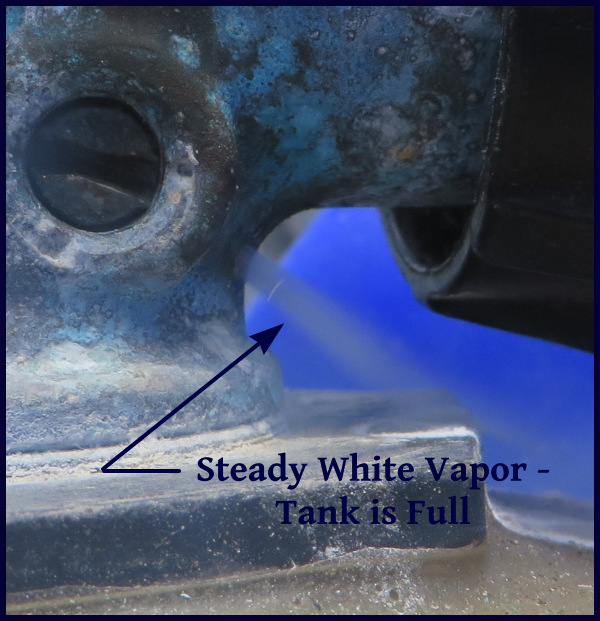
  • The liquid needs a little help to flow into the empty tank once the vapor pressure builds up in the partially filled tank. Most tanks have a small bleed screw that allows the vapor to escape as the tank fills up. I can hear the flow of liquid as it moves from one tank to the other, and once I hear the initial flow of liquid slowing down, I loosen the bleed screw until the vapor begins to escape from the partially filled tank. I watch the escaping vapor - it will be clear with spits of white liquid until the tank is full. Once the tank is full, the escaping propane will turn white, and I know it's time to tighten the bleed screw. Some propane is lost using this technique. If there is no bleed screw or I want to avoid losing any propane, the liquid from the full tank will eventually fill the empty without loosening the bleed screw, but it sometimes takes 24 hours or so.
vapor

  • When I set the full tank upside down, I keep it at a small angle rather than positioning it completely vertical. It likely has rust in the bottom which I don't want transferred to my tanks.
  • If I am not using the bleed screw, before opening the valve on the empty tank, I loosen the connection between the tanks so any air in the line will be purged and not forced into the empty tank. When using the bleed screw, this step is unnecessary since air is lighter than propane and will be purged via the venting process.
fittings

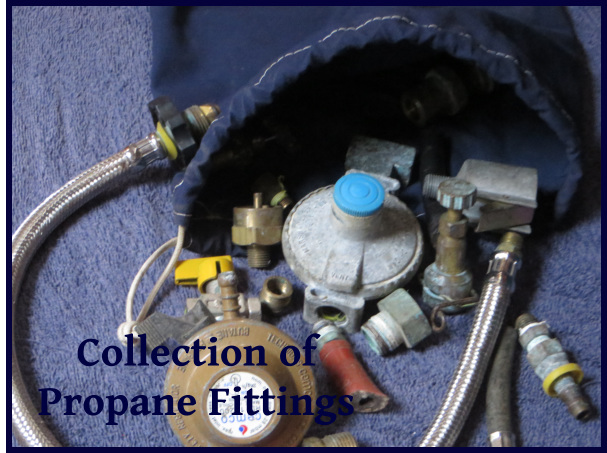
  • Many countries have a different fitting on their propane tanks than what we are used to in the U.S. It seemed like every South American country we visited had a different standard. Part of the adventure was visiting hardware and plumbing stores until I found a fitting (or combination of fittings) that would allow me to connect the local tank to the hose and pigtail connection for my tanks. I have a ditty bag chock full of adapters from around the world.
  • I always secure the full tank in its upside down position so it can't fall over or overboard if there is an unexpected wake or surge.
  • Propane is heavier than air, and any propane that leaks or is released inside the boat will collect in the bilge. If enough collects down there, an explosion and/or fire may result. We had acquaintances on a French boat that blew a hole in the side of their boat after a propane leak. The boat was partially sunk and the wife was badly burned. It happened in a remote part of Patagonia, and they spent a week or so surviving ashore until the Chilean navy found and rescued them. I always make sure any escaping propane vapor is blown overboard – or better yet, I do my decanting ashore when I can.
  • Obviously, the escaping propane vapor is highly flammable – I make sure there are no open flames, sparks, etc. anywhere near.

Our three tanks give us enough cooking fuel for 3-4 months – a little less in the cooler climes when we bake more and a lot longer in the tropics when we avoid baking. We no longer have a BBQ grill which seemed to be less efficient. That's been enough propane to keep the crew happy between refill opportunities, whether a long ocean passage or extended gunkholing in Patagonia or the nether regions of Tasmania.

Back in the Water - Adjustments Required

Well, we've not been on the water since last December and it's definitely noticeable. Cups seems to be enjoying it just fine. She's bobbing in the bay water, rocking and rolling with the waves and wakes. She strains on her mooring like a horse at the starting gate, rearing to go. We, on the other and, are finding it necessary to make a few adjustments to living on the water again. chag harbour trinidad

We can't just climb down the ladder and head to the store or chandlery any more. It requires a dinghy ride. Because of security issues here, the dinghy and engine are hauled each night, so it's a bit of extra work getting ashore. On the other hand, we do not have climb down the ladder to empty the pee bucket or to go pee. I'll vote for launching the dink any time. Dropping something from the deck no longer results in “thud” and descending the ladder to retrieve the screwdriver or whatever. Now we just hear “splash” and whatever dropped is gone forever. Not that we've ever dropped anything into the water ...

On the other hand, there's no need for the long, hot, dusty walk to the Massy's Express Supermarket at Crew's Inn for our daily provisions. Instead, we can just dinghy across the harbor, tie up at the Crew's Inn dinghy dock, do our shopping and dinghy back. Much faster, more convenient and definitely less sweaty.

We haven't been taking it easy though. Before we can leave, there's still lots to do now that Cups is in her element. David reattached the jib furler, tensioned the shrouds and tuned the rig. He reassembled the furler and ran the furling lines.

reattaching furler

Early on a calm, windless morning, we hanked on the foresails and re-rigged the sheets. I've been working on polishing the stainless, filling up the easy-access lockers from the larder, and stowing stuff we won't be needing and what seems like a million other little chores I can't seem to think of now. I'm also still researching possible ports-of-call along the way north, though time is short and there won't be much time for stopping if we're to be north of Cape Hatteras by June 1. David just completed an oil change on the engine and has begun stowing his tools and supplies.

hanking on sails

It's the welcome sound of gulls and terns crying as they fly over that wakes us in the morning now rather than the melodic sound of kiskadees sitting on our solar panels. Frigate birds soar gracefully high above us and pelicans swoop low, just over the water's surface, looking for breakfast. The whir of the wind gen spinning is almost comforting.

The mooring field is quite full and there are anchored boats as well. Chaguaramas Harbour is anything but calm and quiet. There's a certain amount of fetch that comes into the bay when it's windy (and it has been) which can make it a bit rocky aboard. Most of the rock'n'roll however is from the never ending boat traffic around us … fishing boats, ferries, pilots, pleasure boats … all with a penchant to go fast and as close to the moored boats as possible.

boats whizzing by

One motor boat came so close to a small, anchored sailboat that its propeller clipped the sailboat's anchor rode, cutting it loose. The folks on the sailboat were off the boat at the time and another diligent cruiser noticed what happened and rescued the boat. Earlier today, we were “nudged” by a large sport fishing boat. He just wasn't paying attention. There was quite a racket as he detangled himself from our big anchor sitting on the bow, but thankfully, no harm done.

It's crazy out here … and noisy. Locals enjoy loud music and there are lots of party boats that go back and forth all night long, music blaring. Around 5am, it tapers off. Time for us to get up and start our day. Since our mooring is only ~200' from shore, we're entertained non-stop. In fact, many times it sounds as if the DJ is on our deck!

party boat

I think of the rock'n'rollin' ride as a good chance to recover our sea legs a bit and staying up all night with the local music is good practice for night watch. Now if we can only remember how to sail!

FAQ - Do you worry about tropical diseases?

In light of the current Zika pandemic scare, we've been asked frequently about whether we worry about catching exotic diseases that are more prevalent in tropical areas and third world countries and the answer is yes and no. Yes, it's a concern, but we take all reasonable precautions. And, no, we don't worry so much that it prevents us from sailing in the tropics or to third world countries. When we were at Pitcairn Island in 2007, the bird flu was the big scare. The Pitcairners held an island meeting (all 46 of them) and decided to “close the island” until it was prudent to allow visitors again. We were already there and had previously been at sea for more than 14 days when we arrived, so they figured we were safe enough. They did, however, have the island health officer give us a once-over.

We were in South Africa and Namibia when the Ebola virus hysteria was at its peak. We were more concerned that we wouldn't be able to fly out of Africa to the USA for the holidays than we were about actually catching the disease. As it turned out, we had our temperatures taken while waiting in the ticket line at the airport terminal. If there was no temperature, we were allowed to board. We had no problems.

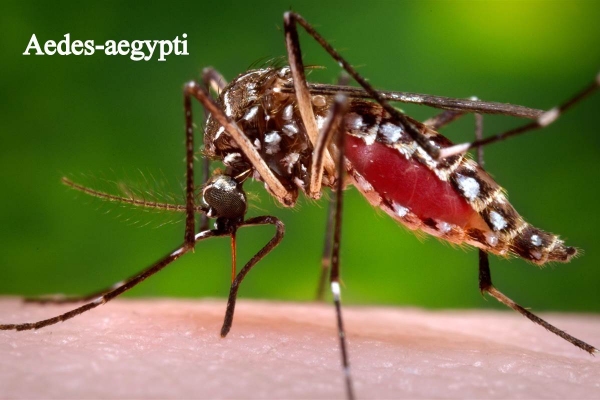
And, now, of course, it's the Zika virus that's the concern. The big difference with the Zika virus is that it's transmitted not by birds or other mammals, but by mosquitoes, much like yellow fever, malaria, dengue or the West Nile viruses. One major difference, however, is that the carrier culprit (female Aedes aegypti) is a daytime-active mosquito. In case you didn't know, the Zika virus was first identified back in 1947 in the Zika Forest of Uganda, hence its name.

zika_aedes-aegypti-mosquito

I found a map which shows the current probability of Zika distribution and occurrence worldwide, and obviously the more tropical areas are the most likely.

probability of zika occurance

As of this month, there have been 16 confirmed cases of the Zika virus in Trinidad. The Minister of Health, Terrence Deyalsingh, has cautioned the population not to panic. Regarding concerns that Zika could be a life threatening public health issue, he said “what you do not want from Zika is panic. Please keep it in perspective. Please let us keep our heads on to eliminate this”. He said that the virus needs to be attacked on the ground level, with a public education and clean up campaign. He said “if you have 100 people in a room, eighty per cent will not show symptoms”. Deyalsingh said: “I am appeal to everyone. Do not create unnecessary panic. The comment of Zika take you, you going to die, is absolutely not true”.

I wasn't sure I'd trust the Trinidadian Minister of Health's comments, but the CDC had the same type of information. “People usually don’t get sick enough to go to the hospital, and they very rarely die of Zika. For this reason, many people might not realize they have been infected.” Obviously though, the concern of pregnant women for birth defects in unborn children and the possible tie of Zika with Guillain-Barré Syndrome is very real.

So what precautions do we take in general? We have had yellow fever shots in the past and had a booster before we left South Africa for the Guianas. The most prudent precaution, other than not visiting the areas at all, is to cover up and use insect repellent religiously, which we try to do. In the past, we were especially careful about the dawn and dusk hours when mosquitoes are most active, but with the Zika, it's an issue all day long. Fortunately, mosquitoes are less of a problem along the coast and we've not been bothered by them. We did get bites while touring the Caroni Swamp despite the insect repellent we applied. So far, no problems. Considering there are only 16 identified cases in Trinidad, we think the chances of contracting Zika are pretty remote.

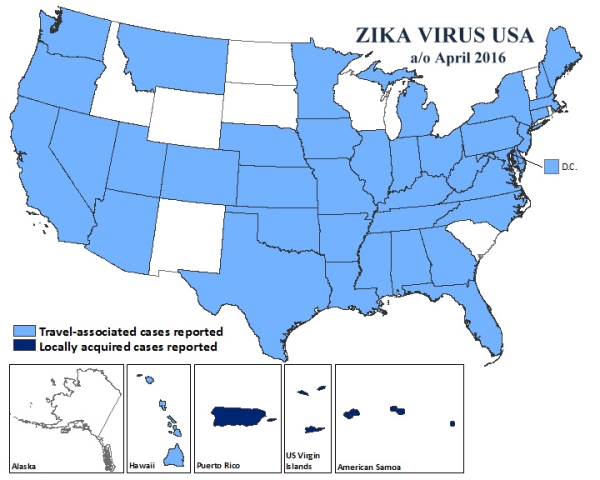
That said, we're thinking of stopping in Puerto Rico on our way north which already has 475 reported cases of Zika, most acquired locally, i.e. bitten by an infected mosquito versus travel-related or sexually transmitted. We'll take extra precautions when we stop there, e.g. mosquito netting, care with insect repellent, covering up during the day, etc. Being aware and prepared is part of the battle.

zika in the us