
Checking out the 'hood - St. Augustine

According to the St. Augustine city website, “Historians credit Juan Ponce de Leon, the first governor of the Island of Puerto Rico, with the discovery of Florida in 1513. [Although the native Timucua knew it was here long before that!] While on an exploratory trip in search of the fabled Bimini he sighted the eastern coast of Florida on Easter Sunday … and claimed Florida for the Spanish Crown, naming it Florida after Pascua Florida”, Spain's "Feast of the Flowers" Easter celebration. timucua engraving

Founded in 1565, St. Augustine is the oldest continuously occupied European settlement in the United States. About 42 years before the English colonized Jamestown and 55 years before the Pilgrims landed at Plymouth Rock, the Spanish established St. Augustine … and here we are! All that's left of the original buildings is the fort, Castillo de San Marcos, completed in the late 17th century. Dubbed as the Ancient City, it's hard not to fall in love with St. Augustine as soon as you sail past the historic fort and pass through the beautiful Bridge of Lions.
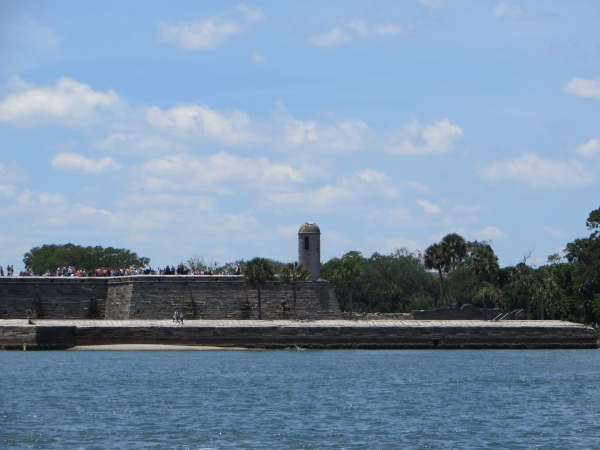
castillo san marcos fort

As usual, the first day or two, we didn't wander too far from Cups as we recuperated from our passage, tidied up, caught up and began repairs. We managed a bus trip to the local Winn Dixie supermarket, found the West Marine and bought some boat supplies. There's lots to do here and I'm compiling the “play list” as David works up the “to-do list” … with negotiations to follow. The plan is to stay about a week, then weather depending, we'll head north to the Chesapeake.

We've visited St. Augustine before … 2001 … but lots has changed since then. Instead of anchoring, we now have a mooring in the Matanzas River, just inside the Bridge of Lions. We have access to all the amenities offered by the St. Augustine Municipal City Marina including a convenient dinghy dock, beautiful showers (with hot and cold water), laundry, propane exchange, ice (!!), free pump-out at the mooring, free wifi and even a pleasant cruiser's lounge. Best of all, we're right downtown in the heart of this beautiful little city. We're talking cruiser's heaven!
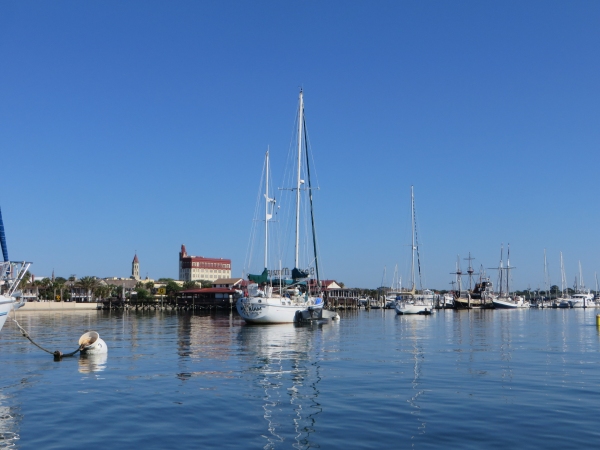
marina in st. augustine

One of our first important discoveries was J.P. Henley's across the street from the marina. It's a small, friendly, neighborhood pub that offers 70 (cold) beers on tap, moderately priced meals, a happy hour and a chance to watch a little baseball … all part of the passage recuperation process. Needless to say, we've visited several times though we've barely made a dent in the extensive beer offerings.

jp henleys in st. augustine

There's a Cruiser's Net on the VHF every morning at 0800 which provides lots of info about happenings in the St. Augustine area. Since we're right in the downtown, most everything is accessible on foot or via the bright yellow buses of the Sunshine Bus Company.

It's sometimes hard to believe we're back in the USA. For the past nine years, whenever we've been aboard Cups, we've been in a foreign country or at sea. We see something in the grocery store and have the urge to scoff it up because it might not be there the next time we shop. When we ask if a shop accepts credit cards, they look at us as if we're from a different planet. Not thinking, I commented the other day that it was odd to see so many American flags on the moored boats. DUH! We're in America.

Stay tuned. We've got lots of exploring to do in the Ancient City and, of course, we plan to take you along with us.

Life Without Refrigeration

fridge-notes-cool  

There are some very big pluses to not having refrigeration aboard. Plus #1 is the amount of power we save, or rather have available for other things like computers, iPads and other electronic stuff.

We know of lots of veteran sailors who have sworn off fridges. Our friends Betty and Luis on Ave del Mar, are fridge-less. Beth Leonard and Evans Starzinger chose to give up refrigeration and felt all the better for it. It takes some planning and some adjustment, but it's really not all that bad.

It's not like we ever used our freezer as a freezer. Ice cubes and ice cream never existed aboard Nine of Cups. In the higher, colder latitudes, who needs ice? In the tropics, we chose to use the freezer as a cold box only, preferring to save the power for other uses. We don't have a generator aboard and starting the engine to keep the fridge cold seemed a waste, not to mention the noise factor.

David tried valiantly to get the fridge going before we left Trinidad. He soldered and brazed, evacuated the system, added dryers and filters, monitored pressures, blew out the system, added refrigerant, evacuated it again, added more refrigerant. You name it, he tried it. In the end, he figures he knows the problem .. .a blocked capillary. There just wasn't enough time to sort it out without delaying our departure. We agreed it wasn't worth the delay.

So … how have we fared? Actually, just fine. Some freshies, like carrots, cabbage, potatoes and even eggs never get refrigerated on Nine of Cups anyway. We miss yogurt for breakfast, but we've adjusted. We've determined an open carton of UHT milk lasts about 3 days unrefrigerated before souring … just long enough for us to use most of it up. We could use non-dairy creamer in a pinch, but hey, we need some luxuries. Margarine melts and cheese separates, but both are still usable, though perhaps a bit less appetizing.

We still have 30+ jars of canned chicken from our Atlantic passage plus canned tuna. The larder is full of canned veggies and fruit. We've not been ambitious enough to fish, but we could if we needed to.

Now that we're in port, refrigeration becomes even less important. Ice is easily accessible and lasts for a couple of days in the cooler. Groceries and freshies are easy to come by and cold beer is right across the street at J. P. Henleys.

So, will we eventually fix the fridge? I imagine “we” will if only to prove to the captain that he can fix it. But it's good to know we can choose to live without it, though I must admit, the biggest hardship … no cold beer once we leave port!

The Blue View - When It All Goes Wrong

Most of our passage from Puerto Rico to St. Augustine was idyllic – a nice broad reach with 15-20 knots of wind, a kindly following sea, warm sunny weather, a 0.5 to 2 knot favorable current, and a full moon to sail by at night. The prop shaft generator and solar panels were producing more power than we needed and nothing major had broken. We couldn't have asked for a more perfect passage – at least for the first six days. dipstick

Marcie's blog yesterday talked about how things can quickly change. And when things start going wrong, usually it happens just as the wind picks up, at night and in the middle of the shipping channels – and usually the problems come in multiples. Our first problem was a transmission leak. Without our engine, we could have beat our way to the St. Augustine inlet, but with wind on the nose and the gulf stream current pushing us NE, this would have taken awhile. Then once we arrived, we would have needed a tow to make our way through the narrow, dog-legged inlet – an expensive option. A much better option would be to figure out the transmission problem.

One possibility was the heat exchanger. It is about the size of a half empty roll of paper towels. Sea water is passed through the heat exchanger, and the transmission oil is cooled by pumping it through a coil of tubing that is immersed in the water. Over time, the inner tubing deteriorates and eventually begins leaking. Since the oil is under pressure, it will leak out into the sea water. Usually, once the engine is shut down, sea water will leak back into the tubing, filling the transmission. I wasn't getting seawater into the transmission, but I thought the heat exchanger might still be the culprit. I try to change the heat exchangers every three years, but this one had been in place more than four years and was overdue.

heat exchanger

I had a spare, and it took only a few minutes to dig it out. To remove and replace the old one, I had to first remove a shelf in the aft part of the engine room that holds a bin of miscellaneous engine spares as well as my compressor. The rest of the R & R process took about an hour, and all together, the whole thing took maybe 90 minutes for the entire procedure. It went well and without a hitch – always a bad sign.

cracked fitting

We topped up the transmission oil and started up the engine. I didn't see anything leaking, so we motored for an hour, then I checked the oil level again. Yikes! It was down another quart. We have three hydraulic hoses connected to the transmission – two that go to the heat exchanger and one that operates the prop shaft brake. With the shelf out I had a better view of the hoses, and I saw a small collection of oil on the hose for the prop brake. I removed it, and sure enough, there was a crack in the underside of one of the fittings.

plug

We could do without the hose if I could figure out a way to plug the hole it was screwed into on the transmission. I rooted around in my various parts bins and finally found a brass hose barb adapter with the right size male thread. Using a bolt, nut and copious amounts of Permatex Gasket Maker (the type impervious to transmission and engine oil), I made a plug for the hole that would withstand the pressure. I screwed it into place, topped up the oil, and we motored for another hour. When I checked the oil level again, the good news was that the oil level seemed to be holding. The bad news was that the engine room was awash in seawater. While I was trying to figure out where it was coming from, the high water bilge alarm went off.

hi water alarm

There is an old adage that there is no better bilge pump than a panicked sailor with a bucket. While we weren't quite at the panic level, it was obvious we needed to handle the problem. I closed all the seacocks that could possibly be feeding water into the engine room then we turned on both electric bilge pumps, Marcie began pumping the manual bilge pump, and I worked at bailing out the engine room. Even so, we were barely keeping up with the water ingress. Where the hell was all that water coming from?

Then I spotted the culprit. The prop shaft seal, which is located well aft of the engine room, has a vent hose that should be led up above the water line. I had routed it to the top of the engine room and secured it in place with cable ties. Apparently, when I removed the shelf, I inadvertently pulled it loose from the cable ties. It stayed in place for awhile, but the vibration from the engine caused it to slide down and the end eventually came to rest on the engine room floor – well below the waterline. It was a quick fix to put it back where it belonged, and this time I made sure it could never come loose again.

It took another half hour to pump out all the water and clear the engine room. After checking everything one last time, we were on our way. We checked the transmission oil every hour for several hours, and it was no longer losing oil.

What I took away from all this was that while it was nice to be able to find and repair the transmission leak problem, I am most embarrassed that I didn't properly secure the vent line, causing an emergency situation.

Looking at the bright side, we did get to test the high water bilge alarm and all three bilge pumps, which, happily, all worked.