The Blue View - A Review of the Boss

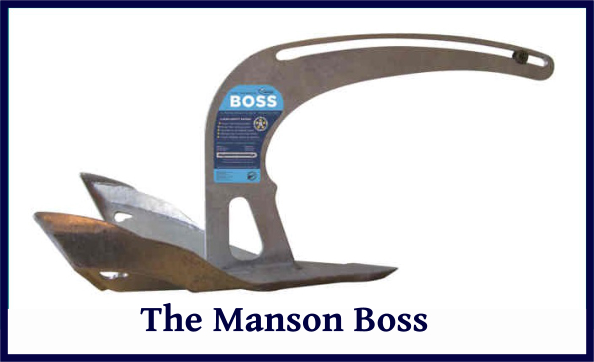
No, this isn’t a review of Marcie... this is an update on our Manson Boss anchor. We purchased our Boss anchor a few years ago when we were cruising the south coast of Australia. Until then, we had been using a 110# (50kg) Bruce anchor, and although it had a few shortcomings, we had been reasonably happy with it. The south Australian coast is known for its hard sand bottoms with very thick, dense grass, however, and our Bruce claw was having difficulty digging in. I went in search of the perfect anchor – one that would serve us well there and also perform well in most other bottom types. I wrote a blog on the topic, and ended up choosing a Manson Boss anchor. manson boss anchor
I was recently asked to do a talk on anchors and anchoring techniques at the SSCA Gam in Melbourne, FL in November. As I started preparing for it, I thought this would be a good opportunity to update my thoughts on our Boss, now that we’ve used it for a few years in a variety of bottoms. So, here’s my review of our Boss anchor:

  • General. The Manson Boss is a scoop type anchor like a Bruce, except it has a very sharp, reinforced point, giving it the ability to dig into the bottom. It also has huge, up-turned flukes that ensure it is self-righting and which give it tremendous holding power once it digs in. It comes in a range of sizes from 5 lb. (2kg) to 400 lb. (182kg). We bought the biggest size that would fit our bow roller, the 80 lb. model, which was a size or two larger than the recommended size for Nine of Cups. We’ve used it in a variety of bottoms, from the hard, grassy bottoms of southern Australia, to soft sand, hard and soft mud, rocky bottoms and shell beds.


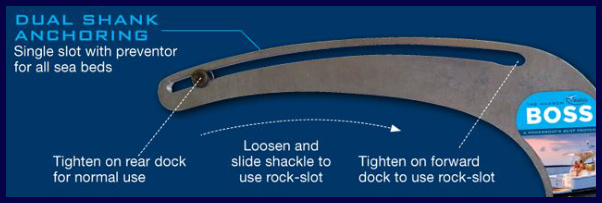
  • Strength. The Boss is made of a high tensile steel. The only issue we had with the strength and construction was the upper part of the shank. The anchor has a slot along the shank that allows the anchor shackle to slide up the shank, making it easier to free the anchor if it becomes wedged in place in a rocky bottom. Manson includes a “shackle preventer”, essentially a nut and bolt that will prevent the shackle from sliding along the slot if the owner feels uncomfortable with the feature or won’t be anchoring in a rocky bottom. Our “shackle preventer” didn’t last long, and we bent the upper part of the shank trying to get it loose from one particularly rocky seabed. We removed the preventer, straightened the shank, and have had no further problems.
bvboss-shank

  • Mud Bottoms. This anchor grabs and holds extremely well in the muddy bottoms we’ve encountered. Only once did we drag. This was in the Albemarle Sound in North Carolina a few months ago. We backed down hard on the anchor and thought we were stuck well on one windy night, but woke up a few hours later and found we had dragged a significant distance. My feeling is that we had fouled the anchor somehow when setting it, because it seems to have been an isolated incident - it is usually stuck so well we have to work it free from the bottom.,
  • Hard Grassy Bottoms. This is the type bottom we bought it for, as our venerable Bruce was having difficulty holding in those thick, grassy, hard sand bottoms, and were happy with it for the most part. We had a few occasions when it took several attempts to get it to dig in, but we eventually got it to hold. On one occasion, we tried unsuccessfully for more than an hour to get it to set, and had resigned ourselves to leaving the anchorage and heaving-to for the night when it finally grabbed and held. We did drag a couple of times, but both times, the anchor reset and held after only dragging a boat length or so. In all honesty, we never slept all that well when the wind picked up in southern Australia. On the other hand, many of the Aussies we spoke to didn’t fare any better.
  • Sand Bottoms. The Boss grabbed quickly and held well in other sand bottoms.
  • Rocky bottoms. Our experience in rocky bottoms isn’t getting the anchor to set, but getting it free once it gets wedged in place. Except as noted above in the “Strength” paragraph, the Boss did well.
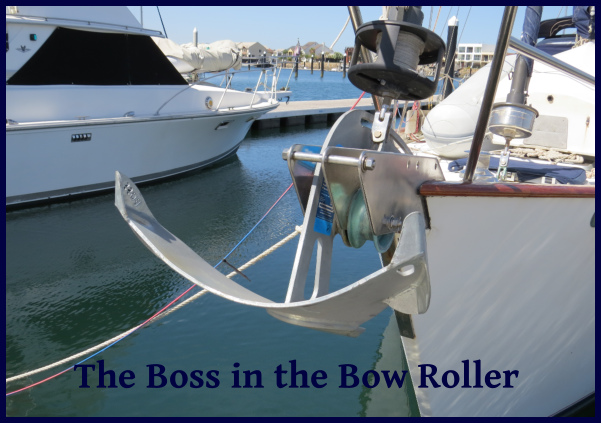
  • Stowage and Deployment. The shank of the Boss is curved, making it fit well in our bow roller. It deploys well and we rarely have problems bringing it back into the bow roller (unlike our big Bruce, which had to be coaxed out of the bow roller and usually smacked the bottom of the roller furler on its way out). The only issue with stowage has to do with the large flukes. When we are in heavy seas, the waves hitting the flukes cause the anchor to bang into the bow roller and roller furler, and I had to go to great lengths to secure it well enough to prevent the anchor causing damage. In storm conditions, I would want to stow it on deck – somewhat of a hassle given its size and weight.
bvboss-stowed

Overall, I would rate the Manson Boss as a B+ to A-. It set and held quite well in most of the bottoms we encountered, especially in mud and sand. In southern Australia, it was better than our Bruce, but was less than perfect. The anchor, as well as the bow roller and roller furler take a beating in heavy seas. It is a good all-around anchor and I don’t regret buying it. On the other hand, I don’t consider it the perfect anchor - if there is such a thing.
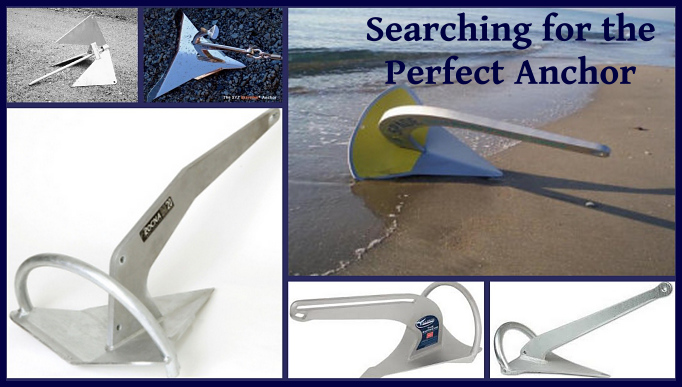
bvboss-collage

If only I had unlimited time and money, I’d make a short list of half a dozen or so anchors and try them out in the worst anchorages we’ve encountered around the world - to see whether the perfect anchor really does exist.

Smithsonian's Museums - the WOW Factor

smithsonian-graphic Day 11 – Moored, Washington, DC

Each day that we've gone out exploring, we've been visiting one of the Smithsonian's museums. According to the Smithsonian Survival Guide (free/$1 donation), the Smithsonian Institution includes 19 museums, the National Zoo, 9 research centers and 12 public gardens. Seven of the museums plus the National Gallery of Art and several public gardens surround the National Mall. We decided which ones held mutual interest and visited those first. As with most national sights in Washington, DC, entrance to all the museums is free.

smithsonian castle washington dc

The Smithsonian Castle seemed the logical place to start, but we didn't start there. (Logic...schmogic!) That said, it's where my blog post starts. The building was completed in 1855, and the museum's entire collection was originally housed here. The Castle is now the Visitor's Center and the Smithsonian icon. An interesting note … James Smithson (1765-1829) was a very wealthy English scientist. He bequeathed his entire fortune to his nephew with the provision that if his nephew died without heirs, his fortune would go to the United States “for the creation of an institution dedicated to the increase and diffusion of knowledge” in Washington, DC. More interesting? Smithson never set foot in the USA. He is buried in a crypt in the Castle...the only person to be interred on the National Mall.

smithson's crypt at the smithsonian in washington dc

Now … on to the museums …

The Air & Space Museum was highest on both David and Paul's list, so we visited there first. This museum details the history of flight. The museum boasts more than 50,000 artifacts, plus a planetarium and an IMAX theater.  We tagged along on a guided tour of the highlights of the museum which took us from Icarus to space travel and everything in between. Talk about mind-boggling! The highlights were Wilbur & Orville Wright's 1903 Flyer, Lindbergh's Spirit of St. Louis, lunar space landing vehicles, rockets, jets … if it flew or flies, it's probably here. smithsonian air and space museum washington dc

Lucky for us, the Wright Brothers were home and consented to having their picture taken with us. Timing's everything.

pic with the wright brothers at the smithsonian

I had voted for the Hirshhorn Museum & Sculpture Garden and since it was just across the street from Air & Space, we headed there next. The Hirshhorn is a circular, drum-shaped building with an outdoor plaza and a sunken sculpture garden. It concentrates on international modern and contemporary art and reminded us very much of Tasmania's MONA.

hirshhorn building

hirshhorn art at the smithsonian

We convinced David to pose next to Big Man (artist: Ron Mueck) to give some perspective to the sculpture's size.

big man at hirschhorn museum

Moving right along, we visited the Natural History museum on two consecutive days and still didn't see it all. The museum houses the largest natural history collection in the world and we were once again overwhelmed by all we saw. Henry, the elephant, greeted us in the main hall on arrival. His ivory tusks were too heavy to mount (80# each), so he's had to manage with fiberglass tusks all these years.

henry at the natural history museum

Like every other museum at the Smithsonian, the exhibits were informative, provocative and fascinating. We saw a T-Rex skull and a triceratops skeleton, cave paintings, a giant squid, mummies, hordes of animals and marine life and a whole gallery dedicated to our prehistoric ancestors.  And, the Hope Diamond was on display … all 45.52 carats of it.

natural history museum washington dc

The American History Museum contains three floors of all that's American. We were particularly enthralled with a gallery entitled American Stories. Dorothy's ruby slippers were on display, as were first ladies' gowns, Mohammed Ali's gloves, Bert & Ernie, Edison's light bulb, Lincoln's top hat, the golden spike for the completion of the Transcontinental railroad, the Star-Spangled Banner and Ben Franklin's walking stick, among other memorabilia.

memorabilia from smithsonian

With so many galleries and exhibits to choose from, we had to choose carefully which to visit. We had finally come to the conclusion, we couldn't see everything … not enough time and not enough brain cells to digest it all. We chose two more galleries, On the Water (of course) and America on the Move, a history of transportation in the USA.  David was particularly interested in the Gunboat Philadelphia, a Revolutionary War era gunboat, that was sunk early in the war and only recently discovered, recovered and brought to the Smithsonian. All three were excellent choices and we learned a lot, but our minds were full to the brim when we left.

gunboat philiadelphia smithsonian

The African American History and Culture Museum opened with great celebration while we were in DC. The lines were long and we opted to wait until our next visit to check out this museum. Good thing, because we couldn't take in many more museums.

african american history and culture museum washington dc

We were so impressed with all we saw, we became members of the Smithsonian. What better way to show our gratitude for such a stupendous institution.

There's still more DC to share. David's Blue View will take precedence tomorrow, then on Sunday we'll report about our visit to the Money Factory and the National Gallery of Art. Check it out.

A Capitol Tour and Library of Congress

capitol-tour-graphic Day 10 – Moored, Washington, DC

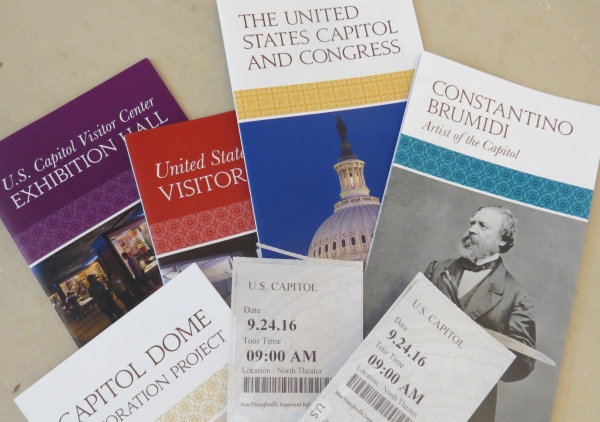
We were up early and ready to tackle another day of being tourists in Washington, DC. I was able to book a free tour of the Capitol Building on line and we headed there first. There's no lack of information nor brochures available about the Capitol and I took advantage of them all.

brochures and tickets for washington dcSituated on nearly 60 acres of winding paths, trees and flowers at the east end of the National Mall, the Capitol Building grounds “reflect a plan completed in 1892 by renowned landscape architect Frederick Law Olmsted”.
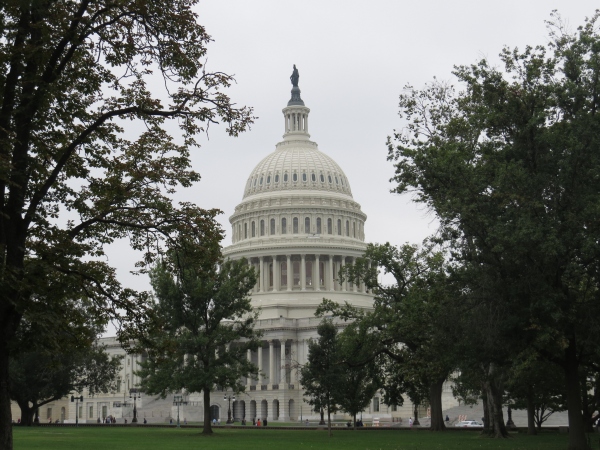
capitol building washington dc

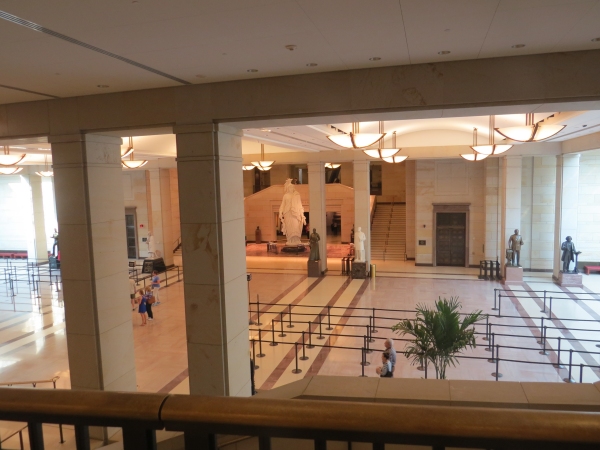
The Capitol Visitor's Center was completed in 2008 and it's absolutely grand. It's wide and expansive, with marble floors and pillars. We passed through Security, picked up our passes and spent some time in the informative Emancipation Hall exhibit area while waiting for the tour to begin.

capitol building exhibition hall washington dc

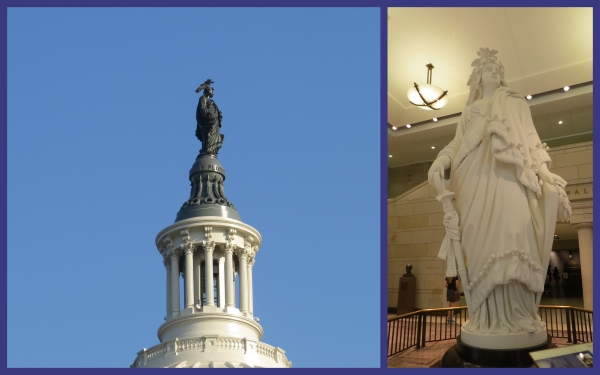
A full-size plaster model of the Statue of Freedom dominates the entrance to the Exhibition Hall. The American sculptor, Thomas Crawford, designed it as the topper for the US Capitol Building. Its 20', 15,000 pound, bronze counterpart has stood atop the cast-iron Capitol dome since 1863. The plaster model has been shuffled around from the National Statuary Hall, to the Smithsonian, to storage and then here when the Visitor's Center opened in 2008.

statue of freedom capitol building washington dc

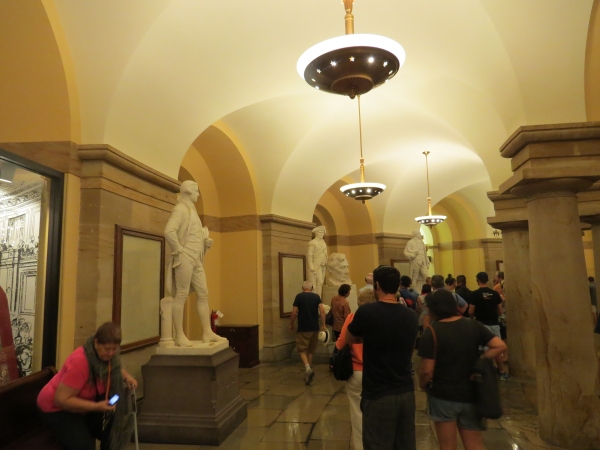
We watched a 15-minute introductory video and then met our well-rehearsed tour guide. Our group of about 25 people followed like sheep as the guide pointed out key statues and architectural features, showed us the old Supreme Court headquarters, the Senate chamber and narrated the history of the Capitol building. In the Hall of Statuary and throughout the building, statues of famous men and women were on display. Each state is allowed two statues and all are displayed somewhere within the Capitol Building.

hall of statuary capitol building washington dc

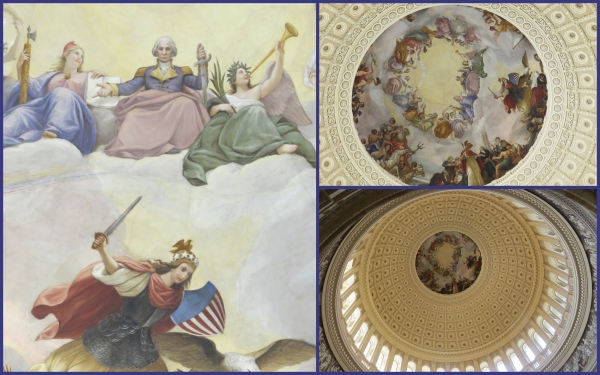
The pièce de resistance, however, was the Capitol Rotunda, the eye of the Capitol dome. Italian immigrant, Constantino Brumidi , was responsible for most of the murals and wall paintings within the Rotunda, including his exquisite masterpiece, The Apotheosis of Washington, which adorns the ceiling of the Rotunda.

capitol rotunda washington dc

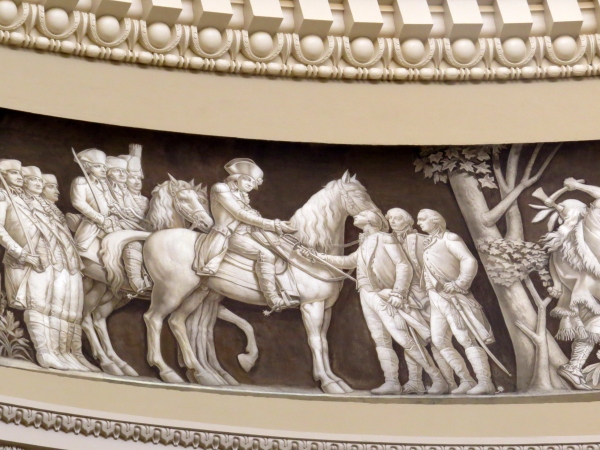
A frieze encircles the base of the dome and depicts significant events in American history including the landing of Columbus, Cornwallis' surrender to Washington, the discovery of gold in California and the Wright Brothers. The fresco technique used was “grisaille, a monochrome of whites and browns to give the effect of sculpture”.

capitol rotunda fresco washington dc

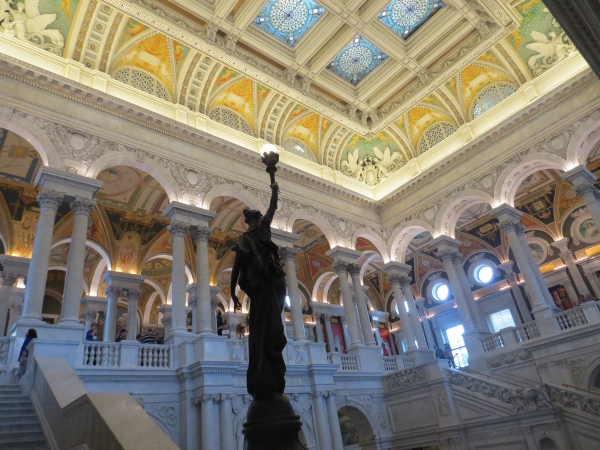
When the tour had ended, the guide suggested we take the underground tunnel from the Capitol to the Library of Congress, a building, he said, was the most beautiful in Washington. How could we resist? “The Library of Congress [established in 1800] is the world's largest repository of knowledge and creativity with a collection of more than 162 million items.” We entered the Great Hall, the centerpiece of the building, and gasped in wonder at its incredible beauty. Wow!

library of congress great hall washington dc

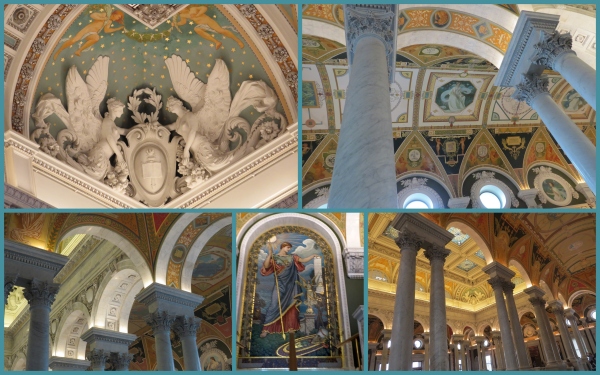
In a Beaux Arts tradition, the heavily ornamented ceiling and walls were exquisite. Stained-glass skylights cast a warm glow on the two marble staircases that flanked the hall and led to the second floor at mezzanine level. There was too much for the eye to see and the mind to contemplate in one session.

library of congress washington dc

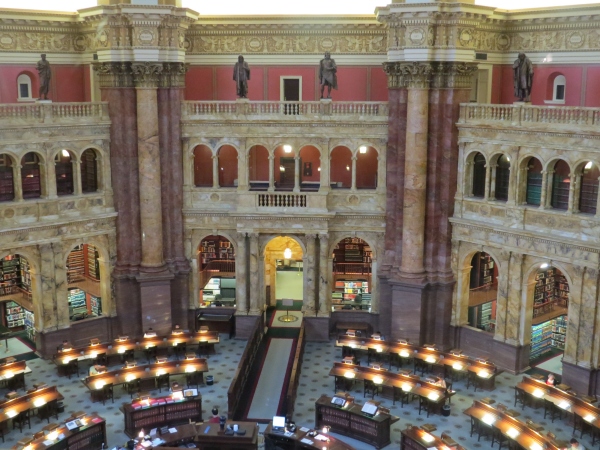
We climbed another marble staircase to a special gallery that overlooks the Reading Room, a center for research and study.

library of congress reading room washington dc

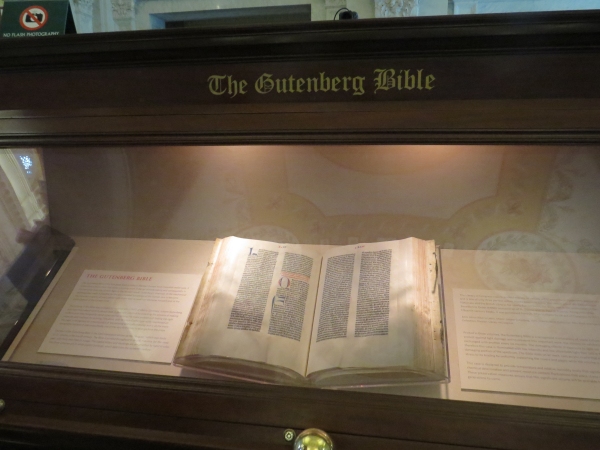
We wandered through the Great Hall and exhibits and side corridors and rooms taking in everything from Bob Hope's funniest jokes, to Marvin Hamlisch's Oscar for Best Score in The Way We Were to the Gutenberg Bible.

gutenburg bible at library of congress washington dc

Once again, we were awed and overwhelmed by what we had seen and experienced. These are not places that can be viewed once and checked off as “been there, done that”. These are incredible places that might take a lifetime to totally take in and comprehend and beckon visitors to return over and over again. For us, we needed time to digest and appreciate. We caught a late lunch at one of the food trucks that line the National Mall, wandered around town some more and by late afternoon, tuckered out in body and mind, headed back to Cups.