PV - Easy-to-Make Fender Covers

Yes, PV … that's Pink View. I know you were expecting the Captain today, but he's up to his eyeballs in alligators, I mean alternators, so you'll have to settle for me instead. That said, this is the how-to blog on making fender covers that I promised the other day. Fenders act as “bumpers” to keep Nine of Cups off the dock and prevent her hull from being scratched and chafed by whatever sticks out from the dock, like cement or wood pilings. Covering them is partly cosmetic … it looks better ... and partly to keep the fenders from rubbing and scuffing the hull. There are pros and cons to using them, but we find them quite useful. Our last fender covers, or fender boots as they are sometimes called, were purchased in Australia and they never fit quite right and were looking pretty ratty. I'd repaired a couple of chafe spots in the past, but their current condition was beyond repair. It was time for something new.
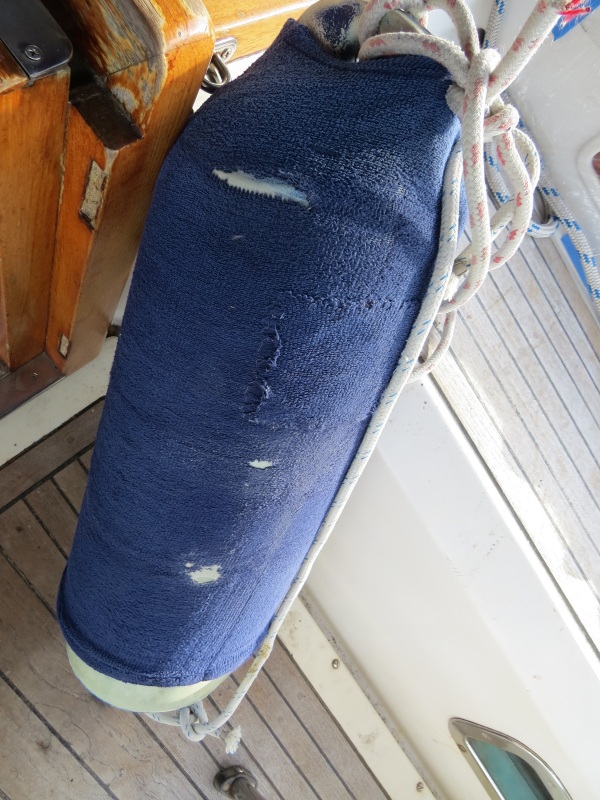
old fender covers

I saw some in West Marine on-line … ~$40 for the size that would fit our fenders and we needed three of them. Yikes! I looked for a pattern on line and found some how-to directions, but none seemed all that cheap nor reasonable until David happened upon a sailing thread that mentioned using sweat pants as fender covers. Brilliant!

Here's how …

  1. Measure the circumference and length of the fender to be covered.
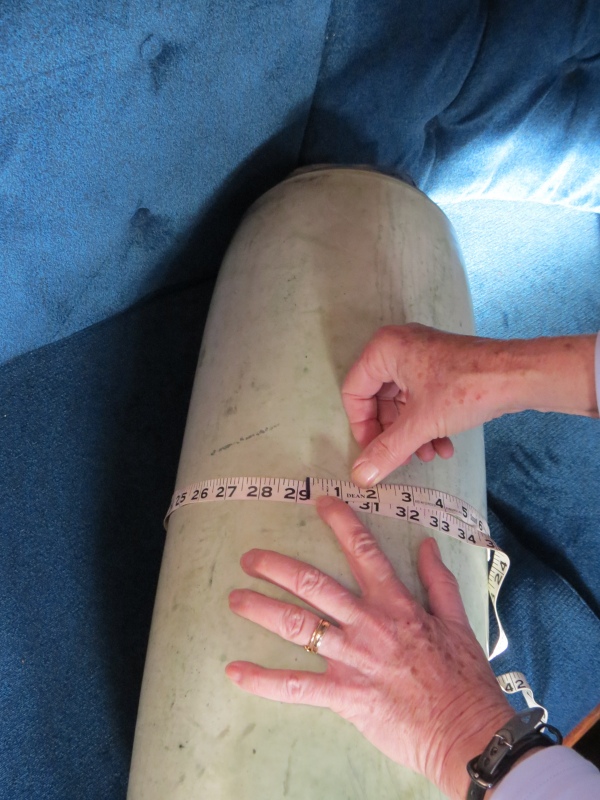
    measuring the fender covers

  2. Purchase sweat pants in your choice of color(s) at a thrift shop or discount store, e.g. WalMart, with the following criteria:

    * Be sure the pants are elasticized on the leg cuffs

    *Measure the width of the pant leg and multiply x2. That number should equal the circumference of the fender. For instance, the circumference of the largest fender was about 29”. We chose size 3XL sweat pants for it and a 2XL was large enough for two slightly smaller fenders. Remember the pants have a bit of stretch and the final fit needs to be snug.

    *Measure the length up to the crotch of the sweat pants to be sure the “leg” is long enough.

    *You can make two fender covers from each pair of sweat pants.

  3. Stuff a fender into a pant leg bringing the elastic end as far as it will go, but keeping the attachment ring on the end exposed. It should be a snug fit.
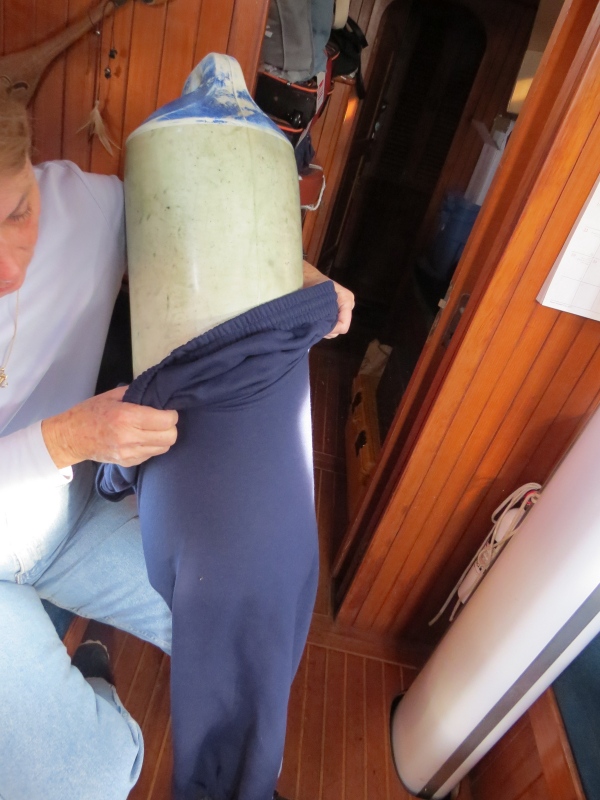
    stuff the fender in the pants leg

  4. Measure the length allowing for a 1” seam at the cut edge and mark accordingly. Remove the fender and make the cut.
  5. Stitch along the top edge, leaving a 1” tube through which you can draw a small length of line.
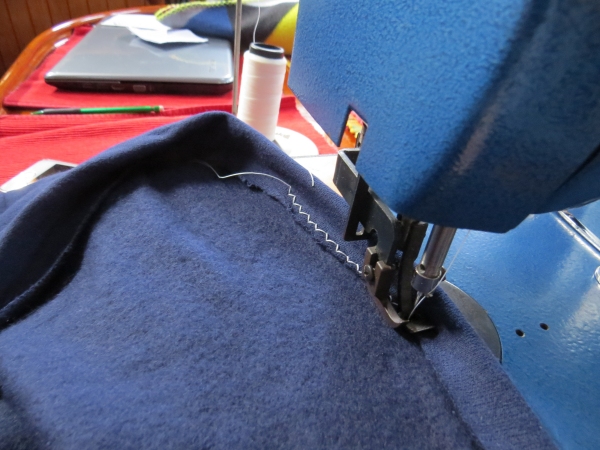
    stitich it up

  6. Make a small cut in the tube and insert a piece of line attached to a safety pin (or paper clip) and work the line through the tube, drawing it through as you go until it meets the other end of the line. Seize the end(s) of the line with a lighter to keep it from unraveling.
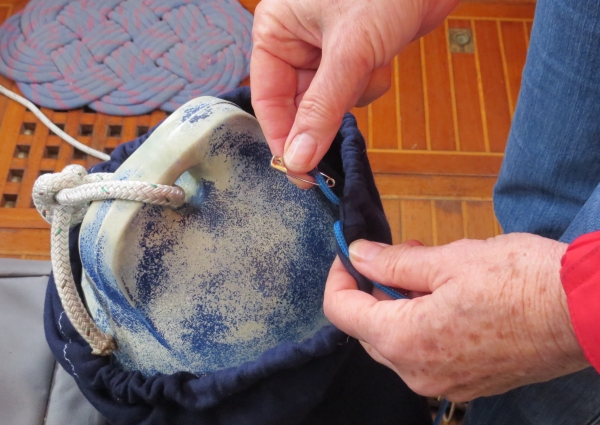
    draw string through the tube with pin

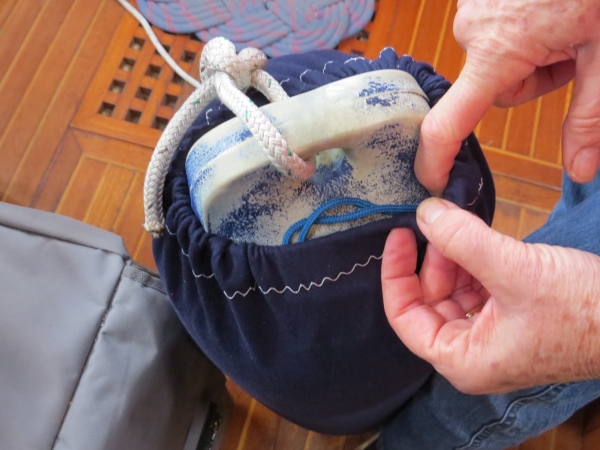
  7. Slip the cover back onto the fender drawing it up snug and tight from one end to the other. The elastic cuff will keep one end in place.
  8. Cinch the drawn line tight on the other end. Tie a knot and tuck it inside the fender cover.
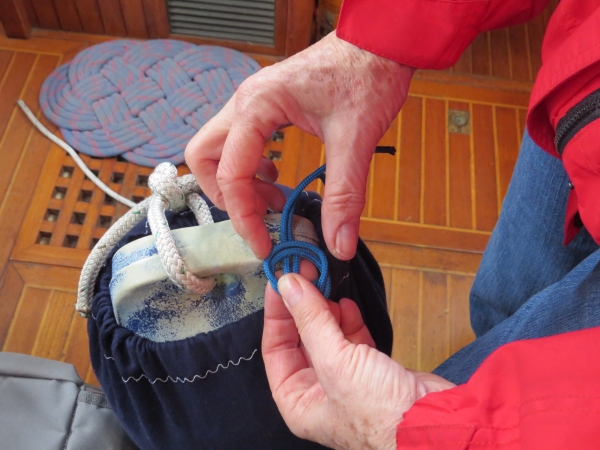
    make a knot and cinch it up

    tuck the line in

  9. Attach lines to the attachment rings as you usually would and make fast to the boat.
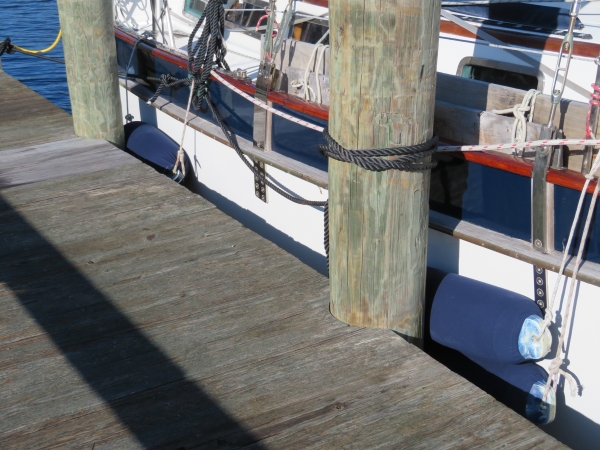
    new fender covers

Voila! A fender cover that looks great and protects the hull. The only maintenance required is periodic laundering. Hint: If you don't drag your fenders in the water, you won't have to wash them as frequently.

Total cost: ~$4.00/fender cover

Sweatpants at WalMart - $7.36/pr + local tax (makes two fender covers)

A bit of thread, about 18” of small line and 20 minutes of my time.

We Pink View girls are very budget-conscious and handy to have around.
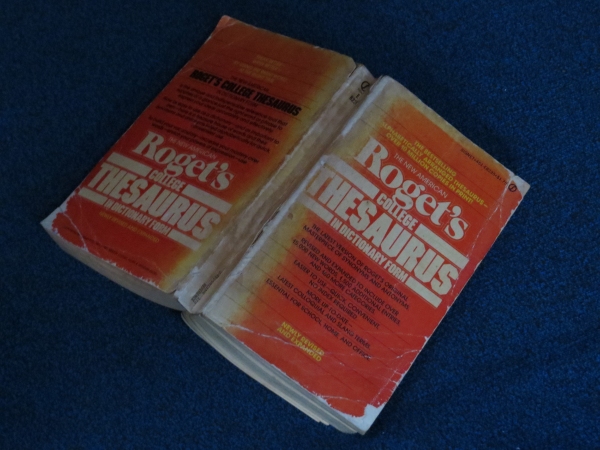
Roget's Thesaurus & Other Dinosaurs

According to many sources, today is Thesaurus Day, an unofficial holiday commemorating the birthday of Peter Mark Roget, best known for Roget's Thesaurus. I still have a battered, dog-eared hard copy of Roget's aboard … 1977 pub date. I knew you'd be impressed. We don't always have internet and I never know when I'll need just the right word and Roget's is chockablock full of them. I admit, however, that having a hard copy of any book aboard makes it a dinosaur.. roget's thesaurus

When we have internet, I do use thesaurus.com and love it, but on the boat, we do not have the luxury of staying on-line all the time … nor even keeping our laptops plugged in and on continuously for that matter. I use an off-line dictionary/thesaurus, Artha, on occasion, but I find pulling the thesaurus from the bookshelf and thumbing through the pages is just as easy and probably more satisfying.

thesaurus dot com


Some thesaurus trivia for you (because you know how I am). The word thesaurus comes from the Greek word, thesauros, meaning treasure or storehouse. First published in 1852 with 15,000 words, Roget's is still one of the most widely used reference books in the English language around the world. Since 1852, the book has never gone out of publication. It is believed that Roget worked on making word lists as a way to combat depression and mental illness, much like Word Find and crossword puzzles are encouraged to ward off (or at least delay) the onset of dementia

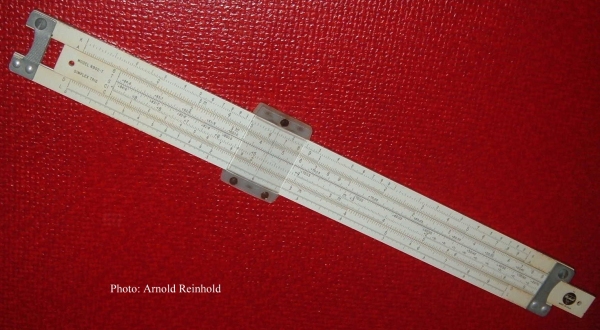
Roget is also known for inventing the log slide rule in 1814. Talk about dinosaurs! Just as an aside, I asked David if he'd still be able to use a slide rule and he said “Of course, I would. It's easy!” Anyone out there remember taking a trig class in high school and having to figure out how to use a slide rule? Not one of my favorite memories. I'll stick with the thesaurus. By the way, when I located this slide rule pic on Wikopedia Commons, it's listed as an “artifact”.

slide rule an artifact

The topic of dinosaurs aboard, however, stirred up a conversation with the captain. We started listing techno-dinosaurs like dial telephones, pay phones, dial-up internet, tube tvs and typewriters. Then there were those we think are near extinction like landline phones, fax machines, telephone books, travel agents, hard copy newspapers and magazines and brick and mortar bookstores. We kind of mourn the fact that kids no longer have to learn cursive writing nor the multiplication tables nor how to tell time on an analog clock or count back change. Are we sounding like old curmudgeons?

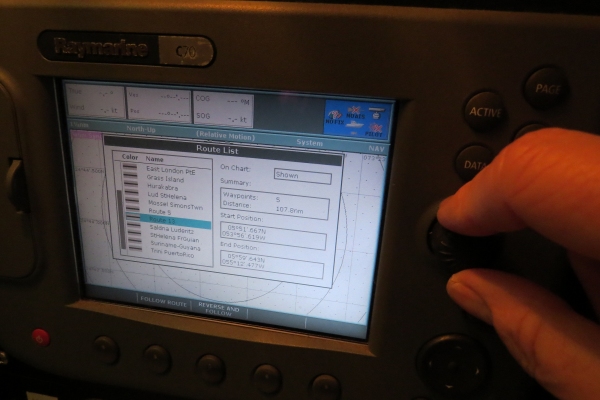
We wondered just how many items we might have aboard that are extinct or on the verge. Our paper charts, for sure, though we find ourselves relying on them less and less. We've still got CDs and DVDs aboard, too. Our chartplotter (2008) requires us to turn knobs and dials instead of using a touchscreen. Yikes … nine years old and a dinosaur already.

antiquated chartplotter

Don't get us wrong. We really do try to embrace new technology. ATMs, GPSs, Wifi and on-line banking allow us to live the life we lead pretty-much hassle-free. Amazon Prime, now that we're back in the USA, has been a godsend.

Yet technological advances are coming so fast and furiously and there are so many things out there that seem superfluous, we have to sit back and wonder if we need all the extra gear, aka “stuff”, that's available and we're encouraged to buy. There's something to be said for a simpler life with fewer toys and a bit more expended effort. Perhaps, we're dinosaurs?

Warming Up & Staying Busy in Chesapeake

“If you don't like the weather … wait a moment, it'll change” is a quote attributed to Mark Twain about New England, but it seems to fit here in Virginia, as well ... except for the “moment” part. The bitter cold weather we recently experienced is history now. It was 17F / -8C outside a week ago today (and 49F/ 9C inside!) and 70F/21C by last Thursday. The temps have been hovering primarily in the 50s and 60s (10-15C). Needless to say, we appreciated watching the river ice melt away. We have definitely embraced the change. river ice

Keeping warm a week ago was a matter of triple and quadruple layering, wearing a scarf, mittens, heavy socks and hat … indoors! Our flannel sheets and bed warmer kept us comfy at night, except our ears and noses always seemed cold. We groused over morning walks up the dock. We had three small electric heaters on timers churning out BTUs day and night. It was uncomfortable, but not untenable. We ate bowls of hot oatmeal for breakfast and homemade soups for lunch and dinner. I happily baked a lot … and at times seriously contemplated jumping into the oven myself.

All bundled up on the saloon settee with a heater at our feet, we busied ourselves with writing and reading. David fixed the old alternator that had crapped out last autumn. He removed the forward head and began sanding the sole in preparation for varnishing when it warmed up and the installation of a new head. He's also involved in an alternator evaluation study and worked on test jigs and protocols. I got an article or two sent off to SSCA. We climbed into our bunk early in the evenings and stayed in our warm bed as long as we could in the mornings.

sanding the forward sole

Now the heaters are off, the temps are mild and our spirits have warmed up accordingly. The gentle sound of melting snow trickling from the boat and wharf into the river below was music to our ears till finally the snow and ice was all gone. David has continued work on his alternator project, but much of it now entails working outside on the dock … a bit easier with no snow and non-frigid temps. I should be working on either the book I'm writing or the website and, of course, I'm doing neither. Instead I've been doing some sewing. Awhile ago I made some curtains for the aft bunk and bought enough extra fabric to cover some pillows which I've never done. This week, I ferreted out the fabric (that took a couple hours since it was well stowed … read that “lost”) and made the pillow covers.

pillow covers

We also needed some replacement fender covers. I searched on-line for either a pattern or instructions and David found one on a sailing forum that made so much sense and was so easy, I'm sorry I didn't think of it myself. A how-to blog will follow in a few days. In the meantime, the fender covers are done and on the fenders and look great.

fender covers

We hadn't been walking much lately, neither in Boston nor here, due to cold temps and inclement weather and I've regretted it. With the return to reasonable weather, we've been walking daily and feeling all the better for it. We're energized! Having no car handy to get to the supermarket or hardware store and having to walk to the toilet several times a day facilitates our achieving the goal of 10,000 steps a day, believe me.

There's been a bit of social interaction. A few cruisers have passed through on their way south and stopped for the night at AYB. One couple came aboard for drinks and we've chatted with others. A Canadian couple has been living aboard here since late last autumn trying to sort out multiple engine issues. We see them quite regularly and empathize with them about their boat problems. Otherwise, we are pretty much left to our own devices at the far end of the dock and, quite honestly, it suits us just fine.