
The Blue View: Knots
/ Knots hold a real fascination for me. I particularly appreciate a well-tied knot that is perfect for a specific application. There are a handful of knots that most sailors know and use frequently...the bowline (BO-lin), the reef knot, and the clove hitch come to mind. Marcie knows the basic knots, and in fact, can tie a bowline faster than anyone I know. But beyond these, and maybe tying a bow in her shoelaces, she quickly loses interest in knots.

I have several books aboard that show how to tie a number of useful knots, but to my knowledge, the absolute best reference is The Ashley Book of Knots. If you've ever read The Shipping News by Annie Proulx, you might remember that each chapter begins with an excerpt from Clifford Ashley's book. He spent his life not only identifying and cataloging knots, but researching their uses and history. It took him eleven years to compile them in his book, which describes 3,854 knots. While the majority of the knots are intended for the sailor, there are knots for every purpose imaginable. Want to secure a bale of cotton? Knot #2073 is the one to use. Want to hoist a horse aboard your boat? Knot #2192 is the one for you. Want to make a snare? You might look at Knot #477.
A couple of decades ago, Marcie bought me a copy of Ashley's for my birthday. It is now falling apart from heavy use. It's water stained from a dousing it endured a few years ago. The dust cover has long since left this world. It still remains one of my favorite books.
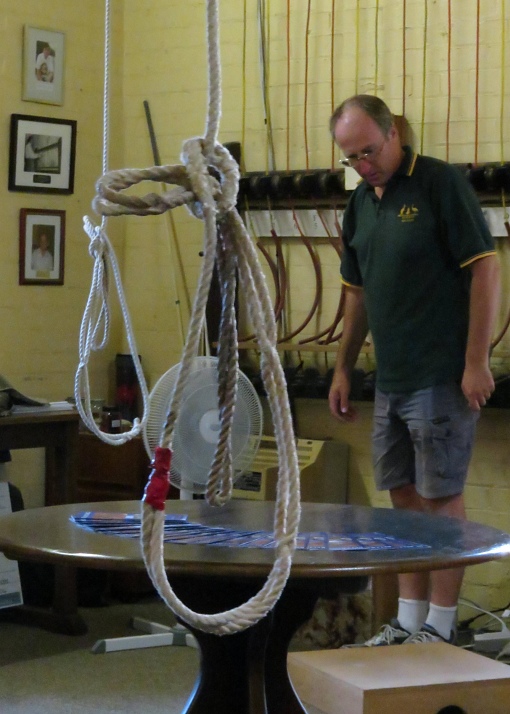
One of my many uses for it is to identify a knot I've encountered somewhere. In a recent blog post, Marcie wrote about visiting the bell ringers at St. David's Cathedral. Something I noticed was that all 12 bell ropes were secured in nice coils using the exact same knot. I asked the bell ringer whether this knot had a name and whether all bell ropes were secured in this fashion. He didn't know if it had a name, but he said that that was the knot he was taught to use. When we returned to Cups, I looked through Clifford's book, and sure enough, knot #172 is the Bell Ringer knot. Knot #173 is an alternative that is used if the bell rope is extra long or heavy.
While we were traveling in the interior of Ecuador once, we happened onto a farmers' market. All sorts of local animals, including dozens of pigs were being taken to the market for sale. I noticed that each of the pigs was being led by a rope using the same unusual knot. All the farmers seemed to know and use this knot for their pigs. It was a three-loop harness, one loop going around the pig's neck, and the other two loops going around the pig's front legs. I later found this exact knot in Ashley's. It was Knot #1110, a knot originating in South America and used widely as a hackamore or emergency bridle. Apparently, it is also the preferred knot to lead a pig to market.
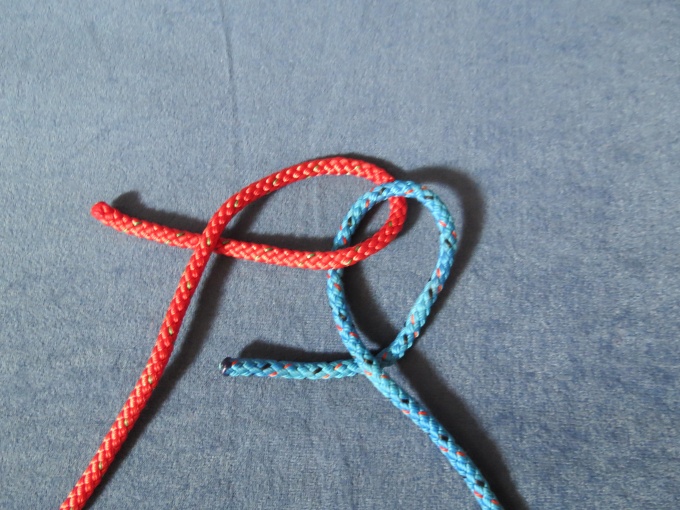
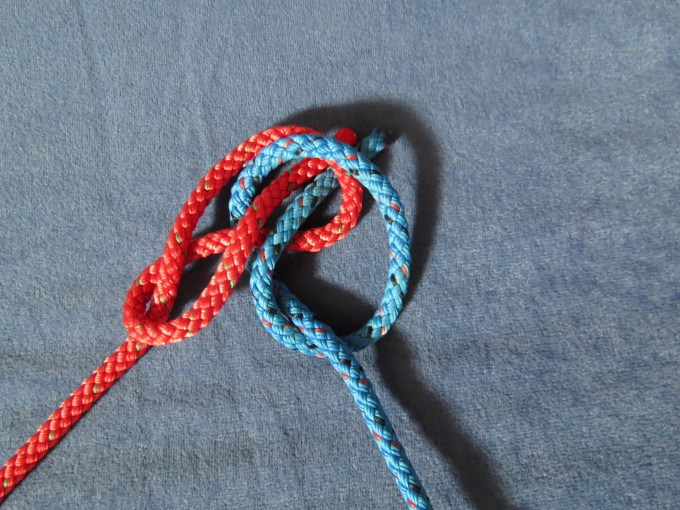
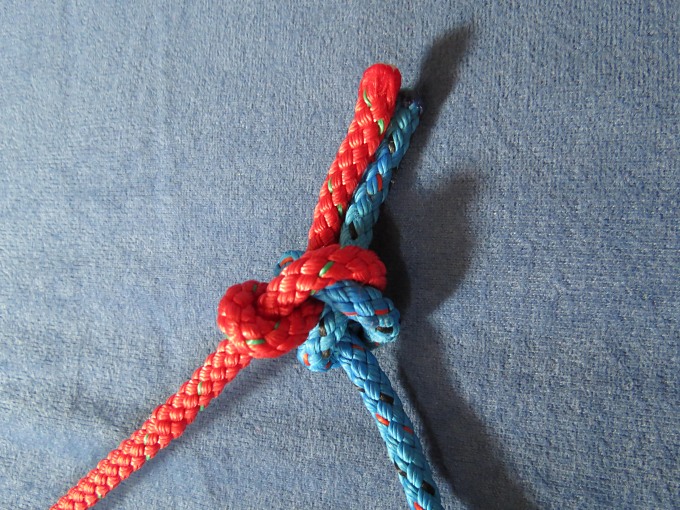
Ashley invented a number of knots as well. He was a modest man and never named them after himself, but over the years, many were given his name. My favorite of his knots is called the Ashley Bend. A bend is a type of knot used to unite two ropes or the ends of the same rope. The Ashley Bend, only referred to as Knot #1452 in his book, is easy to tie, is strong, but never jams or slips. I find it particularly good for tying bungee cord into a loop. The following photos show how to make it.
-------------------------------------------------------------------------------------------------------------------------------------------------------------
Days and Ways to Celebrate Them
A daily list of mostly obscure holidays and fun ways to celebrate them.
Bird Day
celebrates our feathered friends. Can you identify all the birds in your own back yard? Consider doing some birdwatching or learning more about birds in your area...or even in my area. Check out our bird pages.


