The Blue View - Fish Hooks

Fishing aboard Nine of Cups is not so much for sport as it is a method of provisioning. This wasn't always true. When we first started cruising, I would troll with a rod and reel, and when we got a fish on the line, we'd douse the sails and I would fight the fish until either he managed to get free or I landed him. This was never an Old Man and the Sea type epic battle, but sometimes it might take an hour or so to be resolved.  
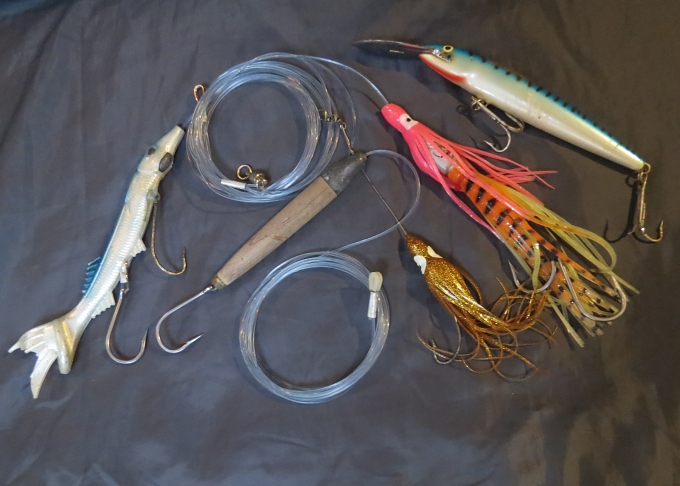
fishing hooks


Now we fish more like a single-hook long-liner. I troll with a lure attached to some seriously heavy tackle, and if we hook something, we tow it until it tires, then we crank it in with a winch. If it breaks the line, it is much more fish than we want to try to bring aboard. We catch enough fish that when Marcie is provisioning for a passage, she assumes 40-50% of our protein will be fish.

Since fishing is such a big part of our lives, I have a fair assortment of fishing tackle which was collected over the years. I used to buy expensive lures, but now I find that weighted champagne corks with feathers and tinsel are just as effective and a lot less painful to lose.
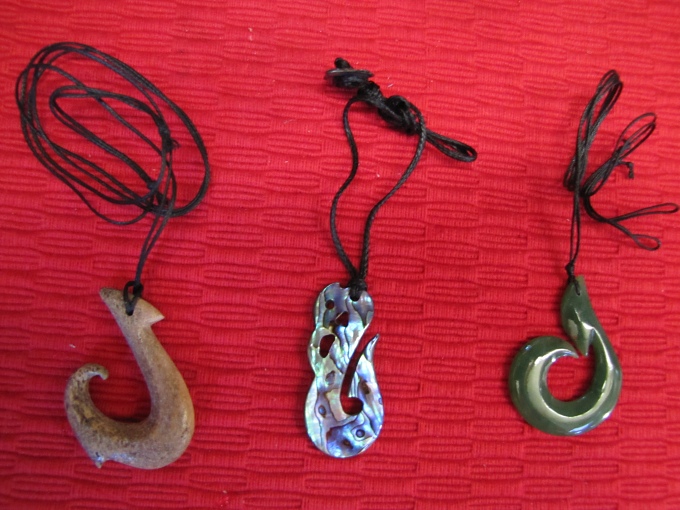
 

new zealand fishing hooks


Before metal hooks were available, people throughout the world carved hooks from bone or shell. They were bright and sparkly and probably worked as both a lure and a hook. When we were in southern Chile, we were wandering around a small fishing village and came across a local artist who specialized in bone carvings, some of which were stylized fish hooks. They were absolutely beautiful, and after negotiating a fair price, I bought one … as a present for Marcie.
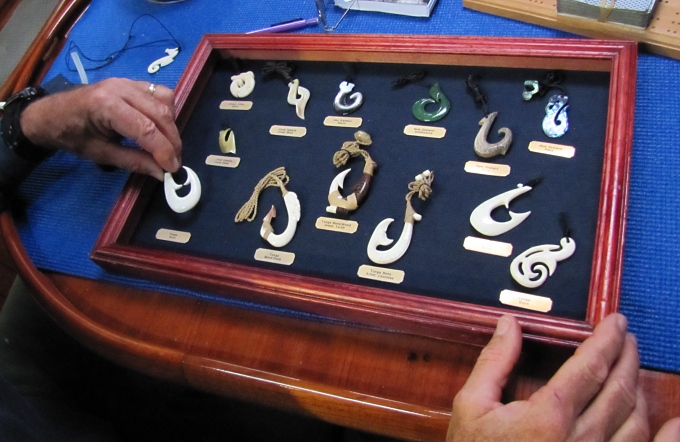
 

shadowbox display of fishing hooks


Since then, we have discovered artists in almost all the island cultures throughout the South Pacific who have used the look of the traditional fish hooks of their culture to create works of art. Each culture seems to have its own style. I have collected hooks from Easter Island, French Polynesia, the Cook Islands, Tonga, and New Zealand. They are made from bone, shell, wood and even greenstone (jade), and each is unique and a thing of beauty.

Since the beauty of the hooks is their artistry and material, I spent some time mounting them into a shadow box display which hangs in the salon. And since I can now call it artwork, Marcie has less trouble accepting the fact that I've accumulated more fishing tackle.

Days and Ways to Celebrate
A daily list of mostly obscure holidays and fun ways to celebrate them.
Tell a Fairy Tale Day
What's your favorite fairy tale? Cinderella, Hansel & Gretel, Snow White? There are hundreds to choose from. Pick a new one, read an old favorite or make up a new one. Download fairy tales for free...Hans Christian Andersen, Grimm, Aesop...just tell a tale today.

The Blue View: Recycling Old Line into Ocean Plait Mats

Ocean_Plat9  

On Nine of Cups, there is not a single piece of rope that is actually called rope. We have halyards, sheets, outhauls, vangs, preventers, reefing pendants, dock lines, snubbers, anchor rode, painters and lanyards, but no rope. Even a coiled, spare section of rope is called “line” and not rope.

Some mariners will say rope becomes line as soon as it is brought aboard a boat. Others say it is rope until it is cut from the spool. I've also seen a definition that states that it is only called rope if it is greater than a given diameter, otherwise it is generically called line. By any of these definitions, we have no rope aboard Cups. I couldn't always make this claim. A few years ago we had an outhaul made of stainless wire that is called wire rope. So we did have some “rope” aboard, even though it was made of stainless, but even this “rope” has now been replaced with synthetic line.

While we may not have any rope aboard, we do have many hundreds of feet of line on Cups, and all this line is constantly wearing out, due to chafe, UV, fatigue and old age. We probably replace two hundred feet of line a year. So what do we do with all the old line that is no longer usable? It seems a shame to just throw it away.

One of the uses for old lines is to make Ocean Plait mats or rugs. Traditionally these mats were used aboard ships as chafing gear. We sometimes use them for the same purpose, to protect the deck from being damaged when setting a propane tank on it, for example. They also make nice welcome mats on the dock to wipe our feet before coming aboard and they're are easy on the feet when we have to stand at the helm for long periods. They are very nautical and quite attractive, and make great gifts. You can use small line, 1/8” diameter or so to make coaster sized mats, or large line, 3/4” or so to make rugs.

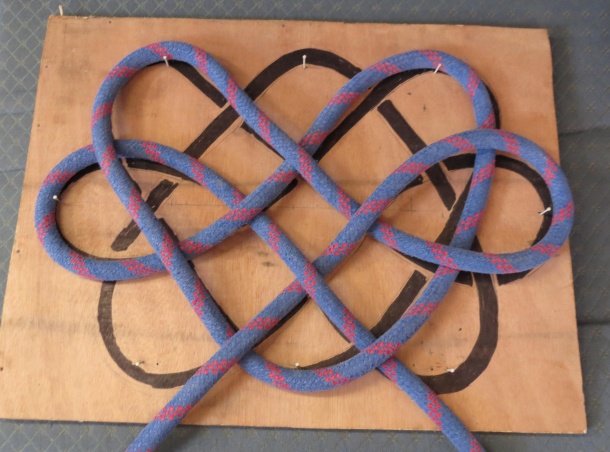
My old friend, The Ashley Book of Knots, describes how to make the Ocean Plait mat (“Ocean Plat” knot #2243). I started with his directions to make the pattern shown below.


Ocean_Plat1


I make so many, I drew the pattern onto plywood, and drove finishing nails into the plywood to help hold the line in place. You could also put nails or tacks into a piece of cardboard, or just print out the pattern on paper.


Ocean_Plat2


You will need about 45 feet of line for a reasonable sized mat made of 1/2” to 3/4” line. Find the middle of the line and start on the left side of the pattern as shown.


Ocean_Plat3


Follow the pattern, paying close attention at each intersection as to whether the line passes over or under itself.


Ocean_Plat4


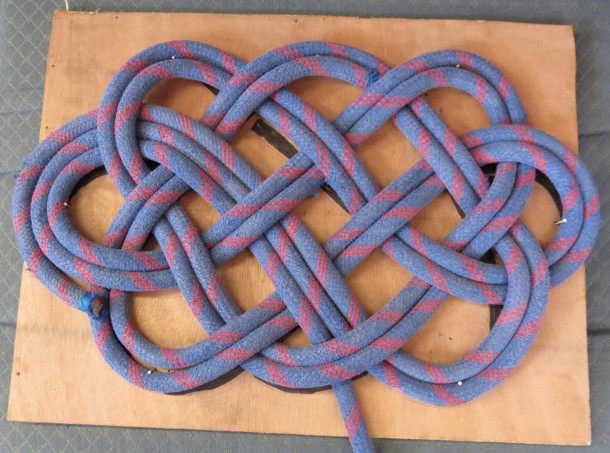
After you complete the first pass of the pattern, check to make sure your mat is correct. It's much easier to undo it and correct a mistake at this stage than it will be later.


Ocean_Plat5


When you are happy with the first pass, take the end of line A and follow line B as shown in Figure 5, doubling the knot.


Ocean_Plat6


Depending on the line size, you will make 3-5 passes to complete the mat. You want the ends to meet in the middle of the mat.


Ocean_Plat8


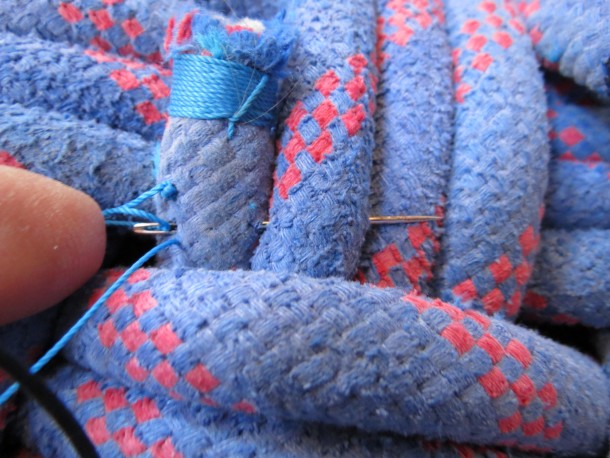
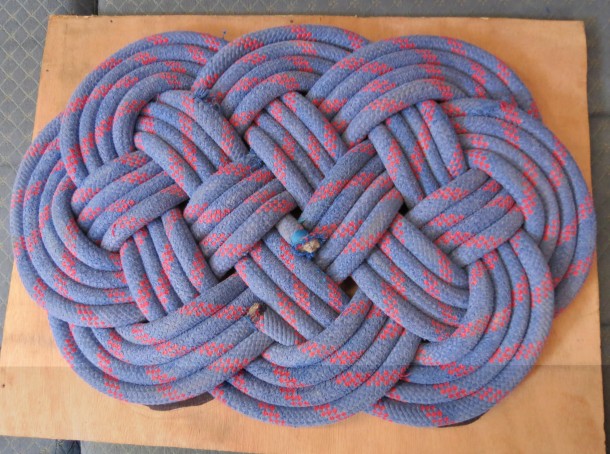
You will have to tighten and loosen some of the loops until the rug looks even and symmetrical, then cut and whip the ends. Stitch the ends to the adjoining line segments and you are done.


Ocean_Plat7


Patience is key. My first mat took hours and I pulled it back apart several times because of mistakes. Now I can make a mat in about 30 minutes.

Days and Ways to Celebrate
A daily list of mostly obscure holidays and fun ways to celebrate them.
Mardi Gras
Christians celebrate Fat Tuesday or Shrove Tuesday, before the austere Lenten season begins. Wear beads and masks of traditional gold, purple and green. It's Carnival...live it up.
Abraham Lincoln's (real) Birthday
He is one of our most honored and brilliant Presidents. From the penny to Lincoln Memorial, we've immortalized our 16th president for his contribution to the country. So lift a toast to Honest Abe tonight and maybe read a little more about him.
International Darwin Day
It's Charles Darwin's birthday, too! Think evolutionary theory and natural selection. Check out our visit to the Galapagos Islands.

Blue View: Refitting in Exotic Places

deck in vanuatu  

Our sailing and passage making pattern over the years usually involves most months of each year cruising. We sail someplace, stay for a short time while exploring, sightseeing and repairing things, then move on. After doing this for 8 or 10 or even 12 months, however, we like to find a place to light for awhile.

For Marcie, this fulfills a need to “nest”. She needs to lay down roots for awhile – a couple of months or so usually does it. I don't mind these respites at all. Constantly moving on, always on your guard for weather changes, hazards, ships and all the other things that can ruin your day is tiring. It's nice to relax in a safe haven somewhere. We take advantage of these breaks to do some inland travel, and from the “Blue” point of view, these nesting times are a good opportunity to start a refit project.


mast in opua new zealand


The definition of “refit” is to “replace or repair machinery, equipment and fittings in a ship”. In my mind, however, a refit project is different from a repair project, the difference being in the magnitude and cost of the project. For example, if the bilge pump quits and I repair or replace it, that's a repair project by my definition. The cost would be under $100 and it would take a few hours to complete. If the water tanks start leaking and I have to replace them, that's a refit project. Now we're talking weeks and more than a thousand dollars. I have no exact definition of when the crossover occurs between a repair and refit, but I have no difficulty categorizing a project as one or the other.


fuel tank  in ecuador


So not only have we had the opportunity to make repairs in exotic places, we've done some major refit projects in exotic places. As a few examples, in Trinidad, our beautiful teak deck boxes were starting to show their age, and I dismantled and rebuilt them. We replaced the standing rigging in Colombia, installed a new chartplotter and radar in Panama, and installed a daytank in Chile. We stopped three times in Ecuador and did a lot of refitting there, including new fuel tanks and a new autopilot. We also removed the teak decks in Ecuador. We really liked the look of our teak decks, but each strip of wood was secured with dozens of screws. Many of the 3000 or so screws began to leak over time, causing problems in the underlying fiberglass decks. After removing the teak, all the holes were filled, the damage was repaired and the decks repainted.


engine removal in new zealand


Likewise, we stopped three times in Opua, New Zealand. The first time we removed and replaced our 26 year old engine from its location under the cockpit. This entailed removing the steering mechanism and hydraulics, as well as the cockpit floor and hoisting all 1000 lbs up and out of the boat while sitting at the dock, then reversing the process for installation of the new engine. Definitely in the refit category. The second time, we replaced our sails; and the third time, we unstepped the mast, replaced the fittings, rewired it, then sanded and repainted it.

I've found the key to successfully starting and completing a refit project is to make sure Marcie is either involved (not usually preferred by either of us) or has projects of her own to complete. We break up the refit and repair projects with inland travel, whether it be by “chicken bus” in Ecuador, car hire in New Zealand or dugout canoe in Panama. Usually by the time I've finished my refit project and we've done a bit of inland travel, we're both ready to move on.

-----------------------------------------------------------------------------------------------------------------------------------------------------------

Days and Ways to Celebrate

A daily list of mostly obscure holidays and fun ways to celebrate them.

“Just Do It” Day

You don't even have to get out your Nikes for this one. Think of something you've been meaning to do for a long time and JUST DO IT.