One of the items on my list to bring back with me on my return to Nine of Cups is a new EPIRB, or Emergency Position Indicating Radio Beacon. Our old model is now 15 years old, and is pretty basic. In an emergency, either it becomes immersed in water or the switch is turned on and it begins sending out an emergency signal that is picked up by two or more satellites. The satellites triangulate the position of the EPIRB and forward the information to the U.S. Coast Guard. They look up our EPIRB registration and call our emergency contacts to verify that we are actually on a passage, then contact any rescue organizations or vessels in our area. If all goes well, this whole process takes only a couple of hours. I remember reading somewhere that the average time spent in a life raft is now under six hours, which is pretty amazing in my view
We know people who have been saved because their EPIRBs worked as advertised and searchers were able to find them at sea. On the other hand, when the vessel Nina went down in the Tasman Sea this past summer with all hands, including our friend Evi, no EPIRB signal was sent. We can only hypothesize that either whatever happened to Nina occurred so quickly that there was no time to release the EPIRB and it went down with the vessel, the boat was not equipped with one, or the unit malfunctioned.
We hold our EPIRB in very high regard. While our life raft and PFDs might keep us afloat, without an EPIRB, we could drift for weeks until a passing ship spotted us or we made landfall somewhere – assuming we didn't drown or perish first. Because it is so important, we take a number of precautions to make sure it does its job if ever it is needed:
Registration. We keep the registration information up to date. It is easy and quick to do online. In the U.S., we have to renew the registration information every two years or whenever the contact information changes. If the Coast Guard cannot reach your emergency contact, rescue will, at the very least, be delayed,and may not be initiated at all if there is no confirmation that there is actually an emergency.
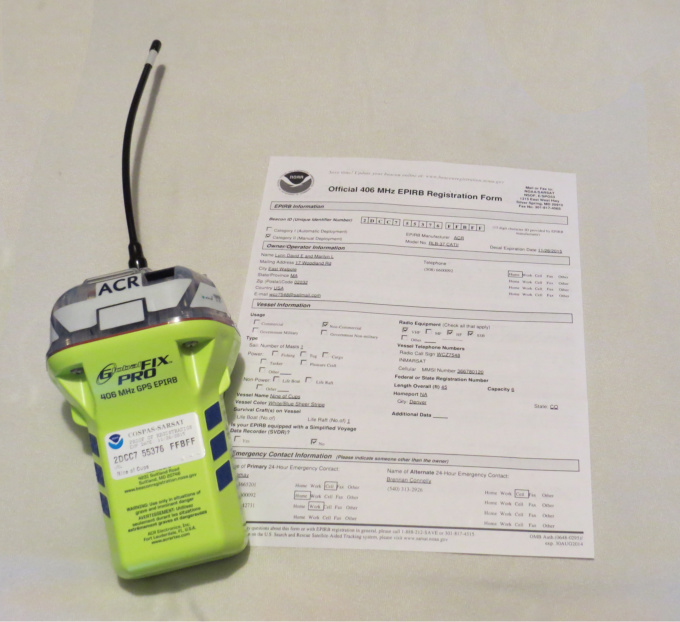
Frequent testing. We inspect and test our EPIRB monthly.
Battery replacement. Most EPIRBs have a five year battery lifetime. Battery replacement must be done by an authorized facility, which will also perform a full functional test of the unit.
Mounting. The EPIRB won't do any good if you can't get to it quickly in an emergency. We mount ours next to the companionway ladder where we can grab it on the way out or reach it from the cockpit.
The reason we are replacing our old EPIRB is that it is now due for a new battery, but it is so old that the manufacturer no longer stocks batteries for our model. Like most electronics, the new EPIRBs are smaller, include many more features, and are half the size of the older models, and as it turns out, a new EPIRB doesn't cost much more than what it used to cost us for the battery replacement.
When it comes time to buy something new, especially something as important as an EPIRB, Marcie and I have different decision making processes. I like to assess our needs, evaluate the technology, determine which features and options are essential vs non- essential, derive cost vs benefit ratios, and eventually narrow the candidates down to a few dozen. Then I check the independent reviews and compare the pros and cons of each of the candidates, agonizingly narrowing them down as much as possible. Finally, I determine who has the best deal and make the purchase. This can take weeks.
Marcie's method is to do a quick search to find something that seems appropriate, is the right color, is reasonably priced and buy it. This can take minutes. (Okay, okay... perhaps I am exaggerating just a bit, but this is, after all, my view of things).
Over the years, in order to preserve family harmony, we have agreed to let me do the product evaluation. I can analyze, assess and grit my teeth to my hearts content, eventually coming up with a recommendation. And so it was that I was tasked with finding a new EPIRB.
Actually, the EPIRB decision making process wasn't all that difficult. The first big decision was whether we should get a model that includes a GPS. Most newer EPIRBs include a GPS which provides much more accurate positional information than solely depending on the satellites to triangulate the location. Having a GPS narrows the search from a square mile to a few meters. The cost for this feature is nothing, since the newer models with GPS are cheaper than the older models without, so this was a 'no brainer'.
The next big decision was whether we wanted a Category 1 Automatic/Manual release model or a Category 2 Manual only release model. The Category 1 models have a hydrostatic release mechanism that automatically releases the EPIRB from its holder and activates it if it is immersed in water. A Category 2 model must be manually released from its holder, but will activate either automatically after immersion or by turning the switch on.
In order for the hydrostatic release mechanism to be of use, the EPIRB would have to be mounted on deck. (It wouldn't be of much use mounted below decks – by the time it was immersed in water below deck, it would most likely still go down with the boat). Being mounted on deck, it is quite possible that it would release and activate when we didn't want it to, such as in the event of a knockdown or waves breaking over the cockpit. We've been in both situations, and we certainly wouldn't have wanted our EPIRB to initiate a search and rescue effort on our behalf as it floated away. Even if we were completely rolled, unless Cups was sinking or one of us was badly injured, we probably wouldn't want the EPIRB to initiate a rescue operation. Since the cost of a Category 1 model is quite a bit more than a Category 2 model, I felt the benefit was not worth the extra cost..
There were a few other features to contemplate, but in my opinion, they weren't worth the added cost either. For example, some models come with a feature that uses the vessel's onboard GPS to continually update the EPIRB's GPS position. That way, when the EPIRB is activated, it already has the current location and doesn't have to search for the GPS satellites and get a fix before transmitting the more accurate position. Since it is typically hours, not minutes, for a rescue operation to be initiated, the extra five minutes it takes for the EPIRB to find its GPS location is probably not an issue.

This process narrowed the candidates down to about 5 models. The hands-down winner was the ACR GlobalFix Pro. Our old EPIRB was also an ACR, and although we never had to deploy it, we were happy with it. We were able to buy the new one online at Amazon at a very reasonable price, and ACR was running a year end promotion that provided $210 worth of cool stuff as a rebate.
We probably won't receive the cool rebate stuff before Marcie leaves for Australia, so it might be another two years before we have it aboard, but I felt better knowing I was getting more for my money.