The Blue View - Aim for Something Cheap

It's boat insurance renewal time again. Each year at this time, we provide the insurance company with our sailing and cruising plans for the upcoming 12 months, and they tell us how much we will need to pay to keep Nine of Cups insured. The last two years have been spent coastal cruising in Australia, and our insurance has been relatively cheap. The word 'relative' is an important adjective in the last sentence. Boat insurance is always very expensive – much more than homeowners or auto insurance. This coming year, since we will be crossing an ocean, the rates will go up significantly – roughly the same as the down payment on our first house, and then only if we have a rigging inspection. It's quite painful.  

big boats


In 2003, we were in Puerto la Cruz, Venezuela when it was time to renew our insurance. At the time, we thought we would be going to some of the islands in the southern Caribbean, then to Cartagena, Colombia, through the Panama Canal and on across the Pacific. (Ha – did those plans ever change!). Based on our cruising plans, the insurance company gave us a quote for the year , and “by the way, you can't stop in Colombia”. Hmmm – does that mean they wouldn't cover the boat while it was in Colombian waters if we choose to go to Cartagena? Surely there was a way to get coverage for going to Cartagena – maybe a special rider? After a few emails back and forth, it became quite clear that if we went to Colombia, not only would they not cover us, but our insurance would be canceled.

We decided we WERE going to Cartagena and if that was the attitude our insurance company was taking, we would let our policy lapse. We'd show them! We would spend the money that was budgeted for insurance on bombproof ground tackle and in making sure Cups was secure and seaworthy.

As it turned out, the very day our insurance ran out was the day we were leaving Puerto la Cruz. Our marina was a few miles up a series of canals that wound through an area where the very rich Venezuelans kept their yachts berthed. There was a 15-20 knot breeze, and just as we came into a short stretch that put the wind on our beam, the engine sputtered and died.

Since we couldn't stop the boat and would soon lose steerage, we had maybe a minute before we either hit or drifted into one of the mega-yachts that were med-moored all around us. Two thoughts came to mind. One was that perhaps I was a bit hasty in deciding to let our insurance lapse. The second thought was something I recalled reading in one of Tom Cunliffe's books. In a situation like this - “Aim for something cheap”.

I saw a gap between two of the yachts that might be just wide enough for Cups. Thinking it would be preferable to hit the jetty than put a major gash in someone's topsides, I aimed for it while Marcie grabbed a fender to try and fend us off from the yachts on either side. As it turned out, the two yachts had spring lines crisscrossed across the opening. As Cups ran into them, they slowed us down, and we only nudged up against the dock. No damage except to our pride.

The crew was on one of the yachts and kindly allowed us to raft up until we got the engine problem sorted out. It turned out to be an air bubble in the fuel line – a problem that has been an issue with Cups since the day we bought her. That's a topic of another blog sometime. It only took a few minutes to bleed the fuel lines and get the engine running again, and we were soon on our way.


boats


We went several years without insurance on the boat. Most marinas and boatyards in New Zealand and Australia require insurance, however, so we have reinstated our insurance (with another company BTW), and intend to keep the policy in force. That said, during all the years since Venezuela, we have had numerous close calls, and several boats have bumped or run into us, but nothing that would have resulted in an insurance claim had we been insured. And except for that one incident in Venezuela, knock on wood and thanking Neptune for all the wonderful lessons in humility and seamanship he has provided us, we have also never had to decide which was the cheapest boat to aim for.

The Blue View - The Importance of Junk

Marcie unexpectedly had to go back to the U.S. for a couple of weeks. While she is gone, I will try my hand at writing the majority of our blogs instead of my usual once weekly contribution. I'll do my best to keep them interesting for everyone, but for those of you who could  not care less about the technical side of our lifestyle – we apologize. -David  


junk faucet


A couple of months ago, a small galley sink faucet that we use with the watermaker broke off. It's hard to believe that the faucet only lasted 25 years – I guess they just don't make things like they used to. We were working our way across the Great Australian Bight at the time, and there wasn't a marine chandlery within 300 miles. I dug around in my bag of old plumbing fittings and found some parts that could be used to make a temporary fix. Ugly doesn't begin to describe how it looked, but it worked just fine. When we arrived here in Mandurah, I found a chandlery that had a respectable looking faucet and repaired it properly.

I used to poke fun at my dad who saved everything that could possibly be useful someday. He even had a big bucket of bent nails. I always thought that it was because he grew up during the Great Depression when times were tough. It didn't seem reasonable to me to save all that junk when there were 12 hardware stores within a 10 minute drive.


junk collage


Now I think my dad would be quite proud of me. I have all kinds of junk... er, I mean potentially useful stuff, stowed in every little nook and cranny on Nine of Cups. I have a big bag of plastic plumbing fittings and valves, another of bronze and a third with brass. I have a drawer filled with connectors, wire and other miscellaneous electrical stuff. One section of the bilge is devoted to all manner of hoses and tubing. I have stowed various hunks of metal, like old flanges, flat stock and old mounting brackets in various little cubbies around the boat. The area behind the starboard settee is my place for keeping stainless, aluminum, copper and PVC tubing.

Hardly a week goes by that I'm not scrounging around, searching for just the right part to fix whatever broke that day. I've made countless temporary fixes and quite a few permanent repairs from my stash of bits and pieces.

So I've adopted my dad's philosophy since living aboard, and I never throw anything away that could be useful someday. Well, actually I don't keep bent nails, but other than that it works for me. There just aren't that many hardware stores in the middle of an ocean.

Lassoing a Mooring

Marcie unexpectedly had to go back to the U.S. for a couple of weeks. While she is gone, I will try my hand at writing the majority of our blogs instead of my usual once weekly contribution. I'll do my best to keep them interesting for everyone, but for those of you who could not care less about the technical side of our lifestyle – we apologize. -David  

casting off mooring


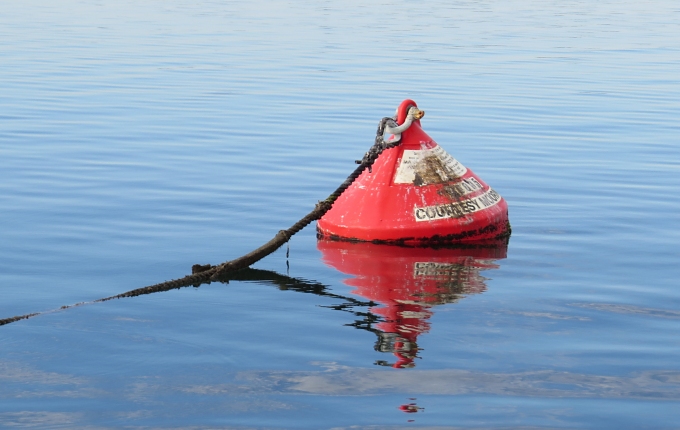
Picking up a mooring is something we do quite frequently, especially here in Australia where many states provide free moorings. These courtesy moorings are well maintained and clearly marked with the maximum boat size they were intended for. We have often been offered the use of municipal, club and even private moorings as well, and as long as we can get some assurance that they are in good shape and large enough for Nine of Cups, we usually gratefully accept the offer.

Sometimes other cruisers inform us that, in some areas, it is perfectly acceptable to pick up any unused mooring. If the owner arrives, he may ask you to leave or he may take another vacant mooring himself. For several reasons, we usually don't follow this advice and drop our anchor instead. The mooring might have been intended for a 23' (5.5m), 4 ton daysailer, and a big boned girl like Cups would drag it all over the harbor. It might have been last serviced by the crew of Mathew Flinders. Then there is the chance the owner will arrive at 2AM, back from a long day of fishing and require us to relocate.

It seems everywhere we go, there is a different method of attaching all the parts of a mooring together. Sometimes the mooring buoy has the pennant attached to the top of it; sometimes there is a pick-up buoy attached to the mooring pennant; sometimes there is only one mooring pennant – sometimes two; sometimes the pennant will fit through our hawse holes, sometimes not. It is usually a surprise until we get the lines out of the water and figure out how we should be making fast to the mooring.


lasso steps


When picking up a mooring, we approach the mooring ball into the wind, and I try to stop Cups just past the pennant. Marcie is at the bow with the boat hook and a dock line at the ready, and her job is to get us attached to the mooring anyway she can. Once we are attached, no matter how tenuously, we can take our time and sort out how best to make fast to the mooring. If conditions are good, the mooring has a pick-up buoy floating next to it, and no one is watching, we can usually pick it up and secure it on the first try. If the wind is gusting, there is no easy way to pick up the pennant, and/or there are other boats to maneuver around, it sometimes takes a few tries. The number of tries it takes is also directly proportional to the number of people watching. I think our record is 13 attempts at the Harlem Yacht Club, when everything went wrong and there were dozens of people watching how these sailors from Colorado go about picking up a mooring. They are probably still chuckling about that bit of evening entertainment 12 years ago.

When there is no pick-up buoy, the process is much more difficult. Sometimes there is just a big round mooring ball floating there with the pennant attached underneath. Other times, there is a ring at the top of the mooring ball. Cups has too much freeboard at the bow to reach the mooring ball, and there is usually no hope of picking up the entire ball with the boat hook. I learned this method of picking up the mooring from another cruiser, and it works quite well.


buoy image


We attach one end of a dock line to the boat, tie a very large bowline, 6-10 feet (2m-3m) in diameter in the other end of the dock line and route it through the lifelines and outside everything. The dock line should be the sinking variety – polypropylene floats and won't work- and should be long enough that the entire bowline will reach the water with a few feet (~1m) to spare. When the boat comes alongside the mooring ball, Marcie simply drops the bowline over the ball. The line will sink and as the boat drifts back, the bowline will constrict around the chain or rope under the mooring ball. Then we keep tension on the dock line as the mooring ball is pulled up to the boat and we figure out how to attach the boat to the pennant.

The bowline will almost always stay in place until we can get the boat secured – unless there are more than six people watching, in which case we can be sure that we will either miss the mooring ball with the bowline or it will slip off the mooring ball entirely. We find it pays to maintain a good sense of humor.