The Blue View - Selecting an Anchorage

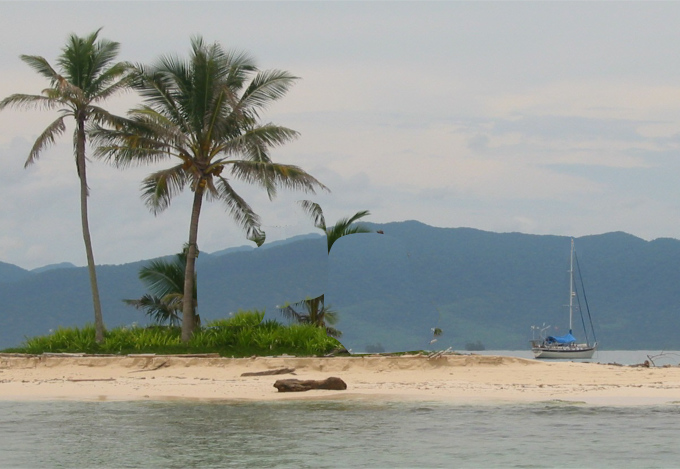
an anchorage  

There is a host of criteria that determine whether an anchorage will be safe and, slightly less importantly, whether it will be comfortable. At the very least, the anchorage should provide shelter from the waves and swell, and it would be nice if the boat wasn't rolling gunwale to gunwale all night.

To begin with, we make sure we have an adequate chart for the area. A great deal of information can also be gleaned from local cruising guides, pilots and sailing guides. Before sailing to a new area, we seek out any cruisers that have previously anchored there. Local fishermen, while probably not willing to share information about the best fishing spots, are usually happy to provide information about anchorages.

Many anchorages can be delightful in some weather conditions and untenable in others, so it is important to know what the weather will be doing. Should we expect a wind shift, either because of the diurnal land effect or because of a change in weather? How much wind can we expect?
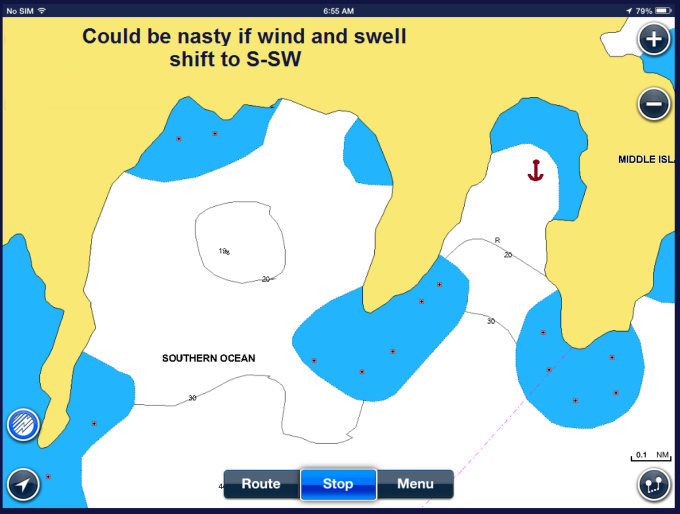
 

track 2


Once we have tentatively decided on an anchorage, there are a number of other things to consider:

  • What are the depths? Too shallow for our draft? Too deep, requiring more scope than there is swinging room and thus requiring a second anchor or lines ashore?
  • What are the depth contours like? Does the anchorage shallow gradually or steeply? Will we be anchoring on the edge of a shelf that drops off sharply?
  • What hazards exist, both on the approach and in the anchorage? Will we need to track our route in, in case we need to leave in the middle of the night? Is it even feasible to exit in the dark or pouring rain with little or no visibility?
  • How is the holding? How close are the hazards if we drag? Will we be up all night standing an anchor watch?
  • How is the approach if the wind shifts and the seas build? Some anchorages are near impossible to get in and out of when the surge and waves begin breaking across the entrance.
  • How crowded is the anchorage? A crowded anchorage often means the other boats are using short scope. If the wind direction changes and/or increases, boats may quite likely drag or we may swing into them.
  • How much tidal swing can we expect, and at what stage will the tide be when we drop the hook. If there are large tides, we need enough scope to keep us secure at high tide, but at the same time we need to assess whether we will be in danger of swinging into a hazard or going aground at low tide.
  • Are there tidal or other currents? A strong current may put the boat broadside to the wind and/or waves, making for a very rolly night.
  • How does the swell enter the anchorage? What seems like a protected spot may see waves that hook around headlands or wave reflections that will make the anchorage very uncomfortable.
  • If the wind shifts, will we be on a lee shore? Will we swing into any hazards?
  • If the wind shifts, how much fetch will we be exposed to?

Once we make the decision to drop the hook in a particular anchorage and start making our way in, if there is any doubt about being able to navigate back out in the dark, we track our route on our chartplotter. On more than one occasion, the winds did not do what they were predicted to do and we found ourselves on a nasty lee shore with the wind blowing at gale force accompanied with sheets of rain. A hasty departure in the middle of the night with very little visibility was necessary. We may or may not have been able to extricate ourselves through the rocks and reefs without the chartplotter track, but having it as an aid greatly reduced the stress of the situation.


track 1


Once we've worked out which anchorage we'll be spending the night in, the next decision is picking the right spot in the anchorage. Stay tuned for the next Blue View.
The Blue View - Chums, Angels and other Buddies

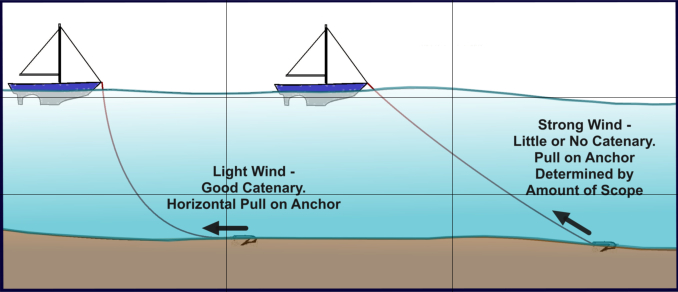
An anchor has its maximum holding power when the rode pulls on it in a horizontal direction. The closer to horizontal, the better it will hold. That's why the amount of scope (the ratio of the length of rode deployed to the depth of the anchorage) is such an important factor in how well an anchor holds. With a 3:1 scope, the maximum angle of pull on the anchor is 19.5º; at 5:1 the angle is 11.5º; and at 7:1, the angle is 8.2º.  

catenary


The catenary effect created by the weight of the rode also causes the pull on the anchor to be more horizontal. If you look at the arc of the anchor rode in the illustration, you can see that, in light winds, the end of the rode nearest the anchor lies on the seabed. As the wind increases, the catenary effect lessens. Eventually, if the wind becomes strong enough, the rode will form a straight line between the bow and the anchor.

The weight of the rode and size of the boat determines how much wind is required to overcome the catenary effect. If the rode is all rope, it takes very little wind to pull the line taut. For example, if Nine of Cups, a 45 foot (14m) boat, was anchored in 20 feet (6m) with 100 feet (30m) of rope rode deployed, it would take less than 10 knots of wind to overcome the catenary of an all rope rode. If the rode was 3/8” (10mm) chain, it would require almost 25 knots of wind before the chain became taut.

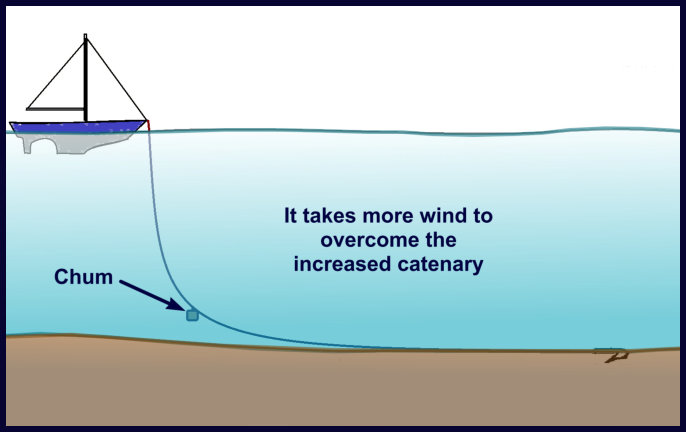
The catenary effect can be increased by adding weight to the rode. This can be accomplished by letting out more chain, and/or attaching a weight to the rode. These weights are referred to by a number of different names – chums, buddies, angels, anchor riders and kellets to name a few.


buddy catenary


We've always called these weights 'chums', and there are quite a number of very experienced voyagers who firmly believe in their use. We know a few who will use a chum every time they anchor, but most only use one when the wind begins to pick up or when in a tight anchorage. A chum will reduce the amount of swinging a boat does when the wind is light to moderate, and will increase the catenary of the anchor rode when it is necessary to use reduced scope, as is often the case when there are a number of other boats anchored close by. No matter how big the chum, however, if the wind gets strong enough, it will eventually overcome the catenary effect, and the angle of pull on the anchor will depend totally on the scope.

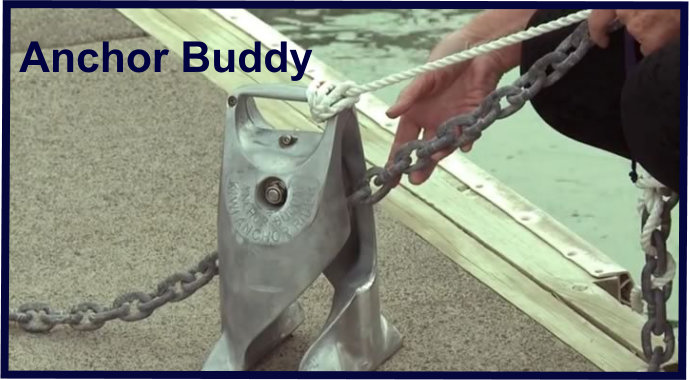
There are a few purpose-made chums available. One that is especially easy to use is the Anchor Buddy, made in New Zealand. (It is marketed in the U.S. by Quickline USA ). Once you get the hang of using it, it can be attached and detached in a minute of two.


anchor buddy

  You can also make one quite easily. To make a 30 lb (13.6kg) chum, you will need a 1.5 gallon or larger container – a 2 gallon plastic ice cream container would be perfect if you can find one, or a 5 gallon paint bucket will do. You will also need a half bag of concrete, and a large galvanized eye hook. After you and your friends eat the ice cream, mix the concrete and pour it into the container. Before the concrete sets, push the hook down into the concrete until just the eye protrudes. Allow it to set and cure for a week or so.


chum construction


To deploy it, you will need a very large shackle and 50-100 feet (15m-30m) of line. Tie one end of the line to the eye hook. After the anchor is set, use the shackle to attach the chum to the anchor rode. You want the shackle to be able to slide up and down the rode – do not shackle the chum to a link of chain if using chain rode. Next, let out enough line so that the chum will be just above the bottom at low tide and secure the line to a cleat.


chum shackled to chain


When it is time to retrieve the chum, it is easy to pull the chum back up the rode if there is tension on the anchor rode. If the wind isn't blowing hard enough to tension the rode, put the boat in slow reverse until the rode is taut, then pull the chum up the rode. Undo the shackle and stow the chum.

The Blue View - Lettering the Dinghy

finished lettering  

We just renewed our boat insurance, and one evening when I had too much time on my hands, I decided to actually read the new policy. I came across a clause that stated that the theft of the dinghy was only covered if the name of the vessel was clearly and permanently marked on it.

There are positives and negatives to putting the vessel name on the dinghy. On the plus side, the dinghy is much more likely to be recovered and returned if the vessel's name is marked on it - which is, I'm sure, why the insurance company requires it. A thief is less likely to joy ride or try to resell a stolen dinghy that has a boat's name on it. In several places we've been, it is required by local regulations to have either the boat's name or registration number stenciled on the dinghy - usually a visiting boat is given some leeway on local regs, but not always. And finally, a well marked dinghy is much easier to pick out on a crowded dinghy dock at night amongst a dozen or so very similar looking dinghies.

On the negative side, your well marked dinghy is going to be harder to sell when it's time to buy a new one. The biggest negative, however, is that when the dinghy is tied up at the dinghy dock, it is a good indication to any would-be-thief that the vessel it belongs to is probably unattended at the moment. (Using the mother ships's registration number instead of the name will avoid this possibility, but if the dinghy goes missing, the insurance company may not cover it, and if someone does find it, matching the registration number on a dinghy to it's mother ship is difficult, especially if the vessel is not local).

Given all the pros and cons, we decided in favor of putting our boat name, Nine of Cups, on our inflatable. I've put the boat name on several of our previous dinghies as well as numerous life rings, fuel cans and propane tanks, and I find the following method works well for me.

I start by making the stencil. Using the computer, I experiment with different font types and sizes until I find the right combination. Sometimes this involves printing the boat name in a few different versions on plain paper and temporarily taping them in place to decide which I like best.

Once I am happy with the font, I print the name on my stencil material. While there is commercially available stencil material, it is expensive and not always easily obtainable. I make my own using a combination of letter sized self-adhesive laminating sheets and letter sized self-adhesive shipping labels. In my experience, adhesive labels don't adhere to most surfaces well enough to prevent the paint from bleeding under the stencil. The laminating sheets adhere quite well, but can't be printed on. I print the lettering on the paper labels, stick these labels to the laminating sheet, and then cut out the letters. Usually, the font size is too large to print the entire boat name on one sheet, but I can usually print each word of the name “Nine of Cups” on one sheet.


cutting the stencil


To cut the letters out, I use scissors and a razor. I utilize a straightedge to guide the razor along the straight segments, and either the razor or the scissors to cut the curved segments. Once cut, but before removing the laminating sheet backing, I tape the letters onto the surface to be painted. With each letter lightly held in place with masking tape, it is easy to adjust and move each letter or word until the lettering looks good. Once I am happy with the spacing and positioning of the letters, I tape the letters of each word together. I put several locating marks on the dinghy surface with a marker, so it will be easy to align the stencil again in the next step.


applying the stencil


To attach the stencil to the surface, I lift one end of the first word and peel back an inch or so of the laminating sheet backing. I lightly press the laminate against the surface, trying to avoid any wrinkles, bubbles or misalignment. Once the end is lightly stuck in place, I remove the masking tape securing the rest of the word, and begin removing the remaining backing material. As each inch or so of backing is removed, I lightly press the laminate against the surface, using the alignment marks to position each letter. A small positioning mistake can be corrected at this stage by using tweezers or needle nose pliers to detach and reattach small sections of the stencil. Once the entire word is in place, I press the entire stencil firmly in place. The backing material for the center sections of the circular letters – O, P, R, Q, etc. - is next removed and these stencil segments are attached. Once the entire stencil has been applied, I mask around and between each word.


painting the letters


I use ordinary spray paint to paint our dinghy. This has worked well for us and usually outlasts the dinghy - but our inflatable is rarely deflated. If we had a dinghy that was routinely deflated and re-inflated, we might look for a paint that was intended for this purpose.

It is amazing how much over spray there is on even the calmest day, so I use masking paper to mask a large area around the stencil. If there is any breeze at all, I hold a large piece of cardboard directly downwind of the area I am spraying.

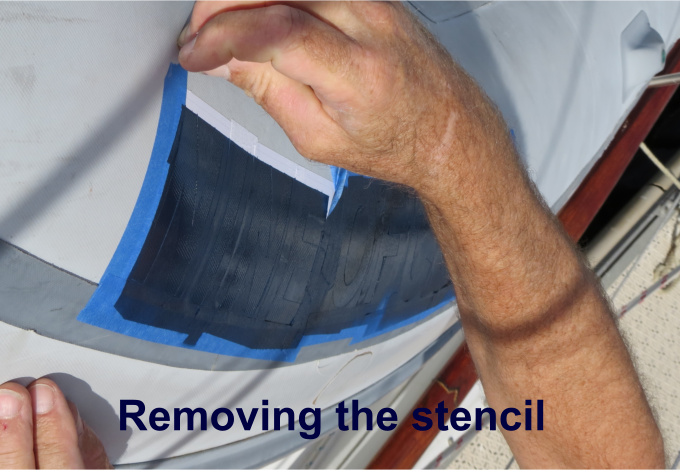
I find that heavier coats of paint are more likely to bleed under the stencil, so I apply several very light coats of paint. I wait 10-15 minutes between coats. Then I wait until it is dry to the touch, 1-3 hours, and carefully remove the stencil. The laminate material sticks really well, so I sometimes need to use tweezers or needle nose pliers to peel back a corner of each stencil. The laminate adhesive will often leave a residue, but it's best to let the paint cure a day or two before removing it. Alcohol or mineral spirits will remove the residue without damaging the paint after it has fully dried.


removing the stencil


Once it is all done, I take a few digital pictures. If ever it goes missing, this might be important to prove to the insurance company that we did have the boat name clearly marked on the dinghy.