Vegas Odds and Ends

We're nearing the end of our stay in Las Vegas, but there are a few odds and ends that I wanted to share with you that didn't really fit anywhere else. This Blue Angel, for instance, sits atop the old, decrepit, long-abandoned, Blue Angel Motel. This ultra low-budget motel never had much going for it, I suspect, except the blue angel designed by Betty Willis, the same graphics artist who designed the Welcome to Fabulous Las Vegas sign. Despite the fact the motel's been abandoned for a long time, Angel still watches over the place.
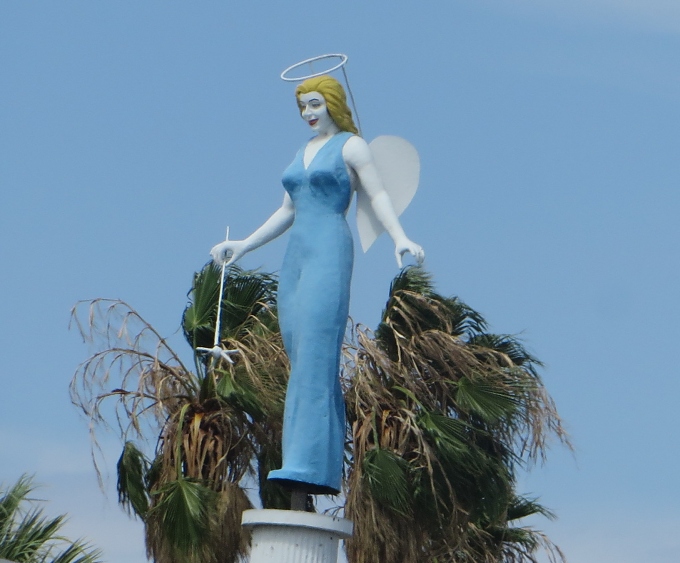
 

blue angel


When I asked other Las Vegas residents about the Lou Revo Center for Brain Health building, they had no idea what I was talking about. Architect Frank Gehry's stainless-steel deconstructivism style seems out of place, especially for a brain health center. I stumbled upon the building photo then had to ferret out exactly what and where it was. It's part of the Cleveland Clinic, by the way, and very legit. I found out that you can take a brain health quiz on the site.
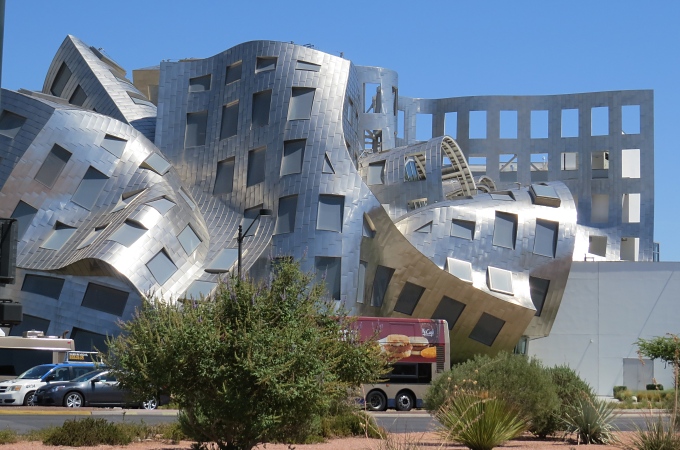
 

lou revo center


We didn't want to miss out on the most photographed bronze statue in Las Vegas. The bare, thonged butts of seven Vegas showgirls, shiny with fondling, grace the outside front entrance of the Riviera Hotel and Casino. We couldn't help adding some additional local (clothed) butt to the scene.

showgirls plus one

Then there's the Hammargren Home of Nevada History, aka the bizarro house, as far as we're concerned. Mary turned us on to this one on the corner of Sandhill and Rosecrest in the upscale Paradise Crest housing subdivision. Behind the walls of this sprawling home which encompasses several lots, Lonnie Hammargren, M.D., neurosurgeon and former Lt. Governor of Nevada, has amassed an unusual (yes, you might say bizarre) collection of Las Vegas / Nevada memorabilia.
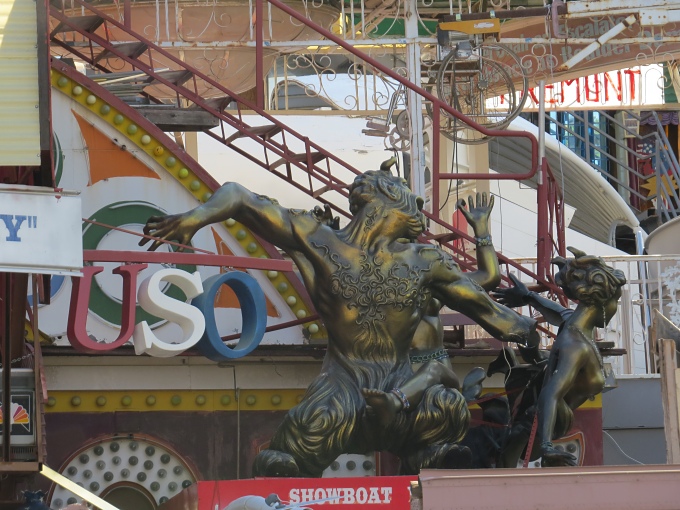
hammargren yard

There's a full-size space shuttle mock-up parked in one of the front driveways. A Bat-mobile sits in another driveway, just in front of the Ramses statue and the Egyptian bird god. Access to the inside is by invitation only (and we weren't invited), so we had to content ourselves with views from across the street. We caught sight of a very large dinosaur as we turned the corner. From the sidewalk, we could see the old Boardwalk casino sign, remnants of several amusement park rides and a John Lennon sign among other things. Evidently Lonnie opens the place up to visitors at certain times throughout the year. Wish we were staying around for a visit.

space shuttle

Last, but certainly not least, is the plethora of Vape Stores. We didn't even know what they were until Mary enlightened us. They're on nearly ever corner and in little strip mall malls everywhere, selling e-cigarettes. No smoke … no fire … no smell … no tar … no carcinogens … just nicotine-laden vapor with flavors like bubblegum and watermelon. They don't smoke … they vape. Look at that … a whole new verb has entered the English language since our last visit.
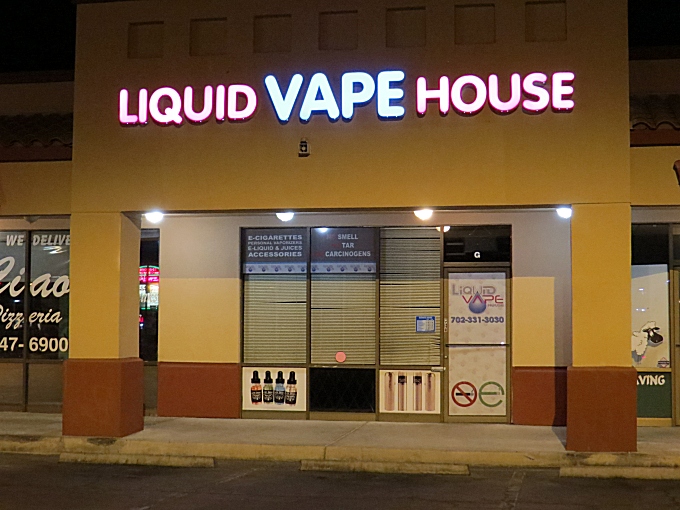
vape house

Enough Las Vegas. It's time to start heading home to Nine of Cups. The countdown is over.

The Blue View - Avoiding Chafe While Moored or Anchored

chafe dock  

A nylon anchor rode, snubber or mooring line will last a long time, maybe a decade or longer, if it is cared for and we can avoid chafing it. Put it under tension and allow it to rub on something sharp – a rock, a deck protuberance or a concrete piling - and it can chafe through in a matter of minutes. Some of the other varieties of line like Spectra, Amsteel and polypropylene exhibit more resistance to chafing than nylon, but they have very little stretch – and stretch is a desirable attribute in an anchor rode, snubber or mooring line. It may take an hour or two instead of ten minutes, but even the most chafe-resistant line will chafe through under the right conditions. Here are some of the things we do to prevent our lines from chafing.

(If you started reading this blog post thinking it was about the pros and cons of jockey shorts versus boxer shorts, sorry - this isn't about that kind of chafing).


chafe dockline


  • Short hose sections. We keep short sections of our old, large diameter hoses to use as chafe guards. We also occasionally come across sections of discarded fire hose, which works very well. These short lengths are used to protect a line from chafe as it goes around a corner. For example, our snubber is secured to the anchor chain, then goes through our port bow roller and is attached to the port bow cleat. If the wind is kicking up and Nine of Cups is pitching and yawing, there are two points at which the snubber is susceptible to chafe. I have two short sections of hose I can slide along the snubber and secure in place, which protects it at those points. If necessary, I drill holes in the ends of the hose and use small line to attach the chafe guard either to the snubber or to the chafe point to keep it from sliding out of place. We also have a few short hose sections that are slit end to end. I can slide these sections into place on the line quickly without having to untie it.
  • Long hose sections. We keep several six foot (2m) sections of hose to protect our lines from chafing on wharves and pilings. A case in point was when we were moored at a commercial wharf in Hobart, Tasmania, and our spring lines were chafing against the barnacle encrusted pilings, especially at low tide. We protected them using long sections of hose. As with the short sections, we prevented the chafe guards from sliding out of place with small line attached to either end of the hose and tied to the spring lines.
  • Shackles. We keep spare galvanized shackles in several sizes aboard. These are used when we need to tie a line to a corroded eye ring or shackle. Often, for example, we want to pick up a mooring with nothing but a corroded eye ring to tie up to. Assuming it isn't so corroded as to be untrustworthy, we will attach our new shackle to the eye ring, then tie our mooring line to the shackle.


ringbolt


  • Short sections of chain. We have about six short sections of chain, ranging in length from 3 feet (1m) to 15 feet (4.6m). We frequently use these chain sections to protect a dock line or a line ashore from chafe. Anytime we are tied up to a finger pier or wharf that has corroded cleats, concrete edges or anything else that can chafe our lines, we attach a length of chain to the cleat using a shackle. Then we attach the dock line to the chain using another shackle. Likewise, when we are running a line ashore, it is often necessary to secure it to a rock. We wrap a chain section around the rock, shackle the ends, and attach the line to the shackle.
  • Thimbles. When we are in an area where we will frequently be shackling our lines to chain sections, we will often splice thimbles in the ends of our lines. When we were in Patagonia and Tierra del Fuego where we ran lines ashore almost nightly, we added thimbles to the ends of our shore lines. This made it less likely that the end of the line would chafe on the shackle. A quick temporary alternative is to slide a short section of hose onto the end of the line, then form it into a tight loop using a bowline.
  • Storms. Storms and gales, whether at anchor or while moored, put a great deal more stress on the lines than do settled conditions. If we have any warning of impending heavy weather, we do what we can we can to prepare, then keep an extra watchful eye out for potential problems. Take a look at our previous blog post on preparing for storms at anchor.
  • Anchor rode. Some bottom types are very hard on nylon anchor rode. We highly recommend having chain for at least part of the anchor rode. When we first started cruising, we were in areas that had sand or mud bottoms, and having chain for the first 50 feet (15m) of our rode was perfectly adequate. In rocky or coral areas, the amount of chain increased to 300 feet (90m).
  • Vigilance. Keeping an eye on things is probably the most important aspect of preventing chafe. Check the lines every morning; when the wind pipes up; when the wind dies down; when the wind direction changes; at high tide; at low tide... anytime conditions change. Fixed piers and wharves usually require more vigilance than floating docks, especially in areas where the tidal swings are large. Often, the lines will be fine until a particular combination of conditions occur, i.e. low tide and a southeast wind causes the aft spring line to chafe on a piling. Address and correct an issue at the first indication of a problem.

The Blue View - Anchoring in a Crowd

anchoring in a crowd  

Once we have picked out an anchorage, the next decision is where in the anchorage is the best place to drop the hook. If the anchorage is large with few other boats and no hazards, any number of places may be just fine, but sometimes it takes some thought to find an acceptable spot, especially in a crowded anchorage.

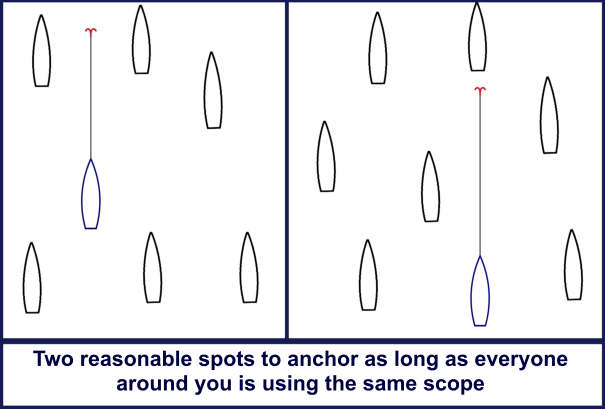
Before we decide where to anchor in a crowd, we first motor slowly through the anchorage to see how the other boats are anchored. Quite often, boats anchored in a crowded anchorage use less scope than usual, and we want to use the same scope as the other vessels around us – within reason. With our all chain rode, we never use a scope of less than 3:1. If we were using a nylon rode, the minimum scope we would use would be 4:1. If we do anchor with a reduced scope, we will set the anchor with a normal scope, and once the anchor has dug in, we reduce the scope as needed. We have no qualms about motoring up to nearby boats and asking them how much rode they have out as we reconnoiter an anchorage. We can also get an idea of how much scope the other vessels have deployed by estimating the distance between boats.

It is also important to use the same anchoring arrangement as the other boats. If everyone is using two anchors, we follow suit – otherwise, our swinging circle will be much different than the other boats.

If the wind or the current is strong enough to stretch out the anchor rodes of the other vessels, finding a spot is somewhat easier. To locate the right place to drop the anchor, we first find the place we want Nine of Cups to lie and check the depth. Then we calculate how much chain we will need to obtain the desired scope, add 20 feet or so to allow some room for the anchor to set, and motor forward that amount. When we reach the right spot, we stop the boat and begin dropping the anchor as we fall back. Ideally, this spot will be right behind or just alongside the vessel in front of us. Then we deploy and set the anchor normally. If I've miscalculated, and we don't end up in the right spot, we don't hesitate to bring the anchor back in and try again.

For example, let's say the spot we want to end up at is in 25 feet (7.5m) of water. The bow roller on Nine of Cups is 5 feet (1.5m) above the water. If we want a scope of 4:1, we will need (25+5)*4 or 120 feet (37m) of chain out. Adding 20 feet (6m) means we need to motor forward about 140 feet (43m), or just over 3 boat lengths for our 45' (14m) boat.

The illustrations below show a couple of crowded anchorages and where we would have chosen to drop the anchor.


crowded anchorage


If the anchorage is calm and the other boats are lying in all directions in a crowded anchorage, finding the right spot is much more difficult. If possible, we will often anchor further out, with the thought that we will move in closer when the wind picks up. When anchoring further out is not possible, we make our best guess as to the right spot, and stay close to the boat until we are sure we won't be banging into someone. As the most recent arrival, it is our obligation to move if we are too close to another vessel.


crowded anchorage


Here are some other considerations when selecting a spot to drop the anchor:

Like vessels – Light displacement, heavy displacement, shallow draft and deep keeled vessels all react to wind and current differently while at anchor. If you have a choice, try to anchor near boats similar to yours.

Moored boats – Moored vessels usually have less scope than anchored vessels. If we are anchoring near a moored boat, we give it more space as we will need more swinging room.

Unoccupied areas – If we find a large unoccupied area in an otherwise crowded anchorage, there is usually a good reason. Maybe we lucked out and several boats just left, but more likely there is a shallow spot or hazard there that the local boats know about. If the charts don't show anything, we do a careful and slow exploration of the area before dropping the hook. And again, we're not shy about soliciting information from boats already anchored.

Large expensive yachts – If we have a choice, we will avoid anchoring near a large expensive motor yacht. They are more likely to have and use jet skis and other water toys, fly past us several times a day in their large, high speed tenders, and will probably be running their generator(s) all night. It really spoils the moment when we find ourselves downwind of a diesel generator while trying to enjoy an otherwise perfect sunset.