The Blue View - Reworking the Alarm Indicator Panel

One of the things that started getting a little flaky on our Indian Ocean crossing was our indicator and alarm panel. This is a panel with a number of LEDs which light up when any of several pumps are running or when we have an alarm condition. redone panel

For example, one of the LEDs lights when the pump for the pressurized fresh water  system is running. This pump should only come on when a faucet is turned on. If it comes on periodically when all the faucets are closed, we probably have a leak in the system. If it runs continuously, we either have a big leak or the water tank has run dry (or both). When we are in a quiet anchorage, we can hear the pump running, but at sea with the wind howling or when we are motoring, we can't hear it. Should a fitting come lose, the pump will continue running until the water tank is empty – not a good thing – then continue running until the motor burns up – also not good.

If we have an alarm condition, one of the LEDs lights up and in addition, a very loud horn starts blaring. The horn is loud enough to wake us, and can be heard anywhere on the boat no matter how much the wind is shrieking. When we hear the horn, right after we remove our fingernails from the ceiling, we check the alarm panel to see which LED is illuminated and then shut the horn off. An example of an alarm condition is the high water alarm which lets us know the water under the floorboards is rising and the small automatic bilge pump is not keeping up with it.

I built the panel a few years ago, and I have never been very happy with it. It functioned okay, but the aesthetics were an embarrassment. The lettering consisted of stick-on labels, and the LEDs were mismatched and enough out of alignment to make me cringe every time I looked at it. I've been meaning to rework it for quite some time, but it never became a high enough priority. On this passage, the bilge pump LED starting flickering on and off whenever the engine was running -  probably due to a loose wire. In addition, several of the LEDs had been pushed back out of their respective holes when I inadvertently fell against the panel after an unexpected wave hit us. As long as I was fixing the wiring and LEDs, ...

the old panel

I removed the panel and reworked the wiring behind it. I also made a new front panel, doing a better job of drilling the holes for the LEDs this time. I used dry transfer type for the lettering. The new wiring is more robust than the old, and the cosmetics are greatly improved.

new circuit board

If you are interested in seeing the schematic, drop us an email and we will send you a copy.

The Blue View - Fishing at Sea

A question that is commonly asked is whether we fish when on a passage, and if so, how often do we catch something. We do fish at sea, and are quite successful most of the time. In fact, when Marcie does her meal planning for a long passage, she usually plans on having fish for about 25% of our meals. fish on


I don't often put a line out for the first couple of days of a passage until we get our sea-legs. If I'm not already seasick, cleaning and filleting a fish on a rolling deck is sure to do the trick. Plus, we really aren't interested in eating fish the first few days, anyway. Once I do put the line out, it usually takes between 3 minutes and 3 days to catch a fish. In most of the Caribbean, parts of the Pacific and off the coast of New Zealand, it doesn't take long at all to hook something, while in the Indian Ocean, we trolled for three days before we caught a fish. Once we hook something and get it aboard, it won't last long in the refrigerator, so we eat fish for the next 3-4 days until it is gone, at which point, we really don't want more fish for a week or so.

Our fishing equipment has really evolved, thanks to a lot of reading and help from friends who knew a lot more about fishing than we did. Our first thought was that we would trail a really heavy line – maybe 200 lb. (90kg) test – and use the winch to crank in anything we caught. We weren’t into fishing as a sport, but rather as a means to acquire food. That approach had two big flaws. The most significant problem was that we very rarely caught anything. I think it was probably due to the line being so heavy and visible, and having no give. Unless we were very lucky, a fish hitting it would have the line snatched right back out of its mouth. We tried adding a shock cord, but it didn’t seem to help a lot. The other problem was that on the rare occasion we caught anything, cranking it in using the winch ended up with a big pile of tangled line that took a long time to sort out.

handline


We sought out the experts to help improve our act. Our friends, Ken & Joanne on the m/v Rusty Bucket, who are quite accomplished fishermen, taught us a lot. Additionally, The Cruiser's Handbook of Fishing, was a great source of information.

So what do we use now? Our offshore equipment is rather modest, as we aren’t interested in landing huge pelagic fish. If the fish is more than about 25 pounds (11kg), we can’t eat it all and we don't use the freezer at sea, so we will reluctantly let it go rather than waste it. This often means losing the lure as well. The reel that has served our needs is a Penn 115 Senator. You can probably get it at Wal-Mart or on the internet for less, but the West Marine price in my old catalog is $179. Our rod is a simple Shakespeare Ugly Stick, medium weight for $60. To hold it in place, I use a homemade PVC rod holder that I lash to the stern rail. Having lost one rod overboard, I now secure it to the boat using some ¼” line and a carabiner.

We use 50 lb. (23kg) test monofilament, as much as the reel will hold. This is attached to a swivel and a 36” (1m) wire leader. Knots work okay to attach the leader, but I feel better about using crimp connectors. Then I have an assortment of lures that attach to the leader. My favorite is a simple cedar plug – we have caught more tuna and dorado using it than any other. I also like Rapala Magnums, as well as several squid skirts in various colors. The cedar plugs and squid work best if the boat speed is above 5 knots. The Rapala works best below 5 knots. Tuna seem to like grey and silver lures; dorado seem to prefer the bright colors (except they all seem to like the reddish cedar plug).

I know what setting on my reel corresponds to 40 pounds (18kg) of drag. When we start trolling, I set the drag to the minimum I can that prevents the lure from pulling line out at the current boat speed. When we get a hit, I set the drag to 40 pounds, then slow the boat down – usually furling the headsails is enough. Leaving it at 40 pounds of drag assures we never part the line. Then I reel in whenever the fish starts to tire or runs towards the boat, and let him take line as needed. We have a gaff hook, but I prefer to just grab the last few feet of line (after donning some gloves) and swing the fish aboard (another reason for preferring smaller fish).


small and nice dorado


We use a few other miscellaneous items like a fish scale to see how big the fish really is, a filleting knife, a nail clipper to cut line, a file to sharpen hooks, extra hooks and maybe an ice pick to dispatch the poor guy. We also bought a good fish identifier and some nice gloves that are impervious to most sharp things such as the fillet knives and the more benign fish teeth. We use a soft sided bag to hold all the gear.  All told, I think I could replace all the gear I actually use for $300-$350.

On rare occasions we troll using the dinghy. When we were in the Carib, we occasionally used a hand line over the side in an anchorage, and caught a number of grouper and snapper (after asking the locals whether ciguatera was a problem). In the Pacific, we didn’t do much reef fishing with the prevalence of ciguatera there. I do have a smaller spinning reel, but have rarely used it.

We are by no means experts on the topic, but we usually catch enough to keep us happy.

The Blue View - Passage Boredom

sailing

Our current passage across the Indian Ocean is quite typical of most of our longer passages. We've had days of pleasant downwind sailing, with sunny, warm days, cool nights, and small following seas, interspersed with some really crappy days with squalls and big seas. A few things have broken, but, so far (knock on wood and thank you Neptune) nothing critical.

We have had some really crappy passages over the years, with nasty weather and a lot of things going wrong. It seems, however, that we have a very short memory for the unpleasant passages and a much longer memory for the good ones. That's a good thing - otherwise we would have sold Nine of Cups to the highest bidder and found another lifestyle a long time ago.

So what do we do to stay occupied during a long passage? Being confined to the boat with real limitations on what we can do would seem to be quite boring after a day or so - let alone weeks or more at sea. While the pace is definitely slower than when we are at anchor or in a marina, we are rarely bored. I'll take you through a typical day.

To begin with, if you read Marcie's blog post about watch-standing a while back, you know we each spend 12 hours every day on watch. Nine of Cups has an autopilot, which means we don't have to stand at the helm steering all this time. Someone does have to remain on watch, paying attention, however. It's the on-watch person's job to keep us on course, keep a lookout for ships and fishing vessels and other obstructions like floating containers, sleeping whales and aircraft debris. That person also keeps an eye out for approaching squalls and thunderstorms, so we have time to reef down, and in general, anything that is out of the ordinary. This all sounds like a lot of activity, but what it really amounts to is being aware of what is going on, taking a good look around every 15 minutes or so, and spending 5 minutes at the top of each hour logging. Of those 12 hours spent on watch, probably only 4 hours are spent doing watch standing activities.
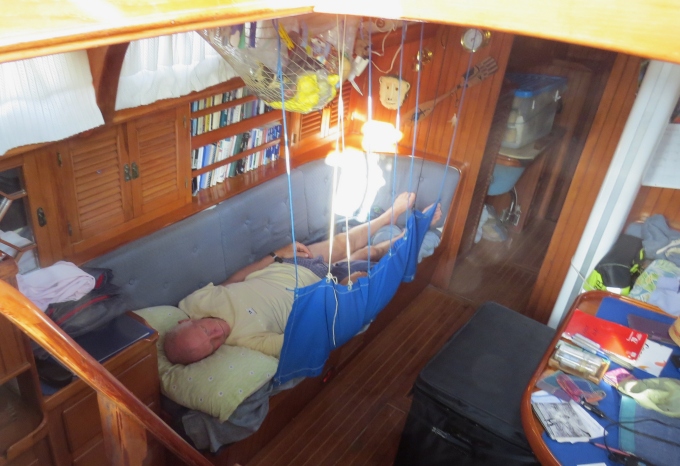
sleeping

When not on watch, we each get two, 3 hour periods of sleep each night, and a couple of 1 hour naps during our off watches during the day. Adding everything up, that means we each have about 12 hours of extra time on our hands. Here is what I do to occupy myself during those 12 hours.

Meals: 2.5-3 hours. Breakfast is usually something light, but lunch and dinner both take about an hour from the time Marcie starts preparing until I finish cleaning up.

Reefing: .5-1 hour. We usually reef down just before dark and shake it out after dawn. We can't always see a squall coming after dark, and we would much rather lose 8-12 nm each day than have an adrenalin rush in the middle of the night trying to reef the mainsail in the middle of a squall.

Sail adjustments: 0-2 hours. We are sailing downwind, which means frequent jibes as the wind shifts. Each jibe requires moving the whisker pole to the other side, and it still takes us between 30 minutes and an hour to switch it over. On my list of things to do are several thoughts for streamlining the process.

Ablutions: 0.5-1 hour. Most days, this covers shaving, washing, brushing teeth and applying sunscreen. Every 3rd day or so, I take a "kettle" bath. Maybe more info than you wanted?

fishing

Fishing: 0.5-3 hours. We usually trail a line. When we don't catch anything, I still spend a little time checking or changing the lure. When we do get a fish, it takes between 1 and 3 hours, depending on the size of the fish and the size of the seas, to land it, gut and fillet it, then clean the mess up and put everything away.

Maintenance: 1-6 hours. Something always, always, always breaks on a passage. Sometimes it is something critical, and I need to work on it until it is fixed or we figure out a temporary jury-rig to get us where we need to go. Most often, it is something less critical that can wait or isn't too difficult to fix underway. Then, there is always routine maintenance that needs doing - stainless to polish, mooring and dock lines that need repair or the ends whipped, tools to lubricate or repair, canvas that needs stitching, cleaning...

chores

Project planning: 0.5-2 hours. I use this time to plan and prioritize the projects that need doing. Currently at the top of the list is to rebuild our aging whisker pole, make some changes to the mast track that will make deploying it more efficient, add a generator to the prop shaft that will generate power as we sail (I've had this on my list for years - I really need to get it done), and repaint our shear stripe (it got dinged up pretty badly when a motor yacht scraped against us in North Haven).

Writing: 2-4 hours. Lots of writing to do - blogs, articles I have promised, and proof/edit Marcie's upcoming book.

Morning cuppa: 0.5 hours. At 0900 each morning, we have a coffee/tea together and talk about any issues from the night before. Marcie discovered a squid lodged in the mainsail this morning, so that was a good part of this morning's conversation - he had to be airborne a good 10 feet out of the water to clear the boom - pretty impressive! We got him unstuck from the sail and tossed overboard.

Morning rounds: 0.5 hours. After our morning cuppa, I take a walk around the decks, getting rid of the night's collection of flying fish and looking for any new or potential problems. Are any lines chafing; any issues with the sails; any hardware lying on the deck? Two days ago, we found a bolt lying in the scupper, and after a brief search, found that it had worked loose from one of the stanchions.

Reading: whatever time is left. We do a lot of reading, especially on night watch. I try to scan the horizon after every couple of pages. Unless the wind picks up or shifts, or the AIS and or radar alarms go off, there usually isn't much else to do.

Total: 24-35 hours/day. There just isn't enough time each day to get everything done. I may have to cut back on my nap time!