The Blue View - Finding the Leak

On our Indian Ocean passage, we developed a deck leak. Whenever we took a big wave over the deck or when it was raining, we would get a slow, but steady drip from the header (ceiling) on the port side for an hour or so. It was particularly annoying when we were on a starboard tack, as this was when we use the port side settee as a sea berth. Each drip would land somewhere on the sea berth, until after an hour or so, the bedding would be sopping wet. This was bad enough, but probably one in three of these drips would splat right on the face of whichever of us was trying to sleep. All in all, it made for a very cranky crew. annoying drip

The deck of Nine of Cups, like most fiberglass boats is constructed like a sandwich. The top and bottom layers, the bread of the sandwich, are fiberglass, while the filling of the sandwich is marine plywood. Attached to the underside of the deck is the header, which on Cups is constructed of wood panels. The top surface of the deck can develop a leak in a myriad of ways. All of the hatches, stanchions, brackets and deck fittings are attached by drilling or cutting holes in the deck. While every attempt is made to make these holes watertight, over time, some of them will begin to leak. In addition, cracks often develop due to the flexing of the hull. Once water makes it through the top layer of fiberglass, it eventually finds a path down through the core to the bottom layer. If it finds another opening or crack,  it then drips down onto the header, and finally finds a screw hole or gap to make its escape into the interior – in this case, right above the sea berth.

Finding the source of a leak is important, not only to get rid of the annoying drip, but also because if enough water gets into the deck, the core will begin to deteriorate and/or lose its bond with the fiberglass layers.  The result is a weakened, spongy deck.

Locating the leak is not always easy, however. The point of ingress through the top layer of fiberglass could be several feet away from where the drip materializes in the cabin. If the header can be removed, the spot that the water is exiting the lower layer of fiberglass can sometimes be found, narrowing the search somewhat.

The next step is to go topsides and reconnoiter the deck area in the vicinity of the leak below.  The point of ingress will not necessarily be near the leak below, but it will most likely be uphill from it. Try to identify all the possibilities. The most likely candidates will be cracks or dings in the gelcoat or loose screws or fittings, but anything that pierces the upper layer of fiberglass is the possible source – no matter how watertight it appears.

The possible sources for the leak over our sea berth included, in the order of likelihood, the main salon hatch, which was close to and just uphill of the leak below, one of several blocks at the foot of the mast, the screws holding the track that secures the bottom of the dodger, or one of several cleats and clutches in the cockpit. Starting with the lowest possible source, inundate each candidate with water, one at a time and go below to see whether you've found the leak. Try to keep the water from running over other possible sources until they have been eliminated.

the culprit

My leak turned out to be none of my candidates. I discovered, after an hour or so of searching, that if I poured water into the seam between the instrument cover and the cockpit coaming, the drip would appear below. I removed the instrument cover and hatch slider, and found – way, way in back, under the cockpit coaming, a small crack in the gelcoat.  Sure enough, if I poured a cup of water onto it, the drip below would start and continue for half an hour or so. Other than the difficulty of reaching the crack, the repair was relatively easy – since it was hidden away under the coaming, the repair would not need to be faired and painted.

repair made

Don Casey's book, This Old Boat, is a great source of information on making repairs to the deck and rebedding fittings to prevent and repair leaks. Also, West System not only provides great epoxy, they are also are a wealth of information on making repairs.

The Blue View - Cockroaches Aboard

roach cookies Cockroaches, like head lice and bedbugs, are something that most of us don't particularly like to talk about. We are especially reluctant to admit we have them. We don't have lice or bedbugs, but as of today, Nine of Cups certainly has cockroaches.

In our  fifteen years of sailing, we've had and eradicated the little buggers four or five times. It is always better to prevent them from getting aboard in the first place, but it is hard to avoid roaches. When you buy groceries, they're in the plastic bags. If you set your backpack down for a minute on the floor, they crawl in. They lie in wait in packaged cardboard boxes of pasta or crackers. They crawl inside bunches of bananas. We began leaving all of our groceries on the dock or in the dinghy, removing every item from its bag, box or over-wrap and  inspecting it carefully before allowing it aboard. A hassle for sure, but much easier than trying to get rid of a whole herd of undesirables later.

Tying up to a jetty or pier also gives them a great opportunity to get aboard. We would almost always prefer to anchor out, but sometimes anchoring isn't an option. Such was the case in Mauritius. If we wanted to visit Port Louis, we would have to side-tie to the wooden and concrete jetty at the Caudin Marina, which would no doubt be teeming with unwelcome critters once the sun went down. We sprayed the docklines and fenders with insecticide in the hope it would keep them at bay.

As we were reading in bed one evening, I spotted a very large, very brazen, and undoubtedly very pregnant roach watching me from outside the screen over the port beside the bed. I gave her my most intimidating stare, but she just stared right back. I tried swatting her off the screen, but she merely scurried up the screen towards the deck. I grabbed a flashlight and went hunting for her, but had no luck finding her. A couple of days later, I spotted her on the galley counter, and this time I got her, but by then I was sure she had laid her eggs. Sure enough, a couple of weeks later we started seeing her little ones – first one, then a couple more. Once we arrived in Durban, I began our eradication program.

We use boric acid to eliminate them. It is much less toxic than most insecticides and very effective. For round one, we use an old salt shaker filled with the boric acid powder. We shake out a light dusting of the powder along the floor and edges of the counters where we've seen them, as well as under any nearby floorboards. The theory is that roaches are very fastidious creatures, much like cats. If they get dirt or dust on their legs and feet, they preen themselves. If they just tracked through the boric acid, it gets ingested as they clean themselves, and it does them in. Since they've tracked it back to their nests, the others living there, including any newly or soon-to-be hatched offspring will also get a dose. I sprinkled the boric acid around the galley and saloon four days ago. I saw one later the same day, but haven't seen another one since.

For round two, we make and distribute roach cookies. Our recipe is below. Obviously, keep them out of reach of children and pets.

Roach Cookies
Recipe Type: Dessert
Cuisine: Deadly!
Author: David Lynn
Make this yummy dessert for your roaches...they'll die for it!
Ingredients
  • 3 parts boric acid powder
  • 1 part flour
  • 1 part sugar
  • milk
Instructions
  1. Mix dry ingredients with enough milk to form a thick paste. Roll out or put teaspoon size dollops on wax paper. Let them air dry. When dry, cut into roach-size servings. Actually, we put a teaspoonful of paste in used plastic bottle caps and let them air dry. We then distribute the caps throughout the boat, sometimes using double-stick tape to keep them in place. Any remaining roaches after round one are attracted to the cookies, which they munch and then take some home to their kiddies.


The Blue View - Removing the Speed Transducer

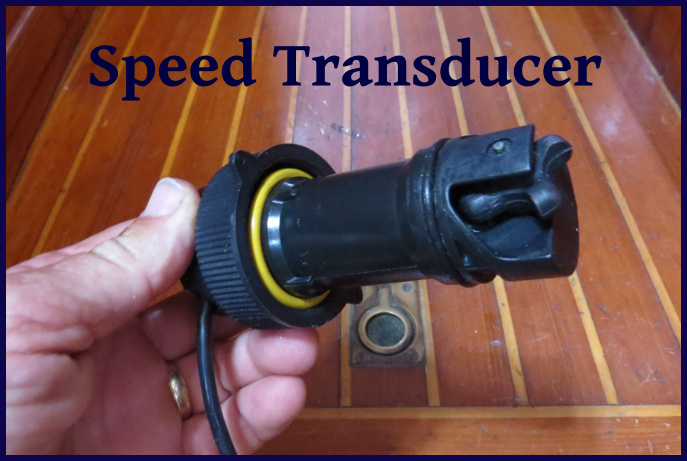
Like most boats, Nine of Cups has a paddle wheel type speed transducer. This little gizmo protrudes from a hole in the bottom of the boat, and as we move through the water, the paddle wheel turns. It is connected to a display in the cockpit that converts the revolutions of the paddle wheel to speed through the water, and shows the result in knots. spped transducer ready to go

Not that many years ago, before GPSs were so cheap and prevalent, it was an essential piece of equipment. Now, with the multitude of GPSs aboard, it is less important, but it is still useful in determining the strength of the current. For example, as we were headed around the bottom of Madagascar on this last passage, it seemed like we were really moving along, but the GPS showed we were only doing 4 knots over the ground. The speed transducer, however, indicated we were doing 6.2 knots through the water. The difference was due to an adverse 2.2 knot current.

The paddle wheel usually works quite well as long as we keep moving. If we stop somewhere for more than a few days, however, it often gets fouled with small sea creatures, and needs to be cleaned before it will work again. Because of this, I usually pull it out and replace it with a dummy plug whenever we are going to stay in one place for awhile.

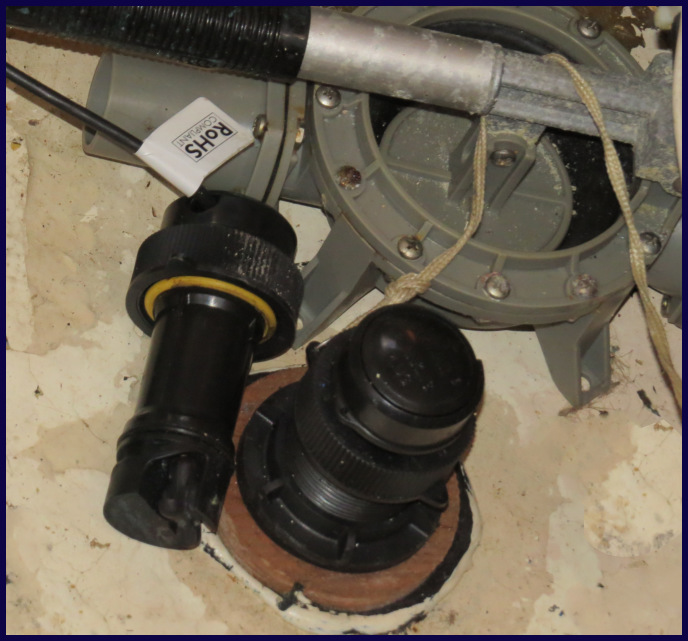
transducer and plug

The first time I removed the transducer, I was filled with trepidation. I was about to open a rather large hole in the bottom of the boat. What if I dropped the plug and/or transducer down into the bilge? What if I couldn't force the plug or the transducer back into its hole? What if the plastic housing that holds the transducer in place broke? We were in Bristol, RI at the time, and I actually called the nearby boatyard to have them on alert with their Travelift®, just in case something went wrong. I'm sure they were quite amused by my inexperience, but they told me the slipway was all clear.

I tied small lengths of line to both the transducer and the plug so they wouldn't go far if I dropped either or both of them. I placed a tapered wooden plug and hammer nearby, just in case. Then I took a deep breath, gritted my teeth and unscrewed the transducer. Sure enough, as it popped out of its housing, there was a very impressive 2-foot geyser of water shooting from the hole. I grabbed the plug, and after a little finagling, I got it in place and screwed down tight.  Most of the water went down into the bilge, and the remaining water on the floorboards was quickly cleaned up with a squeegee and sponge. Like many learning experiences on Nine of Cups, the anticipation was, thankfully, much worse than the reality. Another dragon slayed.

Since then, I have removed and replaced the transducer dozens of times. While I am certainly not totally relaxed or blasé about the process, I am not nearly as concerned about it as I was that first time. Marcie took these photos when I was inserting the transducer for our Indian Ocean passage.

removing the transducer

BTW, a newer design of the housing includes hinged flaps that partially cover the intake side of the hole when the transducer is removed, reducing the amount of water that shoots into the boat. It seemed like a good idea, so we bought one and installed it during one of our haul-outs. It worked fine a few times, but eventually got gummed up and broke off as I pushed the plug in place.