The Blue View - The Legend of The Flying Dutchman

the flying dutchman As a boy, I never tired of reading about sea lore and tales of the sea. Robert Louis Stevenson, Jack London, C. S. Forester, Melville, Richard Dana and Jules Verne were just a few of my favorite authors. One of Marcie's recent blogs mentioned the legend of The Flying Dutchman, which reminded me of an obscure anthology of sea legends I once read. The book was rather cheesy, and I'm sure it never made anyone's best seller list, but it did recount the tale of the ill-fated ship. I have since read several versions of the legend, but my favorite remains the rendition as told in my old anthology, and is as follows:

The ship was a Dutch vessel and sailed from Amsterdam in the 1750s. The captain's name was Van der Decken. He was a stubborn seaman, and very strong willed. They were heading around the Cape of Good Hope, but the wind began shifting until it was on the nose and kept growing in strength, and as it did, Van der Decken paced the deck, swearing at the wind. Another vessel signaled that they were heading into Table Bay, and did  Van der Decken intend to do the same, whereupon he replied : “May I be eternally damned if I do, though I should beat about here till the day of judgment.”  The devil heard his oath and took him up on it, and to this day, Van der Decken on the brig The Flying Dutchman continues to beat around the Cape in the nastiest of weather. The Flying Dutchman is only seen when the weather is, or is soon to become most foul, and is a sure portent of doom and bad luck. In fact, it is believed that a serious accident or death will soon befall the first person aboard to spot the brig. Sightings of the ship report it to be glowing with a ghostly light. Sometimes it is reported that the sails are in tatters, other times sailors say the ship is under full sail and bearing down on them at high speed.

the flying dutchman

There have been many sightings in the 19th and 20th centuries by other ships, lighthouse keepers and people ashore. One of the more interesting accounts was by Prince George of Wales, the future King George V. He and his older brother, Prince Albert, were on a three year training voyage on a British naval ship. Before dawn on the 11th of July, 1881, the prince's log records:

“July 11th. At 4 a.m. the Flying Dutchman crossed our bows. A strange red light as of a phantom ship all aglow, in the midst of which light the masts, spars and sails of a brig 200 yards distant stood out in strong relief as she came up on the port bow, where also the officer of the watch from the bridge clearly saw her, as did the quarterdeck midshipman, who was sent forward at once to the forecastle; but on arriving there was no vestige nor any sign whatever of any material ship was to be seen either near or right away to the horizon, the night being clear and the sea calm. Thirteen persons altogether saw her ... At 10.45 a.m. the ordinary seaman who had this morning reported the Flying Dutchman fell from the foretopmast crosstrees on to the topgallant forecastle and was smashed to atoms."

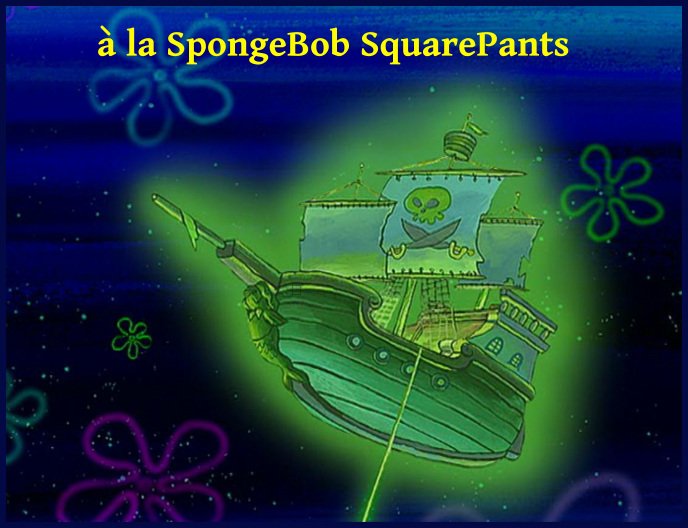
The Flying Dutchman has also been depicted in many movies and TV shows: Pirates of the Caribbean, at least two episodes of Rod Sterling's The Twilight Zone, Xena: Warrior Princess, The Simpsons, and even Sponge Bob Square Pants. Based on the genres, I don't think Hollywood is taking the legend seriously.
spongebobs flying dutchman

As for me, a very superstitious sailor, I have no desire to look for portents of foul weather or  doom, nor do I want anyone smashed to atoms. Fortunately, knock on wood and thanks to the good graces of Neptune, there were no sightings of the legendary ship by the crew of Nine of Cups when we doubled the Cape of Good Hope.

The Blue View - Finding the Current

There are a number of ocean currents around the world, and we've experienced several of them first hand on Nine of Cups. There is the Humbolt Current, a north setting current on the west coast of South America that we fought most of the way down the coast of Peru and Chile. There is the south setting East Australia Current that gave us (and little Nemo in the Disney classic) a fast ride from Bundaberg to Sydney. The Benguela Current assisted us sailing north out of Cape Town the last time we were there. We either made use of or tried to avoid the Gulf Stream Current on our several passages up and down the east coast of the USA. ocean currents

In general, we greatly prefer to go with the current, if possible, but sometimes the currents are contrary to expectations. On our Indian Ocean crossing, we sailed the routes that the pilot charts indicated had favorable currents, but encountered an amazing number of adverse counter-currents, Other boats, a mere 40 or 50 miles away, had a one or two knot push from the currents they saw, while we were losing one or two knots from a current going the opposite direction. Perhaps the tot of rum they gave Neptune was more to his liking than the Bundy rum we were offering.

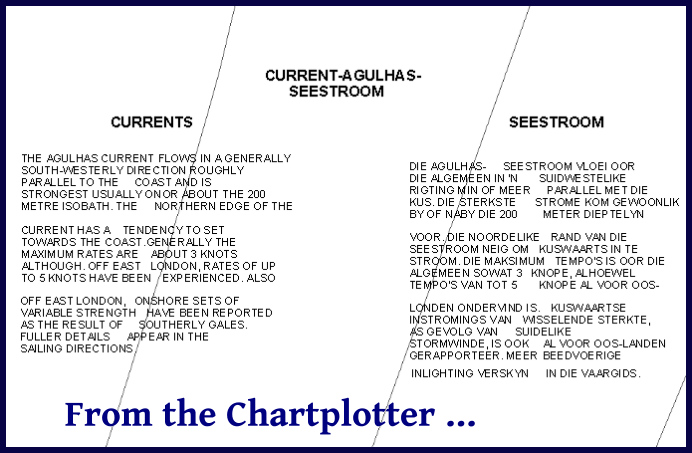
On our passage from Durban to Cape Town, we were looking forward to, but anxious about the Algulhas Current. This current flows along the west and south coasts of South Africa, and reaches speeds of 5+ knots. Only the Florida Current and portions of the Gulf Stream attain higher speeds. The Algulhas Current makes for very fast passages, but if you get caught in it when a “southbuster” comes through, the wind against the current can create huge, deadly waves. Many of our new friends in Durban and East London had stories of vessels lost along this coast when the winds didn't behave as predicted.

current flow

The first trick is finding the current. We had all sorts of conflicting advice. The pilots and sailing directions advise finding the 200 meter (660 feet) depth contour and maintaining that depth along the coast, as this is the edge of the continental shelf. Some local sailors said that we would have a faster passage  if we followed the 30 meter (100 foot) contour, and stayed only 2-3 miles offshore.  Others insisted that we should head offshore until we found three knots of current, then follow that depth contour. Maybe the contradictory advice was due to the fact that the current apparently changes location. The local cruising guide states that “Periodic meanders can move the Algulhas Current as much as 100 miles offshore. Meanders can shift the core by as much as 10 or 20miles in a day.” We decided to head for the 200 meter contour and hope the current wasn't presently off on one of its meanders – or gone on a walkabout.

current chart text

This plan worked quite well for us on the Durban to East London and the East London to Port Elizabeth legs of the passage. We picked up 2.5 knots at the 200 meter contour, and as we followed it, the current increased to 3.5 knots, then 4 knots, and reached a maximum of almost 5 knots. We had two very fast passages, and while the winds were higher than predicted, they were from the right direction.

The 200 meter contour strays from the coast after Port Elizabeth, and if we were going to continue following it, we would have to sail almost 30 miles offshore. Despite the extra miles, if we found 3-4 knots of current, we would still have a faster passage to Mossel Bay than if we sailed a direct course, so we decided to head out to sea until we found the Algulhas Current once again. We sailed southeast 30 miles until we reached a depth of 200 meters - no current; 35 miles – no current; then 40 miles and still no current. Should we keep going offshore? Maybe we'd find the current in another mile or so. Or maybe it was off meandering, and we would need to sail another 40 or 50 miles to find it.

sat image of current

We decided to cut our losses at 40 miles and  headed eastward. The extra miles and lack of current put us into Mossel Bay at midnight the next night instead of a hoped-for afternoon arrival, but the anchorage was wide open and calm. We tidied up and hit the bunk, and I had nary a dream about where that pesky current was off to.

The Blue View - Repairs in Exotic Places...Again

In Marcie's recent blog about our trip down the Wild Coast to East London, she mentioned we broke a few sail slides – 12, in fact. While it isn't all that unusual to break a few sail slides, this may be a new record for Nine of Cups. BVRepairsAgain Broken Slides

One side of each sail slide is attached to the mainsail with webbing. The other side of the slide is t-shaped, and fits into a groove, or track, on the mast. As the name implies, the sail slides slide up and down inside the track, allowing the sail to be raised and lowered. I use mainly nylon sail slides, with the occasional stainless version at high stress points. The nylon sail slides can handle anything the mainsail is likely to encounter, unless the sail starts to flog. The stainless slides are indestructible, but have a tendency to jam-up when trying to reef or lower the sail off the wind, so I use them sparingly. I prefer replacing the occasional broken sail slide to being unable to lower the sail when it's time to reef down.

I keep an inventory of sail slides on hand. I had 20 spares when we left Tasmania a couple of years ago, but when I checked my parts bin, I found I was down to only nine, two of which were stainless. It is rare that we break more than a couple on a passage, so normally nine sail slides would have been more than enough, but obviously not this time. Unless we wanted to repair our Yamaha outboard, East London doesn't have much in the way of boat parts,  so we weren't able to find anything locally, and having something shipped in could potentially cause us to miss the next weather window. Marcie reminded me, however, that the sail slides on the storm trysail were the same size – I could 'borrow' some from it. Since we weren't likely to need our storm sails between here and Cape Town, this seemed like a good plan.

BVRepairsAgain Stitching

It took an afternoon to make the repairs. The process is simple enough – cut the stitching that holds the webbing, remove the broken slide, then hand stitch the new one in place. We've done it enough times that we actually have a 'How-To' video on the subject. I also discovered two broken and one missing batten, which we will do without until Cape Town.

The other problems were easy to fix:

Malfunctioning vacuum gauge on the engine fuel system – swapped it out with the spare

Handheld autopilot remote was flaky – cleaned the contacts on the cockpit connectors

AIS info not being displayed on the Nav station chartplotter – corrected a baud rate setting that somehow changed since the last time it was used.

All in all, not a bad list of repairs for our passage down the Wild Coast.