The Blue View - Prop Shaft Generator pt. 1

installed shaft generator

installed shaft generator

When we are anchored for any period of time, our solar panels and wind generator pretty much keep up with our power needs. On a passage, however, our requirements are higher. The additional electronics – auto pilot, nav instruments, AIS, radar, etc. - all require power, and we usually have to run the engine an hour or more each day to keep the batteries charged. There are a number of reasons why we dislike doing this. On a long passage, the amount of fuel required just to charge the batteries starts adding up. If we are on a significant heel, we have to alter course or reduce sail before and after running the engine. Using the engine at low RPMs and with a light load is hard on the engine.  And in addition, it is very annoying to disrupt that perfect broad reach on a warm, starry night by having to crank on the engine.

shaft generator monitor

shaft generator monitor

Several of our cruising friends have had good success with propeller shaft generators, and adding one to Nine of Cups has been on my to-do list for several years now. If we could generate another 2-3 amps while we were sailing, we probably wouldn't have to run the engine at all. When we were in Durban a few months ago, I decided to take on the project.

What does a prop shaft generator do? We have a fixed blade prop, and when we are sailing, the water moving against the prop causes the prop shaft to rotate. (We actually  have a prop shaft brake which prevents the shaft from rotating when the engine is off, but it can be disabled). By adding a pulley to the shaft, mounting a generator or alternator next to it, and connecting the two with a belt, we should be able to utilize the rotation of the shaft to generate power as we sail. That's the theory, anyway.  The rest is just details, right?
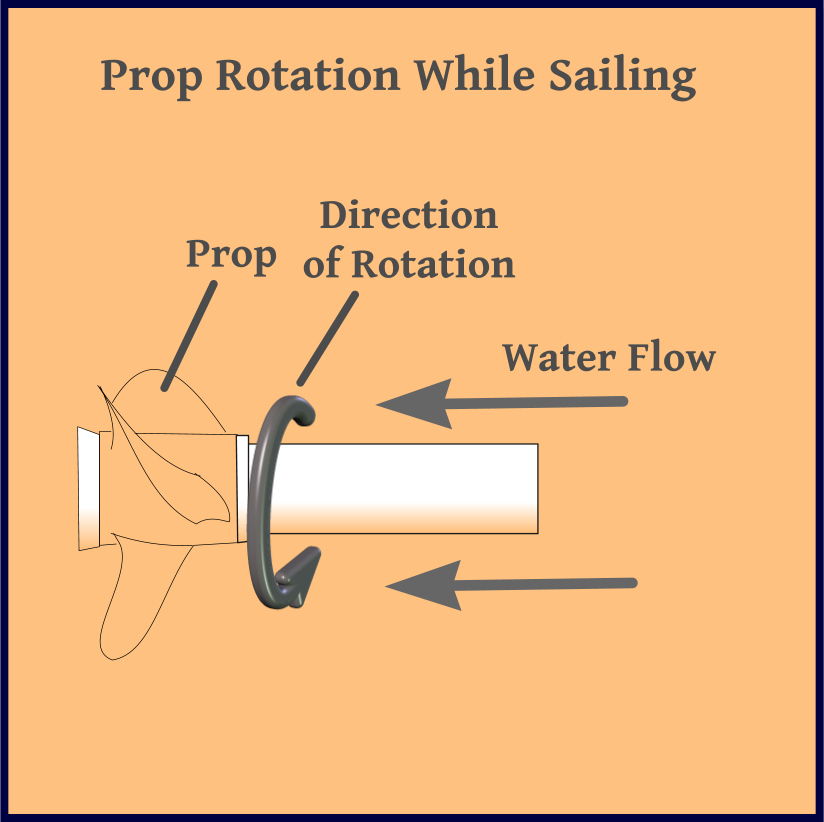
shaft generator rotation

shaft generator rotation

One the more important details is which generator to use and I've found several options. There are three types of generators/alternators that can be used for this application, and each has its own advantages and disadvantages.

Brush-type DC Motor.  The most basic DC motor, which has been around since he late 1800s, has a rotating coil mounted inside several permanent magnets attached to the outer housing. If a battery is connected to a 12 volt DC motor, it will spin. Conversely, if  the rotor of a brush-type DC motor is spun, it will produce a DC voltage. If the motor is big enough and it spins fast enough, it can charge a battery. The advantages are that it is inexpensive and it is simple to implement electrically. It has several disadvantages, however: since it has brushes, the maintenance requirements are higher; it generates electromagnetic interference (EMI), which may be a problem with an HF radio; the maximum allowable RPMs for this type motor is usually less than an alternator; and is more difficult to keep cool.
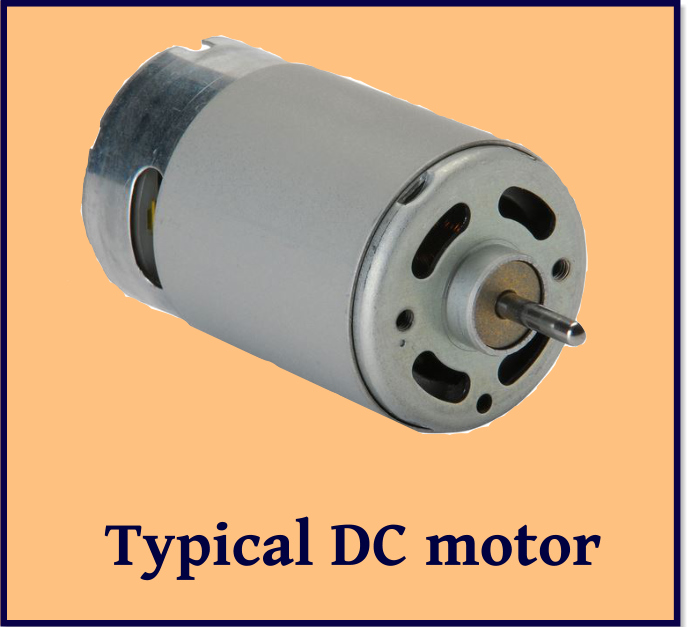
dc motor

dc motor

Brushless DC Motor. This type motor has permanent magnets attached to the rotor and windings that are attached to the housing. Since the windings don't rotate, the need for brushes is eliminated. The advantages of a brushless DC motor are: it requires less maintenance than a DC motor with brushes; generates little or no EMI; and is more efficient. On the other hand, the disadvantages are: it is more expensive; it generates a three phase AC output which requires a diode bridge to convert to DC; and the maximum allowable RPMs are usually less than an alternator.

Alternator. A typical automotive or marine alternator is also a candidate for a prop shaft generator. It overcomes some of the issues of a DC motor: since it is meant to be coupled directly to an engine pulley, the maximum allowable RPMs are quite high; they are made by the million, so the cost is quite low; the output is easily regulated by varying the field current; they are very efficient; and are self-cooling. The disadvantages are: the output is three phase AC, and must be converted to DC; and they are meant to run at high RPMs, so unless the windings are rewound with finer wire, the output at low RPMs is quite small. The biggest disadvantage, however, is that an alternator requires a field current of typically 3-5 amps. Unless the RPMs are quite high, the output will be negligible. In fact, the net amperage might even be negative if the RPMs of the shaft aren't high enough.

alternator

alternator

So which alternative did I choose? Actually, I found a hybrid of sorts that was a nice compromise. A company in the U.S. that makes components for wind turbines, WindBlue Power, buys standard automotive alternators and morphs them into brushless DC motors. They rewind the windings with finer wire so the output is higher at low RPMS; they replace the field coil with a permanent magnet, eliminating the need for the 3-5 amps of field current; and they remove the internal rectifying diodes – which, as will be discussed later, is another important issue. The resulting generator overcomes most of the shortcomings of a standard brushless DC motor for this application.

wind blue model

wind blue model

I'll talk about the design in more detail in next week's Blue View.

The Blue View - Splicing a Sleeve onto a Line

In a recent blog, Marcie mentioned visiting the Southern Ropes factory outlet store. What a great place!Not only did they carry every type of yacht rope, but climbing, fishing, water skiing and other specialty ropes as well. I could hardly contain myself as I checked out all the different rope types and discussed the pros and cons of each with the knowledgeable sales person. Marcie, on the other hand, was able to hide her excitement amazingly well.

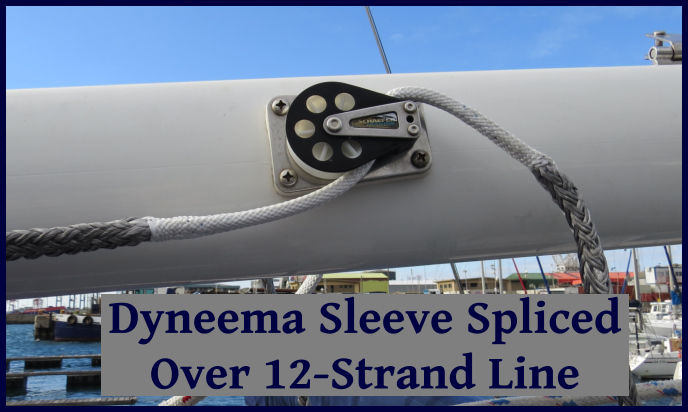
One item I discovered was protective sleeve material. This is a tubular outer cover that can be slid over an existing line and spliced in place to protect the line from chafe. The sleeve is made of UV resistant Dyneema – a material known for its high resistance to chafe. Our reefing lines have a tendency to chafe at one particular spot, and this would be a good remedy. The sleeve material should be purchased in one size larger than the line it is protecting. Since our reefing lines are 10mm, I bought a few meters of 12 mm sleeve material.

a chafed line

In some applications, the sleeve can be merely slid in place and stitched. This would be acceptable for dock and mooring lines. If the line will be passing through blocks and clutches, however, the sleeve should be spliced in place.

There are two types of splices that can be used, depending on the type of line the sleeve will be covering. If the line is a 12-strand type, like Amsteel for example, the splice is quite simple. Once the cover is in place, the combination of the sleeve and the line is essentially a double braid line. I use the method for stripping a cover on double braid class II rope provided by Samson Ropes.

cover over dyneema

If the line is a double braid type, the splice is more complicated. I cut the cover 12” (30cm) longer than needed. I attach the double braid line to a splicing wand or fid, and slide into the cover.

insert and measure

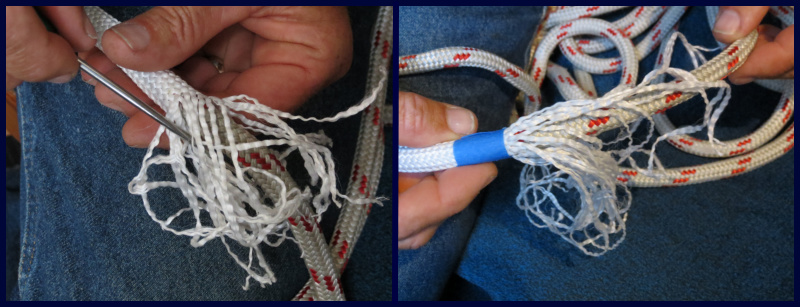
Next, I mark the cover 6” (15 cm) from one end, and then unravel the strands of the cover from that end back to the mark.

unravel

Using a large darning needle, I stitch four sets of strands at a time into the double braid. The splice needs to be tapered, so I vary how far along the double braid each set of strands is stitched. Then I snip off each set of strands where they exit the double braid, and stretch the line until the ends disappear.

stitch

(Note the bandaid – I am seldom allowed to use needles or other sharp instruments unattended). Once one end of the cover has been buried in the double braid, I stretch the cover tight and repeat the process with the other end.

done

The Blue View - Flaking the Dock Lines

flaked line After Nine of Cups is secured to a dock, jetty or finger pier, and the lines are all tied, there is always some excess dock line to deal with. Ideally, it should be flaked so that the line can be run out quickly, without tangling, in the event of an emergency. If the boat next to us is on fire or we just got a tsunami warning, I don't want to spend an extra few minutes untangling knots in my dock lines.

The most common method is to just neatly coil the line  in loops. This is quick, and easy, and if the line is short, it can be run out or untied from the cleat quickly. If the line is longer, it is often coiled in a figure 8 pattern, which prevents the line from kinking or tangling as it is uncoiled.

figure eight pattern

Another method is to use a daisy chain, aka a chain sinnet, to shorten the line. This makes an attractive chain that can be un-knotted, without tangles, by pulling on the end. It is an easy knot to tie, and Grog's Animated Knots shows how.

chain sinnet

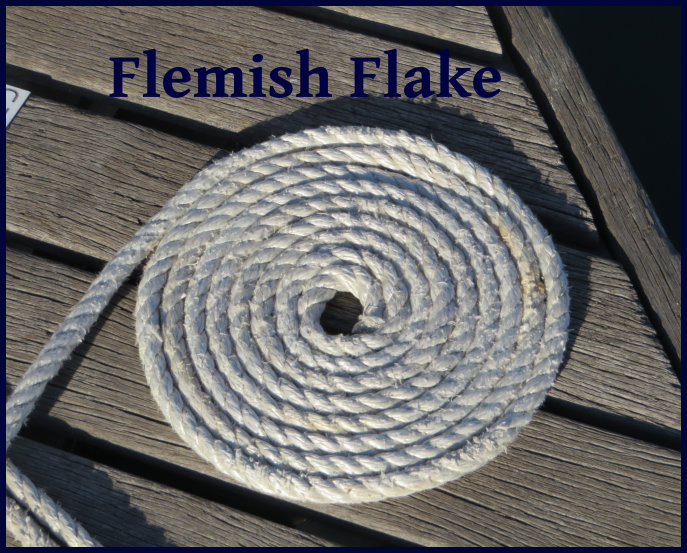
Many yachties like to use a Flemish flake. The line is coiled in a tight spiral on the deck or dock, and the end result is quite pleasing. It does have a few disadvantages, however. It cannot be quickly uncoiled without introducing a number of kinks and tangles; it doesn't dry out easily; and people have a tendency to walk on it, grinding dirt into the fibers.

flemish flake

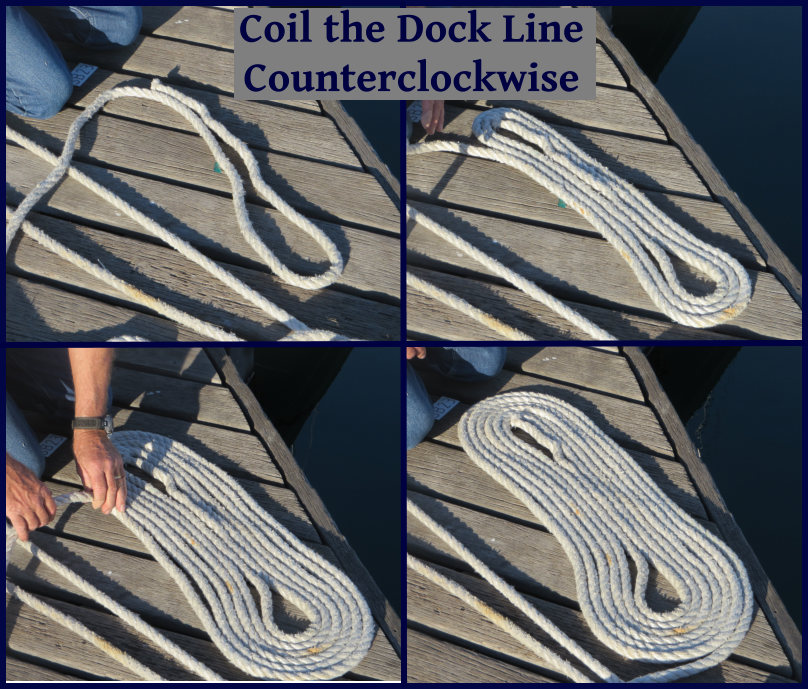
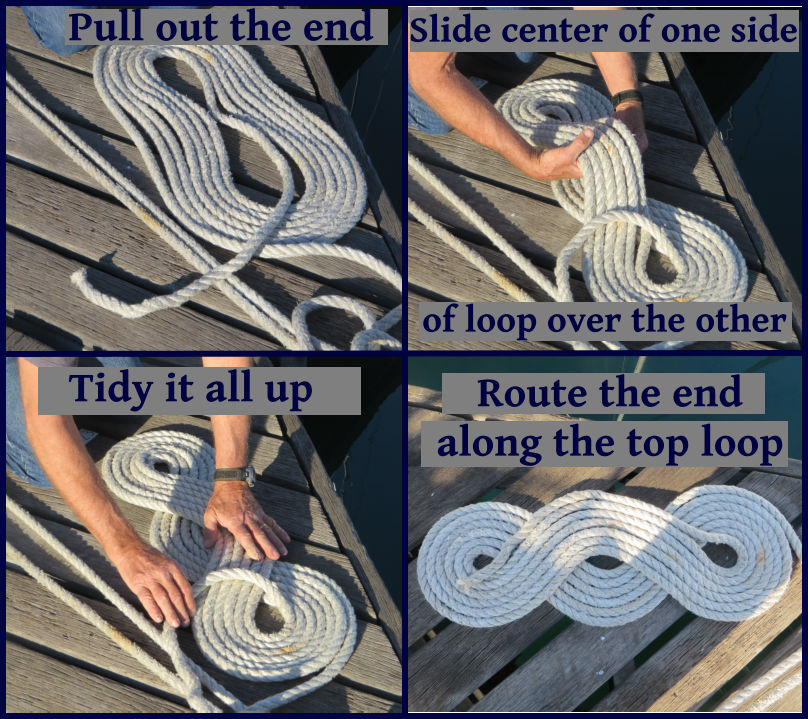
As we were walking up the dock the other day, I noticed that a Swiss flagged boat berthed near us, the Omoo-Faa, had a different method of flaking his docklines – one I hadn't seen before. Marcie took a picture of it (she almost always has her camera with her), and I spent an hour or so when we got back figuring it out and messing around with it. It looks quite attractive and seamanly. By pulling on the end, the coil runs out with nary a kink. The tight coils will probably still take longer to dry out, but the finished coil doesn't look like a mat, so maybe people will be less inclined to stand on it. The following photos show how to do it.

flake collage

BVFlake Collage2

There hasn't been anyone aboard the Omoo-Faa, so I haven't been able to ask the skipper about it.  I don't know the origin, whether the owner invented it or learned it from someone else and whether it has a name. If any of you salts out there have any information about this method of flaking a line, I'd be pleased to hear from you.