The Blue View - Our First Coast Guard Visit

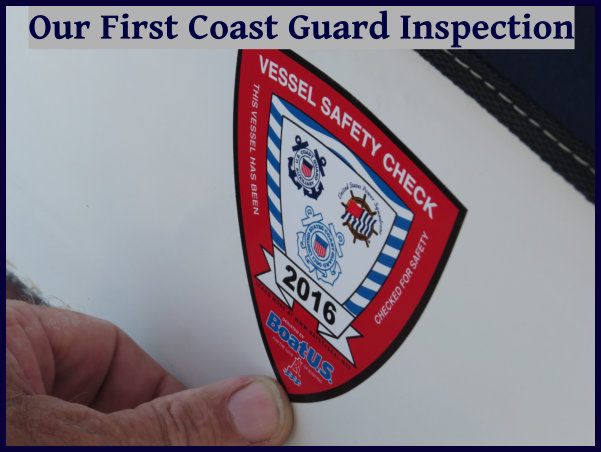
uscg auxilery decal Since we were planning to spend a few days moored in Washington D.C., I thought it might be possible to schedule a U.S. Coast Guard Auxiliary inspection. According to their website, the Coast Guard Auxiliary will do a free, no-strings-attached inspection of a recreational vessel on request. If we pass the inspection, we get a signed form to that effect, as well as a decal to apply to the hull which shows that we not only requested an inspection, but that we passed. If we don’t pass, there is no fine or citation issued, nor are we reported to anyone. Any deficiencies are pointed out and the appropriate corrective measures discussed. It seemed like a no-brainer.

A couple of days prior to our arrival in D.C., I got onto the Coast Guard Website. It has a nifty link to the C.G. Auxiliary website, which put me in touch with the closest inspectors. There were two who lived within a few of miles of our anchorage, and after a couple of emails back and forth with one of them, we figured out a mutually acceptable date and time, and our inspection was scheduled. The process was much faster than I anticipated and quite painless.
united states coast guard inspector

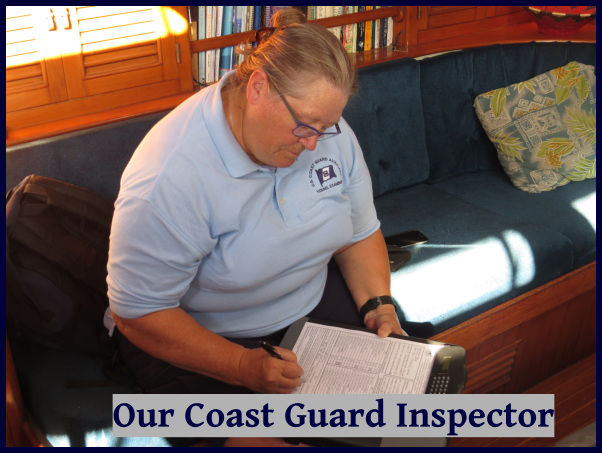
At the appointed time, we got a call from Patt Meyer, our inspector, and we hopped into the dinghy and went ashore to pick her up. Patt retired from the U.S. Navy a number of years ago, and has been a volunteer with both the Coast Guard Auxiliary and the Maryland Department of Natural Resources for several years now. She was pleasant, quite professional and knew her stuff.

Once aboard, she started through her checklist. Patt checked our flares, fire extinguishers, oil discharge and garbage placards, PFDs, documentation, life rings, bilge pumps, and holding tank, as well as a host of other things. She asked dozens of questions.

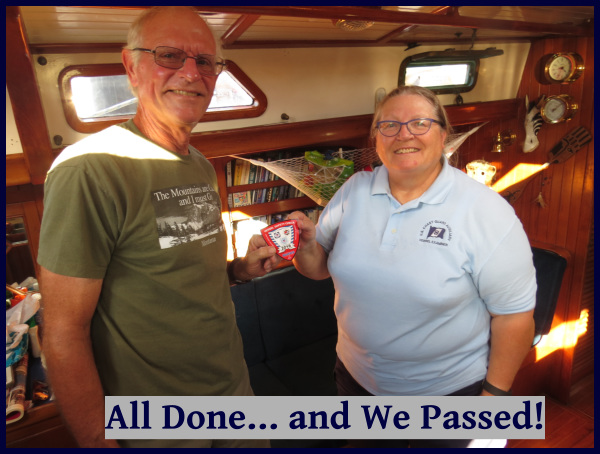
When all was done, we passed without a hitch. She completed and signed the checklist, and I happily signed as well. She issued our decal, which we stuck to the side of the coach-roof, plainly visible on the port side of Nine of Cups. After handshakes all around, we all climbed back into the dinghy and headed back to the marina.
passed the uscg inspection

The whole inspection process took just over an hour, time well spent in my opinion. It was a good confirmation that the time we invested in checking the federal requirements was worthwhile. And while there is no guarantee, our understanding is that the Coast Guard may give us a pass if we are stopped for a routine safety check if we point out our inspection decal. Worth the cost of admission right there!

The Blue View - Coast Guard Checklist

Since it’s been quite a while since we sailed in U.S. waters, we thought it would be a good idea to review the US Coast Guard documentation and make sure we were in compliance with all the regulations. I suspect that if we were boarded for a routine safety inspection, they might want to check a few other things besides the expiration dates on our flares. info collage

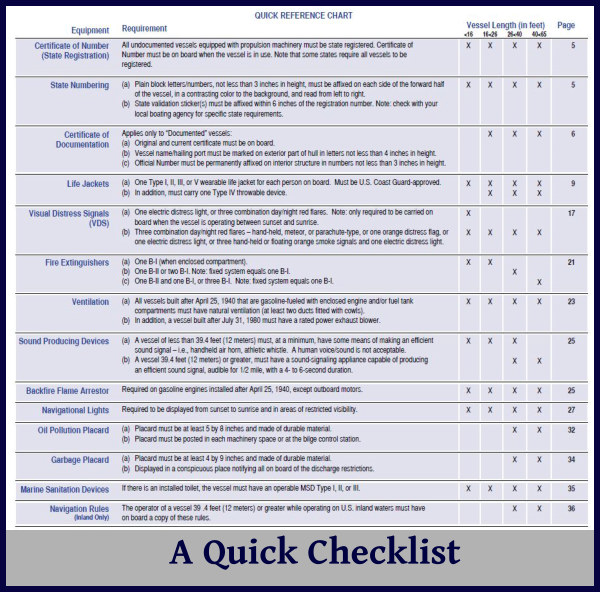
It took only a few minutes of online searching to find a host of documents describing the various guidelines and requirements for pleasure vessels. One particularly helpful document is A Boater’s Guide to the Federal Requirements for Recreational Boats. I found this 45-page pdf document to be quite informative and easy to read. The government writers did a good job of translating the federal code into something that was understandable and almost interesting. I read the entire booklet and found several requirements that were new since we left the U.S. all those years ago – not to mention a number of requirements I had forgotten. It also included a checklist which I found quite useful.

checklist

So, how did we stack up? We met nearly all of the safety requirements – life jackets, fire extinguishers, horns, bells, navigation lights, bilge pumps, etc. One safety issue I had missed was the requirement to cover all battery terminals to prevent a problem should a tool be dropped across them. I fabricated terminal covers from heavy plastic and, using cable ties, attached one to each battery terminal.

battery terminal covers

We also met most of the other requirements, such as a marine sanitation device (a holding tank in our case), and an on-board copy of the navigation rules. (The nav rules are also available digitally on line, in case you need to print them out.) We did, however, find a number of issues that might have been grounds for a citation had we been inspected.) To make sure we were in compliance with everything on the list, we spent the last two days before departing Chesapeake, VA, scurrying around making sure we found everything we needed.

For example, we didn’t have Cup’s documentation number permanently affixed in a conspicuous location inside the boat, with numbers that are at least 3” in height. We do have our doc number painted onto the interior of the hull under the aft bunk, but this is hardly a conspicuous location. We found stick-on letters at the local hardware store and stuck-em on, so we should now meet this requirement.

a conspicuous location

We also did not have a copy of the MARPOL regulations regarding the disposal of garbage and waste overboard. This should be in the form of a permanent placard, affixed in a conspicuous location, so that everybody on board will be aware that it is illegal to dispose of plastics, oil and garbage in U.S. waters. We found these, free of charge by the way, at the local West Marine. While we were there, we picked up a very nice placard with a written trash disposal plan to replace our rather old, weathered version – also free of charge.

anchor ball

Finally, we did not have an anchor ball. When we are anchored at night, we are required to have a white anchor light, visible from all directions. This is not only a requirement, it’s also common sense – we want to make sure other vessels see us at night. More than once, we’ve been run into by fishing boats while anchored, even while our anchor light was shining brightly. Thus, we usually augment our anchor light with our spreader lights, just to make sure we can be seen. When anchored during the day, we are required to display forward, where it can best be seen from all directions, a black ball. In our 16 years of cruising, I doubt I have seen more than half a dozen sailboats that actually do this, but it is a federal (and international) navigation requirement, and we should make an effort to comply. None of the local chandleries had a black ball in stock, so we decided to make our own, and went on a search for something that would work. We eventually found two large plastic, round black bowls for 97-cents each in the Halloween section of a local Walmart. We drilled holes in the top and bottom and attached a small line, then taped them together - using black duct tape, of course. It works quite nicely and should last until, if and when we decide we need a more permanent solution.

anchor ball fabrication

BTW, the volunteers with the U.S. Coast Guard Auxiliary will, at no charge, perform a courtesy safety and compliance check on your vessel. It is informational only - they do not issue citations nor report you for safety violations. If you pass their inspection, the vessel will be issued a signed statement to that effect, as well as a decal that can be affixed to the boat. If we stop anywhere long enough to schedule an inspection, we plan to have it done.

The Blue View - Flares, and More Flares

flares Marcie was doing her annual ditch bag inspection not too long ago, and noted that our flares were due to be replaced. Flares have a shelf life of 3.5 years, which seems like a long time, but it also seems like we are always buying them.

smoke flare

There are a host of different flares available, ranging from handheld flares, to orange smoke flares to signal rocket flares with parachutes. We’ve got quite an assortment. The prices vary accordingly, from expensive to really expensive.

flare gun

We also have a 12-gauge flare pistol. Just like in the movies, a shotgun shell sized flare is loaded into the pistol, which is then fired into the sky, sending a bright red flare 500 feet or so high. Unfortunately, this type flare gun is considered a weapon in some countries, and must be declared and held in bond until the vessel leaves the country.

The U.S. Coast Guard requires us to carry at least three flares for daylight use and three flares for night use as a minimum. (Some types of flares are approved for both day and night use, in which case only three flares in total are needed.) In addition, because we sail offshore, we felt we should follow the International Sailing Federation (ISF) guidelines for offshore vessels, which requires 6 red parachute, 6 red handheld and 2 orange smoke flares. That’s a lot of flares, and did I mention that they ain’t cheap? It’s about $600 for the complete set – ouch!

Our approach was to carry the ISF flares in our sealed life raft, which has to be opened and inspected every three years. If we ever had to abandon ship, we’d be sure to have a good set of flares in the life raft, even if we lost our ditch bag. The coast guard is authorized to board any vessel in U.S. waters (or any U.S. flagged vessel anywhere in the world for that matter) to do a safety check. Since it isn’t practical to open the sealed life raft, we also keep an in-date set of the USCG required flares in our ditch bag to ensure we meet their requirements – and to have on hand if we have an emergency that doesn’t require abandoning ship.

collection of flares

Once the flares pass their “Best if Used By” date, they are most likely still usable and can still be kept aboard, as long as we have sufficient in-date flares to meet the USCG requirements. Thus, we have kept the majority of our outdated flares over the years to use as backups, and we’ve accumulated quite the collection.

Disposing of used flares is difficult. They can’t be tossed in the trash. They can’t be set off without the possibility of creating a false distress alarm. The coast guard won’t take them, nor will most local fire or police departments, and the manufacturers won’t take them back. In some places, the local coast guard auxiliary or sea scouts may take them for use in training. When we decide to start thinning our inventory of old flares, we’ll do what everyone else does - ask around and make lots of calls until we find a solution.

electronic flare

This year, we decided to use a different approach. The coast guard allows an alternative to the usual pyrotechnic flares. It’s now possible to buy an LED electronic flare that is USCG approved and which never expires, as long as the batteries are replaced each year. It is waterproof and floats, and once turned on, it flashes a very bright S.O.S. signal.

electronic flare with flag

Since this is only a night time signal device, it is also necessary to have flares for day use. The coast guard also allows the use of a large orange flag with a black circle and black square printed on it, in lieu of the usual daylight flares. Weems & Plath, the company that manufactures the electronic flares, very cleverly sells a package that includes both the light and the flag.

We ordered the electronic flare package on Amazon, installed four C-cell alkaline batteries and tried it out. The light, which has a visibility of 10 miles, was as bright as expected. We stowed it and the orange flag in the ditch bag, and Marcie has changed her annual safety checklist to include changing the batteries.

Our life raft will be due for inspection this January, and the ISF flare set that is stowed inside will be near its expiration date. Should we invest $600 or so on the replacements or should we scale down a bit? We aren’t planning to cross any more oceans in the next three years, so maybe it’s okay to cut back.

This post contains affiliate links to Amazon for your convenience. If you shop Amazon through any Amazon links on our site, we get a small commission at no extra cost to you. Thank You!