The Blue View - Latest & Greatest Batteries

Nine of Cups has two battery banks: a single 8D starter battery, and a four battery, 800 amp-hour bank that supplies power to the ‘house’ – our electronics, lights, pumps, refrigerator/freezer, water desalinator, autopilot, etc. – pretty much everything electrical except the starter. If we are anchored somewhere and are running the refrigerator and using our computers, our solar panels and wind generator usually won’t quite keep up with our daily electrical consumption. Depending on how sunny and/or windy it is, the fully charged house battery bank will typically last 2-4 days, at which time we have to start the engine and recharge the batteries. Batteries can only be recharged a finite number of times before they start losing their capacity, however. The number of recharge cycles depends on several factors. Battery chemistry, depth of discharge before recharging, battery maintenance and battery design are the primary factors that determine a battery’s useful life aboard a cruising boat.
greatbatteries-lifeline

We last bought house batteries for Nine of Cups in Pape’ete, Tahiti, about 8 years ago. At the time, we felt Lifeline AGM batteries were the best option available, and we had them shipped from Florida to Pape’ete. We took care to treat them well, and they lasted considerably beyond their expected life of 3-4 years. For example, we never let them discharge beyond 50% of full charge, and we equalized them at the first sign of sulfation.
greatbatteries-workingon-the-batteries

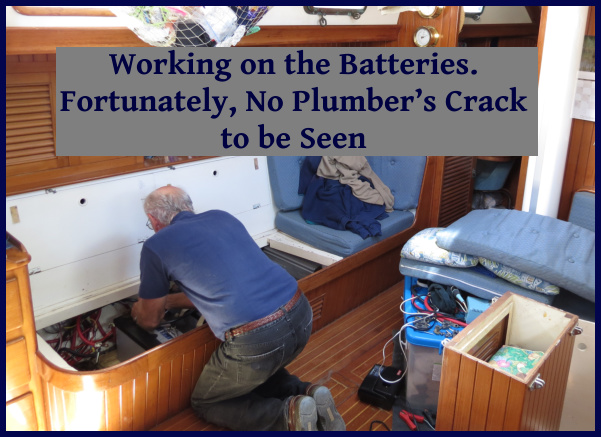
But, alas, even our high quality, well maintained Lifeline batteries aren’t recharging well anymore, and no longer respond to equalizing. I plan to do a capacity test on the batteries when we return to Cups to see just how much life is left, but it’s fairly obvious that they are reaching the end of their useful lives.

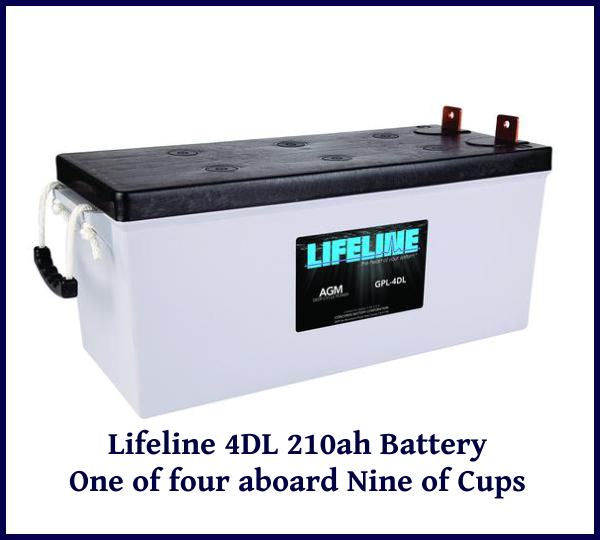
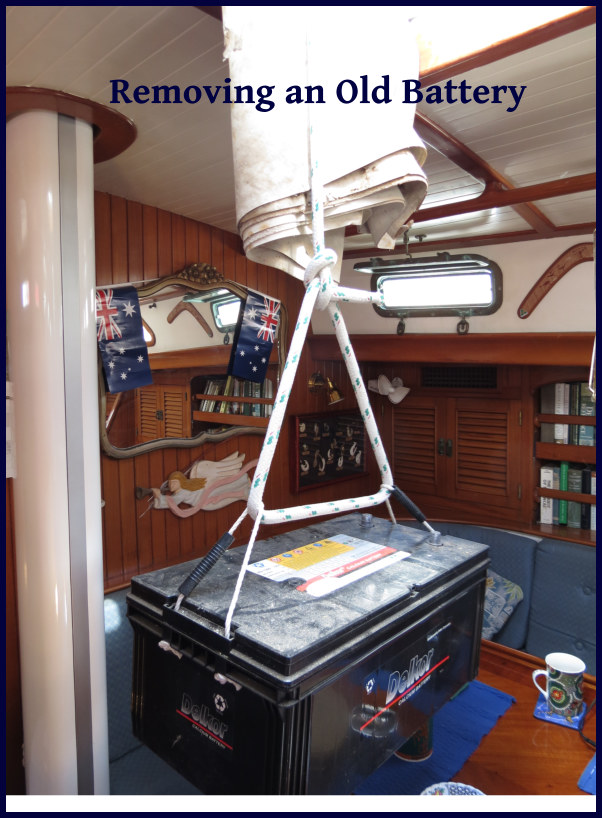
Replacing our house batteries is not like replacing a car battery. First, it is a major cash outlay. The least expensive price I found online to replace our four Lifeline 4DL batteries will cost us more than $2200! Then we have the difficult task of wrestling four 124 lb (56 kg) batteries out of the boat, and reversing the process with the new ones.
greatbatteries-old-battery

There is also the question of whether the Lifeline batteries are still the best choice for us. We were quite pleased with the current batteries, but a lot has happened in battery technology over the last eight years. Has one of the newer technologies - PTTL, Li-Ion, etc. – matured enough to be better suited to our needs? Is it now more cost effective to go with a different battery type? What new products are available? Would we be further ahead to buy less expensive batteries with shorter lives?

Before we plunk out a couple grand or more on new batteries, I need to do some research to make sure we make the best decision. I plan to spend the next week or two evaluating options, checking specs and doing price comparisons. If you are interested in batteries, you are more than welcome to come along. And if you know more about batteries than I do (which isn’t setting the bar real high), I welcome your input and comments.

The Blue View - Winterizing Nine of Cups

winter snow As we are preparing Nine of Cups for a couple of months by herself, one of the jobs on our pre-departure checklist is to prepare her for freezing temperatures. This will be a first for Cups – and us as well. In her entire life, she has never had to be winterized. She grew up with her first parents in Texas, and never saw a hard freeze. Since she’s been ours, we’ve never left her on her own when there was a chance of freezing. So, we had a lot to learn about how best to protect her.


Not to worry. As with most things today, there is no end to internet sources with tons of information on how to winterize a boat. One of the best sources we found was the Boat US site. Since they are in the boat insurance business, they have a vested interest in helping boaters prevent damage – and claims. I did my research and this is the plan I came up with.

  • Hot water tank. I removed the intake fitting from the tank, then opened the drain valve, letting the contents of the hot water tank drain into the bilge. Then I connected the inlet and outlet hoses together.
  • Fresh water system. Obviously, this is one of the most likely systems to freeze. The entire fresh water system must be purged, then refilled with a non-toxic antifreeze. We pumped the tanks dry using both the pressure pump and foot pump. Then we poured a gallon of propylene glycol antifreeze into each tank and pumped both dry again. Next, we poured two gallons of antifreeze into the port tank and four gallons into the starboard tank. We used the starboard tank to purge all the lines: we opened the faucet furthest from the tank – the sink in the aft head - and let it run until we saw a steady stream of pink water coming out. This was done with both the hot and cold faucets. Then these were closed and we worked backward toward the tank at each faucet.

pink coming out of the faucet

  • Seacocks and thru-hulls. Nine of Cups has twelve thru-hulls with seacocks located below the water line. Two of these, the cockpit drains, have to be left open so that when it rains, any accumulated rain water can drain out of the cockpit. Every other seacock should be winterized. To do this, I closed each seacock and removed the hose from it. Then I drained the hose and used a turkey baster to draw out any remaining water from the seacock. After checking the hose clamps and replacing any that were corroded, I reattached and secured the hose to the seacock.
  • Engine raw water cooling system. Our engine uses fresh water for cooling the engine which already had a fresh charge of normal ethylene glycol antifreeze. This coolant, as well as the engine oil and transmission oil, are cooled using seawater that flows through three heat exchangers. The seawater side of the cooling system must be purged and flushed with antifreeze. I started by removing the raw water intake hose, draining it and following the seacock winterizing procedure above. Then I removed the cap from the raw water strainer. One of us started the engine, then watched the water being pumped from the exhaust while the other poured antifreeze into the raw water strainer. Once the exhaust water turned pink, we continued pumping antifreeze through the system for another 30 seconds, then we shut the engine down and put the cap back on the strainer.
  • Watermaker. We have a Katadyne watermaker, and I contacted them directly for their recommended process for winterizing. Following their directions, I disconnected the sea water intake from the seacock (after closing it, of course), then drained it and followed the procedure for winterizing the seacocks as above. I added the appropriate amount of membrane preservative to a gallon of food grade antifreeze. This is a more expensive type of propylene glycol with no alcohol or anti-corrosion additives. The gallon of antifreeze was pumped through the watermaker, then shut down.
  • Holding tank. Our holding tank was pumped out, then partially filled with fresh water and pumped out again. Then a gallon of antifreeze was poured into it.
  • Heads. The intake hose for each head was removed and drained, and the seacock winterized. Before reattaching the hose, a gallon of antifreeze was pumped through the head. The outlet for the aft head is not connected to a holding tank, so after pumping antifreeze through the head, the outlet hose and seacock for it were winterized.
  • Deck wash. The inlet hose was drained and the sea cock winterized. Then the inlet hose was dipped into a bucket of antifreeze and the pump turned on until pink water was seen at the deck wash faucet.
  • Speed transducer. The speed transducer was removed and replaced with the blank plug.
  • Sea water foot pump. The intake hose was drained and the seacock winterized. The intake hose was immersed in a bucket of antifreeze and the foot pump was operated until the discharge water turned pink.
  • Fresh water foot pump. The pump was operated until the water was pink.
  • Miscellaneous. The tea kettle was drained. The fridge was turned off, cleaned out and left open. The pressure water system breaker was turned off.

non toxic antifreeze

We used a total of 15 gallons of non-toxic propylene glycol antifreeze, and one gallon of food grade antifreeze. West Marine conveniently had their antifreeze on sale, so the cost was quite reasonable –certainly cheaper than the cost of repairing a frozen head. The entire process took the better part of a day, but took considerably less time than I expected.

BTW, the average low temp for the Chesapeake City area in December is only 36 degrees F (2 degrees C), so there is a very good chance all this effort was for nothing. Since we did go to the trouble of winterizing Cups, however, I have no doubt the area will experience unseasonably warm temps this year.

My apologies for the lack of pix in this blog. We had every intention of taking a slew of photos while we winterized Cups, then we were so intent on getting the job done, we totally forgot to take a single shot.

The Blue View - A Review of the Boss

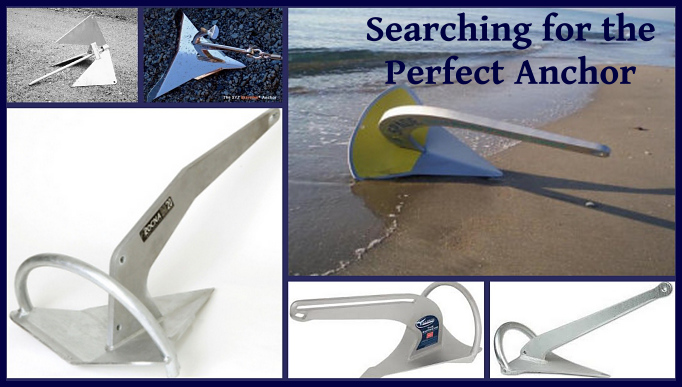
No, this isn’t a review of Marcie... this is an update on our Manson Boss anchor. We purchased our Boss anchor a few years ago when we were cruising the south coast of Australia. Until then, we had been using a 110# (50kg) Bruce anchor, and although it had a few shortcomings, we had been reasonably happy with it. The south Australian coast is known for its hard sand bottoms with very thick, dense grass, however, and our Bruce claw was having difficulty digging in. I went in search of the perfect anchor – one that would serve us well there and also perform well in most other bottom types. I wrote a blog on the topic, and ended up choosing a Manson Boss anchor. manson boss anchor

I was recently asked to do a talk on anchors and anchoring techniques at the SSCA Gam in Melbourne, FL in November. As I started preparing for it, I thought this would be a good opportunity to update my thoughts on our Boss, now that we’ve used it for a few years in a variety of bottoms. So, here’s my review of our Boss anchor:

  • General. The Manson Boss is a scoop type anchor like a Bruce, except it has a very sharp, reinforced point, giving it the ability to dig into the bottom. It also has huge, up-turned flukes that ensure it is self-righting and which give it tremendous holding power once it digs in. It comes in a range of sizes from 5 lb. (2kg) to 400 lb. (182kg). We bought the biggest size that would fit our bow roller, the 80 lb. model, which was a size or two larger than the recommended size for Nine of Cups. We’ve used it in a variety of bottoms, from the hard, grassy bottoms of southern Australia, to soft sand, hard and soft mud, rocky bottoms and shell beds.


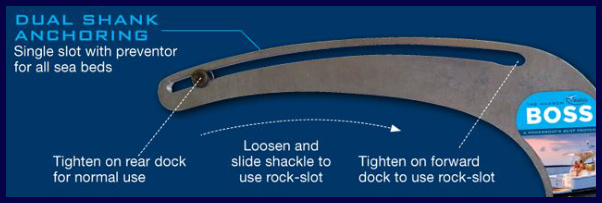
  • Strength. The Boss is made of a high tensile steel. The only issue we had with the strength and construction was the upper part of the shank. The anchor has a slot along the shank that allows the anchor shackle to slide up the shank, making it easier to free the anchor if it becomes wedged in place in a rocky bottom. Manson includes a “shackle preventer”, essentially a nut and bolt that will prevent the shackle from sliding along the slot if the owner feels uncomfortable with the feature or won’t be anchoring in a rocky bottom. Our “shackle preventer” didn’t last long, and we bent the upper part of the shank trying to get it loose from one particularly rocky seabed. We removed the preventer, straightened the shank, and have had no further problems.

bvboss-shank

  • Mud Bottoms. This anchor grabs and holds extremely well in the muddy bottoms we’ve encountered. Only once did we drag. This was in the Albemarle Sound in North Carolina a few months ago. We backed down hard on the anchor and thought we were stuck well on one windy night, but woke up a few hours later and found we had dragged a significant distance. My feeling is that we had fouled the anchor somehow when setting it, because it seems to have been an isolated incident - it is usually stuck so well we have to work it free from the bottom.,
  • Hard Grassy Bottoms. This is the type bottom we bought it for, as our venerable Bruce was having difficulty holding in those thick, grassy, hard sand bottoms, and were happy with it for the most part. We had a few occasions when it took several attempts to get it to dig in, but we eventually got it to hold. On one occasion, we tried unsuccessfully for more than an hour to get it to set, and had resigned ourselves to leaving the anchorage and heaving-to for the night when it finally grabbed and held. We did drag a couple of times, but both times, the anchor reset and held after only dragging a boat length or so. In all honesty, we never slept all that well when the wind picked up in southern Australia. On the other hand, many of the Aussies we spoke to didn’t fare any better.
  • Sand Bottoms. The Boss grabbed quickly and held well in other sand bottoms.
  • Rocky bottoms. Our experience in rocky bottoms isn’t getting the anchor to set, but getting it free once it gets wedged in place. Except as noted above in the “Strength” paragraph, the Boss did well.
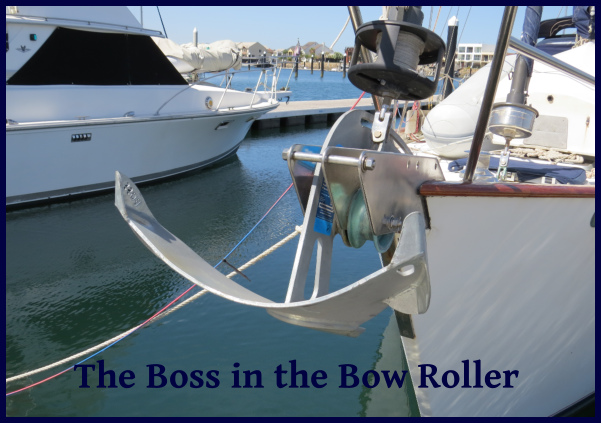
  • Stowage and Deployment. The shank of the Boss is curved, making it fit well in our bow roller. It deploys well and we rarely have problems bringing it back into the bow roller (unlike our big Bruce, which had to be coaxed out of the bow roller and usually smacked the bottom of the roller furler on its way out). The only issue with stowage has to do with the large flukes. When we are in heavy seas, the waves hitting the flukes cause the anchor to bang into the bow roller and roller furler, and I had to go to great lengths to secure it well enough to prevent the anchor causing damage. In storm conditions, I would want to stow it on deck – somewhat of a hassle given its size and weight.

bvboss-stowed

Overall, I would rate the Manson Boss as a B+ to A-. It set and held quite well in most of the bottoms we encountered, especially in mud and sand. In southern Australia, it was better than our Bruce, but was less than perfect. The anchor, as well as the bow roller and roller furler take a beating in heavy seas. It is a good all-around anchor and I don’t regret buying it. On the other hand, I don’t consider it the perfect anchor - if there is such a thing.

bvboss-collage

If only I had unlimited time and money, I’d make a short list of half a dozen or so anchors and try them out in the worst anchorages we’ve encountered around the world - to see whether the perfect anchor really does exist.