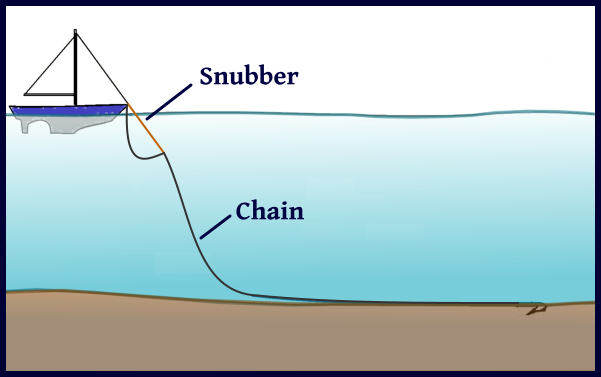
 Nine of Cups has all chain rode, and we never anchor without using a snubber. This is a stretchy nylon line attached between a strong point on the boat and the anchor chain. In strong winds, the anchor chain will stretch out almost straight, and as the wind and waves cause the boat to buck and jerk, there is no give in the chain, causing tremendous stress on the boat - not a good thing. Even worse, the sudden jerks on the anchor can cause it to break free from the bottom – even less of a good thing. The elasticity of the rope snubber reduces the sudden tugs on the anchor and the stress on the windlass and chain stopper.
Over the years, we've gone through dozens of snubbers. We tried smaller diameter line, but found that these would snap when the weather got rough. We tried heavier line, but this didn't have enough stretch. For Cups, the perfect size is 5/8” three strand line. Now we have two. One is about 25 feet long, and we use it in most conditions. The other is 60 feet long, and is our heavy-duty snubber for the “batten the hatches, lash everything down, take the seasick medicine” kind of weather.
When we anchor, we let out enough chain to give us the scope we want, usually five times the depth. If a blow is expected, and there is adequate swinging room, we increase this to at least seven times the depth. Then we set the anchor by backing down on it with a heavy hand on the throttle. Once I am sure it has set, I attach one end of the snubber to a forward cleat and the other end to the anchor chain, and let out enough extra chain so that the snubber is taking the load. Then I let out more chain until the it hangs at least 3-4 feet below the taut snubber. The goal is to make sure there is always slack in the chain no matter how much the nylon snubber stretches.
I use half hitches rather than a spliced eye to attach the snubber to the cleat. That way if I need to adjust the amount of snubber that is deployed or release it entirely, all that needs to be done is to undo the half hitches. If a spliced eye is used, the chain must be brought in enough to take the tension off the snubber, or the snubber must be cut before it can be released. Using half hitches also allows me to go forward periodically and let out a few more inches of snubber if there is any chance the snubber might be chafing – quite important if we are anchored in strong winds.
There are several different ways to attach the snubber to the chain. The methods we’ve used fall into three categories: hooks with no retainers, hooks with retainers and knots. I’ve talked about the knot I use for attaching the snubber to the chain in a previous blog, so I’ll focus on snubber hooks in this blog.
Hooks with No Retainers
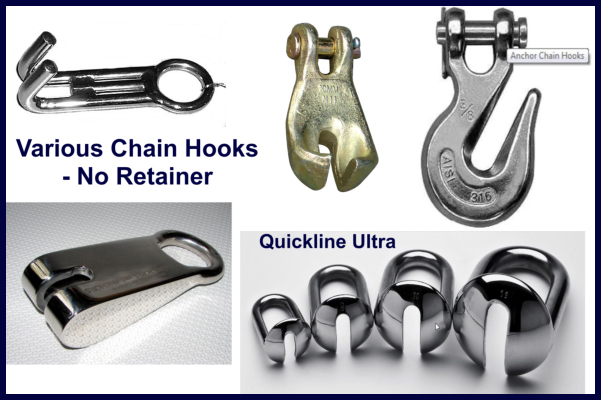
There are several varieties of hooks without retainers. The biggest advantage of these types of hooks is that they are quick to attach and remove. One downside of this type hook is that the snubber line must be kept tight while deploying the chain to prevent the hook from falling off. Once the chain is deployed and the snubber is tensioned, however, the hook will usually stay in place as long as there is enough slack in the chain. Another downside is that if the snubber line ever breaks, the hook will be lost.
It is important to ensure the hook is strong enough - we’ve bent or deformed a few hooks when anchored in rough weather. Check the SWL before buying one.

Another type of hook without a retainer is the chain grabber. It is intended to be used with a bridle, which many sailors prefer – especially catamaran skippers. The biggest advantage of using a bridle is that the boat yaws less when the wind picks up. I find it tricky to keep it in place while deploying the chain, however. As with any hook, make sure it is strong enough for your boat.
Hooks with Retainers
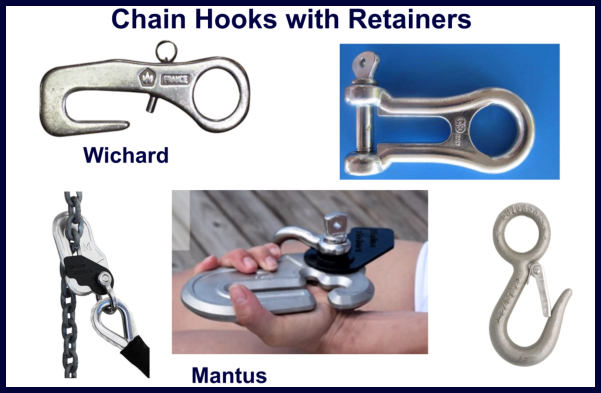
There are also several varieties of hooks with retainers. Most of these take only a second or two to attach, and won’t fall off the chain once in place, even if the snubber line breaks. The only disadvantage is that on some versions, the retainer can become jammed. This happened to us with both the Lewmar version and with a simple hook that utilized a spring-loaded retainer. In one case, it required a hammer and pry-bar and more than a half hour to free the hook.
The shackle-type hook pictured in the upper right of the collage above looks like it would be quite strong and immune to jamming. On the other hand, it would not be quick to attach or remove.
The Mantus hook looks like it has potential, but a friend that has one reports the retainer didn’t last long and was removed after a few months’ use.
We’ve tried perhaps half a dozen different hooks over the years, some with good success and some that we would categorize as somewhat less than successful. In the end, I always end up going back to my old faithful rolling hitch. It is quick to tie, easy to remove, never fails to hold – and best of all – it’s free.

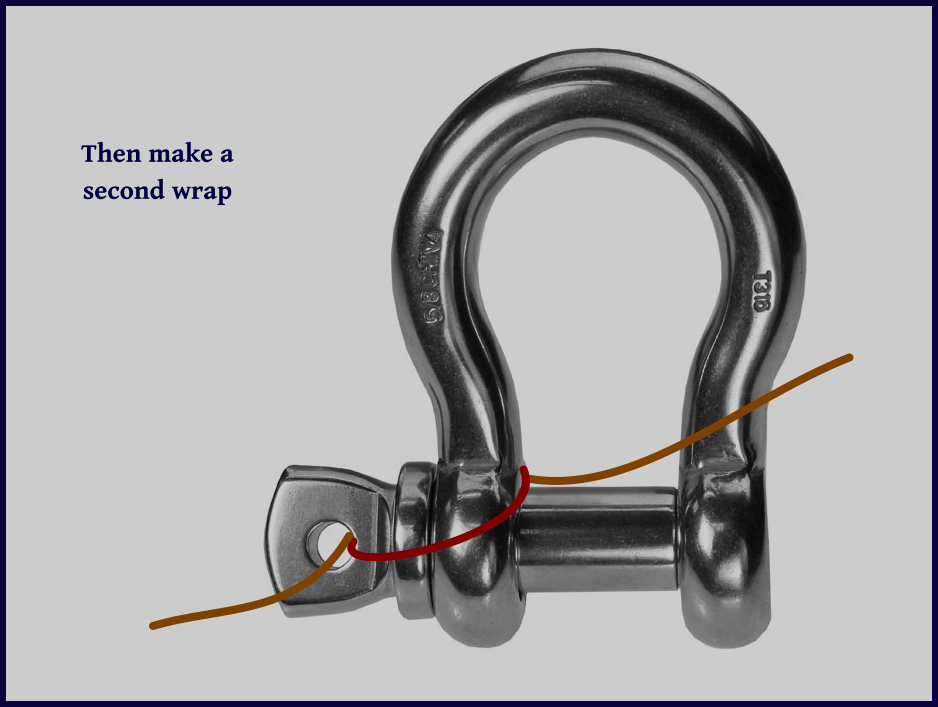
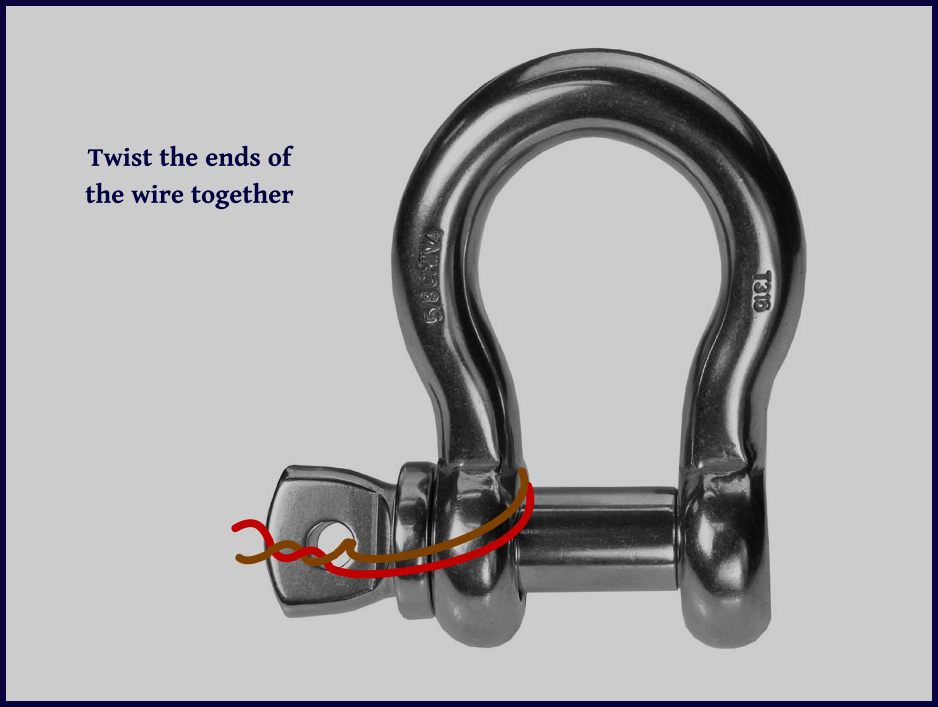
 The topic of this week’s Blue View is how to seize a shackle. (Okay – maybe I took a few liberties with my very bad, very rusty Latin). Seizing a shackle prevents the shackle pin from working loose, and on Nine of Cups, we seize most of our shackles. Any shackle that will be in place any length of time, any that are hard to get to or inspect, and any that would result in injury or catastrophic damage if they came loose, are routinely seized.



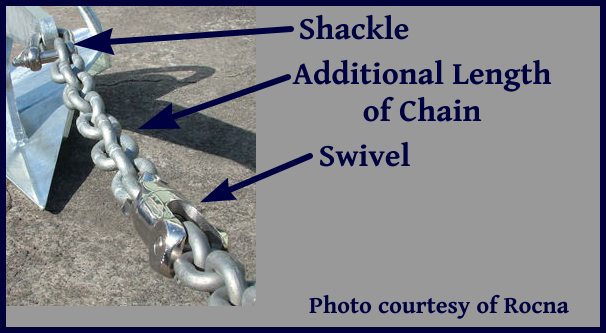
 An anchor swivel is often used to attach the anchor to the end of the chain. I say often, because not everyone sees any advantage to using a swivel.