
The Blue View - All Iced In
/ Now that our big blizzard has passed, there is a prediction of sub-freezing temperatures for the next several days here in Chesapeake, VA, and we were starting to worry about the river freezing. There is no current, it's not very brackish, and we've already seen some skim ice. Will it freeze solid? If so, will the ice damage Nine of Cups? What happens when a barge goes by – will it push the ice into Cups? I remember well, the story of Shackleton's expedition, and how his ship was crushed after becoming trapped in the ice.

We have always managed to sail the high latitudes only during the warmer months and to find more temperate climates during the winter months. Thus, we are truly neophytes when it comes to living aboard in prolonged freezing temperatures. We thought we would be far enough south to avoid a hard freeze, but I'd say we were wrong. Time to do some research.
After searching through a dozen or so forums and checking the recommendations of Boat U.S., the general consensus is that boats usually come to no harm from being frozen in. Several yachties recommend using bubblers or water agitators to keep ice from forming against the hull. On the other hand, several seemingly sane, knowledgeable captains claim they have wintered over in northern Europe and Scandinavia frozen hard in the ice, and their boats did just fine.
There were a few caveats and exceptions, however. Although there was some disagreement, most yachties didn't think motoring through the ice was a good idea, especially with a fiberglass boat. One skipper, who seemed to have a lot of experience, said that he's motored through 2-3 inches (50-75mm) of ice on more than one occasion with no damage other than rubbing off most of the anti-fouling paint along the waterline. Not to worry... unless the wharf is on fire or there is some other major emergency, I can't see us going anywhere until well after the ice is all gone.
Another seemingly knowledgeable captain brought up the possibility of water freezing inside an underwater thru-hull fitting. As the water freezes and expands, it could crack or break the thru-hull, causing a significant leak. On Cups, most of thru-hulls are well below the waterline. Unless the water freezes to a depth of 1 foot (30cm) or more, there is no chance of any of them freezing. We do have three thru-hulls located right at or slightly above the waterline, however. While I think it unlikely that these will become a problem, I will be checking them.

A third potential problem is ice being blown or pushed into us. Although the barge traffic has stopped since the blizzard began, I wonder whether it might be problem when they start running again. I can't imagine there will be enough ice pushed into us to be a threat to Cups, but it may be enough to scratch or gouge our new paint job.
I've read that, in some parts of the world, floats made of hardy reeds are placed around the boat to protect them from floating ice. Another solution I came across is to nail a band of copper sheathing around the boat's waterline. Neither seems very practical for us – guess we'll just take our chances.
P.S. It's now a couple of days since I wrote this blog, and sure enough, we have 1-2 inches of ice surrounding Cups. I've been using a length of 2x4 to break through the ice along the hull (see the video below). I don't know whether it helps or not, but I can't imagine it hurts... plus I didn't have to do my Tabata exercises today.
Fortunately, the weather is warming up tomorrow. Just in time too ... it was almost time to start checking the price of ice skates and snowshoes on Amazon.
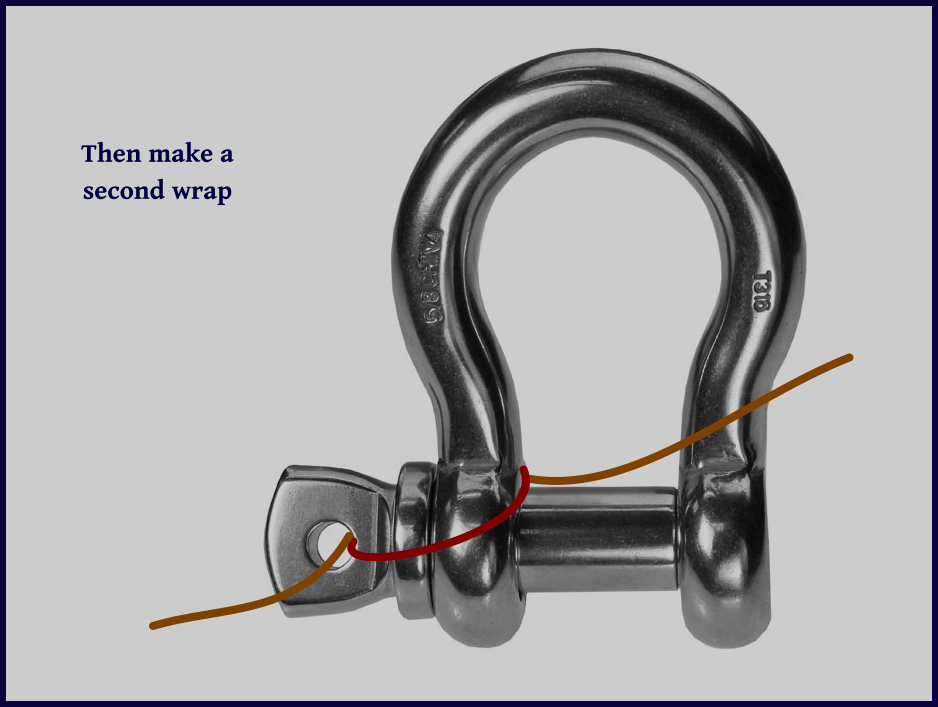
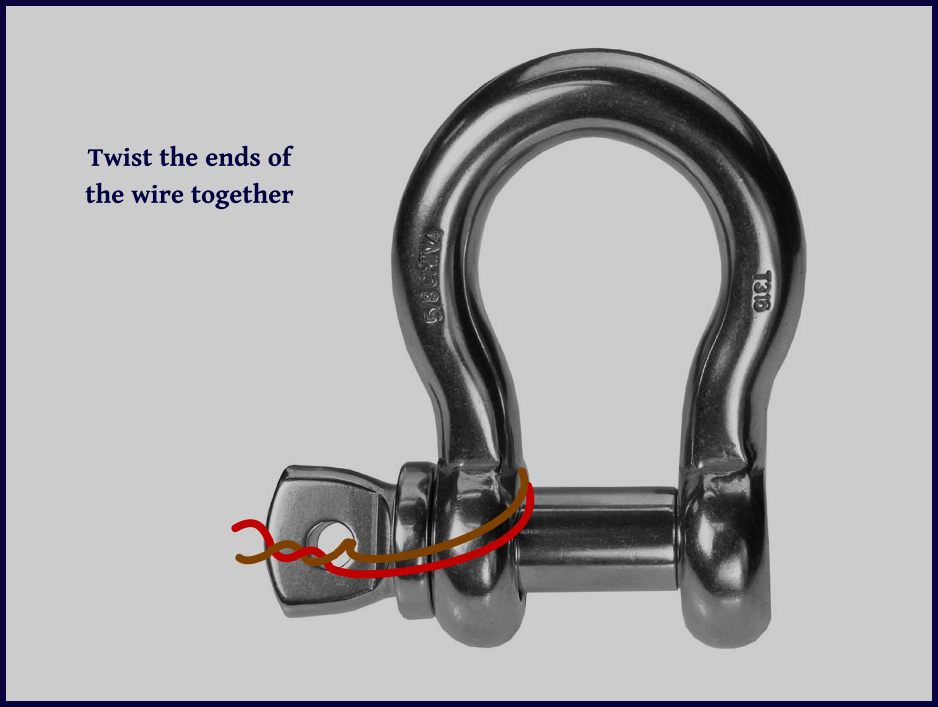
 The topic of this week’s Blue View is how to seize a shackle. (Okay – maybe I took a few liberties with my very bad, very rusty Latin). Seizing a shackle prevents the shackle pin from working loose, and on Nine of Cups, we seize most of our shackles. Any shackle that will be in place any length of time, any that are hard to get to or inspect, and any that would result in injury or catastrophic damage if they came loose, are routinely seized.



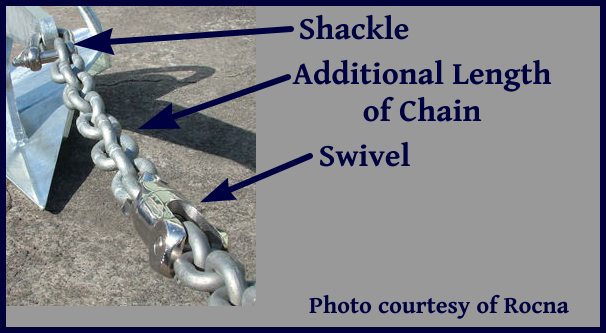
 An anchor swivel is often used to attach the anchor to the end of the chain. I say often, because not everyone sees any advantage to using a swivel.