

Aussie-isms
/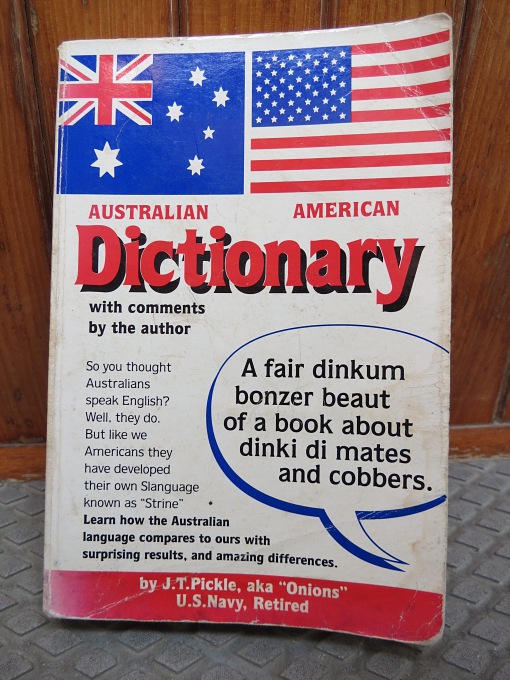 Like Americans, Aussies have their own expressions and local vernacular to which we've slowly grown accustomed. Some expressions are pretty common and others we hear less often, but at least now we have some Aussie friends to ask when we hear something we don't understand. Early on, it was pretty comical. We have an Australian-American dictionary aboard...really! It helps and it's fun to read, but when you couple the accent with the different expressions, you can really get mixed up.
Here's an example of a conversation David had with a local fellow in a Bundaberg fishing tackle shop shortly after we arrived in Australia. David was asking specifically about fishing rules and regulations.
Like Americans, Aussies have their own expressions and local vernacular to which we've slowly grown accustomed. Some expressions are pretty common and others we hear less often, but at least now we have some Aussie friends to ask when we hear something we don't understand. Early on, it was pretty comical. We have an Australian-American dictionary aboard...really! It helps and it's fun to read, but when you couple the accent with the different expressions, you can really get mixed up.
Here's an example of a conversation David had with a local fellow in a Bundaberg fishing tackle shop shortly after we arrived in Australia. David was asking specifically about fishing rules and regulations.
Tom: If you're fishing mundi, you gotta throw 'em back.
David: If you're fishing Monday, you gotta throw back what you caught?
Tom: Yup
David: That's a strange rule. Why do you have to do that?
Tom: Ever since the flood, there haven't been as many of them.
David: Mondays???
Tom: Yup
Translation of what Tom said: If you're fishing for mundi (that's slang for barrimundi, a type of local fish), you have to catch and release. It took awhile to figure this one out.
I had a similar experience when someone asked me if I'd ever seen a goanna.
Marcie: An iguana? Oh, sure, we've seen lots of them. In Ecuador and the Galapagos..., blah, blah, blah.” I droned on and on about about our iguana encounters.
Jim: No, goanna.
Marcie: That's what I said, iguanas. We've seen lots of them.
Jim: No, goanna. I said goanna.
Finally...a light went on.
Marcie: Are goannas and iguanas different?
Jim: I guess so, I've never seen an iguana.
You can see how this can get very complicated, very quickly.
We had local friends on the boat for dinner the other night and Wendy was talking about a frustrating time she'd just had with something. “I nearly spit the dummy”, she said. Hold on a minute...”spit the dummy”? She laughed as she explained that “dummy” is the Aussie word for a baby's pacifier and the expression “spit the dummy” means to become enraged expressing your frustration. New one on us.
 We'd certainly heard “fair dinkum” in the past, but weren't exactly sure what it meant until John explained it meant fair, honest or believable. And then, of course, we all know “you'll come a-waltzing Matilda with me”. I was sure this was about dancing with your best girl, Mattie. Mongo wrongo! It's about being a vagabond, an itinerant out on the road (a swagman) and what happens if you steal someone's sheep.
Aussies have a penchant for shortening words. Breakfast is brekkie and afternoon is arvo. Tasmania is Tassie and Brisbane is Brissie. Registration is shortened to rego (redge-o) and a mozzie is a mosquito. Sometimes we need a translation, but usually we can figure it out from the context.
Then there's “strine”. It's what happens when Australian is spoken fast and slurred so that one word blends into the next OR it's what you get when you say “australian” with a broad, but clipped Australian accent. The accent almost overtakes the language. They say if you've listened to Steve Irwin, “the Crocodile Hunter”, speak, you've had a taste of strine. Here's some info copped from Wikipedia.
“It (Strine) was the subject of humorous columns published in the Sydney Morning Herald from the mid- 1960s. Alastair Morrison, under the Strine pseudonym of Afferbeck Lauder (a syncope for "Alphabetical Order"), wrote a song "With Air Chew" ("Without You") in 1965 followed by a series of books. An example from one of the books: 'Eye-level arch play devoisters ...' ("I'll have a large plate of oysters").” Go ahead. Say the words out loud. You'll be “strine-ing”.
Someone called David a cobber the other morning. He wasn't sure whether to be offended or not. We asked our friend Marcia if the fellow was being rude or friendly. We figured it couldn't be too bad because that's what Marcia calls her dog. But you never know. Seems cobber is another word for “mate”...as in G'day, mate.