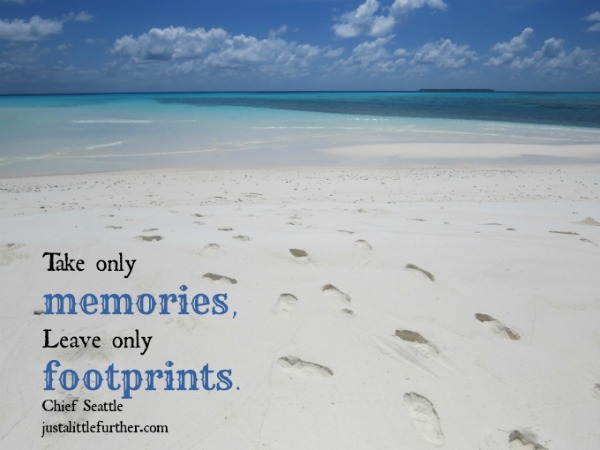
Leave only footprints ...

“Take only memories. Leave only footprints” … Chief Seattle

Chief Seattle, the Anglicized name of Si'ahl, was the revered leader of the Duwamish native American people from the Pacific Northwest. The city of Seattle was named after him, in fact. He is credited with the insightful quote above. It is doubtful he actually said these exact words … translations, transcriptions and history being what they are, but I think he probably believed these words. If you take the time to read his speech from 1854 (one of several versions of the same speech), you cannot help but be inspired … and feel guilty.
chief seattle


We personally are able to take more now … photos and sound bites along with memories … with no repercussions. We collect stones and shells sometimes, a sample of beach sand and even loose feathers once in awhile, but that's not what he was talking about. He was talking about using up resources, abusing the Earth and water and air that sustain us. He recognized even then that men would destroy and deplete in the name of sport, progress and profit.

Living on a sailboat, we think we have a smaller carbon footprint than most. We try to reuse and recycle. We don't dump non-biodegradable trash into the sea. We try to use wind and solar rather than depending upon diesel fuel or gasoline. Then, of course, we “fly” back to the USA on a jet, buy a car and a house and we join the madding crowd. It's hard when you're tooling along on the highway at 65 mph or letting the water run while brushing your teeth or running the A/C, to acknowledge how we waste shamefully and are completely oblivious to it. Modern man has done a good job of botching up Chief Seattle's world ... and ours.

We've been in places, Tristan da Cunha comes to mind, where people are acutely aware of sustainable resources. Too many animals on the island and there's not enough grazing area; too many plantings without rotation and the soil is depleted; too much fishing and lobstering and the fish and lobster are gone. They work hard there to maintain the delicate balance between man and nature.

Do you remember (if you're old enough to have been around in the 70s) the public service ad for the “Keep America Beautiful” campaign featuring a crying Indian, Iron Eyes Cody? Okay, so Iron Eyes Cody was really an Italian immigrant, but it got the point across in a not-so-subtle way.

I remember seeing a sign inside a bus in Ecuador, “Keep the bus clean. Throw your trash out the window.” It wasn't a joke, the bus driver was really keen on keeping his bus clean. We threw some trash into a waste basket in the front of the bus and he methodically emptied it by throwing the same trash out the window.

I look at the trash and rubble on the beautiful local beaches here and my eyes tear up … they really do. Plastic bottles and bags and garbage just strewn about as if it would disappear somehow or maybe someone else will clean it up. Maybe they just don't see it. In all fairness, I certainly remember throwing trash out the car window when we were young kids, encouraged by our parents to do so. Shame on us! It's a matter of education, awareness and pride perhaps, and an innate understanding of the role humans play in the complex web woven by nature and how we abuse our privileges.

I'm getting on my soapbox and waxing philosophical and I really don't mean to. This topic came up because today is Earth Day 2016 and it's a good time to reflect about how we live, how we waste and what we, as individuals, can do differently to preserve our world.

Happy Earth Day … Be kind to her, she's the only planet we've got.

Meme-chief seattle_Earth-Day 2016

Hindu Temple in the Sea & Lord Hanuman

When the British abolished slavery in 1833, there was a significant lack of laborers in the Caribbean. Between 1833-1920, over 143,000 Indian workers were sent to Trinidad as indentured laborers to meet the demands. Consequently, there is a high percentage of Indian population on the island and nearly a quarter million of them are Hindus. It only makes sense then that there would be some elaborate Hindu temples on the island. We find Hindu temples to be fascinating. In fact, there are two in particular of note in Waterloo, just south of Port of Spain, and we decided to pay them a visit. sign in trinidad

We knew we were getting close when we started seeing Hindu prayer flags and tiny temples in each yard. We threaded our way (read that … David maneuvered adeptly) through narrow, crowded streets towards the sea and finally came to the Hindu Temple in the Sea.

temple in the sea trinidad


This temple has an interesting history. The indentured laborer, Sewdass Sadhu, came to Trinidad in 1907. He was a devout Hindu and wished to build a temple. He built his first temple in 1947 on land owned by the sugar cane company for which he worked. The company ordered it torn down, charged Sadhu with trespassing, fined him $500 (2 year's wages) and jailed him for 14 days. A determined man, he figured if he couldn’t build his temple on the land, then he would build it in the sea, and thus Sadhu's dream to rebuild his temple began to take shape.

sewdass sadhu statue trinidad

With two buckets and an old lady’s bicycle with a carrier on the back, Sadhu began the laborious task of building the temple in the sea … 500 feet into the swamp land of the Gulf of Paria. For 25 years, he worked at building his temple and with the help of local people, businesses and a government grant, it continues today to be a place of worship and serenity. A great testament to the devotion and tenacity of the human spirit.

hanuman temple entrance trinidad

A prayer ceremony was in progress when we arrived which we did not want to disturb. We quietly removed our shoes and walked around the outside of the temple, peeking in discreetly for a look at the elaborate decoration within.

temple in the sea trinidad


We headed back inland to find Lord Hanuman, the Monkey King. We were familiar with several Hindu gods, but not Hanuman. It seems that he is regarded as a perfect symbol of selflessness and loyalty. The 85' murti (statue) of Lord Hanuman is reputed to be the largest outside of India.

lord hanuman trinidad

Lord Hanuman towers over the Dattatreya Temple and Yoga Centre, “built according to the Dravidian style of architecture of South India”. It's an elaborate building, guarded by two large elephants at the entrance. Photos were not allowed inside the temple, but after removing our shoes, we walked quietly inside, admiring the intricate and colorful individual temples to various Hindu deities. Fruit and other small offerings were placed in front of each temple.

hindutemple_small hanuman temple

A small store sold souvenirs of the temple, but mostly provided incense and candles for prayer ceremonies.

incense to buy

We had a leisurely lunch in the small town of Carapichaima, then headed north to meet our guide for a late afternoon boat tour of the Caroni Swamp and a look at the scarlet ibis. Wear plenty of sunscreen, insect repellent and a hat and come on along.

Working on Island Time

island_time_clock The Urban Dictionary defines island time as “the time vacuum created by the ocean's presence. Similar to stoner's time, everything moves nice and slow. This carefree aura even has the ability to travel with islanders and can engulf you in their presence.” Perhaps it's being surrounded by the Caribbean Sea and seeing palm trees sway lazily in the breeze or perhaps it's the hot, humid, sultry weather that sucks the energy out of you that accounts for the laid-back attitude and slow way of life here. Things don't happen quickly in Trinidad. We're definitely working on island time here.

People never rush. When they walk, they saunter or amble. There's no swift pace involved … no running. Even the traffic moves slowly … many times at a crawl for no apparent reason … but you rarely see road rage or angry faces on the drivers. So what … traffic is moving slowly … oh, well … we'll get there eventually. The cause of the traffic jam could be a huge pothole in the road or a broken-down bus or just as likely two cars heading in opposite directions stopped on the two lane road for a quick chat. Schedules and appointments are more of a suggestion than they are an actual timetable to which folks adhere.

In a country that has 17 national holidays (that's more than three business weeks of holidays – and that's not counting Carnaval), it's easy to understand the slow pace and delays, but it's especially difficult to deal with if you're relying on people to get projects completed “on time”, because “on time” has little meaning here. Things get done when they get done.

For cruisers, this is a frustrating issue. There seems to be no urgency about anything and, of course, for us everything is urgent. We want to get done and get back in the water. Case in point is David has been waiting for tradesmen to show up for estimates and project work. “I'll be there in an hour or so”, they tell him. The critical words “or so” mean perhaps sometime in the future. It's kind of like “just now” in South Africa. When they haven't shown up after a couple of hours and David calls, they promise “anytime now” which means sometime later in the day. We haven't figured out the American English equivalent for “now” which actually means “NOW!” We're not sure that word exists.

As a result, it's impossible to schedule more than one task a day and sometimes even the one doesn't get accomplished. Work on Nine of Cups is progressing more slowly than we'd hoped. Several projects, like pulling the prop shaft and removing the old sea cock from the engine through-hull, require more specialized tools than we have aboard. (I have trouble imagining a tool that David does not have). Since one task or project relies on another to be finished before starting a new one, we find ourselves getting “behinder and behinder”. The calendar days are quickly being eaten up and May 1st, our anticipated departure day, will be here before we know it.

Perhaps it's time to consider putting Plan B down on paper?