History Lessons While We Walk

I mentioned in a previous blog that the Great Bridge area of Chesapeake, Virginia is rich in history, especially relating to Revolutionary and Civil War battles. There are informational signs and markers everywhere and we've found it interesting to roam around on foot and soak up a little history. Walking through the Great Bridge Battlefields and Waterways Park is like stepping back in history. great bridge park in chesapeake virginia

According to Wiki, “its name is derived from the American Revolutionary War of Great Bridge, which took place on December 9, 1775 and resulted in the final removal of the Brits from the Virginia Colony.

Though the battles of Lexington and Concord took place months earlier, and are historically more memorable, the Battle of Great Bridge can be seen as the first strategically important colonial victory over the British, forcing Lord Dunmore's 200 redcoats to evacuate Fort Murray and withdraw to Norfolk.” A huge mural on the side of a local building commemorates the victory.

mural at great bridge in chesapeake virginia

The “bridge” was originally just a narrow 10' wide causeway and remnants of it still remain under and around the modern Great Bridge bascule bridge, now situated about 50 yards to the south of the original bridge. The modern Great Bridge spans the ICW/ Albermarle and Chesapeake Canal. A replica of the original causeway is just one of the illustrative displays at the park.

replica causeway at great bridge chesapeake virginia

Just across Battlefield Boulevard (yup, that's the name of the main street, aka VA-168) is the Great Bridge Locks Park. This waterway was critical for getting supplies to the Confederates during the Civil War and the Union worked hard to blockade it. The famous Battle of the Merrimack and the Monitor took places just a few miles up the Chesapeake River at Hampton Roads. There's a huge, 7,900 pound ship's anchor sitting on the lawn reputedly from the USS Hartford. The USS Hartford was most noted for its victory in the Battle of Mobile Bay in 1864 when its captain, Admiral Farragut, shouted “Damn the torpedoes! Full speed ahead!” The ship was dismantled at the Norfolk Navy Yard not far away from here and her parts were buried on vacant land along the Elizabeth River. In 2001, the anchor was discovered during excavation and moved here.

big anchor of the uss hartford

Beyond the history of wars and battles there are several informational placards describing the building of the nearby Great Dismal Swamp Canal and the Albermarle and Chesapeake Canal. The Great Dismal Swamp Canal was hand dug and opened in 1805. In the 1820s, Marshall Parks, Sr. was commissioned to deepen and widen the canal to accommodate larger, deeper draft steam vessels. His son, Marshall Parks, Jr. took over when his dad died in 1840, and completed the Albermarle and Chesapeake Canal in 1859. He was one of the first to envision and encourage the connecting of inland waterways along the east coast of the USA … today's Intracoastal Waterway (ICW).

father son canal builders

The actual Great Bridge Lock is “located approximately 750 yards west of the Great Bridge Bridge, and is the western terminus of the Virginia Cut of the Albemarle & Chesapeake Canal. This tidal guard lock is a reversible-head, double-gated structure 600 feet long and 72 feet wide, with a depth of 16 feet. Its primary function is to prevent saltwater intrusion from the Southern Branch of the Elizabeth River into the freshwater North Landing River and to control tidal currents from these two rivers. [...]The first Great Bridge Lock was built by the Albemarle & Chesapeake Canal Company in 1859. The original Great Bridge Lock survived until 1917, when the Canal was widened. For fifteen years thereafter there was no lock, causing bitter complaints from shippers and local residents. [...]Under the management of the US Army Corps of Engineers, the Great Bridge Lock was completed on June 16, 1932.” From a strategic vantage point just west of the bridge, we can easily see boats and barges entering and leaving the locks as the locks open and close, usually in scheduled sync with the opening of the Great Bridge. We'll be heading through these locks in a few days as we make out way west to the Chesapeake Bay.

locks opening up

All in all, our morning walks have been quite educational and entertaining, while still fulfilling some of our daily exercise requirements. Multi-tasking at its best.

Building Walls

Something there is that doesn’t love a wall...

Robert Frost, “Mending Walls”

There have been lots of walls built throughout history … usually to keep someone or something in or out. The 5,500 mi (8,850 km) Great Wall of China, was purportedly begun in the 7th century BCE, the majority of the existing wall built during the Ming Dynasty(1368–1644). Visiting the wall is on my bucket list. I'd like to stand on it and ponder the feeling that millions of feet have walked this wall over centuries before me. It was built as an elaborate defense system to protect the “civilized” Chinese folks from the nomadic northern invaders.


great wall of china

Hadrian's Wall, a 73-mile barricade, was built c.122AD under the orders of Emperor Hadrian “to protect Roman Britain from the Picts and the other barbarian tribes that inhabited northern England and Scotland.” We stayed in Chester on one of our trips to England, so we could get up close and personal with this wall.

hadrians wall

According to Wiki, the Wailing Wall, an ancient limestone wall in the Old City of Jerusalem, is a relatively small segment of a far longer ancient retaining wall, known in its entirety as the "Western Wall". The wall was originally erected as part of the expansion of the Second Jewish Temple by Herod (although some would claim differently). The wall resulted in the encasement of the natural, steep hill known to Jews and Christians as the Temple Mount, the holiest place where Jews are permitted to pray.

It has also been called the "Wailing Wall", referring to the practice of Jews weeping at the site over the destruction of the Temples. The wall has been a site for Jewish prayer and pilgrimage for centuries; the earliest source mentioning this specific site as a place of worship is from the 16th century.

wailing wall

When we were in Peru, we had the opportunity to visit some the of walls built by the Incas. In Sacsayhuaman on the northern outskirts of Cuzco, the capital of the Inca empire, a citadel was built using huge boulders, cut to fit so tightly and exactly, no mortar was needed. We marveled at the craftsmenship of these masons.

oncan wall

In more modern times, the Berlin Wall was a barrier constructed by the German Democratic Republic (i.e. East Germany) that completely divided East Berlin and West Berlin (East Germany from West Germany and ostensibly from the rest of the world) from 1961 to 1989. It became symbolic of the “Iron Curtain” that separated the Eastern Bloc countries from Western Europe.

berlin wall

And then, of course, there's Trump's proposed wall along the Mexican border … we won't go there … too politically hot to touch on this blog.

So what has triggered my pondering of walls? David's recent masonry project. He built a 5' high cinder block wall in our new back yard which matches with the wall that encompasses our property. We're walled in or the neighbors are walled out, whichever way you wish to look at it.

david builds a wall

It was no easy project. We loaded 72 – 6x8x16 cement blocks weighing 28 lbs each, along with 10 cement caps and 14 half blocks onto three separate trolleys at Home Depot. We rented a truck from Home Depot, loaded the blocks onto the truck, unloaded them in the driveway, then hauled them through the gate to the backyard and stacked them for the wall-building project. Whew! The easy part was actually building the wall. After painting it the same color as the house, it looks great. The result was not to keep anyone or anything in or out, but to enclose the unsightly A/C system and make an enclosure for storing garden tools and supplies.

finished wall

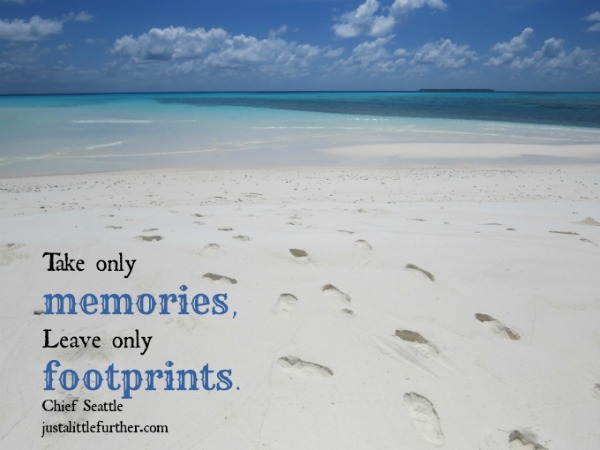
Leave only footprints ...

“Take only memories. Leave only footprints” … Chief Seattle

Chief Seattle, the Anglicized name of Si'ahl, was the revered leader of the Duwamish native American people from the Pacific Northwest. The city of Seattle was named after him, in fact. He is credited with the insightful quote above. It is doubtful he actually said these exact words … translations, transcriptions and history being what they are, but I think he probably believed these words. If you take the time to read his speech from 1854 (one of several versions of the same speech), you cannot help but be inspired … and feel guilty.

chief seattle


We personally are able to take more now … photos and sound bites along with memories … with no repercussions. We collect stones and shells sometimes, a sample of beach sand and even loose feathers once in awhile, but that's not what he was talking about. He was talking about using up resources, abusing the Earth and water and air that sustain us. He recognized even then that men would destroy and deplete in the name of sport, progress and profit.

Living on a sailboat, we think we have a smaller carbon footprint than most. We try to reuse and recycle. We don't dump non-biodegradable trash into the sea. We try to use wind and solar rather than depending upon diesel fuel or gasoline. Then, of course, we “fly” back to the USA on a jet, buy a car and a house and we join the madding crowd. It's hard when you're tooling along on the highway at 65 mph or letting the water run while brushing your teeth or running the A/C, to acknowledge how we waste shamefully and are completely oblivious to it. Modern man has done a good job of botching up Chief Seattle's world ... and ours.

We've been in places, Tristan da Cunha comes to mind, where people are acutely aware of sustainable resources. Too many animals on the island and there's not enough grazing area; too many plantings without rotation and the soil is depleted; too much fishing and lobstering and the fish and lobster are gone. They work hard there to maintain the delicate balance between man and nature.

Do you remember (if you're old enough to have been around in the 70s) the public service ad for the “Keep America Beautiful” campaign featuring a crying Indian, Iron Eyes Cody? Okay, so Iron Eyes Cody was really an Italian immigrant, but it got the point across in a not-so-subtle way.

I remember seeing a sign inside a bus in Ecuador, “Keep the bus clean. Throw your trash out the window.” It wasn't a joke, the bus driver was really keen on keeping his bus clean. We threw some trash into a waste basket in the front of the bus and he methodically emptied it by throwing the same trash out the window.

I look at the trash and rubble on the beautiful local beaches here and my eyes tear up … they really do. Plastic bottles and bags and garbage just strewn about as if it would disappear somehow or maybe someone else will clean it up. Maybe they just don't see it. In all fairness, I certainly remember throwing trash out the car window when we were young kids, encouraged by our parents to do so. Shame on us! It's a matter of education, awareness and pride perhaps, and an innate understanding of the role humans play in the complex web woven by nature and how we abuse our privileges.

I'm getting on my soapbox and waxing philosophical and I really don't mean to. This topic came up because today is Earth Day 2016 and it's a good time to reflect about how we live, how we waste and what we, as individuals, can do differently to preserve our world.

Happy Earth Day … Be kind to her, she's the only planet we've got.

Meme-chief seattle_Earth-Day 2016