Crossing the Line - A Special Celebration at Sea

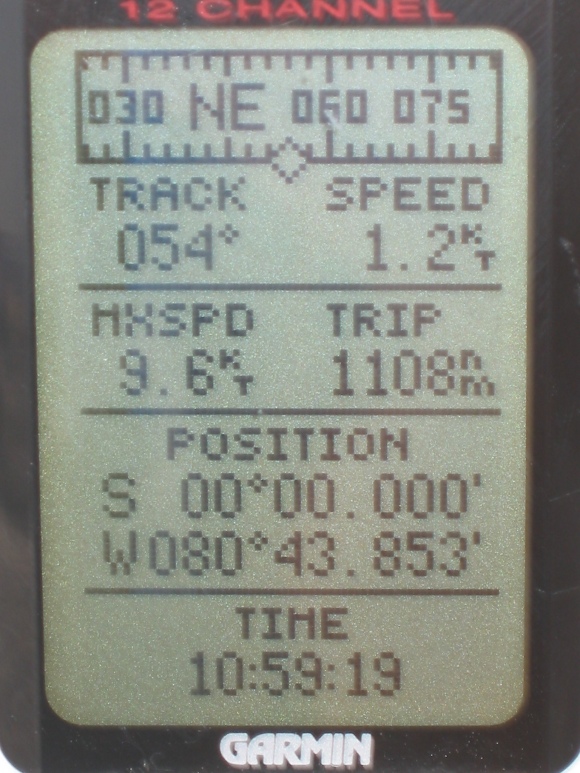
gps at the equator  

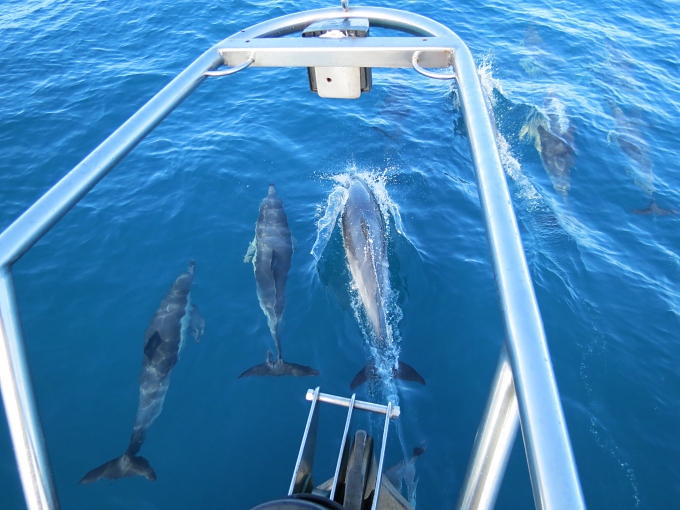
Some celebrations are very special at sea and reserved expressly for sailors. Crossing the equator, known by sailors as “crossing the line”, is one of them. That imaginary (or is it?) line encircling the world and stretching some 25,000 miles (24,901 miles/ 40,075 km to be more exact) is cause for joy when you're in a boat. You're heading into a new hemisphere. The GPS latitude changes from N to S (or vice versa) and there's a chance you'll have to begin hanging from your toes to hold on if you're heading south.


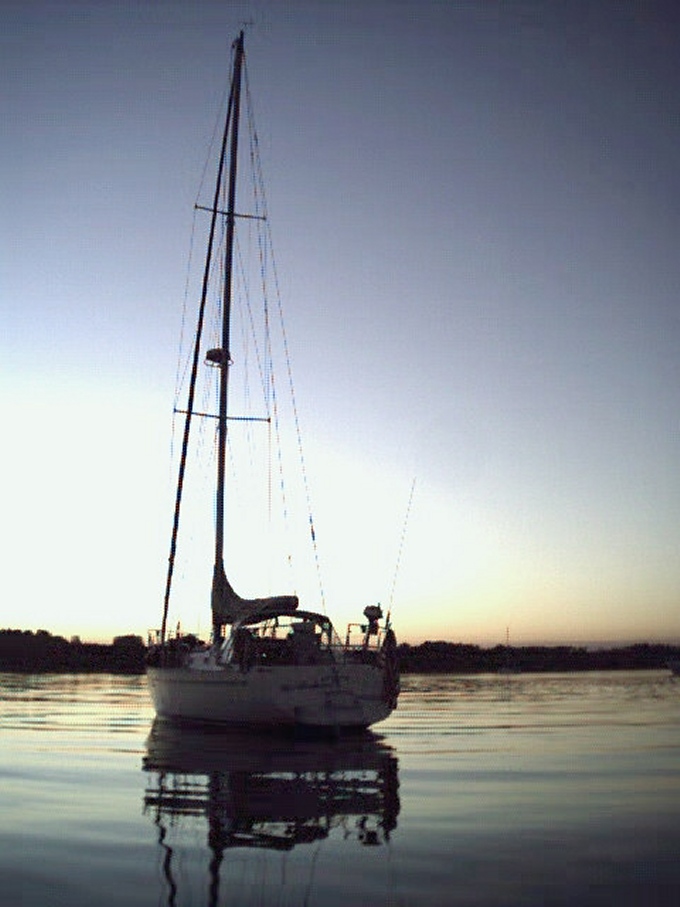
tribute to neptune


The first time we crossed the line, we celebrated in a rather lackluster manner, mostly because it was in the middle of the night. David was on watch. He woke me. He gave Neptune his token tot of rum. I snapped a photo at 0º latitude and went back to sleep. In truth, we had to cross a couple of times to get the exact 0.00º reading on the GPS. That was the extent of the excitement though. We were heading to Ecuador at the time, which in Spanish, by the way, actually translates to Equator.

When our friend, John, joined Nine of Cups as our crew mate and we sailed from Salinas, Ecuador to the Galapagos, we specifically went a few miles north out of way to cross the Equator once again. This time we celebrated in earnest. If you've never crossed the equator, you're a slimy “pollywog”. Once having crossed and gone through the initiation ceremony aboard, you become a trusty “shellback” and member of King Neptune's Court.

So what does the initiation ceremony entail? On naval ships, it's quite the elaborate the procedure. On Nine of Cups, we were a bit more reasonable. At least we thought so. First of all, Neptune received another tot of rum as we crossed the line. John had to make and serve us breakfast, name five “animals” on Nine of Cups (gooseneck, wildcat, etc), compose an appropriate song and sing it to us and kiss the belly (that would be Jelly's furry belly). Being the good sport he is, he complied without complaint. Good thing, because walking the plank was the alternate choice! Read more on John's website. For all his efforts, he was rewarded with an official Crossing the Line Certificate … suitable for framing.
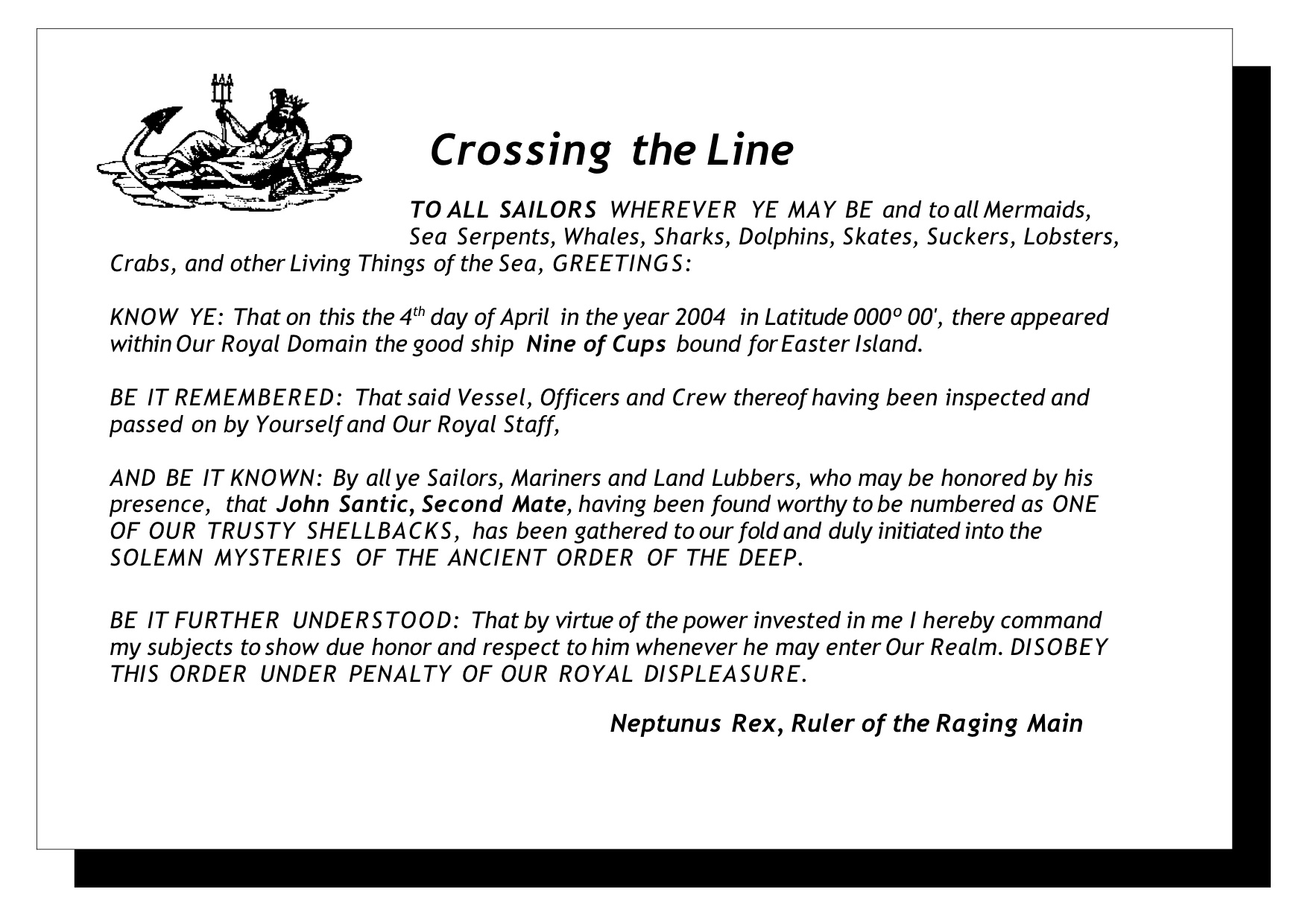
 

Crossing the line certificate


Trivia: You become a Golden Shellback when you cross the Equator and International Dateline (0° Lat/180° Long) at the same time. Then there's the ultimate crossing at the so-called Golden X, the point at which the Equator and the Prime Meridian meet (0° Lat/0° Long). All those crossing at this point become initiated as an Emerald (USA) or Royal Diamond (Britain) Shellbacks. Aboard Nine of Cups, we are mere Shellbacks, but very trusty .

Have you crossed the Equator? How did you celebrate?

Our Friend, Evi Nemeth

We met Evi in Annapolis in 2000. We had just started cruising, and were in a chandlery looking for a part ... how unusual. They didn't have the part and the clerk suggested looking for it at Bacon's Consignment Store, but it was a bit of hike if were walking. A woman standing nearby said that she had overheard our conversation and was heading that way if we wanted a lift.  

Evi Nemeth


As we chatted on our way over to Bacon's, we learned we had quite a bit in common. Like us, she was new to this wonderful cruising lifestyle. She had been a professor of computer sciences at the University of Colorado, David's old alma mater, and we discovered we had several friends in common. As so often happens in the cruising community, we quickly became friends.

Our paths crossed several times over the next few months, and we shared many a meal aboard either Evi's sailboat Wonderland or aboard Nine of Cups. She was a singlehander, but usually took on crew for her passages, and had a number of great stories about some of the more eccentric folks who'd sailed with her.


wonderland


When we headed for South America and points south, the wind blew Wonderland in a different direction, and we didn't see her for a few years. We were close a few times – we just missed her in Panama one year, and she was just sailing to Patagonia as we were leaving. It wasn't until we were in New Zealand the second time that we met again. We looked out one day to see her sailing into Opua. We helped her with her lines, lent a hand making repairs, and renewed our friendship.

It now appears certain that our friend Evi has been lost at sea. She was helping sail the American schooner, Nina, across the Tasman Sea from New Zealand to Australia when the sailboat apparently went down with all hands.

One of the articles written about her stated that there is some comfort in knowing that she died doing something she loved. We'd like to think so, but during the occasions we had to weather a storm at sea, we weren't doing what we loved. Our emotions ranged from intense unease to sheer terror as we watched the next huge wave coming at us and thinking that there was no way we would survive it. So far, Cups always has. Poor Nina did not.

We have lost a number of friends and acquaintances in the past few years. Most were due to health reasons, a few were lost to acts of piracy and some to the vagaries of the sea. While we were greatly saddened by the loss of each these wonderful people, Evi's death seems particularly close.

We'll raise a cup to you tonight, dear friend.

Crayolas for Cruisers

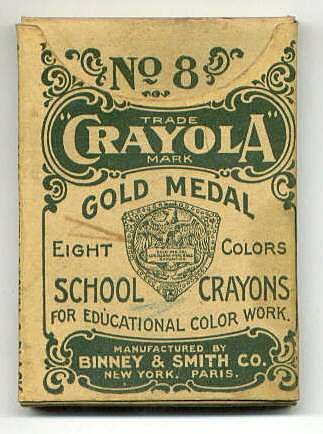
historical crayola package  

The Crayola Crayon is celebrating its 110th birthday. The first box of Binney & Smith Crayola crayons were introduced in 1903. The brand name “Crayola” was originally coined by Edwin Binney’s wife Alice, and comes from “craie,” the French word for chalk, and “ola,” from “oleaginous” (which means oily, not waxy, by the way. Waxy would have been ceraceous, but hey, it's worked for 110 years, so who am I to say).


world's largest crayon


Back in 2003, for their 100th birthday, Crayola manufactured the world's biggest crayon …. 1500 pounds (680kg) and 15' (4.6M) long. Imagine the coloring book that went with that sucker. I was interested in seeing how crayons were made because I had no idea. It's a pretty neat process.

We carry crayons on board as part of the school supplies we give as gifts to kids and schools along the way. I also use crayons on occasion for decoration purposes. In the hotter, equatorial climates, they tend to melt which is a pain, hence the reason we stick to the higher latitudes.

Crayola had a contest recently to re-name their original offerings of the eight basic crayon colors. The winning names were okay, but not great. My favorite winner was “Freshly Squeezed”, but this, of course, got me to thinking about Crayolas for Cruisers. We've come up with our own basic colors.

Cruiser's Crayola colors:


get me a bandaid red


Get me a Bandaid Red


sundowner orange


Sundowner Orange


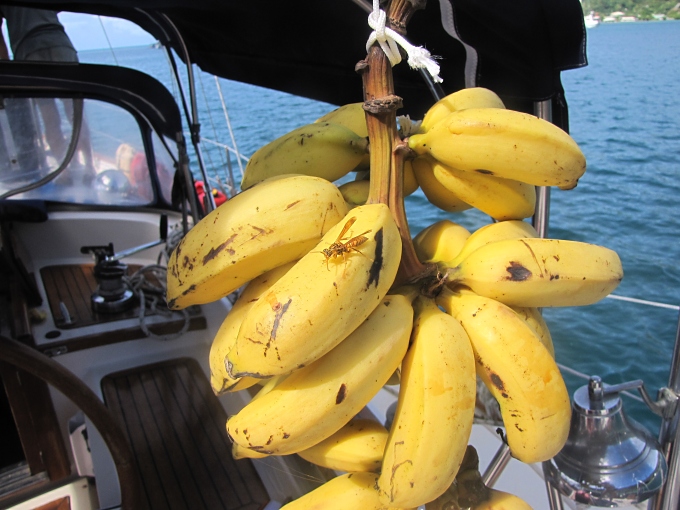
yes we have bananas yellow


Yes, we have bananas (do we ever) Yellow


algae green


Algae Green


sail on through blue


Sail Through Blue


rough passage purple


Rough Passage Purple


dirty dinghy brown


Dirty Dinghy Brown


bottom paint black


Bottom Paint Black

Come on … get your imagination going. Got some improvements or ideas for other cruiser colors? Chime in!