
12 Tips for Provisioning
/
Another frequently asked question is how we provision aboard Nine of Cups. Provisioning can be as easy as a short walk to the grocery store for an overnight and a couple days or as complicated as developing a spreadsheet that includes every possible item you anticipate needing for the next six months. Add to that your transportation availability (or lack thereof), size of your refrigerator/freezer (or lack thereof), stowage space (or lack thereof) and what's available at the local grocery and provisioning can sometimes be quite the challenge. Like anything, the more you do it, the easier it becomes.
Our first passages were short ones … a week was about our longest as we crossed the Gulf of Mexico from Texas to Florida. We'd gone camping and backpacking in the past, so a week's advance planning wasn't difficult. I made a list and we were fine … except we ran out of snacks. Then we hopped along the Florida coast and up the US east coast and never had to travel very far before another grocery store was within reach. We found, however, that we really enjoyed staying in less crowded, more remote anchorages and we started provisioning for 1-2 weeks. It wasn't that hard once we had the basics aboard, but still we ran out of things from time to time which was frustrating, but certainly tolerable. Here are some tips we've learned for provisioning that might be helpful to you.
1. Create a spreadsheet
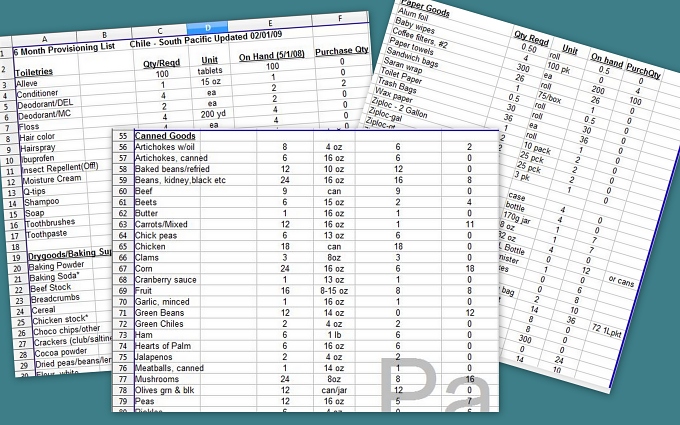 I use a spreadsheet for making our provisioning list if I need to provision for more than a couple of week's worth. The first time you do this, it's cumbersome because every little thing needs to go on the list … salt to onions to condiments. The positive side of using a spreadsheet is that I've created a column for entering our current inventory, a column for what we need and then the "buy" quantity is calculated for me. Once I've completed the spreadsheet for a trip, I print it out and use it as my master shopping list.
2. Over-provision rather than run short
 If we estimate 30 days between shopping trips, I provision for 50 days. Extra is okay in my book. Arrival delays due to weather and wind are the norm, rather than the exception on a longer passage. Running out is a bummer at sea or in an isolated anchorage, especially if you're short on a basic item. I tend to over-provision on items which will keep and we can use in port or on the next trip.
3. Buy what's available
I modify my “needs” list depending on where we are and where we'll be shopping. Many items available in the US or Europe are not available in the Caribbean, South America or the South Pacific, so the list changes to reflect availability of specific fruits/veggies, canned items, etc. I check out the local supermarket(s) and fresh markets, butchers, etc. to determine what's available, what's not, best deals, best quality, etc.
4. Inventory first
I take an accurate inventory of what's aboard as close to provisioning day as possible. I check for out-of-date and obvious no-use items aboard. If out-of-date items look okay, they are moved to the front of the line, where they'll be used first. While inventorying, it's easy to straighten up and place like items together so they're easier to find when we're at sea. Dried up drink mixes, bulging cans, etc. are discarded. No-use items are just taking up space. I give them away.
5. Plan your menus in advance
 I do basic meal planning to get an idea of how much of each item on my list I'll need. If I'm provisioning for 90 days ... that's 90 breakfasts, 90 lunches, 90 dinners and 90+ snacks. For instance, we eat lots of pasta, so I'll assume we'll have a pasta meal of some sort at least twice a week...for about 13 weeks...that's 26 pasta meals. We get two meals from a typical 1 lb(.5kg) package of pasta, so I'll need 13 packages to cover 26 meals as a minimum. What else will go with the pasta? Tomato sauce, canned tomatoes, spices, grated Parmesan, meat, mushrooms, canned or fresh veggies? It sounds tedious, but after awhile I developed "typical" meals and the menus and ingredients became pretty easy.
6. Consider non-edible items
I went through the boat one day and made of a list of every non-food and non-boat part item that we use regularly. Toilet paper topped the list. Then came dish detergent and laundry detergent, bug spray, sunscreen, paper towels, AA batteries … The list was quite long and varied. These went onto the spreadsheet with my guess-timates of what was necessary to keep in stock.
7. Medicines and medical supplies need special attention
 From antibiotics to band-aids and daily vitamins, I've created a separate list of OTC as well as prescription drugs and I inventory these items with care. Running short of cooking spray is inconvenient; being without a medication can be a serious issue.
8. Don't try to do it all at once
It's exhausting! If I can avoid doing a provisioning buy all at once, I do. I prefer to break it up into three or more trips. One for basics and canned goods; one trip for freshies and eggs; and a final trip for all the other stuff I thought of or forgot to buy after reviewing my list just one last time. Some of this depends on just how long I'm provisioning for, what transportation is available and how much room is left in the lockers.
9. Buy in bulk if you can
 Certain places tend to offer some items in bulk at a significantly lower price. There are the Price Club-type stores in larger cities, but in smaller cities and towns, you might have to hunt out the bargain shops. While in Argentina, for example, we found we could buy dry cat food at a fresh market by the kilo at a portion of the price of cat food in the local supermarket. We bought a small quantity first. Jelly liked it and we bought more. We've done the same for cereals, dried beans, popcorn, rice, etc., but we're selective where we buy since we prefer to leave unwanted critters behind. Save egg cartons, by the way, they come in handy in many fresh markets.
10. Buy fresh market stuff at the absolute last minute
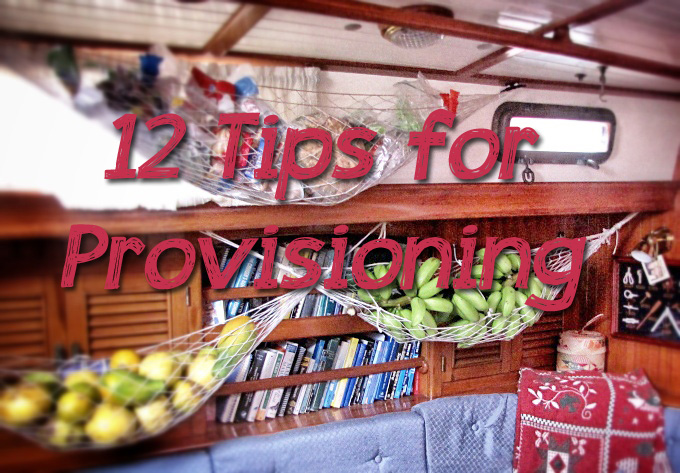
I prefer to buy freshies the morning we leave if possible...and preferably fruits, veggies and eggs which have never been refrigerated. Buy the freshest, healthiest-looking produce you can find. Other than in the USA, by the way, eggs are rarely refrigerated. They're always available just sitting at room temperature on a store shelf. We store lots of fresh produce like squash, onions, potatoes, melons and bananas in hammocks or hanging baskets. Eggs are stored in a crate and turned regularly.
11. Don't bring pests aboard
 The easiest way to transport roaches and other undesirables aboard is to bring them in with your provisions. We immerse all freshies in salt water, if it's feasible. Otherwise, we tote a bucket to the wharf and immerse them in water there. Drown the suckers! All dry and canned goods, especially anything packed in bags or boxes, are left either in the dinghy or on the dock until they're each carefully inspected for critters. Then and only then do they get to board. Properly washing freshies is another matter for another blog.
12. Label and stow
Beyond planning, buying and hauling, I always have to keep in mind where I'm going to stow what I bought. We don't have an elaborate system for stowing provisions. We've purchased plastic crates and hammocks and tiered hanging baskets. We use every available nook and cranny, but I try to use the same locations each time, so I remember what's where. I mark the contents and use-by date on the top of each can with indelible marker before stowing it, making it much easier to sort outdated cans and locate what I want in a hurry. We found an area under some drawers in the aft cabin which afforded us a nice area for stowing wine. Oh yeah, don't forget the wine!
Notes:
Keep your spreadsheet on file for future trip references and adjust it at the end of trip to reflect what you have too much of, what you might have liked more of and what you ran out of (hopefully, never TP). I typically have a 30-day, 60-day and 90 day provisioning list with quantities all filled in. I just inventory, fill in the on-hand quantities and voila, a shopping list.
Try a new item once before buying a large quantity. We've been pleasantly surprised sometimes and most disappointed other times in the past by some products we've purchased.
If you see something that you've haven't seen in a long time and you'd like to have it, buy it NOW. It might not be there the next time or at another shop.
So, how do you provision?
Stay tuned for subsequent blogs on “Storing and Stowing” and “Pressure Canning”.