9 Ways to Network with Other Cruisers

pot luck  

It's easy to get overwhelmed when you first start cruising. Never mind the boat and sailing, what about figuring out where to go, how to clear in, where to clear in and whether there's any fuel available where you're going? How do you figure out where the marinas are and whether it's a safe place to be? Oh, sure, you can buy or borrow a cruising guide, but they're usually outdated as soon as they're printed. The answer unequivocally is cruiser networking. If you haven't been there, someone usually has or they know someone that has. Cruisers willingly share information with each other. Once you've been there, you'll be expected to share information, too.

There are lots of avenues for cruiser networking. Some just tend to come naturally after you've been out there for any length of time and others may take some effort, but are definitely worth your while. Here's our list of the top ways for new cruisers to network and gather information for destinations they might want to visit, equipment they're considering buying or just some insight on a niggling problem.

1. Join SSCA or a cruising club
ssca websiteI know we've blogged about this before, but there's no better way to network than to meet like-minded people who share the same enthusiasm for cruising, adventure and travel and have information to share. SSCA publishes a 44-page monthly Bulletin which is full of information on just about any sailing destination in the world. The past issues are available on a searchable CD. It's pretty easy to find information on most any place or subject you want to know about. They also provide Port Guides for many places in the world.

2. Join an online group

There's lots of on-line information shared by cruisers that's readily available, especially if you're heading where several other people are heading. If you're crossing the Pacific, for instance, consider the Yahoo Puddle Jumpers group for lots of tips, ideas, and stops along the way or check out Latitude 38's Pacific crossing guide.

3. Participate in a rally or a potluck or a gam

These can be formal, costly and regimented or informal, inexpensive and fun. We tend to prefer the latter. Lots of cruising clubs like SSCA sponsor gams and potlucks throughout the year worldwide. Check them out or organize one yourself. It's a great way to meet other sailors. A “gam”, by the way, is sailor-speak for getting together. Rallies are fun and offer a chance to “sail in company” with other boats and meet at pre-determined locations. In-season, there are loads of them to choose from. Check with your local cruising club, SSCA or look for ads in cruising magazines.

4. Exchange boat cards

boat cardBoat cards are like calling cards that most cruisers print up and exchange with each other. We used to keep all the boat cards we received wrapped up with a rubber band like playing cards. It didn't work well. We found that gluing them into a small notebook with a couple of notes as to where we met and what we did together was a great way to find them again, jog our memories and keep in touch. No boat cards? … they're easy enough to make yourself. Check out our website for some ideas.

5. Find other cruiser's websites

Do an on-line search of places you want to visit, then find cruisers who have been there and documented their travel on their websites. There's usually lots of information to be gleaned as well as good photos. Got questions? Contact the folks. They'll share. By the way, if you're just starting out, a website or a daily blog is a fun way to keep in touch and share your experiences and travels with others.

6. Get to know your neighbors

Whether in a marina or in an anchorage, it's always nice to visit other boats, introduce yourself and get to know more about the people you're sharing your dock space or anchorage with. Cruisers are NOT shy. We're a transient population, so we make the most of it and get to know lots of fellow cruisers along the way.

7. Stay in touch

sail mailWith accessible internet most everywhere, on-board SailMail and nearly disposable mobile phones, it's easier than ever to stay in touch. We're still in touch with folks we met 10 years ago in the Carib and they're not even sailing any more. Visiting Seattle, driving through Arkansas, heading to Sweden, or New Zealand or Oz? Wouldn't it be great to know someone there who'd be happy to show you around?

8. Read cruising magazines and articles.

We write lots of articles and you'd be surprised at the number of e-mails we get from people who have read the articles and have questions. We're always happy to respond and provide information. If you read something of interest and want to know more, contact the author.

9. Pay it forward … give it back

Remember that if you get, you should also be willing to give. Share your information with others. You'll find you meet and stay in touch with people to greater extent if you give as well as receive.

Gamming

the gam - ashley  

Yes, that's “gamming” with two mm's, not gaming, though we've done both. There are several definitions for a gam. It can refer to a lady's legs (wrong definition) or a pod of whales which is probably where the seafaring term “gam” originated since whales are pretty social creatures. Among sailors, it's more commonly a social, friendly visit between the crews of whalers or nowadays just boats/ships in general.


gams


I hadn't ever heard the word, other than in reference to a group of whales, until we joined SSCA. They have “gams” quite frequently in different parts of world. These are big get-togethers where like-minded, sea-spirited folks exchange stories, trade goods (treasures of the bilge/flea market), experiences and sometimes tall tales, as sailors are wont to do.

What brought this to mind was our recent visit to the New Bedford Maritime Museum. There were pictures and sketches of old whaling ships at sea, drifting near each other and sending boats between them for visits between the captains and the crews. Whaling ships followed the migratory patterns of the whales they sought and many times would come in contact with other whalers in the same vicinity. The actual whaling portion of the passages was short-lived and frenzied, but the passages themselves sometimes lasted 2-3 years. Life aboard could get pretty boring. You can only do so much scrimshaw. So when another ship was spotted, the boats would hail each other and then commence gamming (and perhaps drinking).


gamming chair


I was especially interested in the gamming chairs that were used by the women aboard. The captain's wife and perhaps even the children would be lowered from the ship to a whaleboat in a gamming chair and then rowed to the other ship for a festive social occasion, visiting with the other captain's wife and family. Other times the gamming chair would be hung from a spar, and swung across as two vessels were side by side. Knowing all the paraphernalia women of those days had to wear, it must have been a wet and hairy ride, but a welcome change from the monotony of ship's life.

If you're interested in participating in a modern day gam, check out the SSCA website for a gam near you. No gamming chairs necessary to attend.

12 Tips for Provisioning

12 tips for provisioning  

Another frequently asked question is how we provision aboard Nine of Cups. Provisioning can be as easy as a short walk to the grocery store for an overnight and a couple days or as complicated as developing a spreadsheet that includes every possible item you anticipate needing for the next six months. Add to that your transportation availability (or lack thereof), size of your refrigerator/freezer (or lack thereof), stowage space (or lack thereof) and what's available at the local grocery and provisioning can sometimes be quite the challenge. Like anything, the more you do it, the easier it becomes.

Our first passages were short ones … a week was about our longest as we crossed the Gulf of Mexico from Texas to Florida. We'd gone camping and backpacking in the past, so a week's advance planning wasn't difficult. I made a list and we were fine … except we ran out of snacks. Then we hopped along the Florida coast and up the US east coast and never had to travel very far before another grocery store was within reach. We found, however, that we really enjoyed staying in less crowded, more remote anchorages and we started provisioning for 1-2 weeks. It wasn't that hard once we had the basics aboard, but still we ran out of things from time to time which was frustrating, but certainly tolerable. Here are some tips we've learned for provisioning that might be helpful to you.

1. Create a spreadsheet

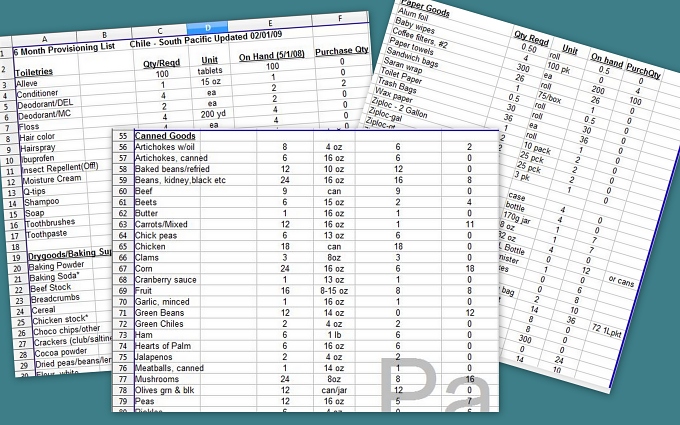
provisioning spreadsheetI use a spreadsheet for making our provisioning list if I need to provision for more than a couple of week's worth. The first time you do this, it's cumbersome because every little thing needs to go on the list … salt to onions to condiments. The positive side of using a spreadsheet is that I've created a column for entering our current inventory, a column for what we need and then the "buy" quantity is calculated for me. Once I've completed the spreadsheet for a trip, I print it out and use it as my master shopping list.

2. Over-provision rather than run short

docksideIf we estimate 30 days between shopping trips, I provision for 50 days. Extra is okay in my book. Arrival delays due to weather and wind are the norm, rather than the exception on a longer passage. Running out is a bummer at sea or in an isolated anchorage, especially if you're short on a basic item. I tend to over-provision on items which will keep and we can use in port or on the next trip.

3. Buy what's available

I modify my “needs” list depending on where we are and where we'll be shopping. Many items available in the US or Europe are not available in the Caribbean, South America or the South Pacific, so the list changes to reflect availability of specific fruits/veggies, canned items, etc. I check out the local supermarket(s) and fresh markets, butchers, etc. to determine what's available, what's not, best deals, best quality, etc.

4. Inventory first

I take an accurate inventory of what's aboard as close to provisioning day as possible. I check for out-of-date and obvious no-use items aboard. If out-of-date items look okay, they are moved to the front of the line, where they'll be used first. While inventorying, it's easy to straighten up and place like items together so they're easier to find when we're at sea. Dried up drink mixes, bulging cans, etc. are discarded. No-use items are just taking up space. I give them away.

5. Plan your menus in advance

provisioning filesI do basic meal planning to get an idea of how much of each item on my list I'll need. If I'm provisioning for 90 days ... that's 90 breakfasts, 90 lunches, 90 dinners and 90+ snacks. For instance, we eat lots of pasta, so I'll assume we'll have a pasta meal of some sort at least twice a week...for about 13 weeks...that's 26 pasta meals. We get two meals from a typical 1 lb(.5kg) package of pasta, so I'll need 13 packages to cover 26 meals as a minimum. What else will go with the pasta? Tomato sauce, canned tomatoes, spices, grated Parmesan, meat, mushrooms, canned or fresh veggies? It sounds tedious, but after awhile I developed "typical" meals and the menus and ingredients became pretty easy.

6. Consider non-edible items

I went through the boat one day and made of a list of every non-food and non-boat part item that we use regularly. Toilet paper topped the list. Then came dish detergent and laundry detergent, bug spray, sunscreen, paper towels, AA batteries … The list was quite long and varied. These went onto the spreadsheet with my guess-timates of what was necessary to keep in stock.

7. Medicines and medical supplies need special attention

medicine drawerFrom antibiotics to band-aids and daily vitamins, I've created a separate list of OTC as well as prescription drugs and I inventory these items with care. Running short of cooking spray is inconvenient; being without a medication can be a serious issue.

8. Don't try to do it all at once

It's exhausting! If I can avoid doing a provisioning buy all at once, I do. I prefer to break it up into three or more trips. One for basics and canned goods; one trip for freshies and eggs; and a final trip for all the other stuff I thought of or forgot to buy after reviewing my list just one last time. Some of this depends on just how long I'm provisioning for, what transportation is available and how much room is left in the lockers.

9. Buy in bulk if you can

bulk drygoodsCertain places tend to offer some items in bulk at a significantly lower price. There are the Price Club-type stores in larger cities, but in smaller cities and towns, you might have to hunt out the bargain shops. While in Argentina, for example, we found we could buy dry cat food at a fresh market by the kilo at a portion of the price of cat food in the local supermarket. We bought a small quantity first. Jelly liked it and we bought more. We've done the same for cereals, dried beans, popcorn, rice, etc., but we're selective where we buy since we prefer to leave unwanted critters behind. Save egg cartons, by the way, they come in handy in many fresh markets.

10. Buy fresh market stuff at the absolute last minute

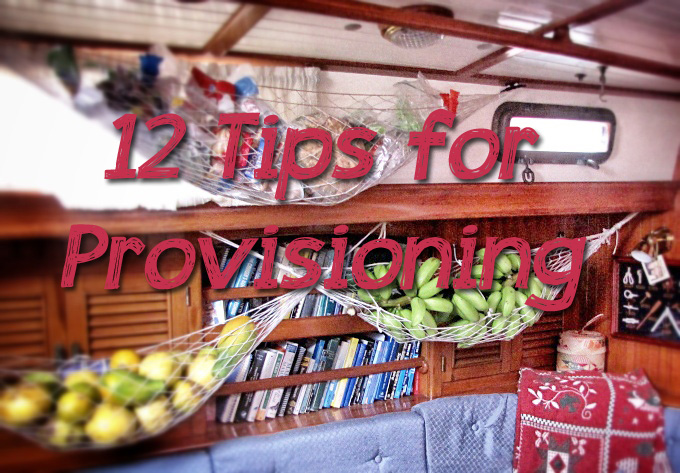
I prefer to buy freshies the morning we leave if possible...and preferably fruits, veggies and eggs which have never been refrigerated. Buy the freshest, healthiest-looking produce you can find. Other than in the USA, by the way, eggs are rarely refrigerated. They're always available just sitting at room temperature on a store shelf. We store lots of fresh produce like squash, onions, potatoes, melons and bananas in hammocks or hanging baskets. Eggs are stored in a crate and turned regularly.

11. Don't bring pests aboard

cockroachThe easiest way to transport roaches and other undesirables aboard is to bring them in with your provisions. We immerse all freshies in salt water, if it's feasible. Otherwise, we tote a bucket to the wharf and immerse them in water there. Drown the suckers! All dry and canned goods, especially anything packed in bags or boxes, are left either in the dinghy or on the dock until they're each carefully inspected for critters. Then and only then do they get to board. Properly washing freshies is another matter for another blog.

12. Label and stow

Beyond planning, buying and hauling, I always have to keep in mind where I'm going to stow what I bought. We don't have an elaborate system for stowing provisions. We've purchased plastic crates and hammocks and tiered hanging baskets. We use every available nook and cranny, but I try to use the same locations each time, so I remember what's where. I mark the contents and use-by date on the top of each can with indelible marker before stowing it, making it much easier to sort outdated cans and locate what I want in a hurry. We found an area under some drawers in the aft cabin which afforded us a nice area for stowing wine. Oh yeah, don't forget the wine!

Notes:

Keep your spreadsheet on file for future trip references and adjust it at the end of trip to reflect what you have too much of, what you might have liked more of and what you ran out of (hopefully, never TP). I typically have a 30-day, 60-day and 90 day provisioning list with quantities all filled in. I just inventory, fill in the on-hand quantities and voila, a shopping list.

Try a new item once before buying a large quantity. We've been pleasantly surprised sometimes and most disappointed other times in the past by some products we've purchased.

If you see something that you've haven't seen in a long time and you'd like to have it, buy it NOW. It might not be there the next time or at another shop.

So, how do you provision?

Stay tuned for subsequent blogs on “Storing and Stowing” and “Pressure Canning”.