St. Francis Island to Eucla

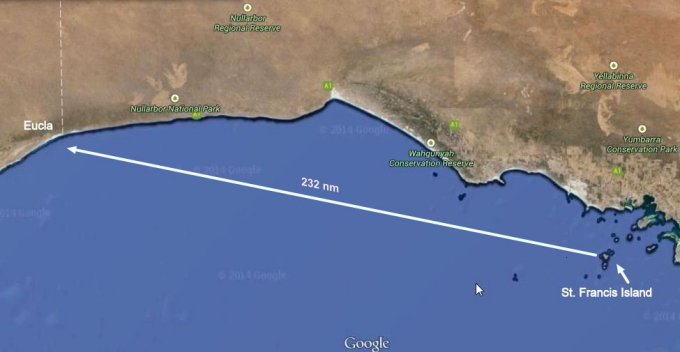
eucla map  

Yes, we did leave St. Francis Island in a hurry, didn't we? It's that way sometimes. There's no internet at St. Francis, so we rely on SailMail to receive our GRIBs and weather once a day. This morning's weather showed a one-day delay in the strong SW winds we were expecting and better winds for heading to Eucla, 232nm to the west. We decided it was worth the rush and the push to get to Eucla, rather than remain at St. Francis for the next 5-6 days.

The morning calm was very welcome. We dug out our old genoa out of mothballs under the forward bunk and had it rigged, hoisted and furled before you could say “what happened to the calm?”. We folded our clewless jib down below because the wind had come up again. It was a comical scene … too much sail in too little an area. But we managed to get it folded eventually and into a sailbag and snugged back in its place on the port settee secured with the lee cloth.


folding the jib


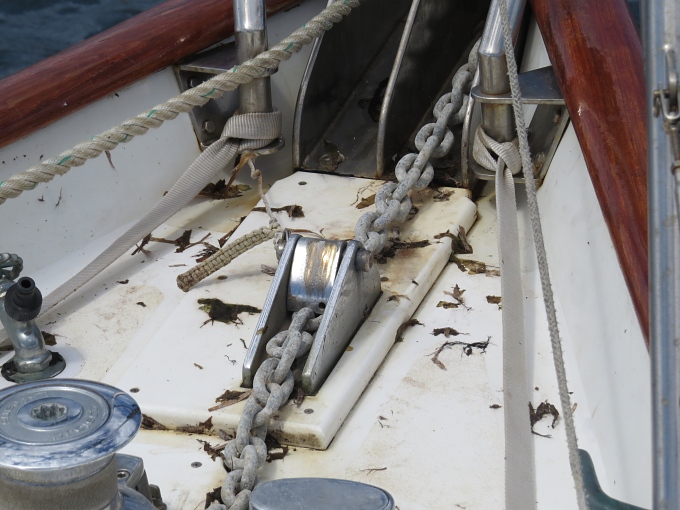
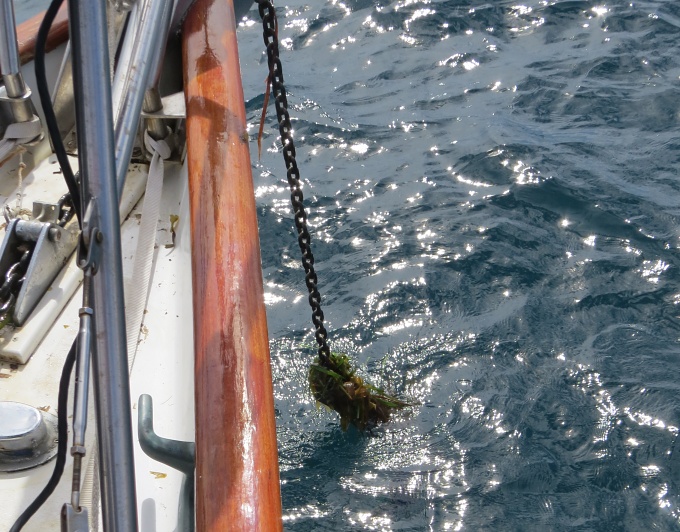
While David removed the sail cover from the main, I made a quick chicken-rice passage soup. (Gotta love that ready-to-go chicken I canned/preserved last month.) Before we hauled anchor, David backed down on it to see if we were really hooked. We definitely were … which was most reassuring. Grass on the anchor was thick and reminded us of our days in Patagonia when hacking off the kelp with a machete was a typical occurrence. Then we were off and the St. Francis Islands were behind us, soon lost from view. Leaving around Noon assured us we'd arrive at Eucla in daylight hours as long as we watched our speed.
 

grassy anchor


We sailed with a fine 15kt SE wind. We glided up and down smooth, long period 10' (3m) SW rollers. It was cold, despite the clear, sunny sky. We were back in sweats, hats, gloves and heavy offshore weather jackets. The SE winds blew themselves out during the night and we motored in 5kts of wind for a few hours, making some fresh water and charging all our gear below as we went. I'd forgotten just how beautiful and peaceful a night watch could be. I watched the moon rise in the east and the sun set in the west and followed upside-down Orion towards Eucla in a sky full of stars.


night sky


Gradually, the wind switched to the east and at first light, we rigged the whisker pole and enjoyed a good downwind sail. One more day to Eucla. If all goes well, we should arrive mid-morning tomorrow. Stay tuned.

 

poled out jib


St. Francis Island - The Neighborhood

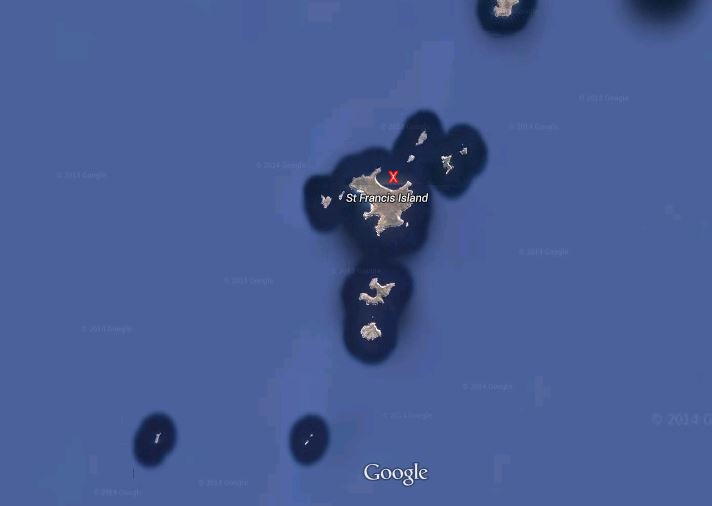
st francis island  

I guess it's time we told you a little bit about our neighborhood at the moment. St. Francis Island first appeared on a Dutch map in 1644 as Eyland St. François. One of the first parts of South Australia to be explored by Europeans, the Dutch navigator, François Thijssen captain of the Dutch East India Company ship “t Gulden Zeepaerdt (The Golden Seahorse) mapped the island and named it after his patron saint in 1627.

St. Francis is part of Nuyts Archipelago, a group of about 30 islands and reefs lying off Ceduna, at the eastern end of the GAB. The archipelago was explored and named by none other than Matthew Flinders during his voyage of 1802. During the 19th century, these islands were used as a base for sealing and whaling. Today they are part of the Nuyts Archipelago Conservation Park, established in 1972 “to conserve island populations and provide a habitat for endangered species.”

It's an important bird area with over 1% of the world population of muttonbirds (short-tailed shearwaters), white-faced petrels and pied oystercatchers in residence. Supposedly over 1,000 pair of little penguins (aka blue penguins) also call the archipelago home, as well as Pacific gulls, Caspian terns, crested terns, egrets, osprey and white-bellied sea eagles. The smaller islets and reefs provide breeding sites for Australian Sea Lions. Tiger snakes and southern carpet pythons also occur in the islands along with rats, bandicoots and bettongs.

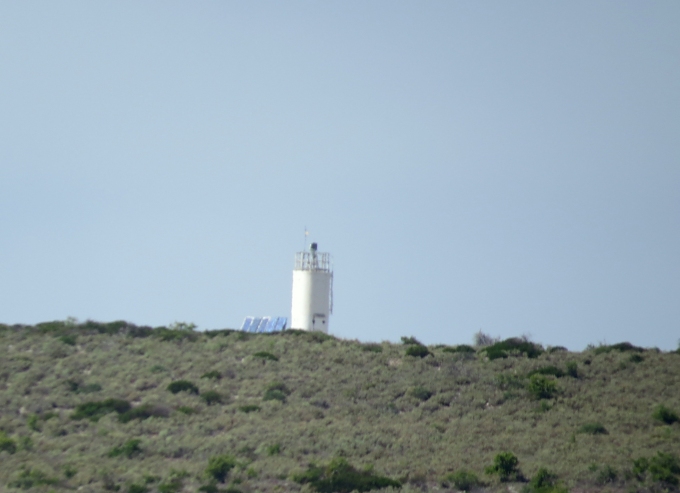
At about 2,000 acres (809 ha), St. Francis is the second largest island in the archipelago. It is covered by a mix of grassland, saltbush and low shrubs, and reportedly supports a very large population of muttonbirds (estimated at 273,000 pairs .. I wondered who counted? WOW!). On its highest point, ~265' (81m), there's an automated lighthouse and radio beacon.


lighthouse


The island has a long history of agricultural use as well as of guano mining. From the boat, we can see the rather nondescript lighthouse, as well as two old buildings, now ramshackle and falling down. One tin roof has Scarlett Rose 1995 painted on it. Graffiti even here! Now that the wind has calmed a bit, we can hear the cacophony of what we assume is the non-melodic squawking of muttonbirds.


ramshackle buildings


ramshackle building


The beach before us looks like a good landing spot. Early this morning, dolphins were working hard as a team, corralled fish for their breakfast. At times we could see nothing but fins, then one would jump high and slap a tail and a frenzy occurred which we think was breakfast.


dolphins working


How plans change! A trip to the island to explore was on the agenda for the morning, but a change in the weather forecast had us scurrying to depart by Noon. Ah, a lost opportunity, but another one found. We'll miss out on 273,000 pairs of muttonbirds, remnants of the guano mining pursuit and snakes, but we'll have a good run to Eucla, our next stop. Read more about our passage to Eucla in the coming days.

A Day Aboard at St. Francis Island

st francis map  

We never woke till 0930. It seemed late even  though we hadn't slept much during the night. It was the calm followed by thunder that woke us. Thunder rumbled, roared and clashed throughout the rest of the morning and afternoon. Wind and heavy rains … big, noisy, splattering drops … followed each thunderous outburst, but we remained firmly ensconced. The anchor held. The continuous cycle of calms and squalls left us unsettled, alert and tired.


rain


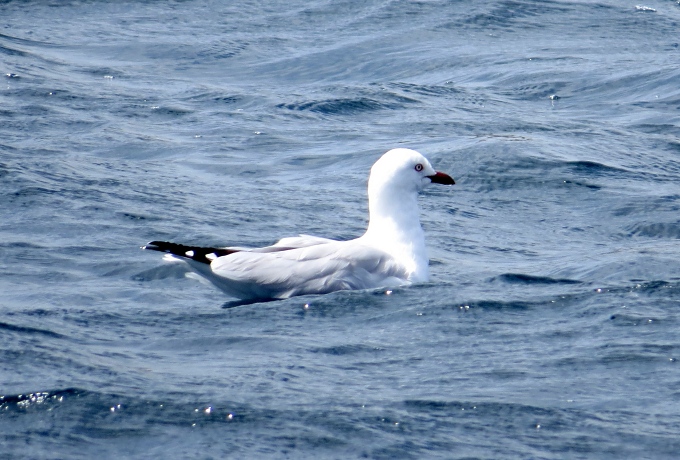
We anchored off the north side of the island in St. Francis' crescent-shaped Petrel Beach. The island, at least what we could see of it, was either shrouded in the mist or the rains, looking grey and dismal or barren in the sun. We could hear birds from the island. Silver gulls lit on the water beside the boat and eyed us nonchalantly.


silver gull


We busied ourselves with chores and “what-if” conversations, usually in snippets. As a new thought or alternative occurred to one or both of us, we'd discuss it for a bit, then go back to our chores, noodling the new idea. We were hoping to come up with an alternative to returning to Streaky Bay. Not that we don't like Streaky Bay, mind you. It's just that we'd give up the 50 miles we'd gained, waste fuel by motoring back and not much more could be gained by being there.

Closer inspection of the torn out clew indicated that the stitching had indeed given way. One piece of webbing was still attached to the clew itself and several others were missing. This part of the sail is not one easily tackled by my SailRite sewing machine. It's just too thick with all the webbing and reinforcements and there's too much of it to try to repair by hand. We reckon we'll need a sailmaker's expertise and equipment to effect the repair.


torn jib


The deck needed to be washed down and the grass either mowed or removed. The sail cover needed to put on. The wind had not subsided in the least which made folding the damaged jib, hoisting the old genoa or even launching the dinghy out of the question.


grass on foredeck


Lighter winds were promised in another day or so. We'll wait patiently (as if) and read and write and chat and do chores and eventually the weather will change and we'll be good as.