Maintaining Log Sheets

underway  

We may be in the middle of the desert, but our thoughts and conversations frequently turn to getting back to Nine of Cups. We've been thinking of our upcoming passage across the Indian Ocean and wanted to review the info on our log sheets to see if we needed to make any adjustments. We've modified this log sheet over the years and every now and then, it still needs a tweak.

First of all, we do keep a log sheet and whenever Cups is on the move, we log hourly. To some, this might sound excessive considering that's 24 log entries a day on a long passage. We've talked to other sailors and some log every 4-6 hours or only once a day and that works for them. For us, however, it's a quick reality check every hour of where we are and what's happening around us. It's easy to become lackadaisical on a calm night watch or after a few days at sea with not much happening. Logging keeps us more attuned and forces us to pay attention to details we might overlook otherwise … like the voltage or maintenance issues, for instance.

We've known some sailors who keep very elaborate logs including sea temperature, sea conditions, true vs. apparent wind direction, etc. We include some of these, but not all. We've figured out over the years what information is most important to us and include that in the log. We find that having the log also provides a good history of our passages, sea conditions en route and anchorages. We've also used it to provide officials with proof of our whereabouts on some occasions. “How come it took you so long to get from Point A to Point B?” “Take a look at our log … the wind was against us and our speed was only 4 kts.”

So … what information do we feel is pertinent? Take a look at our Passage Log. All the usual stuff is there: date, time, track, speed, sky, wind direction and speed, barometer and position. We've kept track of our cumulative mileage since Day 1, hence we can account for our 73,387 nautical miles to date. We also check voltage regularly to ensure that when we're sailing, we know when it's time to start the engine for a bit to top up the batteries. The “Comments” column is used for everything from “Dolphins” to anchorage depth and seabed … 16' / sand, for instance.

We added the General Notes & Maintenance block for ease in making the to-do list. On my watch, I might notice some chafing on a line or a light is out or any number of issues. It's so easy to think of it and then forget to do it or advise David. If I write it down, David notes it and if it needs addressing right away, he'll handle it. Many times, however, it's something that's better handled when we're anchored or moored. David reviews the sheets at the end of each passage and makes sure each noted item is resolved. That way, nothing is overlooked.

On long passages, we keep track of engine hours and fuel consumption as well as water consumption. We want to ensure we have adequate water to see us through a passage even if the watermaker should fail. Entry items such as distance remaining, average speed and hi/lo distance run are more for planning and bragging rights after the passage.


log sheet


A couple of notes:

*While we're at sea on a longer passage, we usually hand-number the pages, so it's easier to reassemble them if they get out of order.

*Each page has 24 lines to accommodate an entire day's passage

*We usually 3-hole punch the sheets at some point during the year and put them in a binder. We left room at the top of the form for 3-hole punching.

*We usually have blank copies made from our original when we're ashore, though we have the capacity to print them aboard in a pinch.

*We use a clipboard for the log sheets while we're underway and keep it safe and dry in a large zip-loc bag in the cockpit.

I know, I know … hard copy of anything sounds so antiquated, but it's what works for us.

Interested in a copy of our log sheet format? Send a request to gentry@justalittlefurther.com and she'll be happy to e-mail it to you.

FAQ: Do you two ever get tired of traveling?

passages  

We're asked quite regularly if we're tired of traveling after all these years aboard. Let's think about that for a nanosecond … NO! I guess I could end it there, but would make for a very short blog. I guess I should elaborate because there are some caveats to that unequivocal “no”.

I'd say we don't tire of traveling, but we do tire of some trips, some locations and some situations. It's more like getting antzy to move on or conversely, looking forward to staying somewhere for awhile. When we're in an anchorage and the weather prevents us from going ashore, for instance, we don't like that aspect of things much. When we sailed for 30 days from Easter Island to Ecuador having to hand-steer because the autopilot was broken (and so was the back-up!), the starter motor crapped out so no engine, the head wasn't working and the list goes on … I'd say we were pretty tired of that trip by the time we reached Ecuador. But tired of traveling in general? No way.

I require some nesting time every few months … a chance to collect myself, put down some temporary roots and get cleaned up and organized after a long passage or even lots of day trips between ports of call. This “nesting time”, as we call it, usually figures well into the schedule because by the time I need to stop for a bit, David has a long list of things to fix on the boat, needs parts and a place to make repairs. It doesn't have to be long … a couple of weeks, maybe, and then I'm good to go. In fact, usually anxious to go.

We figured that the travel bug would have run its course after 14 years, but it really hasn't. Every time we arrive at a place, we're anxious to explore, but at the same time, we have the travel guides out figuring what's next, what's down the road, where to now? The lure of the next place.

I'm thinking that sitting in our rocking chairs at home knitting mittens or whittling little wooden animals is never going to be enough for us. For now, at least, wanderlust is still strong. If you want a look at where we've traveled thus far, check out the Passages link above, and for more photos and insight into our travels check out our website.

Splash in Mandurah

We splashed today. We could not have planned a more miserable day to plan going back into the water. It poured in torrents all through the night and we only hoped that the clouds would rain themselves out before our 0930 appointment with the TravelLift.

Luck was with us. It did not rain on our walk from the hotel to the boatyard. It did not rain while we were making final preparations to go back into the water. We waited rather impatiently as another boat was hauled and then it was Nine of Cups' turn and the TravelLift moved into place.

moving travellift into place

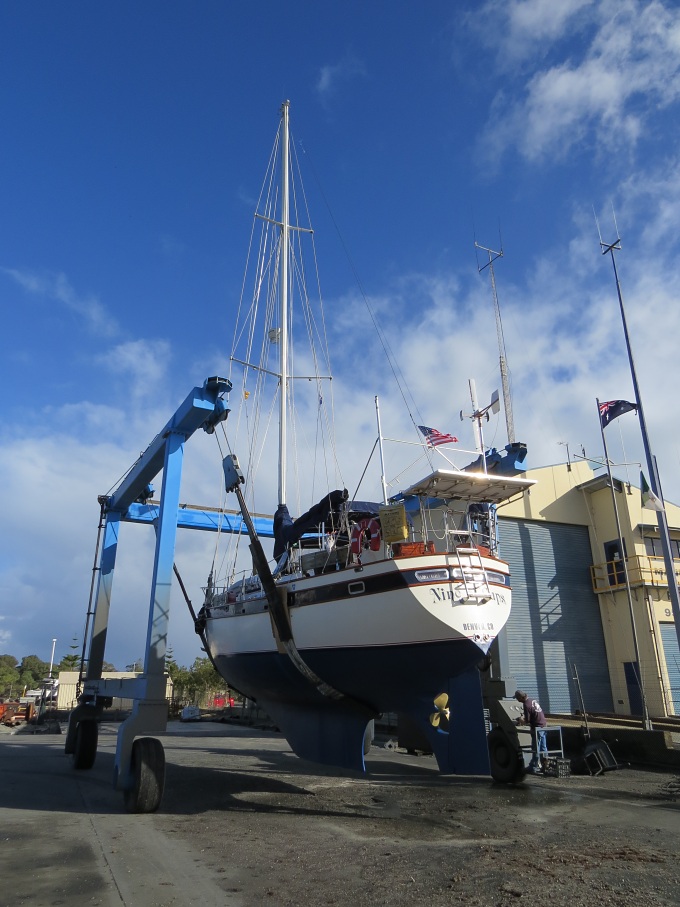
The slings were put into place and the stands were moved out of the way. Cole, the lift operator, is quite friendly and very proficient at his job. He had us ready to go within minutes.

removing stands

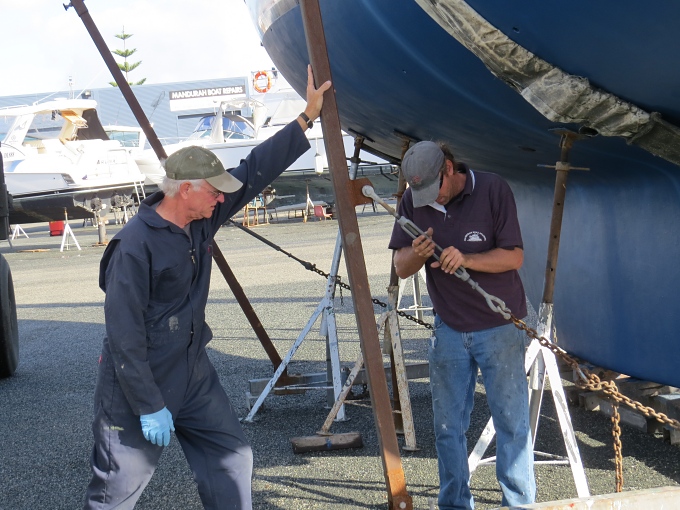
With Cups in the sling, we knocked away the keel supports and David slapped some anti-fouling paint on the places we hadn't been able to access while Cups was on the stands.

painting keel

We had planned letting the paint dry for a ½ hour or so, but Cole indicated that radar showed a rather large squall heading our way. It was already blowing nearing 20 knots; we really didn't need any more wind for launching. Without delay, Cole had Cups moving toward the lift bay.

her comes cups

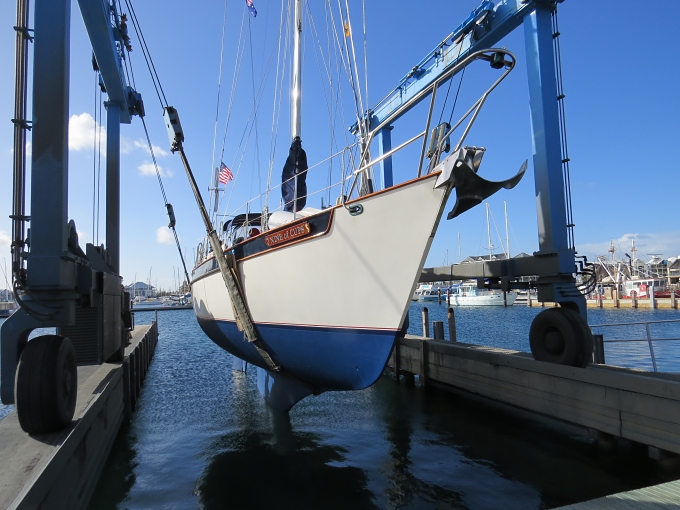
She looked beautiful with her new blue bottom, red bootstripe and shiny topsides. Cole lowered away and her keel touched the water. Splash!

splash

We scrambled aboard using the anchor as a step and ducked under the bow pulpit. We were ready for take off. David burped the shaft seal and turned on the engine.

A friend had brought over large cardboard boxes which David had rigged to shield Cups from the dirty slings and keep the topsides clean. We had a time tying them to lifelines as the wind gusted and blew them like kites. Marcie rigged the docking lines to tie back up at the marina and grabbed the boat hook … just in case. We were ready to head out.

We're pleased to report … no drama. Cole moved us as far to the end of the bay as possible. David backed her out and the wind caught us, but in the right way. He made a u-turn and maneuvered Cups across the channel … the northwest wind pushing us closer to the dock without much effort on our part. We were tying up and removing the cardboard protectors when the winds increased and the torrential rains started up once again. Thank you, Neptune!