A Little Indian Ocean Info

As we depart to cross the Indian Ocean, we thought we'd provide a little info about this major body of water we're intending to cross. According to Knoji Geography, the Indian Ocean “consists of 57 island groups or archipelagos, 16 seas or large gulfs, borders 16 African countries, 18 Asian countries and one Australasian state, and covers five submerged, oceanic ridges, five divergent tectonic plate boundaries and one Triple Point.” ...Wow!  

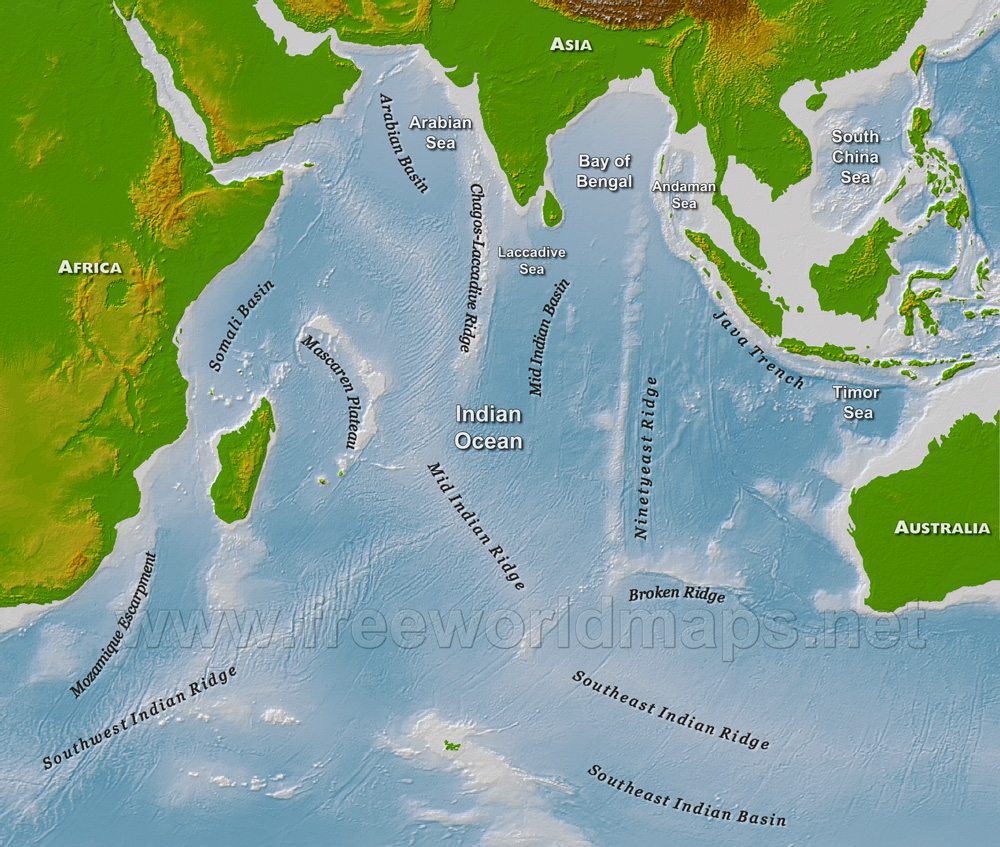
indian ocean map


  • The Indian Ocean is the third largest of the world's oceans, comprising approximately 20% of the water on Earth's surface.
  • It's the warmest ocean in the world.
  • The Indian's average depth is 3,890m (12,762ft).
  • Its deepest point is Diamantina Deep in Diamantina Trench at 8,047m (26,401ft) deep
  • An estimated 40% of the world's offshore oil production comes from the Indian Ocean.
  • The waters of the Indian Ocean provides the world's largest breeding grounds for humpback whales.
  • The Coelacanth, a fish which was thought to be extinct, was discovered in the warm Indian Ocean waters off the Comoro islands between Mozambique and Madagascar.


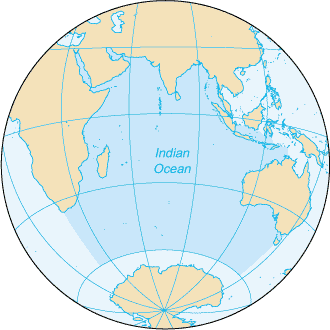
indian ocean globe map


  • The Indian is considered the world's only “closed” ocean because it's landlocked to the north by the Asian continent.
  • Because of its warm temperature, the Indian has the highest evaporation level of all the oceans and therefore the highest salinity (salt) level. This also accounts for the lowest level of marine life in all the world's oceans. (Maybe not much luck fishing as we transit, huh?)
  • TheRodrigues Triple Point, near Rodrigues Island, is a geologic triple junction in the southern Indian where three tectonic plates meet.
  • The Indian Ocean is known as Ratnakara in ancient Sanskrit literature, translating to "the mine of gems".

Standing Watch

david on watch  

Just about a year ago, I wrote a blog post about our watch schedules. At that time, I was looking for things nautical to write about, but we were actually in Boston caring for my mom and hadn't had a watch schedule (on the boat anyway) in many, many months. Now, here we are, having just done one overnight and preparing to leave Oz and head across the Indian Ocean. I thought it might be fun to resurrect this post and add a few changes because it's most appropriate at the moment.

First of all, whenever Nine of Cups is in motion, someone is on watch. One of us is either at the helm, in the cockpit with the helm on autopilot or, in inclement weather, sitting at the nav station below watching the radar. Even when the weather's bad and we are in the middle of an empty ocean, we still keep our eyes on the radar and pop our heads up every 10-15 minutes to take a took around. When the weather and seas are crappy, this is the uncomfortable price we pay for traveling by sailboat. In fine weather, this is a perk. Unless we're on an overnight passage in heavy shipping traffic, this is not a difficult task. You “watch” and make sure you don't hit anything, nothing hits you and Cups is on course and doing her thing. We both enjoy being topside … you can't beat the view.

There are as many different watch schedules as there are sailors out there, it seems. Nothing is “standard”. We've heard of one fellow who can't sleep during the day, so his partner stands watch all night long and sleeps while he's on watch all day. That certainly wouldn't work for us, but it works for them. We tried four hour watches, but found the middle hours interminable. We tried two hour watches, but the off-watch person doesn't get enough sleep. So, over the years, we've settled on three hours on watch-three hours off and this works for us. We rarely have extra crew aboard and manage just fine with the two of us.


david off watch


So, what does one do on “watch” during the night to pass the time when there's nothing going on? David has his own schedule. The first hour he plans his second hour meal. The second hour, he prepares and eats his meal. He reads sometimes or plays a game or two of Sudoku. The third hour, he cleans up and gets ready for bed. Some folks watch movies or play video games on their laptops. I don't usually eat, read or watch movies during the night … I sing. Oh, yes, I can sing to my heart's content as loudly as I please. I've got a whole repertoire to go through. I don't sing particularly well, but David can't hear me below and the fish don't seem to mind. On beautiful clear nights, when the sky is so full of stars there's not room for even one more, I can sit bedazzled by the wonder of it all. I've been known to talk to the moon at length on night watches. She rarely answers.

Of course, there are a few chores to do as well. We log our position, speed, etc. on the hour. We check radar and AIS regularly. We make sure we're on course or at least the best course for taking advantage of the winds and currents. One thing we do not do is sleep on watch. Many folks do. Obviously, that's how single-handed sailors sail. They set radar and AIS alarms and nod off. We feel more comfortable with one of us awake and alert and actually “watching” during our watch. We used to insist that our ship's cat, Jelly, keep watch, but she was unreliable.

Overnight passages and especially long passages introduce a new element to standing watch. Daylight hours are easy. Visibility is usually good. We're diurnal creatures and function best during the day. Night watches can be tiresome. You're by yourself, while your partner sleeps. Visibility is markedly decreased by the darkness. Radar works well, as does AIS, for identifying land masses and larger boats out there. But sometimes there's a lot of boat traffic, fast-moving ferry boats sneak up on you and you're not sure of their route or you don't know where those fishing boats ahead have laid their nets. Lobster pots drive us crazy sometimes. The positive thing about adrenaline rushes is that they keep you awake.

The worst passages for us are the 2-3 day variety. We're tired all the time, perhaps seasick, and then we arrive exhausted. We haven't seen each other because one of us is always sleeping. Longer passages allow us to get into the groove. Our bodies become accustomed to the odd sleep pattern rather quickly … for us 3-4 days. After that, we sleep soundly during our off-watch hours at night and only nap occasionally during the day. Not sleeping together at night is a bummer, but something to look forward to when we reach port again.

Very soon, we'll be standing watch for weeks at a time. Perhaps, you'll join me one night when I'm on watch? Stay tuned.

Crossing the Indian Ocean - Days 4-6

Indian Ocean Crossing - Update 2

Geraldton, Western Australia to Cocos Keeling

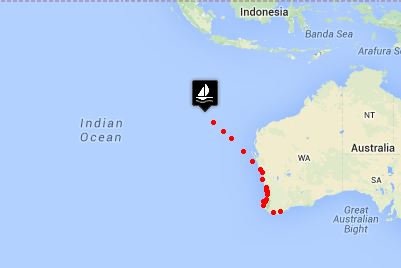
passage map

passage map

Day 4 Begin: 973 nm  -  End of Day 4:  832  nm to go

We're getting on a sched now. Up during most of the day with naps only as needed, eating regular meals and generally enjoying our time at sea. We''re not sure how long the sunny days and fine winds will continue, but we're loving them at the moment.

During our morning deck walk, we found a tiny flying fish in the scupper. He either flew in or got washed aboard, either way there he lay … stranded. He was an itty-bitty guy, no more than 2” (5cm) long, shiny gray and black with gossamer wings, bulging eyes and stiff as a board. Our all-time record for flying fish in one day found in the scuppers was 23 while crossing the Atlantic. They smell awful, so we're not trying to break any records here.

Night watches, though cold, have been beautiful. The stars, especially the Southern Cross, have been brilliant, that is until the moon rises after midnight and steals the show. The moonrise is always a shocker. The sky is totally black and then a loom appears on the eastern horizon and up she pops … dazzling.

The wind switched to SW for awhile today and is now a steady south tending to SSE. Looking at the forecast for the next few days, we're pretty sure we've found the trades … southeast, southeast, southeast.

Day 5Begin: 832 nm  -  End of Day 5: 686  nm to go

Sunrises tend to be quite dramatic the last few days. The tops of the clouds pink up a little in anticipation of the big arrival. Then an absolutely brilliant sphere of dazzling sun rises midst dark clouds and the contrast is startling. It's an artist's rendition of Christ's rising … no exaggeration. Sharp, golden shards of light pierce the clouds and shine back down to the sea in a Hollywood-esque fashion that only Mother Nature's flair for the dramatic can carry off effortlessly.

Beyond super sunrises, I lost my favorite “Good Old Boat” hat overboard. We were tooling along at 8 knots and turning back to fish it out of the drink was never a consideration.

We are officially in the tropics now … when we crossed the 23.5 latitude line known as the Tropic of Capricorn. We celebrated with an extra TimTam with our cuppas. And today, for our ongoing passage entertainment as I was checking out the sails, I noticed the silhouette of a squid caught in the first reef of the mainsail. He was stubbornly stuck to the sail and we had to sort of peel him off. Look at that … calamari, can't get it fresher!

Day 6Begin: 686 nm  -  End of Day 6:  566 nm to go

A dark, sapphire blue sea for as far as we can see under a cornflower blue sky … not a cloud in sight. Days have been glorious. We're 600 nm off the Western Australia coast now and Java is about 700 nm due north. We're more than half way to Cocos Keeling and we celebrated with Half Way Alfredo for dinner.

It's a slow sailing day today. The winds are light and a bit contrary. We only made 120 nm to the good. Quite honestly, it's so beautiful out here, who cares?

We're slowly shedding layers … scarf, gloves and foul weather jackets are stowed away and we're down to one blanket on night watch. We're edging our way to the warm, day by day.  Reading, writing, making plans, eating, napping and chores occupy most of our days and nights. I still do 95% of the cooking on passages, but David usually does clean-up and dishes which limits our individual time in the galley. Needless to say, long passages have their hidden perks for the first mate.

Another flying fish met his demise in the scupper … this one pretty large comparative to the 2-incher who glided aboard the other night. We regularly see them gliding long distances from wave to wave … must be something chasing them. David put out the fishing lines today.

Continue with us on our Indian Ocean crossing.