Crossing the Indian Ocean - Days 7-9

IO days 7-9

IO days 7-9

Indian Ocean Crossing - Update 3

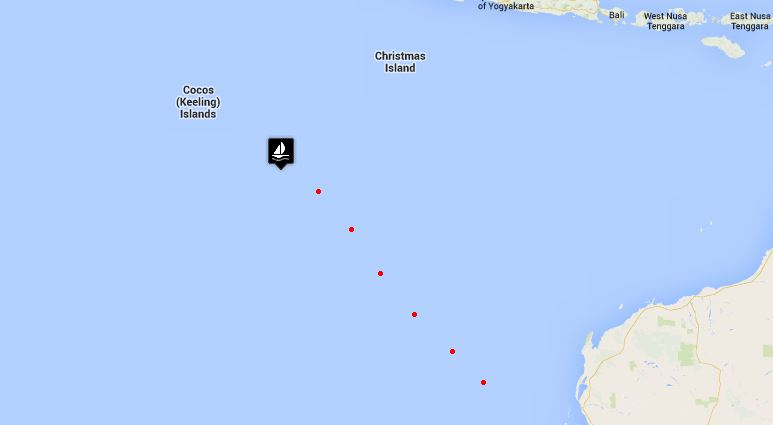
Geraldton, Western Australia to Cocos Keeling

Day 7Begin:  566nm    Miles to go:  433nm

Day 7...already a week at sea. We've shut down the freezer now and are just maintaining the fridge. The freezer's a power hog especially as we climb into the lower latitudes. Even with our solar panels and wind generator, we still have to run the engine a couple of hours each day to keep the batteries charged. All those electronics certainly do suck down the power.

All of our fresh chicken and turkey mince have been eaten now and we're relying on our canned provisions and David to catch fish for dinners. No luck yet in the fishing department, but we are trolling two lines. No chance of us starving ...plenty of food in the larder. We also try to have at least one or two meatless dinners a week ..like Half Way Alfredo, for instance.

The fishing lines get lots of attention from the passing birds. After a couple of fly-overs, they're smart enough to  figure out it's nothing they're interested in. Not all birds are this smart. Boobies are pretty dumb (hence their name) and we've had to unhook many of them along the way...sometimes more than once. They're not fast learners.

The moon rises later and later now. This morning, a lemon wedge of a moon rose just before 0300. Soon her cycle will be complete and we'll sail moonless for a few nights.

Today's on-deck count:     Squid -  2    Flying fish - 0

Day 8Begin: 433    Miles to go: 316nm A circle of dark clouds surrounded us this morning and, for the first time in a week, it rained. We witnessed a good tropical downpour for all of 20 minutes, just enough to rinse the squid ink off the deck, and then it cleared and the day turned beautiful once more. We're becoming quite spoiled with this weather.

No luck fishing although it appears the big wad of plastic debris caught on the end of the line might have accounted for some of the problem. Once cleared, we got one solid hit which even left bite marks on the lure, but no fish for supper.

What a contrast to a week ago! We're barefoot and in t-shirts now and...sweating.  We've definitely found the warm. Do not in any way  construe this as a complaint.

The winds were light today and dead downwind which had us tacking to maintain a reasonable course. It's reflected in our low mileage today. Fresher winds from the SSE are forecast for tomorrow. We're nearing the Cocos now and, like horses getting close to the barn, we're keen on getting there.

Only one flying fish in the scuppers this morning ...slow night.

Day 9Begin: 316 nm  Miles to go: 207nm

As we move further west on our route, the sun rises and sets later. We're sailing into a new time zone: GMT +6-1/2 hours - a 1-1/2 hour difference from Western Australia. The time of day makes little difference to us at sea and since the change is minimal, we'll wait until we arrive in the Cocos to collect our extra hour and a half.

Neptune is teasing us big time these last two days with light, fickle winds. As we get closer to the Cocos and excited about our arrival, he's been holding back the southeast trade winds and sending 3 knot breezes from the ENE and E in their place. We had thought to make landfall in two days, but two slow days in a row might necessitate an extra day at sea. Much depends on the winds over the next two days. So much for plans.

The nights have been as sweet and beautiful as only tropical nights can be. Other than a few errant sprinkles, the sky has been clear and star-studded ...absolutely mesmerizing. Warm breezes play on your face and though we're not moving very fast, it's so very pleasant. The wisp of a crescent moon waits till nearly dawn to rise, allowing the stars to have the night sky to themselves for a change and they take advantage of this monthly opportunity. What a show!

David loaded a new app on the iPad before we left called StarMap 3D. It uses GPS to figure out where we are and the current time and  displays the constellations, stars and planets in the night sky. A compass heading provides the orientation and there's an artificial horizon. We hold the tablet up to the sky and compare it to the real thing ...voila ...all the heavens on display. We're still playing with it to learn more about the southern skies.

Deck count: 3 flying fish; 1 squid or least parts of one and lots of ink.
Continue with us on our Indian Ocean Crossing.

A Little Indian Ocean Info

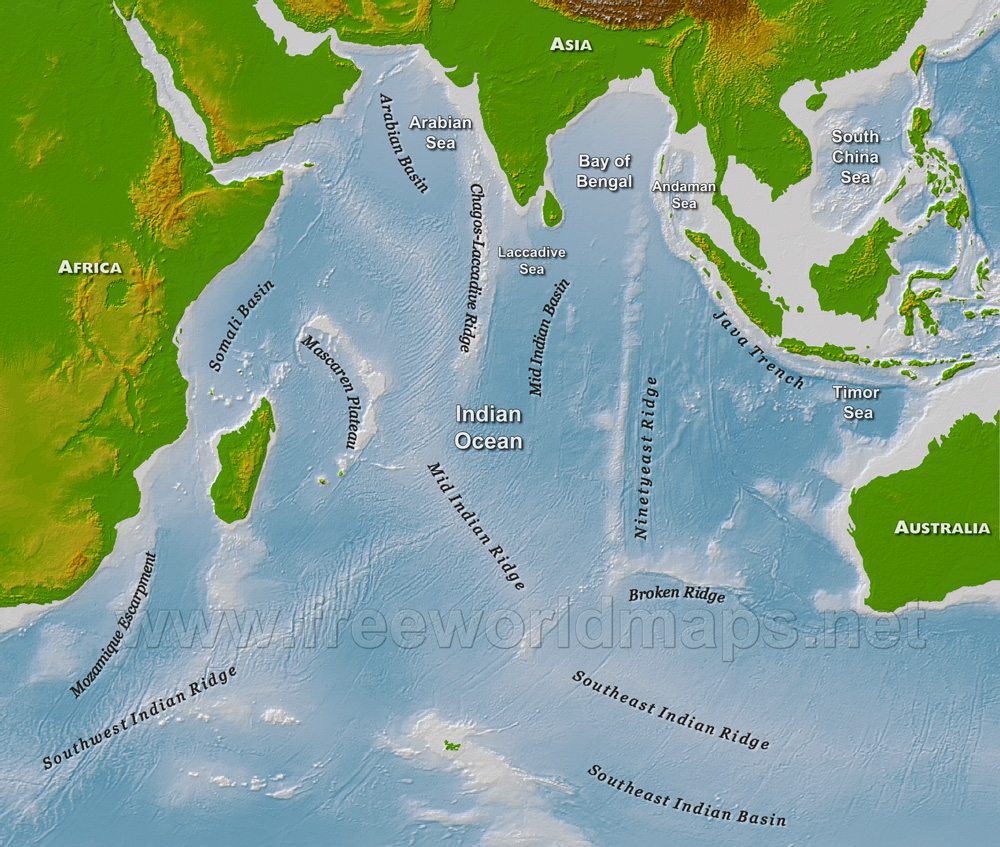
As we depart to cross the Indian Ocean, we thought we'd provide a little info about this major body of water we're intending to cross. According to Knoji Geography, the Indian Ocean “consists of 57 island groups or archipelagos, 16 seas or large gulfs, borders 16 African countries, 18 Asian countries and one Australasian state, and covers five submerged, oceanic ridges, five divergent tectonic plate boundaries and one Triple Point.” ...Wow!  

indian ocean map


  • The Indian Ocean is the third largest of the world's oceans, comprising approximately 20% of the water on Earth's surface.
  • It's the warmest ocean in the world.
  • The Indian's average depth is 3,890m (12,762ft).
  • Its deepest point is Diamantina Deep in Diamantina Trench at 8,047m (26,401ft) deep
  • An estimated 40% of the world's offshore oil production comes from the Indian Ocean.
  • The waters of the Indian Ocean provides the world's largest breeding grounds for humpback whales.
  • The Coelacanth, a fish which was thought to be extinct, was discovered in the warm Indian Ocean waters off the Comoro islands between Mozambique and Madagascar.


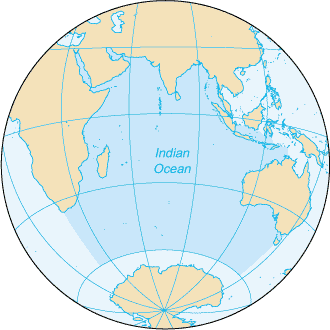
indian ocean globe map


  • The Indian is considered the world's only “closed” ocean because it's landlocked to the north by the Asian continent.
  • Because of its warm temperature, the Indian has the highest evaporation level of all the oceans and therefore the highest salinity (salt) level. This also accounts for the lowest level of marine life in all the world's oceans. (Maybe not much luck fishing as we transit, huh?)
  • TheRodrigues Triple Point, near Rodrigues Island, is a geologic triple junction in the southern Indian where three tectonic plates meet.
  • The Indian Ocean is known as Ratnakara in ancient Sanskrit literature, translating to "the mine of gems".

Standing Watch

david on watch  

Just about a year ago, I wrote a blog post about our watch schedules. At that time, I was looking for things nautical to write about, but we were actually in Boston caring for my mom and hadn't had a watch schedule (on the boat anyway) in many, many months. Now, here we are, having just done one overnight and preparing to leave Oz and head across the Indian Ocean. I thought it might be fun to resurrect this post and add a few changes because it's most appropriate at the moment.

First of all, whenever Nine of Cups is in motion, someone is on watch. One of us is either at the helm, in the cockpit with the helm on autopilot or, in inclement weather, sitting at the nav station below watching the radar. Even when the weather's bad and we are in the middle of an empty ocean, we still keep our eyes on the radar and pop our heads up every 10-15 minutes to take a took around. When the weather and seas are crappy, this is the uncomfortable price we pay for traveling by sailboat. In fine weather, this is a perk. Unless we're on an overnight passage in heavy shipping traffic, this is not a difficult task. You “watch” and make sure you don't hit anything, nothing hits you and Cups is on course and doing her thing. We both enjoy being topside … you can't beat the view.

There are as many different watch schedules as there are sailors out there, it seems. Nothing is “standard”. We've heard of one fellow who can't sleep during the day, so his partner stands watch all night long and sleeps while he's on watch all day. That certainly wouldn't work for us, but it works for them. We tried four hour watches, but found the middle hours interminable. We tried two hour watches, but the off-watch person doesn't get enough sleep. So, over the years, we've settled on three hours on watch-three hours off and this works for us. We rarely have extra crew aboard and manage just fine with the two of us.


david off watch


So, what does one do on “watch” during the night to pass the time when there's nothing going on? David has his own schedule. The first hour he plans his second hour meal. The second hour, he prepares and eats his meal. He reads sometimes or plays a game or two of Sudoku. The third hour, he cleans up and gets ready for bed. Some folks watch movies or play video games on their laptops. I don't usually eat, read or watch movies during the night … I sing. Oh, yes, I can sing to my heart's content as loudly as I please. I've got a whole repertoire to go through. I don't sing particularly well, but David can't hear me below and the fish don't seem to mind. On beautiful clear nights, when the sky is so full of stars there's not room for even one more, I can sit bedazzled by the wonder of it all. I've been known to talk to the moon at length on night watches. She rarely answers.

Of course, there are a few chores to do as well. We log our position, speed, etc. on the hour. We check radar and AIS regularly. We make sure we're on course or at least the best course for taking advantage of the winds and currents. One thing we do not do is sleep on watch. Many folks do. Obviously, that's how single-handed sailors sail. They set radar and AIS alarms and nod off. We feel more comfortable with one of us awake and alert and actually “watching” during our watch. We used to insist that our ship's cat, Jelly, keep watch, but she was unreliable.

Overnight passages and especially long passages introduce a new element to standing watch. Daylight hours are easy. Visibility is usually good. We're diurnal creatures and function best during the day. Night watches can be tiresome. You're by yourself, while your partner sleeps. Visibility is markedly decreased by the darkness. Radar works well, as does AIS, for identifying land masses and larger boats out there. But sometimes there's a lot of boat traffic, fast-moving ferry boats sneak up on you and you're not sure of their route or you don't know where those fishing boats ahead have laid their nets. Lobster pots drive us crazy sometimes. The positive thing about adrenaline rushes is that they keep you awake.

The worst passages for us are the 2-3 day variety. We're tired all the time, perhaps seasick, and then we arrive exhausted. We haven't seen each other because one of us is always sleeping. Longer passages allow us to get into the groove. Our bodies become accustomed to the odd sleep pattern rather quickly … for us 3-4 days. After that, we sleep soundly during our off-watch hours at night and only nap occasionally during the day. Not sleeping together at night is a bummer, but something to look forward to when we reach port again.

Very soon, we'll be standing watch for weeks at a time. Perhaps, you'll join me one night when I'm on watch? Stay tuned.