Crossing the Indian Ocean - Mauritius to Durban Days 11 &12

Durban days 11-12

Durban days 11-12

Day 11 Miles to go:  644 nm

So, you've got to ask yourself, what else can go wrong on Nine of Cups' infamous passage across the Indian Ocean? We certainly have been giving that question some thought ... between repairs. We didn't have to wait long before we had an answer. As David was taking a reef out of the main, the port reefing winch parted from the boom. I had the camera ready for another reason, but the "oh, shit!" look on his face as the winch came off in his hand was a true Kodak moment. Surely, Neptune is rolling on the ocean floor and getting his jollies about this one. David was able to re-attach it and it will be fine till we reach Africa. In the meantime, the repair/maintenance to-do list for Durban is lengthening much faster than we're sailing at the moment.

Rippled grey skies have been with us for several days now. Terns and white-tailed tropic birds wing by every once in awhile, mostly at dawn and dusk. They're noisy and announce their presence rather loudly, but so far none have stopped off for a rest or a chat.

And what's this? Winds, albeit light, in our direction with a helping current? It can't be ... We are gob-smacked!  Despite the change in winds and a little overnight motoring,  it all came too late to help our daily mileage ...  a whopping 68  nm.

A carton of milk evidently tipped over in the fridge unbeknownst to us until the sour stench about knocked me off my heels when I went to get milk for tea this morning. It's an effort to unload the fridge underway, but the stench-incentive made it a necessity. We got it all handled, washed out and wiped down with vinegar and re-stowed and did an inventory as well. I really need to use up those limes I bought in Mauritius.

Day 12 Miles to go:  546 nm

There's a two hour time change between Mauritius and South Africa which we haven't bothered with yet. The sun is rising closer to 0700 now and, correspondingly, setting later in the day which is kind of nice. The skies have been clear and sunny with nary a cloud to be seen in the pale blue sky ... sort of like daylight savings time. The barometer has been rising slowly and steadily. Unfortunately the winds have remained light, except when they're on the nose! The current forecast calls for another day of light winds, then stronger winds from the west ... our intended direction.

The crossing of the Mozambique Channel has been and continues to be a slow one. I look at the chart plotter at the beginning of each watch and it seems we've barely moved at all ... because, of course, we haven't barely moved at all. These usually lazy sailors are grasping at any wisp of wind that blows by.

We've been doing lots of reading and writing. David's working on a promised article for Good Old Boat. In addition to the passage blogs, I've been working on our holiday newsletter and have started an outline for a new book. We're staying out of trouble, but getting a bit antsy to get into port and start whittling down the to-do list which, if you've been following along, is getting rather unmanageable.

We've given up hope of getting to Durban by Thanksgiving. Now, we're hoping we make it by Christmas.

We’ll eventually get there! Promise! Continue on our long passage to South Africa.

Crossing the Indian Ocean - Mauritius to Durban Days 9 & 10

durban days 9-10

durban days 9-10

Day 9 Miles to go:   821 nm

Midst all my griping about weather and currents the past few days, a curious thing happened. As I was was sitting in the cockpit contemplating major topics like life and what we were going to have for dinner tonight, I spotted a furry moth flying over the solar panels and fluttering his way directly towards me. Wherever could he have flown in from? We're well over a hundred miles away from the closest land.

He whizzed by my nose, flew around my head once and then dove below, under the closed cockpit slider. He was very deliberate in his actions, as if he knew exactly where he was going and had a mission. This seemed all too much like Lassie communicating that Timmy had fallen in the well. I was compelled to follow.

It took awhile to find him. He had that grey/brown camouflage coloring going for him and the lighting below was none too bright. As if to say "Here I am!", he fluttered up again and lighted on the white mast. David was snoozing peacefully and didn't look to be in any distress; he certainly hadn't fallen down the well. I scooped up our winged visitor ... felt him wriggling in my hand ... and let him go outside with an au revoir, off you go.

No dice. He was back in a second, much like our stubborn booby hitchhiker of a few weeks ago. He determinedly darted below. I followed, but couldn't find him. I can only conclude he's tired and needs a rest or has heard I've got a couple of woolen sweaters below, prime for munching. Obviously, the passage is getting to me, huh?  ;-)

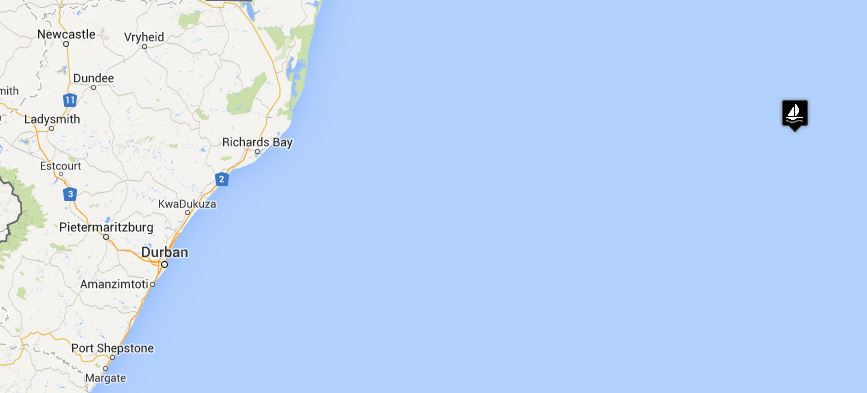
The going is slow under continued grey skies. We are still caught in the clutches of the adverse current and our choices are to go west or south to evade it. To the north about 100 miles is Madagascar and, of course, east is where we've come from. So far we've obviously not been successful in breaking its grip on us. Nine  days at sea and we're not quite half way there, but close enough to have Half Way Alfredo for dinner. The grey skies have greatly reduced our solar power intake and we've had to crank on the engine an extra hour or two each day.

About 0230 on my watch, I heard a light flutter and saw a shadowy wisp of wings fly over the starboard rail. The moth gave up on a free ride aboard Nine of Cups ...  he could fly much faster than we were sailing.

Day 10 Miles to go:  712 nm

Change of watch at 2100. I snuggled down in the sea berth. It's been chilly on night watch and the blankets were still warm from David's nap. David was letting out a bit more jib. I could hear the furling line go out and then the winch, trimming it up ... and then a lot of fluttering and luffing ... much more than expected. The flashlight beam bounced around on deck. My "what's going on?" question brought an unexpected response. "The jib halyard has parted!"

I turned on the spreader lights to get a better look and there dangling in the wind was part of the jib halyard, all frayed and parted. We managed to furl the jib. David let out the staysail and I went back to sleep. Repairs are always best kept till the morning light, if possible. Something to noodle about all night long.

The light winds continued till there was barely any wind at all. Not good for sailing, but good for taking down the jib and replacing the parted halyard with a spare one. I woke up groggy; David was ready to tackle the repair. The jib came down easily in a great mass on the foredeck with David's guidance. He cut off the old halyard and attached the spare using a halyard hitch (Clifford Ashley's Book of Knots comes to the rescue again!). We were set to go. Well, not quite.

David had noticed some chafe on the starboard sheet at the clew. It made sense to take care of it now. He shortened the sheet by a foot, whipped it and reattached it to the jib. Now, we were ready to go. Well, not quite.

I was at the bow, ready to guide the jib up the furler and noticed the collar on the furler foil was loose. David grabbed his tools, went forward and tightened it up. Good to go. Well, not quite.

Back in position at the bow, I noticed the orientation of the furler looked odd. Now what? David came forward, gathered more tools and set to work again. He discovered the furler cage had somehow worked loose and he wasn't sure what caused the misalignment, but he fixed what needed fixing. NOW ... We were ready to hoist the jib get underway again. Really!

We are just entering the Mozambique Channel. Pretty much out of the cyclone zone, but still at risk for South Africa's notorious Wild Coast "south-busters".

Continue on to Durban with us on our Indian Ocean crossing.

Weather Predicting...the old fashioned way

The Annapolis Book of Seamanship states “Clouds are the faces of weather”. In fact, they dedicate a section of their Weather chapter to reading clouds and another to reading the wind. As sailors, we rely on weather forecasts heavily, but we certainly take heed of clouds, winds and what the sky tells us, as well. There are all sorts of old seafarers' sayings that are good indicators of weather to come. One, in particular, I remember from my childhood and it is probably the best known of all ...“Red sky at night, sailor's delight. Red sky in morning, sailor take warning.”

It makes sense. As the sun is setting in the west, the sky becomes red when light passes through dust particles in the air. Dust is a sign of dry weather and since most weather comes from the west, a red sky at night indicates fair weather on the horizon. A grey sky at night indicates moisture in the air and rain is in the forecast. A red sky in morning signals that the dry air has moved away … also a signal of rain. Interestingly enough, even Jesus talks to his fishermen friends about this very phenomenon in Matthew 16.2-3: "When it is evening, you say, 'It will be fair weather, for the sky is red.' and in the morning 'It will be stormy today, for the sky is red and threatening." I'd say this old saying has some merit.


red sky at night


Then there's "Mare's tails, mare's tail make lofty ships carry low sails." These thin, wispy, high cirrus clouds called mare's tails arrive a day or two in advance of frontal systems … usually wind and rain. We definitely take note and check the weather forecasts. We know a change is on the way.


mares tales


“Mackerel scales, furl your sails.” A mackerel sky does, indeed, look scaly. These puffy clouds under cirrocumulus clouds often precede an advancing warm front …  backing winds and rain.


mackerel sky


There are several sayings about rainbows and weather, such as ... “Rainbow in the morning, gives you fair warning.” The sun rises in the east. If the associated rain that caused the rainbow is in the west, rain is coming your way.


rainbow over fiji


Predicting a squall is usually pretty easy. When we see dark clouds approaching and actually see the showers, we're pretty sure rain is imminent. The darker the clouds, the more violent the squall will be. We learned from the following maxim, that wind before the rain is better than rain before the wind. Shallow fronts pass quickly with rain on the backside. Deeper fronts and big depressions, however, are surrounded by bad weather and the rain usually precedes the big winds. Lucky for us no topsails … we just take a reef in the main.

When the wind before the rain Let your topsails draw again; When the rain before the wind, Topsail sheets and halyards mind.


shower


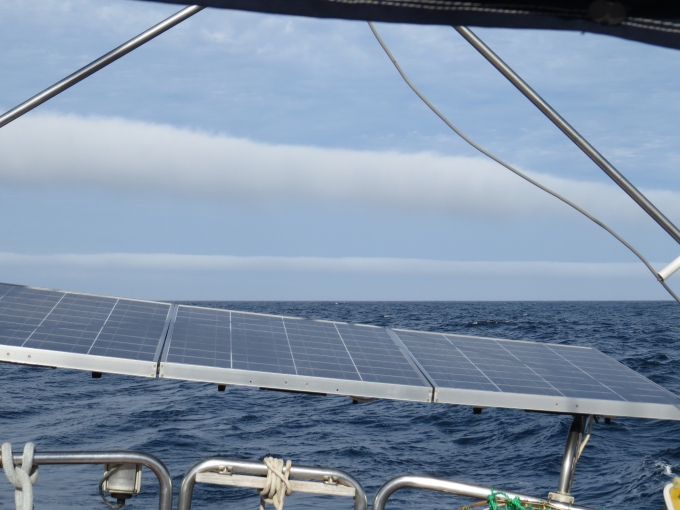
There are no sayings I'm aware of that are associated with rare roll clouds. According to Wiki, these are arcus clouds, low and horizontal tubes in the sky usually formed by outflows of cold air from sea breezes or cold fronts in the absence of thunderstorms. We've only seen them once, while crossing the Great Australian Bight,and that was enough for us. They were ominous looking on approach and each cloud (there were about eight of them in a row) brought severe squalls with several minutes of gale force winds. Not something predictable although if we saw them again, we'd know what to expect.


roll clouds over the bight


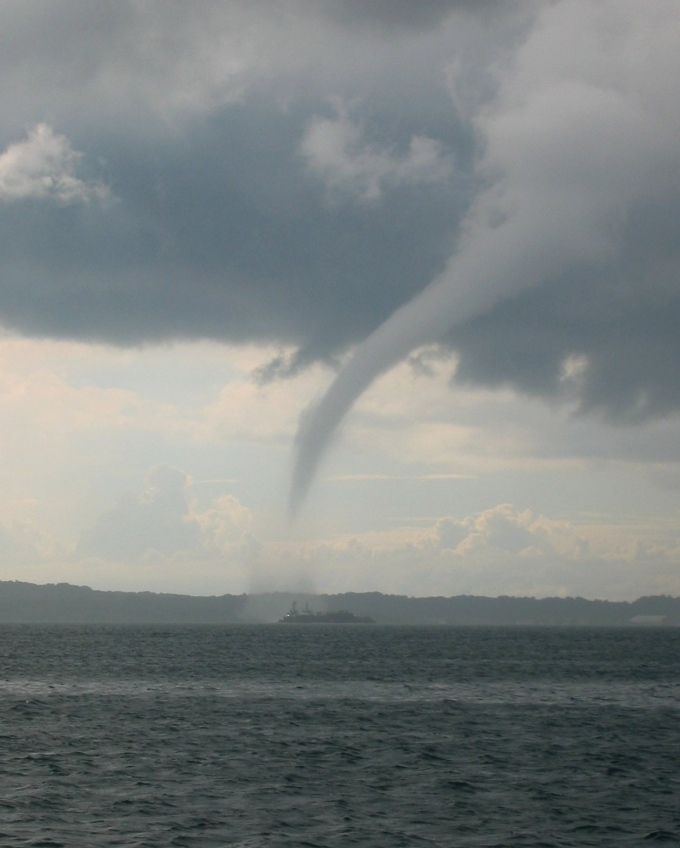
Like roll clouds, waterspouts (funnel clouds on water) are not predictable nor pleasant especially since they're usually associated with torrential downpours and thunder and lightning. Fascinating though.


waterspout


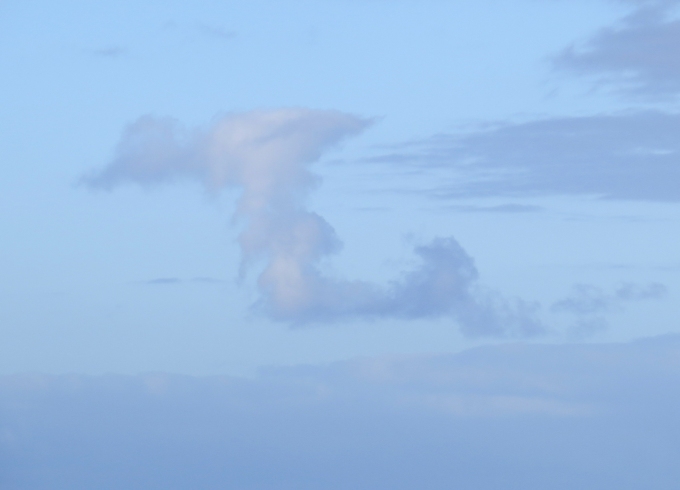
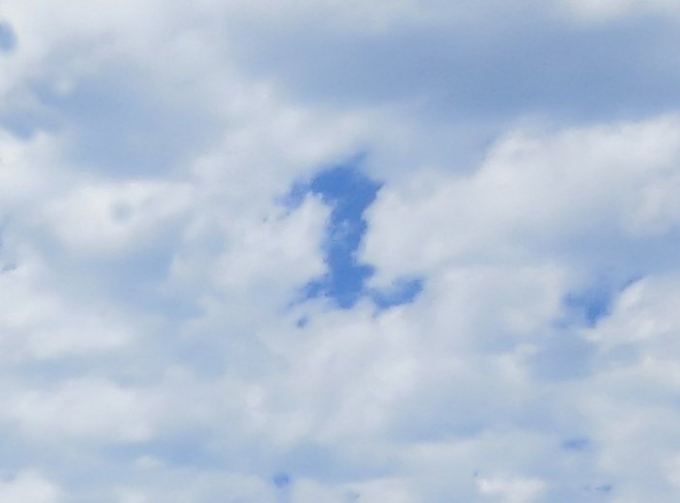
Of course, not all clouds are associated with weather … some just amuse us. Like the letter “L” for Lynn or Lucky.


letter l


or Nine of Cups … you're #1!  

number one