Arrival at Durban, South Africa

approaching durban

approaching durban

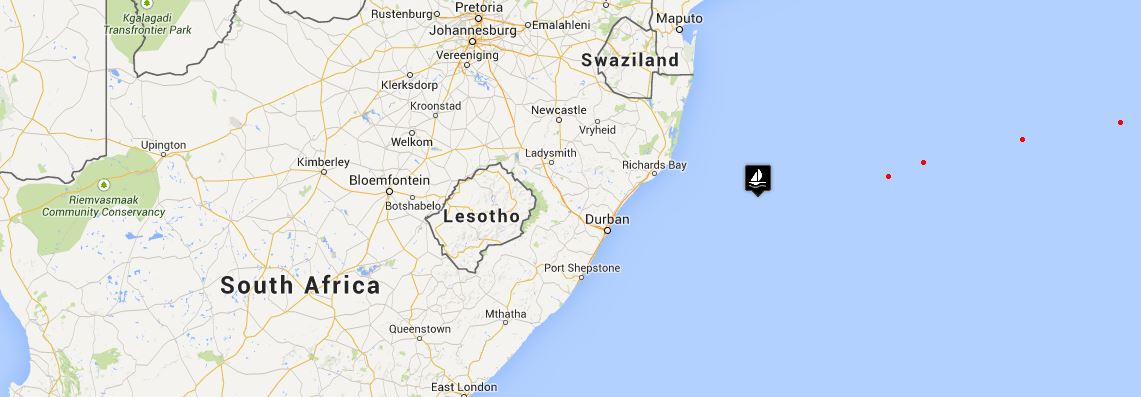
I can remember very few times when we have been more eager to get to port. The last 24-48 hours of the passage were horrendous, as if to minimize the days before. The winds and waves were right up there with the most we have seen at sea. Steady 40 knots of wind with gusts to 52+ knots and waves that crashed and thrashed us. There was no safe or comfortable place on the boat. We had to wait it out.

The weather forecasts were only minimally helpful and definitely underestimated the strength and wrath of Neptune. We had a triple-reefed main, but needed to lower the main entirely. A sail slide broke mid-way down the mast and we could get it neither up nor down. The poor main was thrashing itself to death. David, attached to the mast by his tether, worked the sail until his knuckles were raw and bleeding. Wave after wave broke over the deck. The wind was relentless. Finally, we managed to get the main down into the lazy jacks and lashed. We continued on with a handkerchief of a staysail.

We made reasonable progress until the wind backed to the northwest and then west. We were less than 60 miles from Durban now, but they would be hard fought miles. The torrential rain and lightning began soon after the wind changed. The night sky, bright with lightning flashes, looked like a colossal battle was being fought nearby. There was no rest and no respite for the crew. The wind and waves just kept on coming, knocking us down time after time. Things were airborne below that had been securely lashed. We thought of heaving-to, but without the mainsail, we weren't sure we could. Luckily, the staysail alone worked for us and we huddled below as Cups drifted northeast with the wind and current … surrendering the miles we had already made to the good.

On Marcie's watch, a fast change occurred. 40 knots from the southwest became 6 knots from the southeast and then the east . We cranked on the engine, and though the seas were rough, we made good progress. We could see the loom of Durban in the far distance. The AIS lit up with ships at anchor and in transit into and out of the port.

entering breakwater

entering breakwater

Around dawn, we hailed Durban Radio Control and received permission to enter the harbor and proceed to the International Jetty. The light winds increased to 35+ knots as we neared the port entrance. We could see the Durban skyline. We were so close. As we finally moved inside the relative calm and protection of the breakwater, we sighed in relief. We maneuvered our way past the large container and cargo ships. We spotted masts in distance.

maneuvering past cargo ships

maneuvering past cargo ships

By 0630, we were rigged for a starboard tie-up and making our approach to the jetty. To our surprise, two dockhands appeared out of nowhere to grab our lines.

cups awaiting check in

cups awaiting check in

Durban … at last. Time for a cuppa. Whew!

Crossing the Indian Ocean - Mauritius to Durban Days 15 & 16

to durban days 15 and 16

to durban days 15 and 16

Day 15

Miles to go: 239 nm

It's been a whopper of a 24 hours. Seas have been ferociously high in the 20' range and the winds have remained steady in the mid-30s, with gusts to the 40s, and both on the nose. Nine of Cups has been tossed and thrashed and pummeled and she's really taken some licks.

After a huge wave crashed over the bow, we heard a clanging forward that sounded like the anchor in distress ... not something that could wait till later despite the wretched conditions on deck. David always lashes the anchor tightly in place when we're on a passage, so something had definitely gone afoul. The lashing had chafed through. The intensity of the wave had yanked the anchor out of the chain stopper and our 80 lb anchor was hanging over the bow roller, banging violently against the bow. The shackle had slipped down the groove in the stock and the stock was now bent. Through sheer luck and persistence, David was able to slip the shackle back in place while hanging precariously over the side of the bow pulpit. He wrangled the anchor into position while Marcie engaged the windlass into action and we got it back aboard and secured into place again. We were soaked and freezing cold by the time we got back below.

Totally unrelated, David noticed a short time later that the indicator light for the fresh water pump was on and we weren't drawing any water. He wasn't sure for how long, but we subsequently found the starboard tank was empty. Bummer! A leak in the system somewhere, but conditions aboard were certainly not conducive to sussing out where. He shut off the pressure and will deal with it when the seas calm a bit. In the meantime,the port tank is still full and we can use the foot pump.

Oh, yes, and the wind gen tail is coming apart again. Go figure ... 35 knot winds and it's having a problem? Wuss!

And .... sigh ... My teakettle went airborne off the counter and ended up on the galley sole, water everywhere and big dents in its side ... battle scars. Perhaps, after nearly 20 years, it's time for new one.

All this and the most bothersome thing today? A miserable, incessant, niggling drip of water that emanates somewhere above the sea berth and finds just the right angle to fall and splat on our faces while we're trying to sleep. It's not regular ... about once very 4-5 minutes when the waves crash overhead. Chinese water torture. Grrr!

Day 16

Miles to go: 96 nm

So much for a very short-lived celebration and respite. As we get nearer Durban, Neptune is challenging us in a big, big way. As I was sitting in the cockpit this morning on my morning watch, sipping my cuppa, thinking all was right with the world, sailing along at 7 knots, the sails suddenly started luffing. It wasn't just a wave putting them off the wind, it was something more. The autopilot wasn't working. I switched to stand-by and manual steering, but the rudder did not respond.

About that time, David poked his head up. “What's up?” No steering ... and it wasn't the hydraulics. He headed aft, lugged our Franken-mattress off the bunk and dove under the berth to figure out what was going on. One of the bolts securing the steering quadrant had sheered off!

The sails were complaining in a big way. I tried to haul in the jib. The furling line was fouled. Evidently during the anchor drama, the anchor had hit the bottom of the furler guide cage and bent it. As we let out the jib after that, the line had fouled and now I couldn't get it in or let it out. As I headed from the bow back to tell David the bad news, a wave knocked me off balance and I fell into the dodger. Loose stitching gave way. One thing at a time. We let Cups self-steer close on the wind and went to sort out the steering quadrant issue.

We hauled out the emergency tiller and I kept the rudder in place while David finessed the rest of the broken bolt out. We were lucky it was accessible and came out as easily as it did. We found a replacement and with much persistence, got the steering quadrant back in place and the hydraulic pump purring again. Phew! Now to tackle the jib furler.

The guide cage for the jib furler was totally wrecked and the furling line was jammed tight. Once again, David's patience willed out and after over an hour of tugging, prodding and prying the furler line, we got it free. The cage needed to be removed, but the screws were seized tight. David managed to hack saw it apart, withstanding the waves on the bow. The jib was useable again, but with care since there was no furler guide in place any longer. What next?

The water leak and the wind gen are waiting patiently in line for attention.

Note: the link to the teakettle is an affiliate link and would make a very nice Christmas present for the tea-lover in your life

At last … our arrival in Durban, South Africa

Crossing the Indian Ocean - Mauritius to Durban Days 13 & 14

durband days 13 - 14

durband days 13 - 14

Day 13 Miles to go:  432 nm

I didn't provision well for this trip. We thought we'd be at sea for about 12 days. Normally, we'd plan on 100 miles a day and do better than that. Our experience thus far in the Indian Ocean, however, rendered us a bit cocky and overconfident and thus, we're running out of things each day we sail beyond Day 12. There's no danger of starving; we've got lots of food stores in the larder. It's just that we'll be going without some things I wish I'd stocked up on. This thought led to a cockpit discussion about the 10 Top Things Not to Run Out of on a Passage. Here's our list, not necessarily foodstuffs and not in order of survival importance, but as we thought of them.

1. Toilet Paper We do not have a Sears catalog aboard nor corn husks (although an old West Marine catalog might do in a pinch). Running out of TP is not even something I care to contemplate. We've got plenty.

2. Water Even though we have a watermaker, we make sure our tanks are topped off when we leave port and never let them get too low.We also have a small hand-operated water maker in our ditch bag for emergencies.

3. Fuel Yes, we are a sailboat although from time to time, we are a motor-sailer. Having enough diesel aboard is primarily important for running the engine to charge the batteries and getting into port and docking.

4. Propane The inability to cook while on passage would be a hardship. No hot food for days?  Ouch! We carry extra propane tanks on deck to avoid ever running out.

5. Eggs We use lots of eggs ... sometimes as an ingredient for cakes, etc., and sometimes as a meal in itself like omelets or scrambles. I underestimated our usage for this trip and should have kept better track of just how many we were using. We're running low and I have no one to blame but myself. As an aside, I can substitute white vinegar for an egg in many recipes, but scrambled vinegar just doesn't cut it.

6. Coffee/tea Just don't even talk to me until I've had my wake-up cuppa. In a pinch, I can drink coffee and David will drink tea ... but doing without both altogether? Perish the thought.

7. Pasta/rice Pasta and rice constitute a major part of our meals. Running out of either would definitely put a crimp in our menu planning and it would be hard to find a substitute once the potatoes were gone.

8. Flour We bake quite a bit during passages. Bread, cakes, brownies ... even pizza on occasion. Flour is an essential ingredient that would severely limit our baking activities.

9. Chocolate I never much cared for chocolate. David is in the chocoholic category. Over the years, I've grown to like it and David hasn't changed at all. A special treat en route is sharing a chocolate bar. It's a comfort food and provides a good attitude lift when necessary.

10. Patience/sense of humor Luckily, we did manage to provision heavily in this area. Keeping things in perspective and laughing when you can keeps the crew in good spirits and able to cope with most anything ... including each other.

Day 14 Miles to go:  362 nm

One thing we're not lacking today is wind. Be careful what you wish for, right? We were plodding along, poled out to port, when the wind started backing ... earlier than forecast, but evidently the wind gods hadn't gotten the memo. At the change of the 0300 watch, we switched the pole to the starboard side. We're getting pretty good at this maneuver, having done it so often recently. The actual changeover and re-rigging takes less than 10 minutes. It's furling the sails, jibing and then re-setting the sails that takes all the time. We've got about a 1 knot push from the current now, so we were tooling right along.

At the change of the watch at 0600, we were steady as she goes, still heading west across the Mozambique Channel. By 0700, the wind was continuing to back and I switched the jib from the pole to the port side and we were beam reaching with 15 knots from the NE. By 0800, I'd reefed the jib, but we needed to take a reef in the main as the winds escalated to the mid-20s. Reefing the main is easier with two people aboard Cups, so David's nap was cut a bit short. Based on the forecast, we double-reefed the main and Cups rode easier.

The barometer fell to 1009. The wind continued to build and backed to the north then northwest.  We clawed for every bit of westerly we could get, but when the wind finally backed to the west at 35 knots, we hove-to for several hours until the SW winds took over.  David fought his way to the mast and we took another reef in the main, doused the jib and let out a reefed staysail. We are making slow progress, but at least in the right direction.

The sky is a deceptively bright blue and the sun is bright, but the seas are roiling and angry ... all frothed up, spray flying everywhere. Huge waves are breaking over the bow. The wind is shrieking like a banshee, a high shrill keen that vibrates through the rigging and is sometimes unnerving. With so much wind and wave action, we are uncomfortable captives below deck although NOT seasick.

So ... that's our day. What's going on in your corner of the world?

Whew! We’re almost there. Stick with us and continue on to South Africa here.