Boston and Durban - Working Together

On this side of the world … While David's working hard on the boat in South Africa, it hasn't been all fun and games here in Boston, although what I'm doing definitely beats polishing stainless. Apart from socializing with my sister and friends, my jobs have been to write and publish the Christmas newsletter, get Christmas cards and gifts sent out to family and, the hardest part of all, gather together boat parts and bits to transport back to Africa. This is not always as easy as you might think.
computer

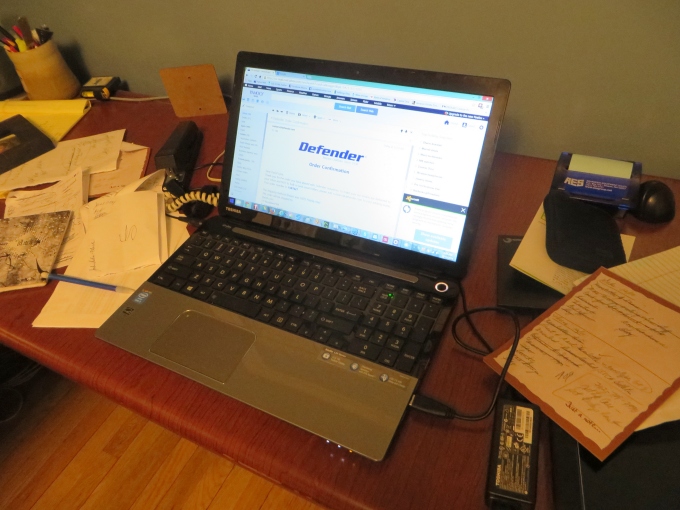
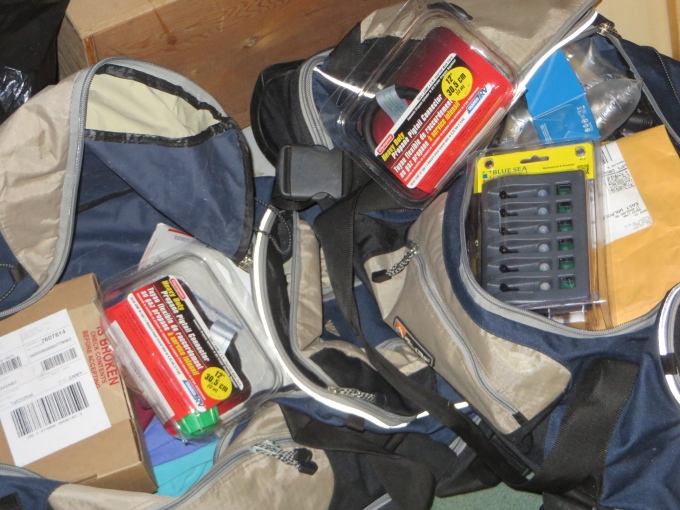
In many cases, David has specified and ordered parts online and had them delivered. I just have to accept them, make sure they're what was ordered and figure out a way to get them all packed into two duffel bags and still have room for my underwear. Despite the fact I have internet and a car at my disposal, it's been hard locating some of the parts and quite time-consuming.

A “for instance”? An o-ring for the windlass. We purchased a windlass back in August in Australia, if you'll remember. Evidently an o-ring was not seated properly when we received it and got squished and subsequently broke after a couple of uses. We had purchased a repair kit ($150) which included one o-ring among other bits, but now we've used it and wanted a spare. Well, they're not to be found. I've gone to plumbing supply stores, hardware stores, Home Depot, Lowe's. I'm still on the prowl, but it's been a challenge. In the meantime, the clock is ticking and the duffels are quickly filling up.
the duffels are filling up

On the other side of the world ...

Here in Durban, I have been under the gun doing a lot of time critical stuff. There are many very skilled people here – machinists, sailmakers, canvas fabricators and other tradesmen. In addition, the rand is soft against the dollar right now, and we are finding the cost of getting things done is quite reasonable, especially compared to what things cost in Australia. So, the to-do list is longer than just the needed repairs. We are getting a new staysail, new bimini and dodger, and perhaps new upholstery below.  I also plan to attach a generator to the prop shaft so we can generate power as we sail. This has been on my list for a long time, and I now have the opportunity to get the necessary brackets and fixtures made.

A complication is that most of the local businesses and their suppliers close shop over the Christmas holidays, more or less from Dec 15th to as late as Jan 10th. Many of the smaller businesses and the individual tradesmen don't all take such long vacations, but they may not be able to get the materials they need during this period. So I have been working at getting drawings made and parts on order before the summer holiday begins.

part drawings

I also need to get the parts on order for Marcie to bring back. Everything needs to be received by Dec 24th, and I don't want to wait until the last minute and have to pay for expedited shipping.

In between these things, I've been knocking off a few items on the repairs list... the anchor shaft has been straightened, most of the whisker pole repairs are done (I'm waiting on fabrication of a part), the alarm/indicator panel is done, the jib halyard has been replaced, as well as a host of smaller tasks.

I also drank my last bottle of home-brewed beer last night. Fortunately, I had enough ingredients for one more batch, and it is brewing as I write. It will be ready for bottling in a few more days and drinkable in another week or so, but in the meantime, the yacht club bar is only a short walk away where the ambiance is pleasant, the yachties friendly and the beer is cheap.

beer brewing

Highlights (or Lowlights) of a Most Challenging Passage

We're not sure that this was the worst passage of our sailing careers, but this 1,778 nm passage definitely rates right up there (or down there) as one of the most arduous and difficult passages we've experienced. As with most passages, there were ups and downs, good days and bad, gear failures and successes in repairing what broke while under way. As I reviewed the pictures we took, there were certainly more repair pics and hard times than there were birds and sea critters. It was that kind of passage. We continually promise to give you a taste of what sailing is really about. This is it. Leaving Mauritius – There are two happy days for the Nine of Cups crew … when we arrive in a new port and when we leave for the next one.

leaving mauritius


Where's Reunion Island? We were only four miles offshore, but the French kept it hidden in a shroud of mist.

that's reunion island


Beautiful sunsets were rare on this trip.

rere beautiful sunset


The skies were often deceptively blue and beautiful, while the seas were rough on Nine and Cups and crew.

rough seas blue skies


The wind gen took a beating and David worked hard to keep it operational and pumping out amps.

fixing the windgen


A moth stopped by for a rest, but soon grew tired of our slow pace and headed off on his own.

moth hitching a ride


The parting of the jib halyard was an unusual occurrence and totally unexpected. Luckily, the spare halyard was ready to go.

parted jib halyard


No sooner was the jib halyard issue sorted out and handled, than the port boom reefing winch broke free from the boom. Really?

boom reefing winch


Being without a rudder on a boat is liking driving a car without a steering wheel. When a bolt sheered off the steering quadrant, we were adrift until David was able to suss out the problem and replace the bolt. I promise to stop complaining about all those extra bolts and bits and pieces aboard.

replacing broken bolt


The continual thrashing we took from waves, took its toll on the anchor. Despite the chain stopper and lashing, the anchor pulled out of the bow roller. We lassoed it and secured it, but not before it flipped up and cracked the jib furler guide cage. It needed to be removed, but a screw on the cage was seized, so David resorted to hacksawing it off.

sawing off broken fuler guide cage


We saw over 52 knot gusts as we neared Durban. A sail slide broke and jammed as we tried to lower the main, causing the sail to flail in the high winds and we were unable to move it up or down the sail track. David's persistence willed out and we finally got the main lowered and lashed, but not without battle scars on David's knuckles.

knuckles after a fight with the mainsail

And then … we were on the dock in Durban and washed all the bad memories away with a hot shower and a bottle of celebratory champers. That's how it is after a bad passage: a long list of to-do's and views towards the next port.

Arrival at Durban, South Africa

approaching durban

approaching durban

I can remember very few times when we have been more eager to get to port. The last 24-48 hours of the passage were horrendous, as if to minimize the days before. The winds and waves were right up there with the most we have seen at sea. Steady 40 knots of wind with gusts to 52+ knots and waves that crashed and thrashed us. There was no safe or comfortable place on the boat. We had to wait it out.

The weather forecasts were only minimally helpful and definitely underestimated the strength and wrath of Neptune. We had a triple-reefed main, but needed to lower the main entirely. A sail slide broke mid-way down the mast and we could get it neither up nor down. The poor main was thrashing itself to death. David, attached to the mast by his tether, worked the sail until his knuckles were raw and bleeding. Wave after wave broke over the deck. The wind was relentless. Finally, we managed to get the main down into the lazy jacks and lashed. We continued on with a handkerchief of a staysail.

We made reasonable progress until the wind backed to the northwest and then west. We were less than 60 miles from Durban now, but they would be hard fought miles. The torrential rain and lightning began soon after the wind changed. The night sky, bright with lightning flashes, looked like a colossal battle was being fought nearby. There was no rest and no respite for the crew. The wind and waves just kept on coming, knocking us down time after time. Things were airborne below that had been securely lashed. We thought of heaving-to, but without the mainsail, we weren't sure we could. Luckily, the staysail alone worked for us and we huddled below as Cups drifted northeast with the wind and current … surrendering the miles we had already made to the good.

On Marcie's watch, a fast change occurred. 40 knots from the southwest became 6 knots from the southeast and then the east . We cranked on the engine, and though the seas were rough, we made good progress. We could see the loom of Durban in the far distance. The AIS lit up with ships at anchor and in transit into and out of the port.

entering breakwater

entering breakwater

Around dawn, we hailed Durban Radio Control and received permission to enter the harbor and proceed to the International Jetty. The light winds increased to 35+ knots as we neared the port entrance. We could see the Durban skyline. We were so close. As we finally moved inside the relative calm and protection of the breakwater, we sighed in relief. We maneuvered our way past the large container and cargo ships. We spotted masts in distance.

maneuvering past cargo ships

maneuvering past cargo ships

By 0630, we were rigged for a starboard tie-up and making our approach to the jetty. To our surprise, two dockhands appeared out of nowhere to grab our lines.

cups awaiting check in

cups awaiting check in

Durban … at last. Time for a cuppa. Whew!