Checking Out is Hard to Do

If you think breaking up is hard to do, you've never tried checking out of a South African port. We're not leaving the country, just moving to the next port, but it's still a major undertaking. For those of you who are considering the cruising life, this is a lesson in patience, beyond waiting for weather windows or tradesmen. all the paperwork
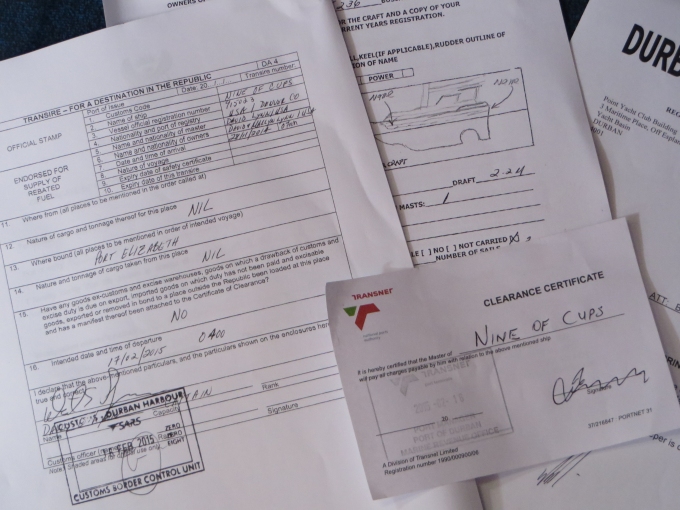
We inquired  at the Durban Marina office what the procedure for check-out was. She smiled knowingly and began compiling a sheaf of papers to be completed. “Fill these out and bring them back.”

No problem, I thought, until I got back to Nine of Cups and gave them a good look. Port Authority required a float plan which included the usual boat info, crew list and last ports of call, but they also required a sketch of the boat along with many other of the boat's vital statistics (four pages worth), all radio frequencies monitored and much, much more. Mind you, we'd provided most of this information when we arrived.

The Customs form centered upon our cargo. How much were we carrying? What cargo had we dropped off and how much were we hauling out? Really? As in many countries, visiting sailboats are treated like large commercial vessels and the paperwork reflects this.

We completed all the forms and returned to the office. Adri had prepared our final marina bill, as well as a calculation of port fees … a R25.80/day charge for being in the marina beyond 30 days. We paid the marina bill and got a receipt. The port fees, however, could not be paid in cash or with a credit card at Port Authority. It needed to be deposited to the proper account at the Standard Bank in downtown Durban, which of course required us to walk downtown, wait in line and make the deposit (in cash) at the bank and obtain the receipt.

customs house

From the bank, we walked to the Port Authority. The fellow wasn't there, but we were invited to sit and wait for him. About 15 minutes later, he arrived, reviewed the receipt, stamped a couple of forms and told us to proceed to Immigration with our passports, and then to Customs and then return to his office … and we'd better hurry because all the offices close at 4pm.

Immigration asked when we had arrived … end of November. They lugged out a file box full of completed forms and sorted through them until they came across Nine of Cups' original entry paperwork. They reviewed our float plan, made a copy and then reviewed our passports … no stamps, just initials and a date on one of the pieces of paper we were hauling around. They instructed us to go to Customs.

The Customs fellow was friendly, but new. We gave him our completed form which he reviewed with another co-worker. He made several copies, then signed off on another form. We were then instructed to return to Port Authority.

We trudged back over to Port Authority who assembled all this paperwork, stapled it together and added it to the the piles on his desk. He stamped our clearance form and bid us a good afternoon. Done! The bad news? This is the procedure at every South African port we sail to … probably a few more forms and stamps will be required when we actually leave the country.
Waiting for a Weather Window

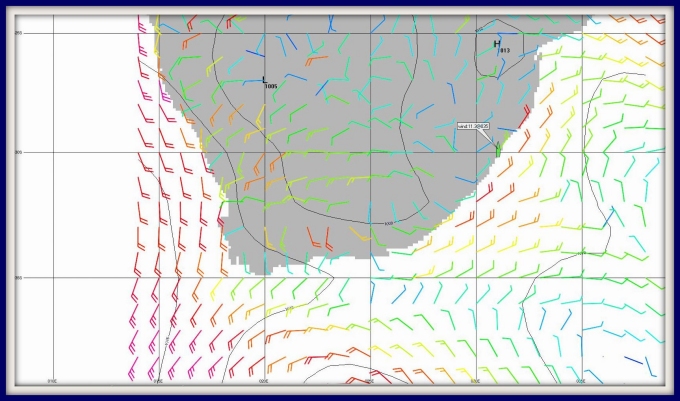
We've had several delays in leaving ports before, some much akin to our delays in leaving Durban. We had repairs to make, but South Africa closes down around the holidays for a couple of weeks, so things weren't as streamlined as we'd hoped. We planned to leave in mid-January, but our sails weren't finished, nor was our bimini or dodger … nor the saloon upholstery. David was still working on several “A-list” projects subsequent to my returning from the States with boat parts. We took off for a land trip and returned. grib weather

Then February rolled around. The new staysail was complete and the Yankee and jib were repaired, but the bimini and dodger were still not finished, although they were close to completion. Brennan and Hannah visited for a couple of days, then the bimini and dodger were done at last and we were ready to take off. Alas … no weather windows. Looking at pilots and Jimmy Cornell's World Cruising Routes, January through March are the best times of the year to make the transit from Durban to Cape Town. Patience is a virtue when it comes to waiting for weather windows. We've said it many times before and at the moment, we were practicing it … waiting for a good window to leave Durban. In fact, it seems like we've been waiting forever, but the windows that have appeared have been elusive and much too short. At last, however, our patience was rewarded with a short, but adequate window to sail from Durban as far as Port Elizabeth, about 390 nm away. We checked the forecasts religiously and waited hopefully . At last … a real window appeared and then it was high-stress rush, rush, rush.

We hurriedly provisioned. A resident cruising friend took us to Liberty Liquors and Mozzie's Butchery and the biggest Pic'n'Pay hyper-supermarket we've ever seen. We loaded up on everything we'd need and we were ready to go. We don't have much time left on our visas, so we provisioned as if we were heading across the Atlantic.

provisions everywhere

We paid up at the marina and checked out of Durban port. In South Africa, it is necessary to check out of and into every port … not so different from a few South American countries, actually. This is a saga to be told another day.

We stopped in quickly at Tony Herrick's new shop and picked up a copy of his South African Cruising Notes, something we'd planned on doing much earlier, but forgot till the last minute. Tony is a local cruising guru with lots of sailing experience and several cruising guides under his belt. He's also the SSCA Cruising Station Host, and he took the time to share his knowledge of the passage from Durban to Cape own with us.

david and tony looking at he cruising guide

Five boats are scheduled to leave with this window, all hoping that the window doesn't disappear with the morning's weather forecast or worse yet,  mid-route. We'll see how it goes. Tune in tomorrow for “Checking Out is Hard to Do”, a popular cruiser's lament in Durban.

What's in a Name?

7 things to think about when naming a boat

Wandering along the piers in the marina, we were wondering about the names of some of the boats. Some are obviously personal like Miss Victoria or the Lady J. Some reflect the intended use of the boat like fishing boats named Reel It In or Hooked. Then there are the foreign names that sound exotic like Bonita or Ciao Bella, which would lose a bit in translation. A boat named Pretty or Hi, Beautiful, doesn't sound quite as exotic. Then there are those folks that like to name their boats after fictional characters like Hobbit, Ivanhoe, Spartacus or Zazu. Our discussion gave rise to some considerations when choosing a boat name.

zazu

1. Does the name suit you and the boat?

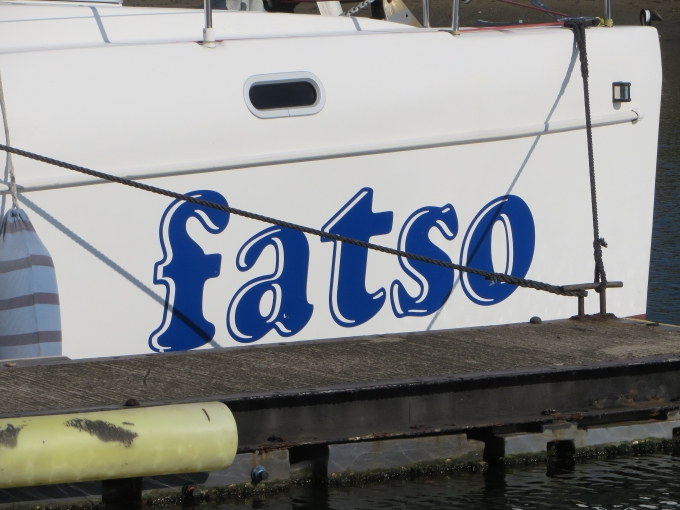
Some names are just not good for boats. Names like Perfidious (untrustworthy?) or Titanic, for instance, just don't seem appropriate. We think of Nine of Cups as a part of our own persona and the meaning of her name, “dreams realized”, reflects our feelings about sailing around the world. We could only speculate about the boats named Skitzo, Fatso and Bandit.

fatso

2. Is the name too common?

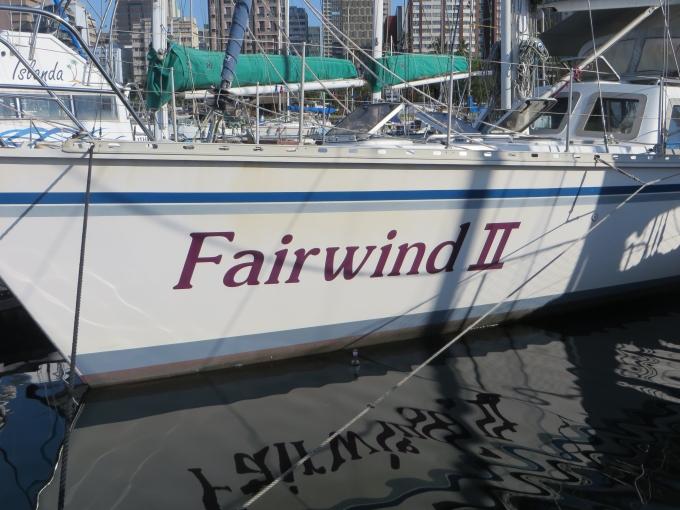
Some names are very common for boats. Do a search to see how many other boats have the same name as the one you're thinking about. It's preferable to be unique without being too weird or cutesy. In some countries, two boats are not allowed to have the same name and therefore, 1, 2, 3, etc. is used after the name or the home port is added to distinguish it from others. Waverunner II of Portsmouth, for instance. It seems that any boat name with sea, wave, dream or wind in it is pretty much overused.

fairwind 2

3. Is the name too cutesy?

Some folks go out of their way to be cute when naming their boat, but remember you're going to have to live with the name for a long time. Clever is good; cutesy, not so much. Some examples we saw recently that were on the cutesy side: Reely Nauti and Fanta-Sea

reely nauti

4. If you're planning to go abroad, how does the name translate into another language?

We had friends who named their boat “Tata”. For them, this meant goodbye, as in tata for now (TTFN). To others it means “thanks”. It's also a slang for breasts in Spanish. They got a few snickers when they pulled into Central American ports. You might remember the story about Ford Motors naming a car “Nova” which translated to “no-go” in Spanish or the perfume named “Night Wind” which means fart in some places. Make sure the boat name translates well into other languages and cultures if you intend to travel to foreign ports.

5. Is the name easy to say and is it easily understood on the radio?

May Day, Help Me, and Goin' Down are not good choices for obvious reasons. We do have problems with Nine of Cups on occasion. We've been called Cup of Nines and Nine of Clubs among other things.

6. Is it easy to spell?

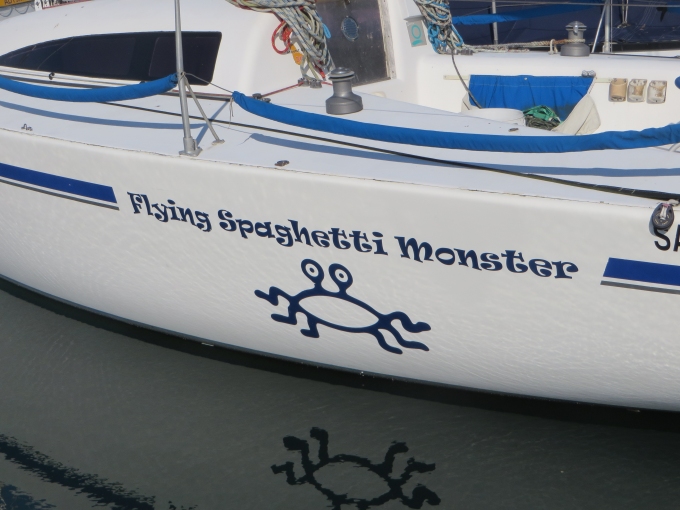
Long names are an issue when you're spelling the name over the radio for the Coast Guard, for instance. If you travel abroad, you will be spelling it frequently using the phonetic alphabet. Nine of Cups gets to be a bit tedious when spelling it out. November, India, November, Echo (new word) Oscar, Foxtrot (new word) Charlie,Uniform, Papa, Sierra Most people want to quit after “NINE”.  The marina winner in this category is Flying Spaghetti Monster.

flying spaghetti monster

7. Are you superstitious?

If you're the least bit superstitious, as many sailors are, you'll want to do a little research about naming your boat and the ceremony involved. If you're changing the name of your boat, then you're in for a de-naming and a re-naming ceremony in order to ensure that you and your boat remain in Neptune's good graces.