Down South Africa's Wild Coast pt. 2

A Wild Ride Down the Wild Coast

The day started out peacefully enough as we raised the mainsail in the bay and began our passage to East London. There were light winds from the south/southwest as predicted and we motor-sailed, looking for the Agulhas Current that would provide the push we needed to get down the coast quickly. The Durban coastline receded into a haze and disappeared behind us as we made our way south.

hazy durban coastline

The prevailing southeast swell was 2m and a long period, but the southwest waves were short and close, making for a bumpy, unsettling ride. We were glad we'd taken our Stugeron. We had expected rain, but sailed under unexpectedly, pleasant, sunny skies. The light southerlies persisted long into the afternoon before turning southeasterly. We ventured out past the 200m contour to about 25nm offshore finding a max of only 2-1/2 knots of current. We wandered back to the 200m contour about 12 miles offshore and settled for 8 knots of speed (5.5 knots motor-sailing against light SW winds + the current) which would put our arrival at East London precariously close to the end of our favorable weather window … IF the weather window stayed true to forecast.

All the usual malfunctions cropped up immediately after three months of not sailing. The handheld auto-pilot remote wasn't working. The chartplotter was fickle … sometimes working, sometimes not. David sorted through the problems and one by one and got them handled as best he could. The chartplotter, for instance, was working fine, but would not display AIS results, so we had to rely on the VHF for AIS data. In general though, the day was uneventful and replete with naps, until nightfall. Then, as dusk rolled around and darkness enveloped us, things started happening.

First, the current increased to 3-4 knots, then the wind direction finally changed to ENE. This was a good thing. We shut down the engine and did an easy 9 knots with the single-reefed mainsail alone. The wind continued to back and increase until we were nearly downwind. The current increased to 5 knots. The crescent moon hid behind thick clouds and we sped ahead at 10 knots, then 11, then 12. The rain began, visibility decreased, and the AIS began chirping. We hadn't seen another boat or ship all afternoon, now they converged on us as if heading to a freighters' convention. The wind changed more northerly. We jibed and altered course a bit.

freighter coming out of the mist

The wind freshened to 25-30 knots. Downwind that's not usually an issue, but in retrospect we should have reduced the main and poled out with a reefed headsail at that point to better balance the boat. We didn't. When the winds increased to a sustained 40 knots, combined with following seas, we decided it was time to take another reef. Before we managed to accomplish this however, an unexpected 50 knot blast from the north and huge following waves caused a series of unfortunate events.

50 knots on the guage

We jibed first one direction, then back the other, causing the main to flog violently. A sail slide snapped and then another. Ping, ping, ping, ping like dominoes … until the mainsail clung precariously to the mast with only a few sail slides left to hold it. In the rain and wind, we managed to corral the mainsail in the lazy jacks and get it down and lashed. In the process, a batten snapped when it slammed against the spreader. We continued on with the staysail, still maintaining 11-12 knots. When dawn appeared, we were tired but still on track for an early arrival in East London.

broken sailslides

The shore was mostly huge sand dunes which seemed to merge with the sea until we spotted the East London skyline around 1200.

dunes along the coast

We headed for the breakwater at the entrance to the Buffalo River. With permission from Port Control, we entered the harbor and passed huge car carriers loading and unloading at the busy dock. By 1430, we were anchored peacefully in the river behind moored boats at the Buffalo River Yacht Club across from Latimer's Landing. We broke an all-time record for the most miles sailed in Nine of Cups in 24 hours … an impressive 214 nm. Keep in mind, that's with motor-sailing and up to a 5-knot current to help us along. We were glad to be in East London and very, very tired.

east london breakwater

There were repairs to do, but for now … sleep … we just needed some sleep.


Down South Africa's Wild Coast Pt. 1

Goodbye, Durban

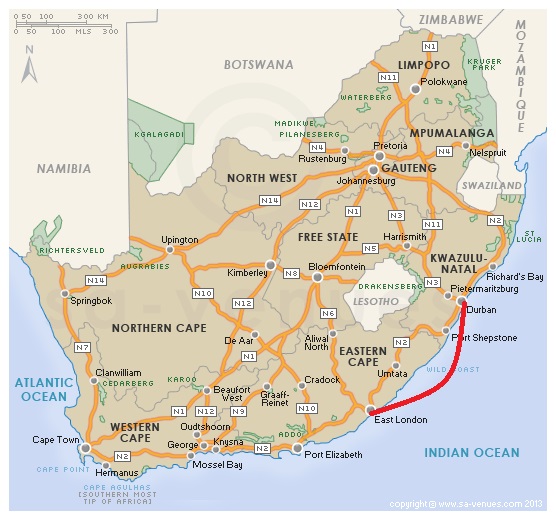
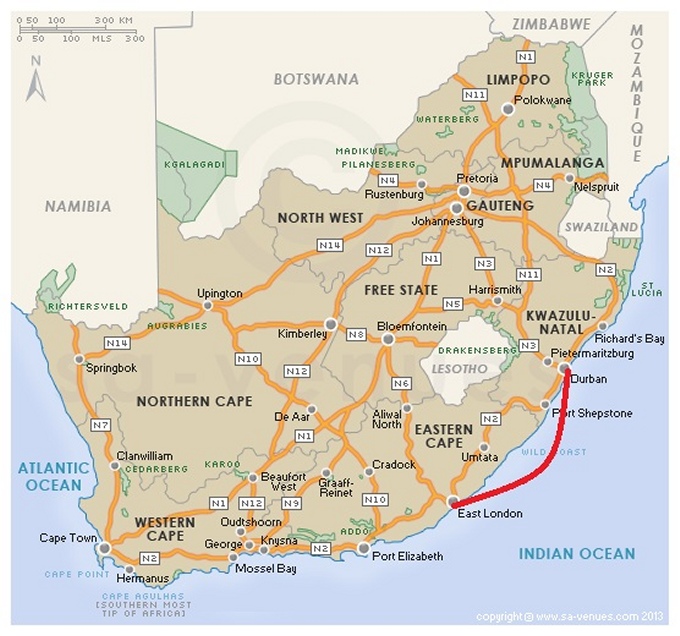
There are more than 2,000 shipwrecks, dating back at least 500 years, off the South African coast. The Wild Coast is a section of coastline between KwaZulu-Natal (Durban) stretching south to the port of East London in East Cape and it's claimed more than its share of ships. Several ships simply vanished without a trace. The sail from port to port is about 265nm and there are no safe havens in between. Hence, the reason we sought local knowledge and we were keen on waiting for a reasonable weather window of at least 2-3 days.

east london 265 nm

east london 265 nm

The south-setting Agulhas Current narrows between Durban and East London and can run at speeds of up to 6 knots where it flows over the 200-meter (650') contour line at the edge of the continental shelf. It can obviously be an awesome push for southbound boats like us, but there are some serious caveats as well. When the wind kicks up from the southwest, which it does with regularity, it blows directly into the current, creating giant breaking waves described in Tony Herrick's cruising guide as abnormal. The local pilot describes them as appalling. Both seem to be masters of understatement. Monstrous freak waves "of up to 20 metres (65 feet!) in height, preceded by deep troughs, may be encountered in the area". The long and short of it? Don't get caught in the Agulhas Current when a southbuster hits. Unfortunately, southwesterly gales blow here frequently.

great waves

great waves

Locals advise patience. Forget about deadlines getting from one port to another. Wait for the right weather forecast. If, however, you happen to be passage-making and the wind switches suddenly from northeast to southwest, which it can do in a matter of minutes, head for shore. Once out of the opposing current/wind situation, the waters tend to be calmer and the waves dissipate. Heave-to, if necessary, and ride it out. Needless to say, we're approaching this passage with some trepidation.

durban to east london

durban to east london

We'd been watching the weather all week. Thursday looked good … then it didn't. Saturday night looked promising, although it appeared we might be motoring against light southerlies for the first few hours. At this point, burning a few gallons of diesel seemed reasonable. For the third time, we made the rounds of the bank and all of the pertinent authorities. They knew us on sight. The procedure seems to change every time we check out, but we were cleared and good to go at the end of two hours.

We had a farewell dinner with Wind Wanderer at the Royal Natal Yacht Club. They weren't quite ready to leave yet and cruisers never know if they'll see each other again, so we celebrate when we can. We made an early night of it, took our Stugeron and headed to bed for a restless night's sleep. We were up at 0400 to check the weather and emails one last time. The weather window was short, but still reasonable. We cast off and slid out of our berth just before 0600 into the millpond-smooth marina waters. The sky was just pinking up as we kept company with fishing boats, motoring across the calm harbor past huge, docked freighters, out the entrance canal and into the bay. We were in the Indian Ocean once again, heading southwest for East London and points beyond.

Here’s Part 2 of our passage down the Wild Coast to East London. Brace yourself for 50kt winds and wild seas.

goodbye durban

goodbye durban

Waiting with Friends

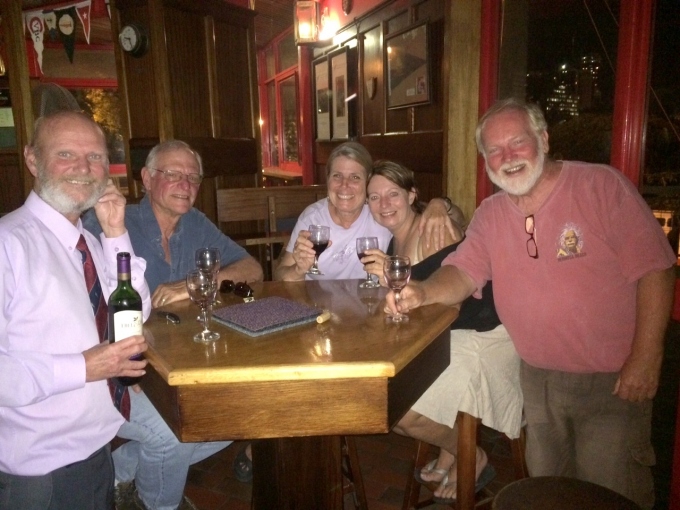
There's Dinner with Friends and Words with Friends. We are Waiting with Friends. Waiting for a weather window is a lesson in patience, as we've reiterated so often, but it isn't quite so bad when you're doing it with friends. We met Vic and Sandy aboard Wind Wanderer way back in the Cocos Keeling Islands. We saw them again in Mauritius and both boats ended up at the Durban Marina at the end of last year. We enjoyed some pre-Christmas activities together and then, like us, they had repairs to do, headed home for a bit and did some inland traveling. Now we are waiting together for that elusive weather window to leave Durban and head to Cape Town. Though each boat makes its own decision when to leave, if the weather window is good, most boats leave around the same time and, by default, travel in loose company. That's Vic and Sandy to the right. fun with wind wanderer

We've shared several evening meals at the yacht club with the Wind Wanderer crew. Mid-day coffee on one boat or the other isn't unusual nor is a quick stop to chat about this or that. Sandy and I shared a cab to nearby Davenport Square to take advantage of a larger, better-stocked Checkers supermarket and Dirk's, a good meat/poultry market. We've exchanged info on weather resources and commiserated about repair issues and bad passages. We've talked about sewing machines and pressure canners and canvas work and heat exchangers and a myriad of other topics we have in common over sundowners. It's a pleasant way to play the waiting game.

We'd been watching the weather religiously twice each day and listening to the PeriPeri Net each morning. At 72 hours, we were finally looking good for a weather window. At 48 hours, all was still good. We checked out 36 hours in advance of departure with the same reasonable weather window forecast although the window had shortened from 2-1/2 days to 2 days. The tedious check-out procedure was the same as last time, but it seemed easier since we knew the routine and where to go. We topped up the provisions and loaded more freshies aboard. An early check-out allowed us a leisurely day before departure. At 24 hours, the weather window was shrinking a little more. We needed about 36 hours to make it the 265nm to East London. 12 hours prior to departure, the forecast was iffy and our weather sources disagreed as to when the wind would shift from northeast to southwest. We left the decision till morning.

map durban to east london

We use several weather sources, but weather forecasting is obviously not an exact science. At 0500 on the morning of departure, it was calm and showed signs of being a nice day on the Durban end. The GRIBS, Buoy Weather, one of the Predict Wind models, Passage weather and Wind Guru all agreed that the wind would change to 25 knots SW (on the nose) by early the next morning. One of the Predict Wind models called for a mid-afternoon change … still too short, even if we believed it. The local AcuWeather was calling for heavy rains and a southwesterly wind by mid-morning in East London. Prudence prevailed. The PeriPeri net agreed. Our weather window had disappeared. Passage canceled. This is how it goes sometimes.

Sigh! Back to the waiting game ... with friends.