Making Plans...Changing Plans

now what In the words of John Lennon “Life is what happens to you while you're busy making other plans.” We make plans and change them all the time. Do you?

One thing about living on a sailboat and cruising full time, there are too many decisions to make. Too many plans to make and change and make and change again. Sometimes because life happens; sometimes on a whim. This time, it's because we need to take care of some necessary repairs to Nine of Cups. We'll be spending a good part of the winter months in southern Africa.

Ever since David determined that the chainplates were suspect and needed replacing, we've been making plans. In fact, every evening we make plans with the daily information we receive and quickly change them the following morning when new information comes to light. Will we do the work here in Cape Town or move someplace else? Will David do the work or will we have some of the work done? What's the cost? No, that's not right, you're missing something … now what's the cost? Does that include hardware and supplies? No? now what's the cost? The frustration grows as does the number of decisions to be made and the cost, but we're sorting it all out.

One question, of course, is where do we go after the work is done? It's nearly winter here in South Africa, but our visas are expiring once again, as is the Customs permit for Nine of Cups. We can't stay in South Africa and by the time we arrive in the States, hurricane season will be upon us. So … what are the options?

where to

Well, we can spend some time along the Namibian coast (the next country up from South Africa on the west coast), then dawdle at St. Helena and Ascension and head to some place in the southern Carib, like Trinidad, for instance, which is out of the hurricane belt. We considered Brazil, but Americans visiting Brazil pay hefty fees for visas (reciprocity, I'm sure) and friends currently in Brazil are not enjoying the high costs nor the security issues nor the bureaucracy. Europe's always an option, especially with the Euro nearly at par with the US$. So … no decisions on that front yet.

There's no sense in making firm plans at the moment. There are too many what-ifs and not enough  information to make informed decisions. And quite honestly, even if all the answers were in place … we'd probably change our minds anyway. Stay tuned. We'll keep you updated on the boat repair progress and let you know when it's time to head out. You know you're always welcome to come along for the ride … wherever we go … or stay.

A Round versus Around

After arriving in Cape Town, we had to review our track and actually convince ourselves that we had indeed completed a bona fide circumnavigation … and we had. Rounding of the Capes, however, required more review than we'd previously given it. It might be a question of semantics, but we're embarrassed to say that we may not have rounded all of the five great capes after all. We have rounded four of them, but we sailed “around” Cape Horn like most yachties do. We were unaware of the “rules” regarding a rounding of the world's southernmost cape. cape horn

Upon researching "rounding the Horn", I found some conflicting  information. Wikipedia, for instance indicates that a rounding of the Horn “is traditionally understood to involve sailing from 50 degrees south on one coast of South America to 50 degrees south on the other coast, the two benchmark latitudes of a Horn run...”. Though it's not perfectly clear, we think this means crossing the latitudes at 50 degrees in both the Atlantic and Pacific. Well, we'd been at 50 south on the west coast (Gulfo de Trinidad, Chile in the Patagonian Archipelagos) and 50 south on the east coast (heading north up the Argentine coast from Ushuaia to Mar del Plata), perhaps we had rounded the Horn.

Around Cape 50DegreeMap

Then I stumbled upon the  IACH website (International Association of Cape Horners) and their eligibility criteria. “The Horn rounding shall be part of a non-stop passage of at least 3000nm and shall pass through fifty degrees south in both Pacific (or Indian) and Atlantic Oceans … under sail.”  They also added that that Cape Horners must “have rounded Cape Horn in a commercial sailing ship in trade.” Well, we definitely didn't qualify in this regard. Obviously, these rules are not for yachties and we don't qualify to be Cape Horners.

Looking at the websites of several commercial passenger boats that ply the Cape Horn waters, many mention “rounding the Horn”, but can you trust an advertisement for adventure seekers? Are they really “rounding the Horn”? Certainly, our trip around Cape Horn was a bit more dramatic than being on a cruise ship or a crewed passenger vessel, but the question remained … was it a round or around?

We think the true criteria for rounding Cape Horn is probably sailing from 50 degrees south from the Atlantic to 50 south in the  Pacific (or vice versa) … non-stop and outside the protection of the Patagonia and Tierra del Fuego archipelagos. With this criteria in mind, Joshua Slocum never rounded the Horn aboard “Spray” (though he did manage it twice sailing on a commercial vessel). Nor did Magellan in 1520 make it nor did Sir Francis Drake round the Horn in 1578, for that matter. They both took the shortcut through the Straits of Magellan  … and still they named the Drake Passage after Sir Francis. Go figure. It wasn't until 1616, when Dutch explorer and navigator Willem Schouten rounded and named Kaap Hoorn that the Cape was rounded for the first time. Our hero, Captain James Cook, managed it from both directions. What a guy! Nine of Cups and crew, however, did not.

Around Cape Horn

So, readers and fellow sailors, we didn't mean to lead you astray or boast about accomplishing something that we'd really not done. Nostra culpa … but sailing “around” Cape Horn will have to suffice.

A few notes about what we're NOT entitled to...

A sailor that rounds the Horn can wear a gold loop earring. Tradition has it that the earring should be worn in the ear that faced the Horn as it was rounded. I actually bought a gold earring for David at the time which he never wore. Good thing, huh?

Another amenity offered to sailors who've rounded the Horn is being allowed to put one foot on the table. If they'd rounded the Cape of Good Hope, too, they were allowed to put both feet on the table. I don't see this as a big privilege, but that's just me.

We're also missing out in the tattoo department because true Cape Horners can have a fully rigged ship tattooed somewhere on their body parts. Just as well we didn't do this because at our ages, our tattoos would  probably look like sinking ships.

A Bona Fide Circumnavigation

CircumDef NOCMap It seems there are some strict criteria for actually completing a bona fide circumnavigation … and we thought it just entailed sailing around the world and “tying the knot”, i.e. crossing your track. It seems it's much more complicated than that.

For example, Guiness states that:

A true circumnavigation of the Earth must:

  • Start and finish at the same point, traveling in one general direction
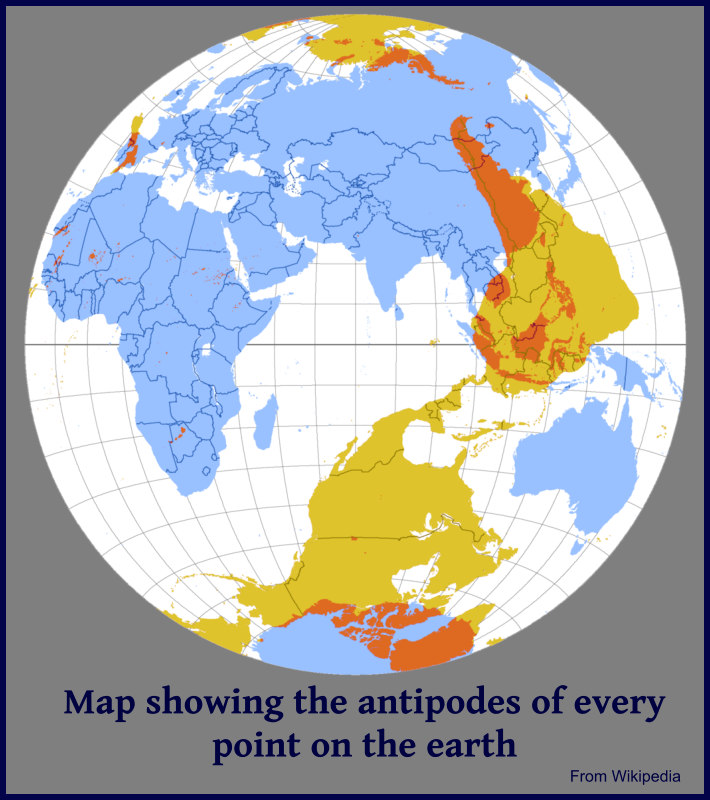
  • Reach two antipodes (antipodes are two points on the Earth that are diametrically opposite each other, i.e. a straight line drawn between the two points would pass through the center of the Earth)

From the above, it follows that a true circumnavigation must:

  • Cross the equator a minimum of two times
  • Cross all longitudes
  • Cover a minimum of 40,000km or 21,600nm (a great circle)

Francis Chichester, the famous British sailor who completed a solo circumnavigation on Gypsy Moth in the 1960s, the Explorers Web Adventure Stats, and many others use the same criteria. The World Sailing Speed Record Council uses a slightly different criteria, however. They state that the vessel must start from and finish at the same port, cross all meridians of longitude, cross the equator, and travel at least 21,600 nautical miles. Each leg must commence at the exact point where the previous finished off (meaning the legs cannot be completed out of order). They have no requirement to reach antipodal points.

CircumDef AntipodesGlobe

I know – this is way too much trivia, and why do we care anyway? We care because a circumnavigation is an achievement, and it is human nature to attempt to set records accomplishing it. Who was the fastest? the youngest? the oldest to circumnavigate the globe? And to set a record circumnavigating the globe, there must be a definition of what constitutes a circumnavigation. While sailing around the world via a route entirely in the Southern Ocean would be an admirable feat, the distance traveled would be well under 10,000 nautical miles, less than half the distance of a great circle of the Earth, and it is not reasonable to call this a true circumnavigation.

Some interesting circumnavigations:

First circumnavigation: Juan Sebastián Elcano and the remaining members of Magellan's crew. They set out with 5 ships and 200 men in 1519, and returned to Spain after a west-about circumnavigation with 1 ship and 18 men who were barely alive. Maybe this was also a record for the highest crew attrition rate for a circumnavigation?

First solo circumnavigation: Joshua Slocum on Spray in 1898. He actually had four sets of antipodal points on his trip.

First nonstop solo circumnavigation: Bernard Moitessier. He was a participant in the 1968 Golden Globe Race, but dropped out of the race, deciding to continue on to Tahiti and not return to the finish line in England. While he didn't finish the race, he circled the globe 1-1/2 times, and actually closed the loop for a circumnavigation before the race winner, Robin Knox-Johnson.

Most amazing: Jon Sanders who completed a non-stop, solo, unassisted triple circumnavigation in 1988. He was alone at sea for 658 days. Wow!

So how did we stack up? Was our trip around the world a bona fide circumnavigation? Here are our particulars:

  • Starting and ending port: Cape Town, South Africa
  • Distance required: 21,600 nm; Distance sailed: 47,409 nm
  • Equator crossings: 2
  • All longitudes traversed
  • Antipodes: Florida to Panama 12 Jan 2008 – 0820   14 degrees 43 min N/ 80 degrees 05 min W Fremantle to Cape Town 21 Sept 2014 – 0300  14 degrees 43minutes S / 99 degrees 55 min E
  • Direction: Generally west-about

noc circumnavigation

It took us eight years and we certainly didn't set any records (although if it took us much longer, we might have qualified as either the slowest or the oldest circumnavigators). While our meandering route encompassed more than double the distance required, I didn't find a record for the longest sail around the world, but probably no record there either. By any definition, however, it was a bona fide circumnavigation … accomplished by sailing just a little further.