A Lofty Invitation

Having had a new staysail made by Ullman Sails in Durban last January and thus far really liking it, we felt very confident that ordering a replacement yankee from Ullman in Cape Town was a good move. The existing yankee had caused us lots of problems over the last few years and repairing it again seemed like money down the drain. David reminded me that the old headsail was over five years old and had seen over 20,000 hard miles … southern New Zealand, the Chathams, Tasmania, the Great Australian Bight, an Indian Ocean crossing. I had hoped, of course, it would last forever, but then I still believe in the Easter Bunny. ullman sails

We didn't know much about Ullman Sails. We're familiar with North Sails, the largest sailmaker in the world and then there's Quantum and Doyle and Hood Sails and Rolly Tasker Sails and a host of others. Ullman is actually the #5 sailmaker in the world, thanks to renowned American competitive sailor David Ullman. He started Ullman Sails in 1967 in Newport Beach, California and has been intimately involved in the business ever since. In 2013, Ullman combined forces with previous competitor, Jannie Reuvers Sails in South Africa. Ullman Sails is represented in 32 countries of the world, including 42 full service sail lofts. This means that if we have problems with the yankee, as we did with our previous sail, we have some recourse for service.

ullman sails locations

A good number of  Ullman's sails are made right here in Cape Town. We'd become friendly with our sales rep, Winston, over the past couple of weeks and when he offered to give us a tour of the loft, we jumped at the chance.

ullman sails facility

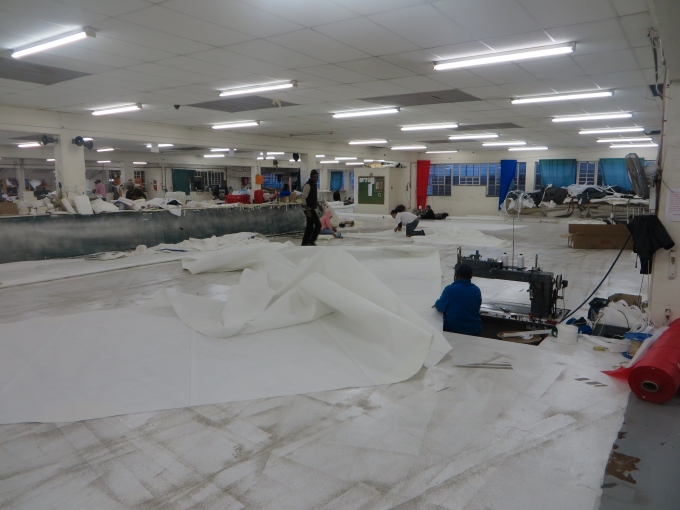
We've visited many sail lofts over the years … usually small ones. They consist of wide open floor spaces with canvas spread out in varied stages of  in-process sails. A couple of long arm, heavy-duty zig-zag sewing machines are recessed into the floor to allow easy stitching of the sails. Rolls of Dacron and colored Sunbrella UV-material are lined up along the walls. Scraps of fabric are here and there and the place is usually dusty, the hum of sewing machines and the tap of hammers providing background noise. We weren't quite prepared for the size of Ullman's facilities nor the number of people working nor the number of sails in process. It doesn't look like much from the outside as we pulled up over the curb and squeezed ourselves into a tiny parking space. Looks can be deceiving.
huge sail loft

Ullman Sails' facility is huge and spread out over a city block in several buildings. We visited four multi-storied buildings and each area was a beehive of activity. After a digital design is set, the measurements are entered into a laser-cutter which works constantly, precision-cutting and numbering panel pieces for  each sail.
sail assembly

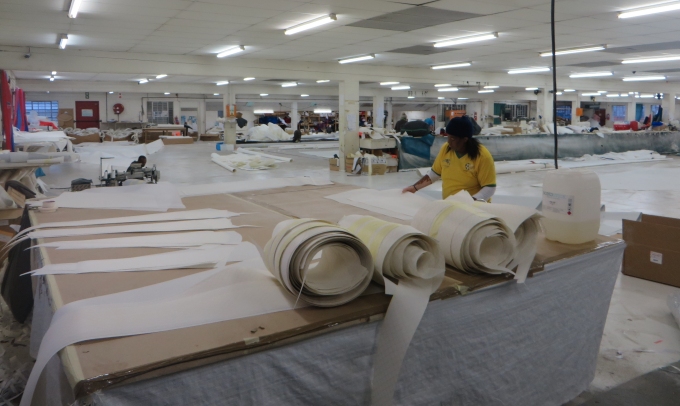
The cut pieces are removed in order and moved to an assembly area where they are spread out on the floor, taped and ready to be sewn. UV is added later, then hardware in a different area and finally quality control is performed. I've oversimplified the process significantly, but that's the gist of it. A smooth, efficient work flow producing thousands of sails each year.

lofty_guys sewing

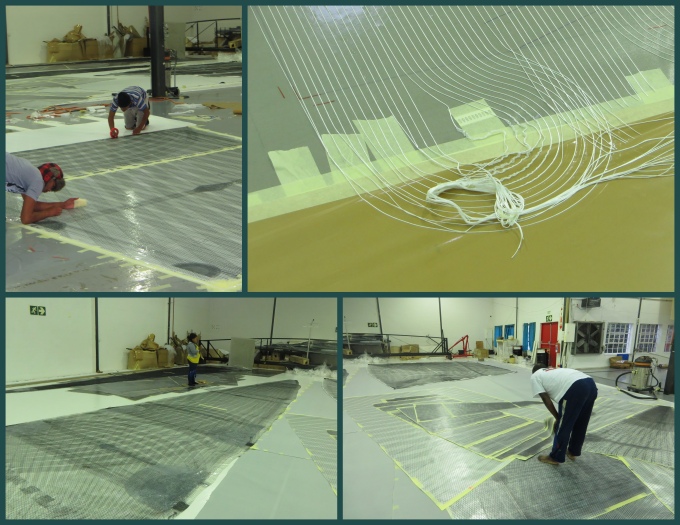
We were intrigued with their FiberPath sail construction: thousands of carbon fibers woven into a sail shape and then bonded and double-laminated. There's minimal sewing involved. There is little stretch and the primary and secondary loads on the sail are dispersed more effectively. These sails are known for speed and performance … not traits for which Nine of Cups has ever been known. The cost? Though we felt we were getting a good price for our sail, it was still quite painful to the budget. Our yankee in a FiberPath material would have effectively been a little over double the price. We'll stick with Dacron this time around.
fiber path technology

Winston has assured us the sail will be completed in the specified timeframe. As much as we like Cape Town, we're looking forward to the day when we can sail away … with our new sail.
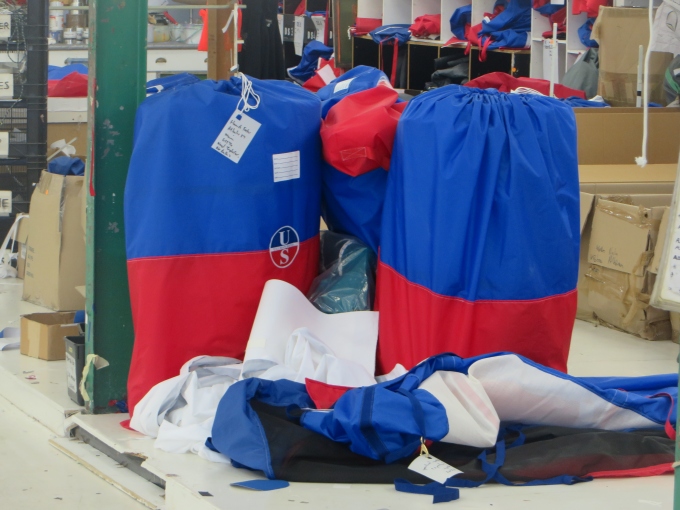
sail bags

Sorting Out the Problems

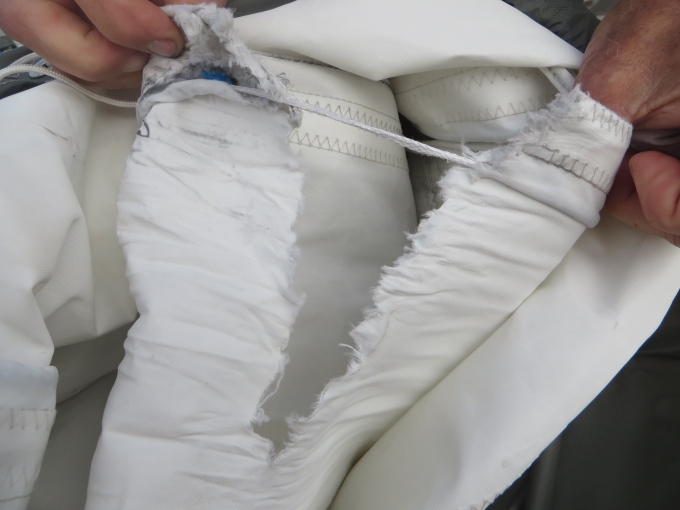
We returned to Royal Cape YC with three problems: 1) tear in the yankee, 2) alternator not charging and 3) cockpit GPS not working. You'd think with all the work we'd just done and the systems checks we'd made before departure, we'd have discovered all the problems in advance. That's not the way it works on a sailboat though. When she hasn't been sailing in a while, rigor mortis sets in, and things just stop working. Connectors corrode, wires get brittle, parts seize … mainly from lack of use in a salt-water environment. The malfunctions are usually discovered once we're at sea. We were aware of a small tear in the yankee sail caused by the break in the furler foil. We'd gotten a quote from the local sailmaker, but he was backed up and couldn't make the repair before our visas expired. We didn't have time to wait, so we repaired it ourselves with the thought of getting a more permanent repair in Luderitz. We obviously thought we'd done a good job, but evidently not and now we were paying the price. We were in touch with the sailmaker again. He took a look at it, now in worse condition than he'd originally seen it. Though he could repair it, he recommended a whole new sail … 4-6 weeks. We've had so many problems with this yankee, we've decided a new sail is probably the most prudent course. We ordered it from Ullman Sails (formerly Quantum) with the condition that they complete it in less than three weeks … not longer. They agreed to put our sail on the fast track. They've already picked up the old sail, as well as taken measurements. One problem handled.

torn sail

David is sorting out the alternator problem. It's nothing obvious … not a loose wire nor a pulley belt issue. We only know that the batteries aren't being charged when the engine is running. More investigation is required. You'll be hearing more about that in the next day as he troubleshoots the alternator.

alternator

The GPS problem is probably due to a corroded connector since it sits in the cockpit all the time. It also requires more investigation. We have several other GPSs aboard, but this is our back-up and we want it functioning when we leave.

In the meantime, we're tied up once again in Berth B25 at the Royal Cape Yacht Club, whinging and moaning and trying to get our heads around being back in port instead of en route to Lüderitz. Updates to follow.

frustrated homer

Out and Back Again

We slipped out of our berth at oh-dark-thirty into a cold, inky, wet, windy morning. It doesn't get light here till 0730 now and we wanted to be on our way early. We didn't sleep well in anticipation of our new passage. We were all bundled up in layer upon layer of warm clothing with a topper of offshore foul weather gear and we could still feel the chill. I coiled the lines and stowed them in the forepeak locker along with the fenders as David wended our way out of the marina. We wouldn't need fenders and lines for awhile. I had the bottle of rum handy to offer a tot to Neptune as soon as we were under way. bottle o rum

We hoisted a double-reefed mainsail in the calmer, protected waters of Duncan Docks and headed out the channel into Table Bay. As we let out the yankee and a gust caught it, I noticed that the tear in the luff I had recently repaired had torn out again. We cranked in the headsail, started the iron jenny and headed back in. Sailing across the Atlantic without a useable headsail obviously didn't make sense and Cape Town is the best place to make repairs. It was then, as we were motoring back in, that David noticed we were not getting a charge current out of the alternator. Then, the cockpit GPS just stopped working. Yet more problems  to investigate. I rigged up the just-stowed fenders and lines and we reluctantly headed back into our very same berth at Royal Cape. The increasing wind made tying up in the dark a challenge. Not an auspicious start to our passage.

torn sail

Cancelling our departure meant we needed to recheck in with Customs and Immigration … not a pleasant thought since our visas are expiring within a couple of days. We waited till the staff at Royal Cape arrived and explained our plight. They immediately wrote a letter for us describing our problem and sent us on our way to see the officials assuring us that there had never been a problem in the past extending visas for unforeseen boat problems. We had no idea what the officials would say, but we were hoping for a reprieve that would allow us to make the necessary repairs. Maritime law allows the boat to stay in port if it is not seaworthy. In other words, we can't be forced to leave port with a problem such as ours, but how understanding the officials would be and how much time would be allowed was another issue.

passport stamp

Well … the officials weren't very understanding at all. We trudged the mile back to the Immigration office and were told: “The boat can stay. You must leave.” Really? Our choices: 1) leave on the boat immediately; 2) extend our visas for a total of 7 days to complete repairs and then leave (not enough time); 3) leave Nine of Cups at RCYC and fly back to the USA (our country of residence) to extend our visas.

Now what to do? We returned in the evening to speak to a supervisor. He listened to our story and pondered his alternatives. Our stomachs were in knots as we waited for his final decision. Finally, with some reluctance, he stamped our passports and allowed us another 30 days. We sighed with relief as we headed back to the yacht club. Whew!