Searching for a Land Anchor

Land anchors … those things that keep you tied to the land when you're at sea. David didn't include them in his anchor book, but they're very real. When we decided to sell up and sail off back in 2000, we sold our home, furniture, cars … all those material things that kept us tied to land. We wanted no mortgages, no property taxes, no cars, no storage pods with furniture… and we were quite successful. Our family has been wonderful for nearly two decades, offering bed, board and storage whenever we show up … for a week or a month or sometimes longer. Now, we're thinking we'd like a place of our own to nest once in awhile. Yup, we're looking to buy a land anchor. After 16 years afloat, we need a place to store our souvenirs. anchor and house

We've been out of the market for a long time and things have changed. Duh! For instance, getting pre-qualified and/or pre-approved for a mortgage loan ...you can do it on-line. In fact, they almost insist you do. You just spill your guts, including all your financial intestines, to a loan specialist via “chat”, whom you've never met and could never hope to meet. Before you know it, you're pre-qualified. We felt uncomfortable with that process and asked for a face-to-face sit-down with a loan officer at a bank we've dealt with for a couple decades. The bank, too, preferred an on-line or telephone interview, but we insisted and they acquiesced. We're definitely old-fashioned that way, I guess. It was a waste of time. We were on time and he was late and unprepared. No problems getting the approval, but we knew more than the “loan specialist” did … plus he forgot we were the customers. Grrr!

Searching for a place to live? Easy enough … whether we're interested in a house, condo, mobile home or desert property, we can shop on-line for that, too. That process, though exhausting, we've kind of liked. We don't have to deal with aggressive realtors too early in the game. We've decided that Las Vegas would be a good place to have a condo. David's mum and sisters live here. There's no state income tax. It's easy and relatively inexpensive to travel here. And, at the moment, property values are reasonable and mortgage rates are low. We figure it's better to invest in real estate than let our savings stagnate in a next-to-no-interest bank account or lose its value in the volatile market.

anchor sign

It turned out that once we found a place we wanted to look at, however, we couldn't get a realtor to call us back. Must be too many realty sales in Nevada to bother with us. Mary finally contacted a fellow she knew and, by default, he became our agent. The place we liked was not available, but he had more to show us. We provided our general criteria: location somewhere near Mary, bargain price, lots of square footage, no yard to maintain, but a private patio for a grill, beautiful grounds and views, facing east (morning sun, you know), several self-cleaning bathrooms, all top-of-the-line appliances included, low taxes and low or no HOA fees. We didn't think we were asking for much. He wasn't able to find one to show us until we compromised on our criteria a bit.

We've seen a couple of properties now, but we think this will be a slow process which is okay because we're used to traveling on a sailboat. Of course, once we buy a place, we'll want to buy a car and furniture and “stuff”. It's almost depressing! And if we don't find a place we like, what then? Well, life will go on and we'll look again another time or another place, maybe. The big question you ask … do we intend to swallow the sea anchor once we acquire a land anchor? NO! We figure we've still got quite a few good sailing years left in us and there's still lots to see out there. Stay tuned and we'll all see how it all turns out.
US Customs & Border Protection & Us

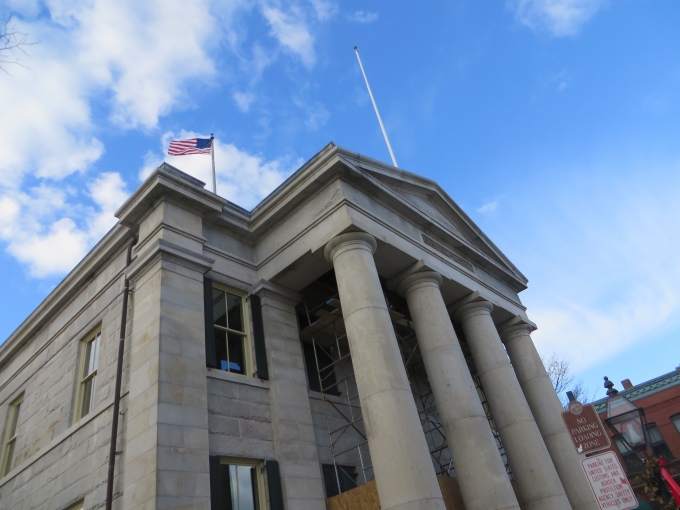
historic custom house in new bedford The last time Nine of Cups entered US territorial waters was in 2007. It was a non-event. We tied up at the Charleston Maritime Center. The marina called Customs/Immigration for us and two officers came to the boat within an hour, chatted with us for a few minutes and we were good to go. The rules have changed, however, and since we intend to sail back to the States sometime in the near future, we thought we should be prepared.
Pursuant to 19 CFR 4.2, “The master of a pleasure boat must report to U.S. Customs and Border Protection (CBP) immediately upon arriving into the United States from a foreign port or place and must provide a formal vessel entry on CF 1300 within 48 hours. He will also need to … result in civil penalties as defined … to include a penalty of $5,000 for the first violation and $10,000 for each subsequent violation with the conveyance subject to seizure and forfeiture. In addition to being liable for a civil penalty, the master ... is liable for a fine of not more than $2,000 or imprisonment for one year, or both.” CBP … formal entry … CF1300 … fines … penalties … seizures … forfeitures … jail? This sounds serious.

On our list of to-do's while in Boston was to check out the new rules and regulations for Cups and her crew to re-enter the United States in the hope that we won't be fined, get Cups seized or go to jail. First, we needed to buy a Customs Decal (US$27.50 ...cha-ching). In the past, we bought them at the local Customs House, but now it's only done on-line, costs more and the processing time can be up to three weeks. We applied on-line, paid our fees and got a response and decal number within a week. Awesome! No decal yet, but we know it's on the way.

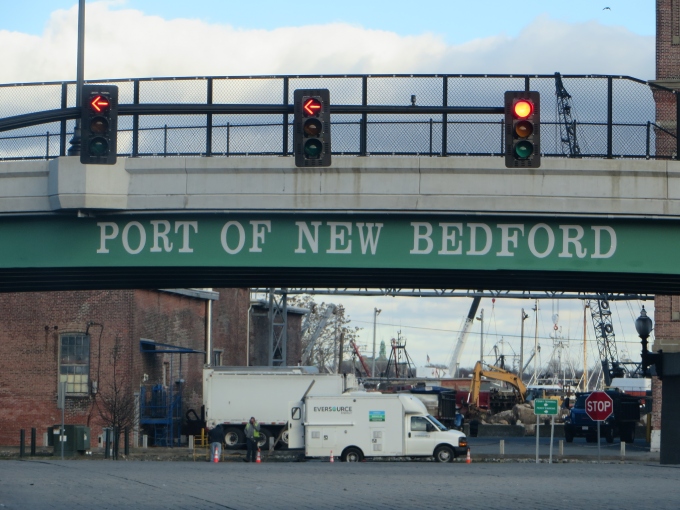
port of new bedford

Then we needed to schedule an in-person interview with a US Customs and Border Protection office. We opted for New Bedford … easier than Boston … and set up an appointment for the interview on-line. Easy...peasy. We made the hour trek to New Bedford, parked on Johnny Cake Hill in New Bedford's wonderful historic district and walked the cobblestone streets to the old Customs House. They're doing all sorts of renovations and restoration on the building and finding our way to the actual Customs Office was a bit of a hunt, but we prevailed.

The Customs Officer was surprised to see us. The Customs office in New Bedford wasn't aware we'd made the on-line appointment … a tiny glitch in the system, but she was very accommodating. The interview took ten minutes. Verification of our valid boat registration and passports (plus we look like really honest folks) and we were good to go. We are now signed up for the SVRS (Small Vessel Reporting System) with the CBP (Customs and Border Protection). We got our SVRS validation numbers via e-mail ASAP and we can now clear in PDQ as long as we file our float plan which “will satisfy the boat operator’s legal requirement to report to a POE (port of entry) for face-to-face inspection in accordance with 8 CFR 235.1 ... but boaters must still phone in their arrival to satisfy 19 USC 1433.” Once you wade through the alphabet soup, it seems reasonable enough.

A couple of little glitches we noted … the specified “float plan” which must be filed at least 24 hours prior to leaving the last port before arriving in USA territorial waters is actually not available as a .pdf on-line as advertised in neither our approval letter nor on the CBP website. Instead, it can only be filled in online via a “wizard”, and filed electronically – which may be an issue when internet access is iffy and expensive or simply not available. In addition, part of the information provided on the float plan is the date and time of arrival, which is purely guesswork for a passage of any length on a sailboat. They encourage the boater to update the float plan en route, but this won't be possible once we are at sea. Another blank to be filled in is the address of the arrival location, and the only alternatives are Public Boat Launch, Marina and Residence. Anchorage in a POE is evidently not an option. We'll see how convenient the new program really is when we try to use it. Stay tuned … we'll let you know.

En Route to Trinidad - Day 3

Day 3 Miles to go: 61

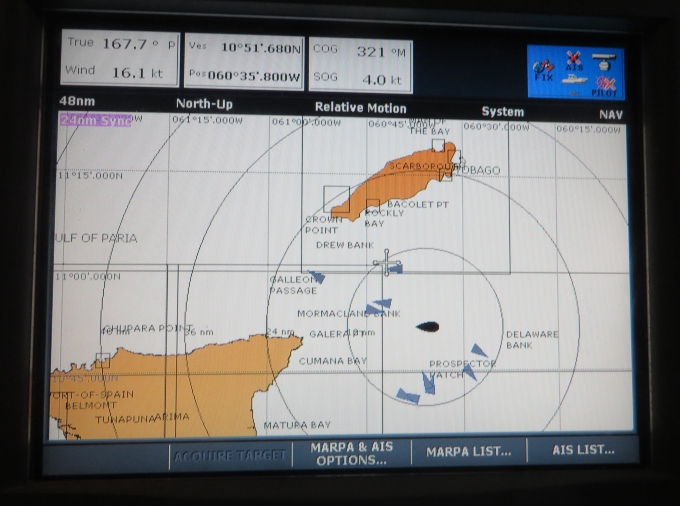
In the early morning hours, we threaded the needle through Galleons Passage between the islands of Trinidad and Tobago. It was still dark, and the horizon was lit up like a sprawling city … oil platforms, tankers, cargo ships, bulk carriers, car carriers, fishing boats, tugs … an endless stream coming and going through the channel. On watch, our eyes were glued to the AIS. We radioed at least a half dozen ships that seemed to be either bearing down on us or heading straight at us. All answered their hails promptly, found us on radar and managed to avoid colliding with us or running us down. It made for a high stress, less than peaceful night, but overall, we were pleased to remain unscathed.

chartplotter with ships all around

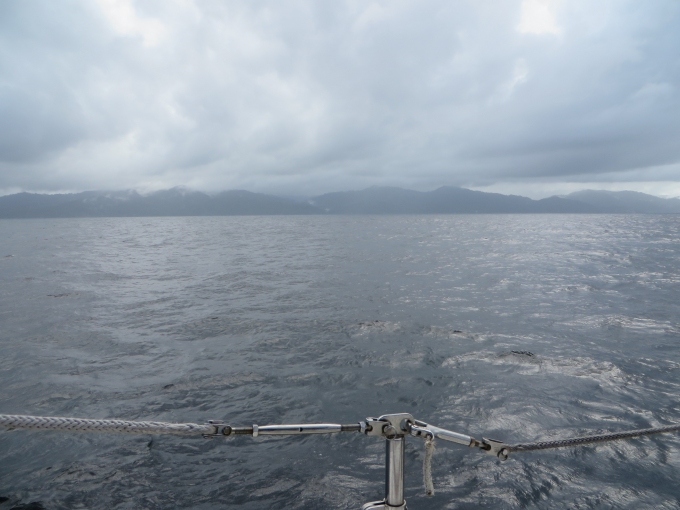
As we rounded the northwest corner of Trinidad, we left the North Atlantic Ocean and entered the Caribbean Sea. Hallelujah! Unfortunately, when we turned the corner, we also lost our good angle on the wind. We slowed to 4 knots … too slow for a “business hours arrival”. We couldn't make it by 4 pm, and we were reluctant to pay an extra $100 for arriving outside business hours. The only other alternative was to slow down even more, spend another night enroute, and try to arrive after 8 am tomorrow. We reduced sail to the staysail only. Through the morning mist, Trinidad came into view. By 10 am, with 61 nm to go, with little wind, we were moving along at 2.5- 3 knots with the help of a favorable current.

mistry trinidad

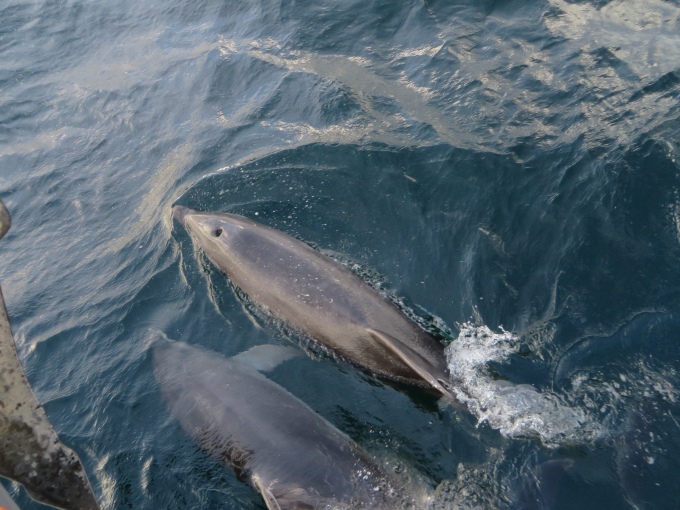
It rained and remained misty for most of the day with alternating squalls and calms. We dawdled along, resigned to spending another night at sea in order to arrive at the Customs dock at the proper time. As if to provide entertainment as we plodded along, a pod of dolphins appeared out of nowhere.

dolphin escort to trinidad

I heard the familiar dolphin breath sounds and ducked below quickly for my camera and the dolphin ID book.

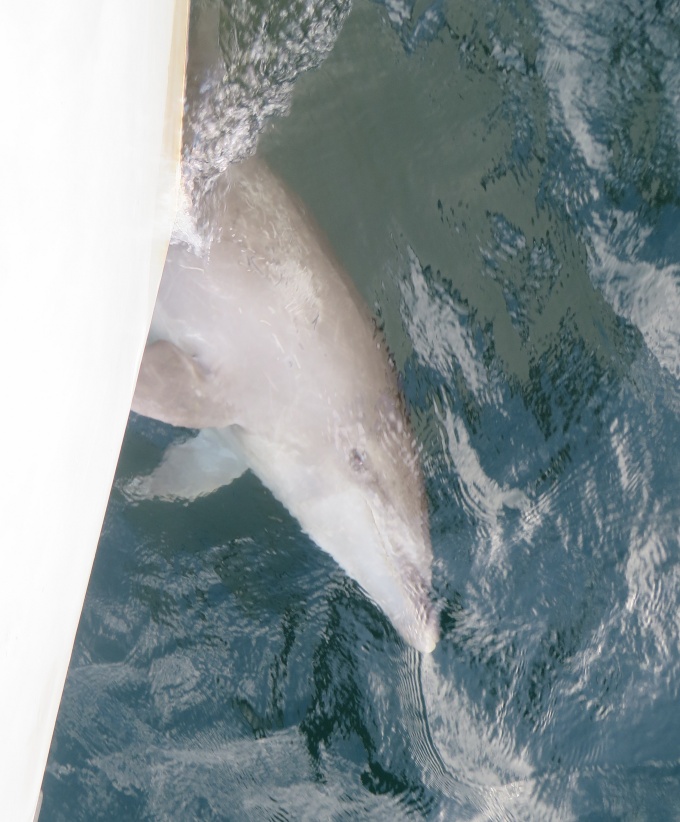
These were big guys … 8 feet or more (2.5m+), with distinctively tall dorsal fins, blotchy coloring and lots of scars. We identified them as rough-toothed dolphins. This was a playful lot and in no particular hurry, it seemed. They played with us for nearly two hours, diving under the boat and riding the bow wake. When I stood at the bow to take pictures, the dolphins turned on their sides to look directly up at me. I thought it was my imagination at first, but the eye to eye contact was repeated several times.

dolphin giving me the eye on the way to trinidad

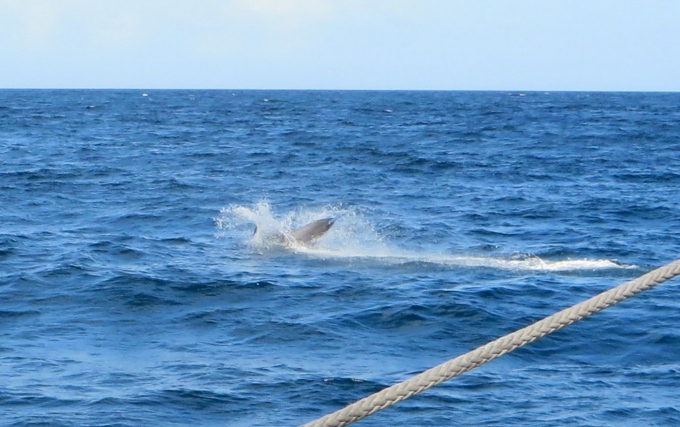
I sat at the bow for nearly an hour, my feet hanging over the rail, the dolphins nearly close enough to touch. Though entertained, I finally returned to the cockpit. I heard a sharp slap sound, then a thud and then another slap, and another thud. David watched as one dolphin slapped his tail on the water, another slapped against the hull, and yet another jumped into the air. He walked to the bow and the dolphins followed. He returned to the cockpit and the slap/thud began again. These guys liked an audience. No matter how many times we've seen dolphins, they never cease to amaze us. Not to mention, dolphins are good luck for sailors and we considered their visit an auspicious welcome to Trinidad.

dolphin jumping and slapping

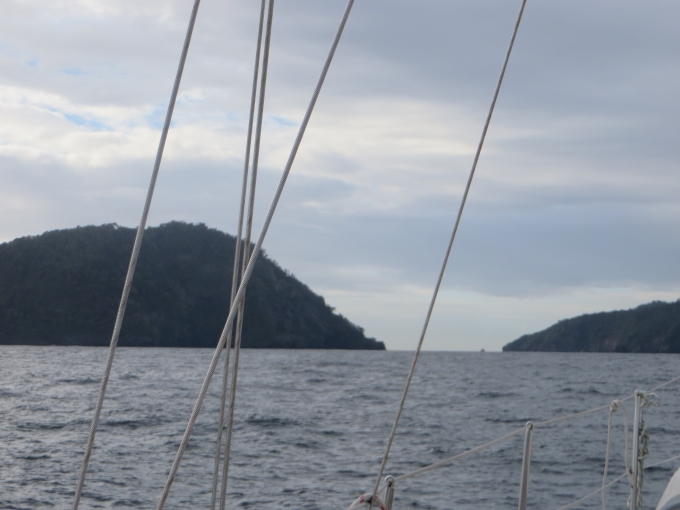
Night came and with it a calm and loss of current. We were two miles offshore and bobbed and rolled gently. For all intents and purposes, we were hove-to and remained so till 0630. We estimated two hours to the Customs dock, cranked up the engine and headed for Boca de Monos (Monkey's Mouth), a narrow channel between mainland Trinidad and Monos Island.

boca de monos in trinidad

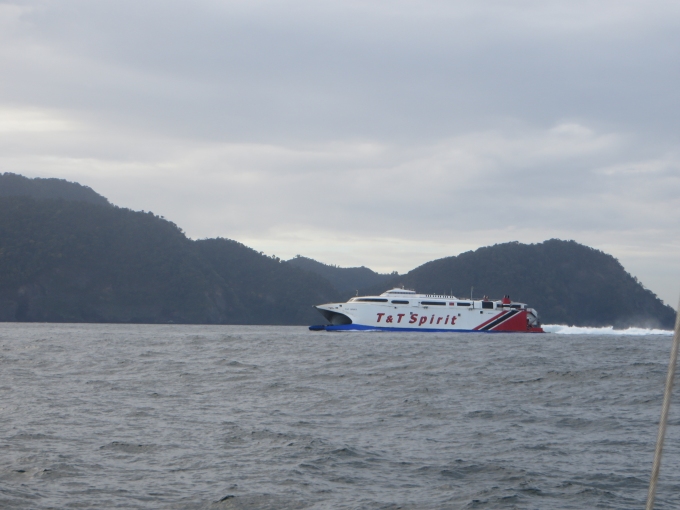
We altered course to allow the fast ferry between Trinidad and Tobago, T&T Spirit, to pass and then entered the channel.

t and t spirit in trinidad

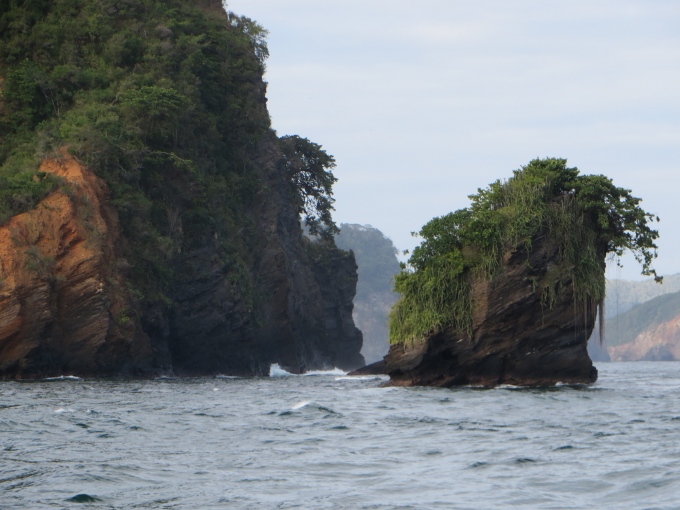
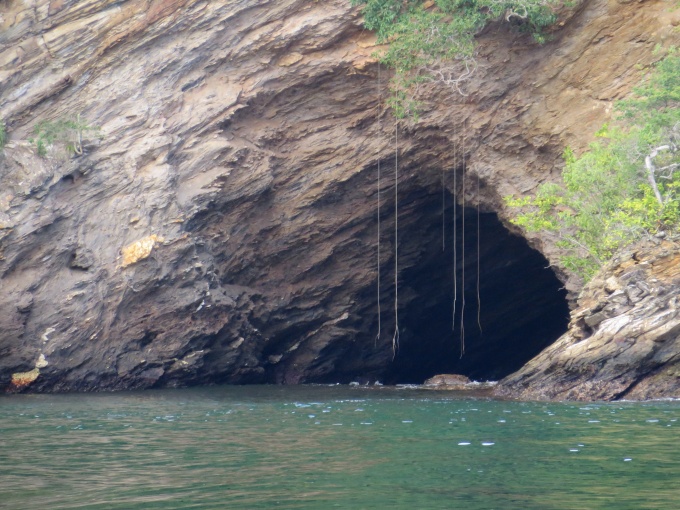
The channel was picturesque with interesting caves carved into Monos Island and large, craggy offshore rocks covered in greenery. Scotland Bay, on the opposite side of the channel, looked serene and inviting with two sailboats peacefully at anchor.

boca de monos trinidad


caves at boca de monos trinidad

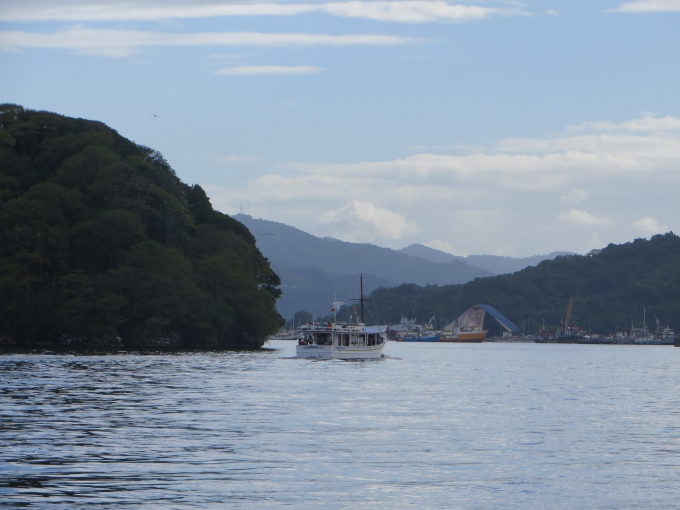
We turned the corner heading into Chaguaramas Bay. Gasparillo Island came into view and beyond it, the congestion and frenzy we associate with this port.

entering chaguaramas trinidad

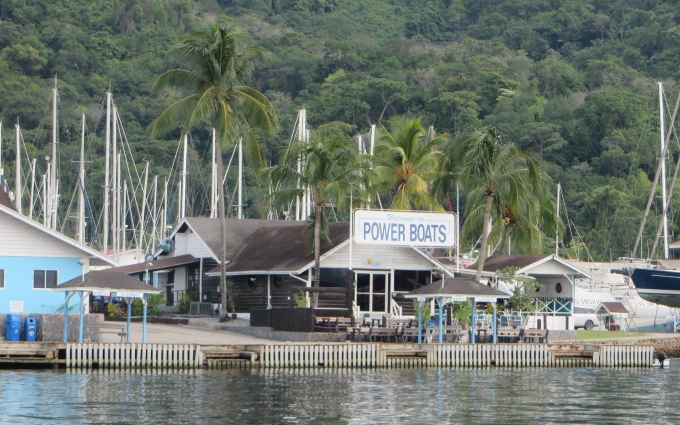
Freighters, fishing boats and ferries, tankers, tenders and tugs … all competing for space. David threaded his way carefully past anchored ships, fast boats and through the mooring field of sailboats. We passed Power Boats and noted the location of the haul-out pen for future reference. We finally found a fairway to the Customs dock, tied up and sighed ... 0830 … perfect timing. Whew … we're in Trinidad.

power boats in trinidad