Name That Wind

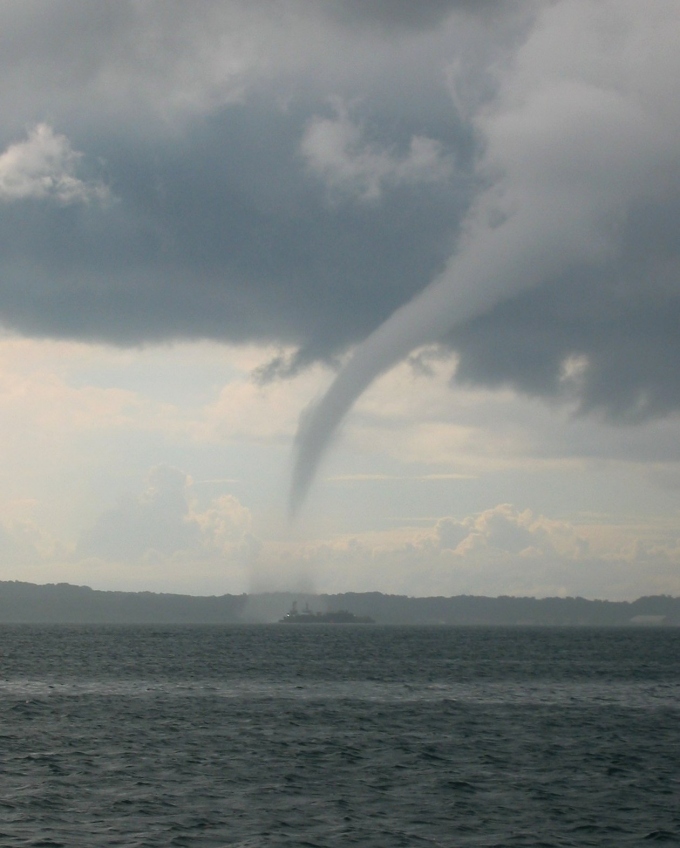
People complain about the wind in Las Vegas all the time. It does get windy here. In fact, the highest recorded wind gust here was in March 1984 – 82mph/70+ knot winds. That's a lot of wind wherever you are. Wind, however, is an essential part of a sailor's life, especially on a sailboat. People have many names for the wind depending on where they're from and the intensity with which the wind blows. There are gentle winds and breezes and zephyrs. There are destructive winds like tornadoes and twisters, waterspouts, cyclones, typhoons and diablos. There are icy blasts, gusts and gales ... siroccos, pamperos, foehns and mistrals. waterspout in panama
The Greeks named the winds based on direction from which they came. Boreas was the god of the north wind and winter. Eurus was the unlucky east or southeast wind. Notus was god of the warm, south winds and Zephyrus was the god of gentle west winds. The ruler of the winds, Aeolus, was venerated and respected as much as Poseidon, the Greek's equivalent to the Roman god of the sea, Neptune.

aeolus god of the wind

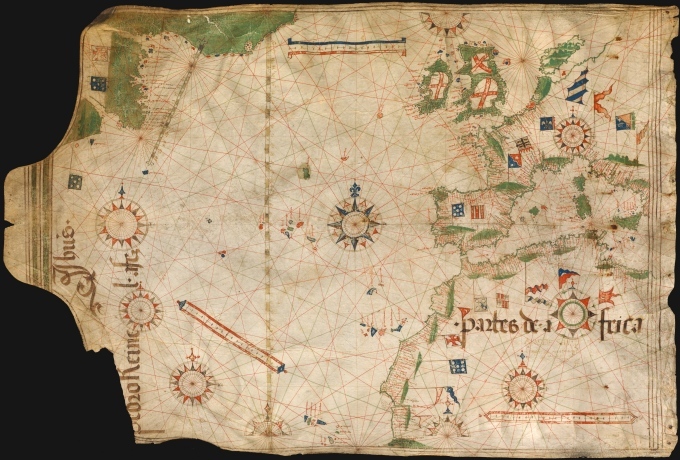
Pedro Reinel, a 15th-16th century Portuguese cartographer, is the author of the oldest signed nautical chart in existence. In 1504, he was also the first cartographer to depict a wind rose on his Atlantic Chart. Reinel showed not only a scale of latitudes for the first time, but an ornate fleur-de-lys wind rose.
reinels wind rose

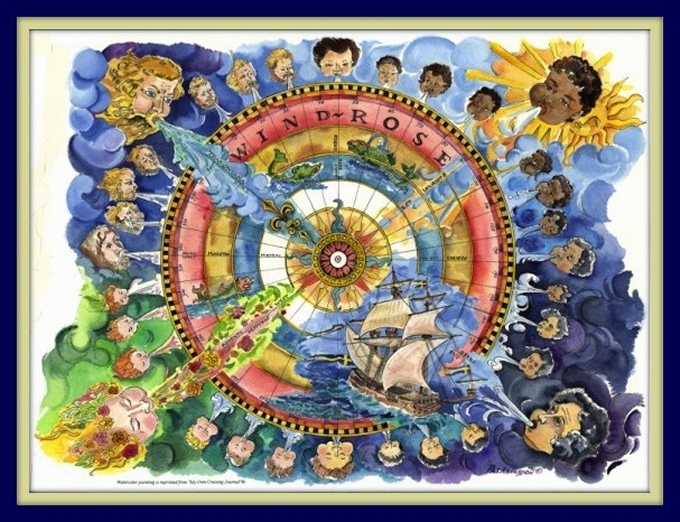
If you're a sailor and have ever used paper charts, you've very familiar with the compass rose. When plotting a course on a paper chart, we still use the compass rose with a parallel rule and dividers to determine our heading. Before the development of the compass rose, “a wind rose was included on maps in order to show sailors from which directions the eight major winds blew within the plan view.” North was always depicted with a fleur-de-lys, while east was shown as a Christian cross to indicate the direction of Jerusalem from Europe. Later charts sometimes included half winds (8) and quarter winds (16).
ornate wind rose

Eight points on the compass rose delineated the eight principal winds (N, S, E, W) at 90º intervals plus the ordinal directions (NE, SE, SW, NW) at 45 intervalsº. When the angles were bisected again (22.5º), the half-winds were shown, e.g. SSE, ESE, SSW, WSW, etc. Some were pretty elaborate, showing quarter-winds as well. When all 32 points on the rose are shown, it's called “boxing the compass”.
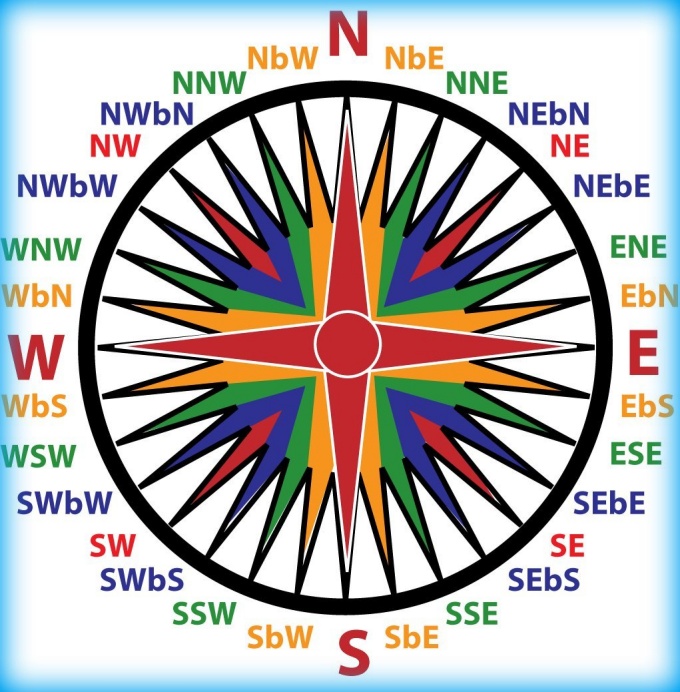
boxing the compass

In 1805, Francis Beaufort devised the Beaufort Scale which measured wind speed based upon observed conditions on land or sea and standardized an objective reporting of wind speeds.
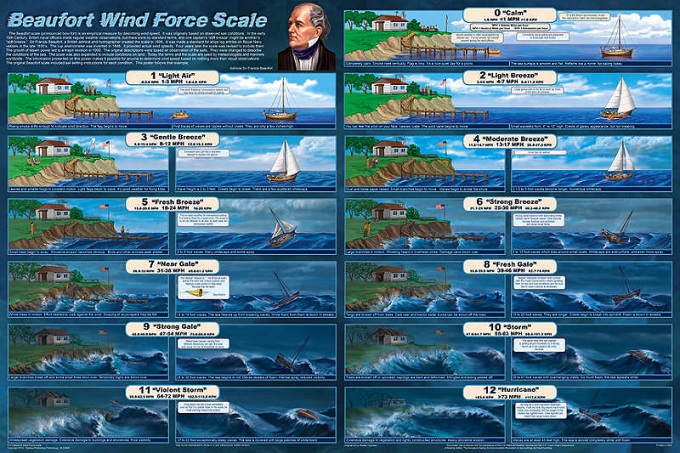
beaufort scale

As we've traveled around the world, we've heard the wind called by many names. The strong southeasterly Cape Doctor in Cape Town and the Fremantle Doctor in Perth. The southwest busters on Africa's wild west coast and the willywaws and rachas that thundered through like freight trains in Patagonia and Tierra del Fuego. I grew up with nor'easters in New England. The Santa Anas are well known in southern California. The warm chinooks of the Rockies are also known as “snow eaters”.

And, of course, if you've ever seen “Paint Your Wagon”, They Call the Wind Maria.

#TBT - Crisscrossing the Dateline

Since we're not aboard Nine of Cups sailing at the moment (be patient, we'll be back aboard soon), reminiscing by reading and sharing some old blogs is a good way to refresh our memories about life aboard during passages. Storms are a popular topic of discussion among old salts and newbie sailors alike. These posts recount a couple of miserable days on our 2011 passage from the Chatham Islands back to New Zealand's North Island. chatham passage route

En route to Mainland New Zealand

 Day 6 -Across the dateline

Around 10 AM today, we finally crossed 180 degrees and are now in the Eastern Hemisphere again, west of the dateline. The winds have been obstinate and we're clawing our way back to the New Zealand mainland and fighting for every inch of westerly gain. The ride is uncomfortable with big waves and it's squally making sitting in the cockpit unpleasant.

We were hoping to clear East Cape by this evening, but the wind increased and our tack, though gaining us westerly progress, diminished our northerly progress. Thus, we are too far south to clear the cape as we had hoped and with gale warnings in force and the wind and waves increasing each hour, we finally could make no progress at all and opted to heave-to for the evening until the worst of the winds and waves had passed.

Usually heaving-to allows a pretty comfortable ride, but tonight we are heeled over and being tossed about. Though Cups seems to be weathering the storm well enough, the crew is not.

Day 7 - Blown back across the dateline again

zig zag route

Yesterday's miserable winds and weather deteriorated significantly overnight and though we were hove-to, life aboard was most unpleasant. Winds increased to 40+ knots with commensurate wave height and wave action. The wind shrieked and Cups shook and shuddered. The noise was deafening as huge waves crashed with a sudden bang and washed over her. Heavy rain punctuated with hail bombarded the decks.

Prisoners below, there was little we could do, but wait it out. "Grinning" was out of the question; "bearing it" was the only option. At one point I complained to David "Get me off this ride!" to which he replied with grin "I'll work on it". Trying to sleep was useless. We napped a bit, but we were always shaken awake by the sudden jolts and jars of the boat … an amusement ride gone amok. We were lame and sore, back and limbs aching from being scrunched up and wedged in the same position for so long on this heel.

sometimes no wind

The morning sun rose displaying a mackerel-clouded blue sky … a change in the weather on its way. Our position at dawn had us back east of the dateline. We had been blown back 25 miles east during the night. The wind had abated to westerly 30s, allowing some northerly progress, but against the built-up NW waves. We crawled along awaiting the promised SW winds in the next day or two. The sea is a washing machine, but on a slightly more gentle cycle.

Just after dark, we heard a loud snap and the main started luffing. We are triple-reefed and the reefing line broke. It's a brand new line, so it must have chafed through. With much difficulty, David was able to use the port side reefing line to secure the reef again and then reinforced it with another line. Getting this accomplished with the wind blowing 30+ knots, the boat thrashing on a heel and the waves crashing on and around him was a monumental task.

By the end of the day as I write, we have only recaptured the 25 miles we lost overnight plus two positive miles...a total of 27 miles to the good in a whole day … 25 of which we'd already sailed. We are still just off East Cape and on the east side of the dateline. The promised SW winds are coming, but the forecast is now calling for gale and/or storm conditions with winds up to SW 50 knots. Oh, my! THIS is the part of cruising that sucks!

In summary ...

The passage back to New Zealand was one of our biggest challenges. We had no wind (0-5 knots), too much wind (50+ knots), rarely the right amount of wind (15-20...lovely) and mostly "on the nose" wind (NW). We anticipated 4-5 days to get back and it took us forever moving at a sea slug's pace, usually in the wrong direction.

We suffered our first-ever knockdown in a storm just off East Cape which blew out our mainsail, tore the bimini to shreds, knocked out a deck stanchion and generally took our breaths away. Additionally, we had watermaker and transmission problems which thankfully, David was able to fix en route. We hove-to for another night and, sick and exhausted, we lay ahull for another after the mainsail blew. The projected 750 mile passage took 12 days and was actually 1,140 nm by the time we reached Opua.

Just saying … it's not always paradise out there.

The hardest thing we ever did

andre gide

“Man cannot discover new oceans unless he has the courage to leave sight of the shore.”

Andre Gide

We've been asked many times what our biggest challenges have been as cruisers and we always respond that the hardest thing we ever did was leave the dock in Kemah, Texas. I cannot imagine the angst and fear and anticipation that sailors of old must have felt as they sailed from the comfort of their home ports to explore an unknown world. I remember the mix of anxiety and exhilaration as we left Kemah ... and we were only heading across the Gulf of Mexico to Florida.

We've written about slaying dragons often in the past. Perhaps that's why our “just a little further” philosophy has worked for us. Having to worry about all the new things we were going to encounter … all those little dragons to slay … like night watches, squalls and storms, navigation, sailing skills …. was hard enough. Add to that bigger challenges/dragons like long ocean passages, rounding southern capes, high latitude sailing and circumnavigating the globe. Just contemplating those possibilities was beyond the realm of our realistic imaginations. Had we worried about all that before leaving, I think we might have stayed in a nice, cozy marina and perhaps gone coastal sailing on weekends. But we didn't.

Getting up the courage to leave was easy when we were just talking about it. Doing it … well, that was quite another thing. Remember, we didn't have years of sailing experience under our belts, but rather we took sailing lessons in our 40s, read lots, chartered a bit and then we sold up and sailed off. The morning we tossed off that last dockline and slowly watched the coast disappear into the horizon was a “gulp and swallow” kind of experience. Yikes … what were we getting ourselves into?

So what does it take to make the big leap? Well, along with a bit of courage, it takes preparation. Certainly, confidence in yourself and each other is a main ingredient. You need to trust each other. You have to have confidence in your boat, that she'll handle whatever comes your way because you've maintained and equipped her properly. Confidence and a mindset that whatever happens, you'll figure out what to do. Once you're out there, there's no telling where the wind will blow you, what you'll see, what you'll discover … about the world and yourself.

Yup. We left Kemah, Texas and then we were sailing and we kept going around and here we are … some 86,000 miles later … all because we left the dock.